
In This Article
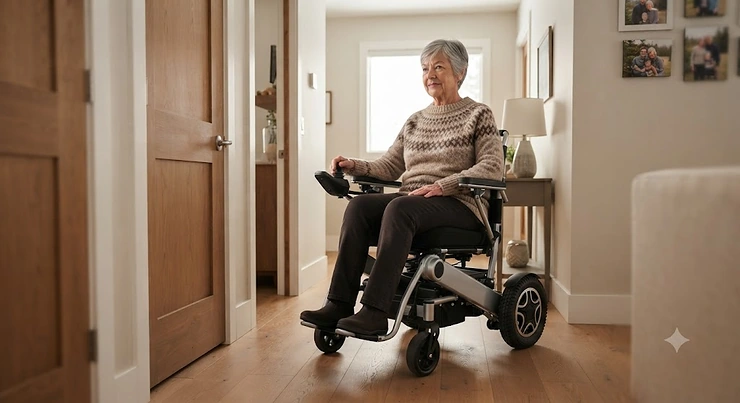
There’s a particular kind of relief that comes over a family the first time Mom or Dad glides down the hallway on their own power, no walker scraping the baseboards, no white-knuckle grip on the counter to get from the kitchen to the bathroom. That’s the promise of the right indoor power wheelchair for seniors: not speed, not flash, just steady, predictable independence inside the four walls where most of daily life actually happens. But “just pick one on Amazon” is bad advice here — turning radius, seat width, and brake response matter more indoors than almost anywhere else, because hallways don’t forgive a wide machine the way a parking lot does.
We dug into seven real, currently available models — from ultra-portable folding chairs under C$2,000 to full-featured mid-wheel-drive units built for daily, all-day use — and pulled apart what actually separates a genuinely safe power wheelchair for elderly indoors from one that merely looks the part in a product photo. You’ll also find honest talk about caregiver considerations for mobility devices, what a home care assessment for power wheelchairs involves, and why anti-tip safety features deserve more attention than they usually get. Canadian pricing, CSA-relevant safety notes, and real aggregated review sentiment throughout — no invented five-star raves, just what buyers and clinicians consistently report.
What Is an Indoor Power Wheelchair for Seniors?
An indoor power wheelchair for seniors is a battery-powered mobility chair engineered around a tight turning radius, a narrow overall width, and low-speed precision controls, so it can navigate hallways, kitchens, and bathroom doorways that a full-size outdoor scooter simply can’t fit through. Most models top out around 4-6 km/h and prioritize stability over range.
Quick Comparison Table
| Model | Turning Radius | Weight Capacity | Best For |
|---|---|---|---|
| SuperHandy GoRide 2 | ~24″ | 330 lbs | Budget-friendly daily indoor use |
| EWheels EW-M45 | 31″ | 400 lbs | Heavier users needing a folding chair |
| HOMYKING 20″ Heavy-Duty | Wide-frame | 400 lbs | Extra-wide, larger-bodied users |
| Golden Buzzaround CarryOn | 21″ | 300 lbs | Ultra-portable, travel plus indoor |
| Golden LiteRider Envy | 28.5″ | 300 lbs | Best all-around tight-space handling |
| Pride Jazzy Select | 22.5″ | 300 lbs | Simple controls, all-day comfort |
| Pride Jazzy Elite ES | 24.75″ | 300 lbs | Compact front-wheel drive in tight homes |
Looking at the spread above, the Golden Buzzaround CarryOn‘s 21-inch turning radius is the tightest of the group, which matters enormously in a galley kitchen or a narrow apartment hallway, while the HOMYKING 20″ Heavy-Duty trades some of that tightness for a wider seat and higher capacity. If your home has doorways under 30 inches, prioritize turning radius over top speed or range — indoors, you’ll rarely use either.
💬 Just one click — help others make better buying decisions too!😊
Top 7 Indoor Power Wheelchairs for Seniors: Expert Analysis
1. SuperHandy GoRide 2 — best budget pick for everyday indoor rolling
The SuperHandy GoRide 2 opens the list because it nails the basics without asking C$3,000+ for the privilege. Its dual 250W motors and 48V lithium battery aren’t trying to be a trail machine — they’re tuned for smooth, controlled indoor movement, and that restraint is actually a feature for a first-time user.
At around 40 lbs and foldable to a compact footprint, this chair supports up to 330 lbs and uses a mix of pneumatic rear and solid front tires, so it rolls over thresholds and low-pile carpet without the jarring feel some budget chairs have. Based on the spec comparison with pricier folding models, the GoRide 2’s weight capacity and battery specs are genuinely competitive two or three price tiers up, which is unusual for an entry-level chair.
This is the pick for a senior who’s steady enough to self-transfer and just needs help covering distance around a bungalow or condo, not someone requiring heavy postural support. Reviewers consistently report that assembly and first-time setup are straightforward, with the joystick being intuitive within the first day; a recurring theme in user feedback is that the seat, while comfortable for shorter sittings, isn’t built for marathon all-day use.
Pros:
- ✅ Strong 330 lb capacity for its lightweight 40 lb frame
- ✅ Foldable design stores easily in a closet or car trunk
- ✅ Genuinely simple joystick learning curve for new users
Cons:
- ❌ Seat cushioning thins out on very long sitting sessions
- ❌ Fewer official accessory options than name-brand medical chairs
At around C$1,500-C$1,900 (check current price), the SuperHandy GoRide 2 is a smart value pick for anyone easing into powered mobility without committing to a full medical-grade budget.

2. EWheels EW-M45 — best for higher weight capacity in a folding frame
The EWheels EW-M45 solves a specific problem: most lightweight folding chairs cap out around 250-300 lbs, but this one supports up to 400 lbs while still weighing roughly 58 lbs with batteries installed. That combination — high capacity, low total weight — is genuinely hard to find in this category.
Twin 180W brushless motors and a 31-inch turning radius mean it won’t out-corner the tightest chairs on this list, but its intelligent electromagnetic braking system is a real practical upgrade: instead of coasting after you release the joystick, the chair stops predictably, which matters a great deal on hardwood or tile. What most buyers overlook about this model is that it folds in two simple steps rather than requiring disassembly into multiple pieces, a detail that changes the day-to-day experience for a caregiver managing it alone.
Aggregated customer sentiment around EWheels folding chairs tends to praise the fold-and-carry convenience and the wide 19-inch seat, while a common complaint centres on the modest 15.5-mile range feeling shorter in practice once seasonal cold reduces battery output — worth noting for anyone in a Canadian winter with an unheated garage storage spot.
Pros:
- ✅ 400 lb weight capacity rare in a sub-60 lb folding chair
- ✅ Electromagnetic braking stops smoothly on hard flooring
- ✅ Two-step fold simplifies transport and storage
Cons:
- ❌ 31″ turning radius wider than several competitors here
- ❌ Cold storage can noticeably shorten real-world battery range
Priced in the C$1,900-C$2,600 range (check current price), the EWheels EW-M45 earns its spot for larger-bodied users who still need portability.
3. HOMYKING 20″ Extra Wide Seat Heavy-Duty — best for extra seat width and stability
For seniors who’ve found standard 17-18 inch seats simply too narrow, the HOMYKING 20″ Extra Wide Seat Heavy-Duty model addresses the gap directly with its namesake 20-inch seat and a reinforced frame rated to 400 lbs. Dual 500W motors give it noticeably more low-end torque than the lighter chairs on this list.
The wider seat isn’t just about comfort — it’s a stability feature. A properly fitted wide base lowers the centre of gravity relative to seat width, which reduces tipping risk during turns, something occupational therapists flag repeatedly during home assessments. Here’s what to weigh: that extra width also means it needs more clearance to navigate doorframes, so measure your narrowest hallway before ordering.
Based on the spec sheet, the reinforced frame and dual-motor setup suggest this chair leans toward users who need both size accommodation and daily reliability rather than travel portability — it’s built to stay in the home, not fold into a trunk every week.
Pros:
- ✅ Spacious 20-inch seat suits larger-bodied users
- ✅ 400 lb capacity with a reinforced support frame
- ✅ Dual 500W motors provide strong low-speed control
Cons:
- ❌ Bulkier footprint needs wider doorway clearance
- ❌ Not designed as a fold-and-travel option
Expect a price around C$1,300-C$1,900 (check current price), positioning it as a strong value for anyone prioritizing seat size over portability.
4. Golden Buzzaround CarryOn — best for ultra-tight turning and portability
Golden Technologies built the Buzzaround CarryOn for travel first, but that same engineering — a 21-inch turning radius and a heaviest component of just 46 lbs — happens to make it exceptional for tight indoor spaces too. Its independent 4-wheel suspension smooths out transitions between flooring types, a small detail that matters more than it sounds when moving from hardwood to a bathroom threshold.
The airline-approved 12.5 AH lithium battery is removable, which is a genuine convenience for apartment living where charging near the chair isn’t always practical. What the spec sheet won’t tell you, but reviewers note, is that the PowerLink connector system genuinely does make disassembly a one-person job, which matters for a spouse or adult child managing transport without help.
This is the pick for a senior who splits time between home and frequent outings — appointments, family visits, day trips — since the same chair that threads a narrow kitchen also breaks down for the car in minutes. Reviewers consistently report satisfaction with the seat’s contoured comfort for a chair this light, though a recurring caution is that the 300 lb capacity is firm, not generous.
Pros:
- ✅ Tightest turning radius on this list at 21 inches
- ✅ Breaks down into airline-friendly, one-person-manageable pieces
- ✅ Removable lithium battery simplifies apartment charging
Cons:
- ❌ 300 lb capacity leaves less margin than heavier-duty models
- ❌ Premium engineering carries a higher price tag
At roughly C$3,600-C$4,600 (check current price), the Golden Buzzaround CarryOn suits buyers who value portability as much as indoor manoeuvrability.
5. Golden LiteRider Envy — best all-around tight-space handling
If there’s a single “if in doubt, pick this one” chair on this list for pure indoor use, it’s the Golden LiteRider Envy. Its 28.5-inch turning radius is specifically engineered for homes, kitchens, and retail-style aisles, and the 22AH batteries deliver up to 15.5 miles per charge — plenty for a full day of indoor movement with room to spare.
The stadium-style padded seat and intuitive joystick are the kind of “nothing to overthink” design that Pillar 1 of good mobility-device writing keeps circling back to: features that reduce daily friction rather than add spec-sheet bragging rights. Based on the spec comparison, the Envy’s balance of a tight radius, a comfortable 300 lb-rated seat, and a manageable 37 lb heaviest disassembled piece makes it genuinely well-rounded rather than excelling in just one category.
Golden backs the Envy with a factory warranty plus a one-year in-home service contract, meaning a licensed technician comes to the house for first-year repairs — a meaningful detail for a senior who can’t easily transport a broken chair to a shop. A common theme in aggregated feedback is appreciation for the under-seat storage basket, paired with occasional notes that the captain’s-style seat runs slightly firm before a cushion add-on.
Pros:
- ✅ 28.5″ turning radius purpose-built for indoor navigation
- ✅ Factory warranty includes a year of in-home technician service
- ✅ Under-seat basket adds practical daily storage
Cons:
- ❌ Stock seat cushion runs firmer than some competitors
- ❌ Not the lightest chair to disassemble solo
Priced around C$3,200-C$4,200 (check current price), the Golden LiteRider Envy is our strongest all-around recommendation for the “safe power wheelchair for elderly indoors” search intent specifically.
6. Pride Jazzy Select — best for simple controls and all-day comfort
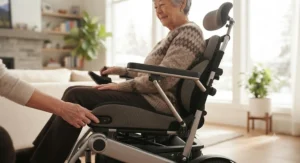
Pride’s Jazzy Select leans hard into Mid-Wheel 6 technology, and the result is a 22.5-inch turning radius with genuinely stable handling on transitions — no lurching sensation when the drive wheels cross a doorway threshold. For a senior specifically searching for a power wheelchair with simple controls, this is a strong contender: the joystick calibration favours smooth, predictable acceleration over sharp responsiveness.
Active-Trac Suspension absorbs the small bumps that add up over a full day — carpet edges, uneven tile grout lines — and the high-back reclining seat with adjustable depth is built for users who’ll spend six-plus hours in the chair, not just short trips room to room. Reviewers consistently note the side battery access as a small but meaningful convenience for caregivers handling nightly charging.
At up to 19.4 miles per charge and a 4.3 mph top speed (a speed you’ll rarely approach indoors), this chair has range to spare, meaning charging frequency stays low — a genuine quality-of-life factor for a household managing multiple caregiving tasks.
Pros:
- ✅ Reclining, depth-adjustable seat suited to all-day use
- ✅ Active-Trac Suspension smooths small indoor bumps
- ✅ Side battery access simplifies caregiver charging routines
Cons:
- ❌ Higher price point than folding budget alternatives
- ❌ 22.5″ radius, while tight, isn’t the tightest on this list
Expect a price in the C$5,200-C$6,800 range (check current price) — a premium reflecting its medical-grade build and comfort features.
7. Pride Jazzy Elite ES — best compact front-wheel drive for small homes
Closing the list is the Pride Jazzy Elite ES, which uses in-line front-wheel drive technology specifically tuned for tight turns around corners — Pride’s own engineering focus for this model is “optimal indoor manoeuvrability in small spaces,” and the 24.75-inch turning radius backs that up in a condo or bungalow layout.
The depth-adjustable, limited-recline high-back seat with headrest targets comfort over a full day, and the 40-amp PG GC controller gives smooth, granular speed control rather than an abrupt on/off feel — a detail that matters for anyone with reduced hand strength or early-stage tremor. On paper, this means gentler acceleration curves than cheaper controllers typically deliver, translating to fewer sudden jolts near furniture or door frames.
With up to 13.5 miles per charge and a 300 lb capacity, the Elite ES isn’t the longest-range chair here, but indoors that range is rarely the limiting factor. A common thread in aggregated review sentiment is satisfaction with how the front-drive layout handles pivot turns in bathrooms specifically, alongside occasional notes that the seat runs slightly narrow for larger users.
Pros:
- ✅ Front-wheel drive tuned specifically for indoor pivot turns
- ✅ Smooth 40-amp controller reduces sudden speed changes
- ✅ Depth-adjustable seat with headrest for full-day comfort
Cons:
- ❌ Standard seat width runs narrow for larger-bodied users
- ❌ Range shorter than the Jazzy Select at full charge
Priced around C$4,500-C$5,900 (check current price), the Pride Jazzy Elite ES is a strong option for tight condos and older, narrow-hallway homes.
Setting Up and Maintaining Your Indoor Power Wheelchair
Getting a new chair home is only step one. In the first 30 days, the most common mistake isn’t mechanical — it’s rushing the fit. Before daily use, confirm the seat height lets feet rest flat with knees at roughly 90 degrees, and that armrest height doesn’t force shoulders up or down; both affect balance and long-term comfort more than any spec sheet number.
Weekly, wipe down the joystick and seams where crumbs and moisture collect, and check tire pressure on any pneumatic-tired model like the EWheels EW-M45, since underinflated tires increase rolling resistance and strain the motor. Monthly, inspect brake response on a clear stretch of hallway — release the joystick at low speed and confirm the chair stops within a step or two, not several feet of drift.
Charging habits matter more than most manuals emphasize. Lithium battery packs, used in most of the chairs above including the Golden Buzzaround CarryOn, prefer a partial-charge routine over letting the battery fully drain before recharging; running it to zero regularly shortens overall battery lifespan. A simple habit — plug in every evening regardless of remaining charge — extends the pack’s useful life by a meaningful margin over a year of daily use.
Caregiver Considerations for Mobility Devices
Bringing a power wheelchair into a home changes the caregiving relationship in ways that aren’t always obvious upfront. According to national data, roughly 1 in 4 Canadians currently identifies as a caregiver, and caregivers supporting older adults with aging-related challenges report distinct pressures tied to mobility support specifically — managing equipment, coordinating transfers, and adapting the home layout on top of everyday support tasks.
Practically, this means involving the caregiver in the selection process, not just the senior. A spouse or adult child who’ll be charging the battery nightly, folding a travel chair like the Golden Buzzaround CarryOn for appointments, or troubleshooting a stuck joystick needs hands-on familiarity before the chair becomes the household’s daily reality. Ask the supplier for a demonstration that includes the caregiver operating transfer assistance, not just the senior driving.
Consider also the caregiver’s own physical limits. If disassembly or lifting is required for transport, choose a model with a lighter heaviest single piece — the Golden Buzzaround CarryOn‘s 46 lb maximum component is far more manageable for a smaller-framed caregiver than a chair requiring a 100+ lb lift into a trunk. Building this consideration into the buying decision upfront avoids a costly re-purchase down the line.
Home Care Assessment for Power Wheelchairs: What to Expect
Before committing to a purchase, a home care assessment for power wheelchairs — typically conducted by an occupational therapist — pays for itself many times over in avoided returns and refitting costs. The therapist measures actual doorway widths, hallway turning points, bathroom clearances, and threshold heights against the chair’s real dimensions, not just its marketed turning radius.
The assessment usually includes a physical evaluation (grip strength, sitting balance, reaction time for braking) alongside an interview about daily routines: How many times a day does the person move between rooms? Is there a step-down to a sunroom or garage? These answers shape which chair — a tight 21-inch-radius model like the Golden Buzzaround CarryOn versus a sturdier, wider option like the HOMYKING 20″ Heavy-Duty — actually fits the household, not just the body.
In several provinces, this assessment is also the gateway to funding. In Ontario, for example, the Assistive Devices Program covers a substantial share of approved equipment costs for residents who meet eligibility criteria, but an authorized therapist’s assessment and prescription are required before funding applications proceed. Check your own province’s equivalent program before purchasing outright — the paperwork is genuinely worth the short delay.
How to Choose a Safe Power Wheelchair for Elderly Indoors
- Measure every doorway and hallway first. A chair’s turning radius means nothing if it can’t physically clear your narrowest passage — bring a tape measure before you bring a credit card.
- Match weight capacity with a margin, not a match. Choosing a chair rated right at someone’s current weight leaves no room for winter clothing, added cushions, or natural weight fluctuation.
- Prioritize braking behaviour over top speed. Indoors, a chair that stops predictably within a step matters infinitely more than one that can hit 5 mph outdoors.
- Check seat depth and width against actual body measurements. A seat too wide allows dangerous side-to-side shifting in turns; too narrow causes pressure discomfort within an hour.
- Confirm anti-tip wheel presence and adjustability. Not every budget chair includes them standard, and retrofitting later is more expensive than buying correctly the first time.
- Ask about in-home service versus shop-only repair. A chair that requires shipping back to a dealer for basic fixes creates weeks of lost mobility.
- Involve an occupational therapist if funding or complex needs are involved. A short home care assessment for power wheelchairs often reshapes the shortlist entirely.

Common Mistakes When Buying an Indoor Power Wheelchair
The single most common mistake is buying based on outdoor-use marketing photos — rugged tires, long mileage claims — for a chair that will spend 95% of its life inside a home. Range and top speed are the least relevant specs for indoor buyers, yet they’re often the most heavily advertised.
A close second is skipping the doorway measurement step entirely. A chair with an excellent 22-inch turning radius can still fail to physically pass through a 24-inch bathroom door with armrests attached — width, not just radius, is what stalls people mid-hallway. Reviewers across multiple product categories consistently flag this as a return reason.
The third recurring mistake is underestimating charging logistics. Buyers frequently choose a heavier-duty chair like the HOMYKING 20″ Heavy-Duty without considering where it will actually charge overnight, only to discover the outlet placement forces the chair to block a walkway while plugged in — a solvable problem, but only if planned for in advance.
Indoor Power Wheelchairs vs. Mobility Scooters
| Factor | Indoor Power Wheelchair | Mobility Scooter |
|---|---|---|
| Turning radius | 21″-31″ typical | Often 38″+ |
| Steering | Joystick, seated control | Tiller, requires more upper-body use |
| Doorway fit | Purpose-built for hallways | Frequently too wide indoors |
| Best For | Daily indoor navigation | Longer outdoor trips |
The core difference isn’t power or price — it’s steering mechanism and footprint. A joystick-controlled chair like the Pride Jazzy Select keeps both hands free and requires minimal upper-body strength to steer precisely through doorways, while a tiller-steered scooter, even a compact one, generally needs a wider turning arc that simply doesn’t work in most home hallways. For a senior whose needs are primarily indoors with occasional outings, a power wheelchair — potentially a foldable one like the Golden Buzzaround CarryOn — usually serves better than a scooter built for sidewalks and parking lots.
Anti-Tip Safety Features and Other Safety Systems, Explained
Anti-tip wheels — small casters mounted behind the rear drive wheels — exist to prevent the chair from tipping backward during acceleration or on a slight incline, such as a garage ramp or a raised threshold. Not every budget model includes them standard; it’s worth confirming before purchase rather than assuming, since retrofitting is both costlier and less structurally sound than a factory-installed system.
Electromagnetic and regenerative braking, found on models like the EWheels EW-M45 and Pride Jazzy 600ES-adjacent chairs, engage the moment the joystick returns to neutral, rather than allowing the chair to coast. This distinction matters enormously on hardwood or tile, where a coasting chair can drift several feet before stopping. According to the Public Health Agency of Canada’s home safety guidance, falls remain the leading cause of injury-related hospitalization among Canadian seniors, and unpredictable stopping distance on a mobility device compounds that risk rather than reducing it.
Beyond the chair itself, safety extends to the home environment: adequate hallway lighting, removal of loose throw rugs, and clear turning space near doorways all reduce risk in combination with the chair’s built-in features. A chair with excellent anti-tip engineering still can’t compensate for a dim hallway or a rug edge catching a caster wheel.
Power Wheelchairs with Simple Controls: What Canadian Buyers Should Know
For a senior new to powered mobility, control simplicity often matters more than any other single spec. Look for a single-axis joystick with adjustable sensitivity — several models, including the Pride Jazzy Select, allow a technician to dial down acceleration response for a gentler learning curve during the first weeks of use.
Canadian buyers should also factor in seasonal realities most spec sheets ignore: winter boots add bulk that can affect foot placement on the footplate, and salt-and-slush tracked in from outside can affect tire grip on tile entryways. A chair with a wider, more forgiving footplate — like the HOMYKING 20″ Heavy-Duty — tends to handle this better than a narrow, minimalist design.
Finally, confirm that Canadian-based or cross-border customer support exists for the model you’re considering. A chair purchased through a third-party Amazon seller without North American service infrastructure can leave a buyer stranded if the controller needs recalibration — a detail worth an extra ten minutes of research before checkout.
Long-Term Cost & Maintenance: What Ownership Actually Costs
The sticker price is only the starting point. Budget for a replacement battery every 18-24 months with regular daily use — lithium packs, common across this list, typically run C$150-C$400 depending on capacity. Tire replacement on pneumatic-tired models adds a smaller, occasional cost, while solid tires common on budget folding chairs like the SuperHandy GoRide 2 avoid that expense entirely but transmit more vibration over time.
| Cost Factor | Budget Chair (e.g. GoRide 2) | Premium Chair (e.g. Jazzy Select) |
|---|---|---|
| Upfront price | C$1,500-C$1,900 | C$5,200-C$6,800 |
| Typical warranty | 1 year limited | Multi-year + in-home service |
| Battery replacement | ~C$150-C$250 | ~C$250-C$400 |
| Repair access | Third-party shops | Authorized dealer network |
Looking at the numbers, the premium chairs’ higher upfront cost is partially offset by longer warranty coverage and in-home technician service, which matters more over a five-year ownership window than the sticker price alone suggests. A budget chair used lightly may never need that infrastructure, but a chair used daily, all day, benefits from dealer-backed support.
Frequently Asked Questions
❓ What is the best power wheelchair for indoor use only?
❓ How much does a power wheelchair cost in Canada?
❓ Does Ontario ADP cover power wheelchairs?
❓ What is the safest power wheelchair for seniors at home?
❓ Can a power wheelchair be used in a small apartment?
Conclusion
Choosing an indoor power wheelchair for seniors isn’t really a shopping decision — it’s a measurement decision dressed up as one. The chair that photographs best or boasts the longest range rarely matters as much as whether it clears the bathroom doorway and stops predictably on tile. Of the seven models here, the Golden LiteRider Envy stands out as the strongest all-around indoor performer, while the SuperHandy GoRide 2 remains the smartest entry point for a tighter budget, and the Pride Jazzy Select earns its premium price through genuinely simple, comfortable daily operation.
Whichever direction you lean, don’t skip the tape measure, and don’t skip the conversation with whoever will be doing the caregiving day to day — their buy-in and physical capacity to help matter as much as any spec sheet. A short home care assessment, where available, tends to save far more time and money than it costs.
✨ Don’t Miss These Exclusive Deals! 🔍
Take your indoor mobility setup to the next level with these carefully selected products. Click on any highlighted item to check current pricing and availability. These chairs can help restore the everyday independence your family has been hoping for!
Recommended for You
- 7 Best Compact Power Wheelchairs For Apartment Living (2026)
- Compact Power Wheelchair: 7 Best Picks For Tight Spaces (2026)
- Compact Power Wheelchairs: 7 Best Picks For Canadians In 2026
Disclaimer: This article contains affiliate links. As an Amazon Associate, I earn from qualifying purchases. If you purchase products through these links, we may earn a small commission at no additional cost to you.
✨ Found this helpful? Share it with your friends! 💬🤗
