
In This Article
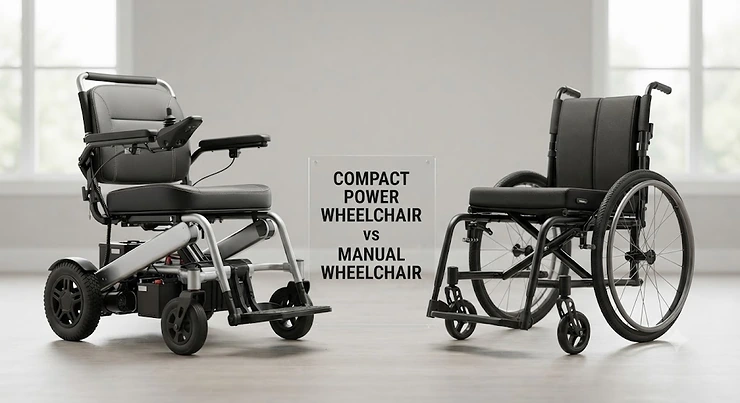
Here’s the thing about the compact power wheelchair vs manual wheelchair decision: most people frame it as a shopping question, when it’s really a question about your shoulders, your schedule, and the next ten years of your life.
A manual chair is freedom you power yourself. It’s light, simple, cheap to maintain and fits in the trunk of a Corolla without a fuss. A compact power chair is freedom someone else’s motor pays for — the kind that lets you cross a Costco parking lot in February without arriving with burning triceps and nothing left for the actual shopping.
Neither is “better.” That’s the uncomfortable truth. The right answer depends on how far you travel in a day, how strong (and how pain-free) your arms are, whether you’ll be lifting the chair into a car yourself, and — this is the big one for Canadians — which provincial program is helping pay for it.
The compact power wheelchair vs manual wheelchair comparison has also shifted in the last few years. Folding lithium-powered chairs now weigh in the 27-31 kg range, which is closer to a heavy manual chair than to the 100+ kg rehab power bases most people picture. That narrowing gap is exactly why so many families are reconsidering the question in 2026.
In this guide, I break down seven real chairs — four compact power models and three manual models — using manufacturer spec sheets and the recurring themes in real buyer reviews. You’ll also get a plain-English look at upper-body strain research, a decision framework for when to switch, and how funding works through programs like Ontario’s Assistive Devices Program.
No hype. No invented testing stories. Just the reasoning you need to pick with confidence. 🦽⚡
What Is the Compact Power Wheelchair vs Manual Wheelchair Question?
The compact power wheelchair vs manual wheelchair question compares two mobility approaches: a folding, battery-driven chair (typically 25-45 kg, joystick-controlled, 8-24 km range) versus a self-propelled chair (roughly 11-20 kg) moved by the user’s arms or an attendant. It weighs independence, physical strain, portability and cost.
That’s the snippet version. The longer version is that both devices belong to a much bigger family — the history and categories of motorized wheelchairs run from heavy rehab bases with tilt and recline to the airline-friendly folding chairs this article focuses on.
Why “compact” changes the math
Traditional power chairs don’t fold. They need a ramp van or a hitch lift. Compact models fold in seconds and can split the battery off, so the heaviest single lift might be under 30 kg. That’s still heavy for many caregivers, but it’s workable with a trunk lift or a strong partner.
Why manual chairs still win plenty of arguments
A manual chair has no battery to die, no controller to fail, and no charger to forget at the cottage. For short distances and strong upper bodies, it remains the most reliable tool in the shed.
Quick Comparison Table: Compact Power vs Manual at a Glance
| Factor | Compact Power Wheelchair | Manual Wheelchair | Best For |
|---|---|---|---|
| Typical weight | 27-66 kg (battery included) | 11-19 kg | Manual for solo car lifting |
| Daily range | 8-24 km per charge | Limited by your arms | Power for long outings |
| Upfront cost | ~C$2,000-C$4,500 | ~C$250-C$800 | Manual on a tight budget |
| Upper-body load | Minimal (joystick) | High (thousands of pushes/day) | Power for shoulder pain |
| Maintenance | Batteries, controller, motors | Tires, bearings, brakes | Manual for low upkeep |
Looking at the table, the trade-off is stark: a manual chair saves you roughly C$1,500-C$4,000 up front and a lot of kilograms, but it charges you daily in shoulder effort. The compact power side flips that bill — more money and weight, far less wear on your body. If you already have shoulder pain, that last row should carry more weight than any price column.
💬 Just one click — help others make better buying decisions too!😊
Top 7 Chairs: Expert Analysis for Canadian Buyers
The four compact power chairs below cover budget, mid-range and premium folding options, while the three manual chairs cover ultralight, everyday and budget standard frames. Prices are approximate CAD ranges at the time of research — prices may vary, so check current price on amazon.ca before buying.
1. EZ Lite Cruiser Deluxe DX10 — best premium folding power chair
The EZ Lite Cruiser Deluxe DX10 is the chair people point to when they want power without the bulk. According to the manufacturer’s comparison sheet, the frame weighs about 26-28 kg (58-62 lb) before the lithium battery, folds to roughly 86 × 66 × 38 cm (34 × 26 × 15 in), and supports users up to 150 kg (330 lb).
What does that mean in practice? The battery comes off, so the heaviest lift stays under 30 kg — manageable for many caregivers, still too much for a solo user with limited arm strength. Range is up to 16 km (10 mi) with the 10 Ah battery or 24 km (15 mi) with the 15 Ah pack, and top speed is around 8 km/h (5 mph).
Based on the spec comparison, the EZ Lite Cruiser Deluxe DX10 suits active users who travel, shop and visit family often, and who want a higher weight capacity than most folding chairs offer. The 19-inch seat is roomier than the Jazzy Passport’s.
Recurring themes in buyer reviews praise its portability and sturdy feel, while the most common complaint centres on price and the cost of replacement parts. I couldn’t verify specific review counts on amazon.ca, so read the listing yourself.
Pros:
- ✅ High 150 kg capacity for a folding chair
- ✅ Removable lithium battery lightens the lift
- ✅ Up to 24 km range with larger battery
Cons:
- ❌ Premium pricing versus budget folding models
- ❌ Still heavy for solo lifting into a car
Expect roughly C$3,500-C$4,500 depending on configuration — a strong long-term value for heavy daily use.
2. Pride Jazzy Passport — most trusted brand in the compact class
The Pride Jazzy Passport brings a big-name mobility brand to the folding category. Pride lists it at about 27 kg (59.8 lb) without batteries, with a 113 kg (250 lb) weight capacity and a top speed of roughly 5.8 km/h (3.6 mph).
Range is the catch. Pride quotes up to 8 km (5 mi) with the 10.4 Ah travel battery and roughly 13.8 km (8.6 mi) with the 18 Ah lithium pack, both tested at a 100 kg (220 lb) user. Translation: this is a chair for errands, malls, cruise ships and airports — not all-day rambles along the Rideau Canal.
My honest analytical take: the Pride Jazzy Passport is for buyers who prioritize dealer support and parts availability over raw range. Pride’s Canadian dealer network matters when a controller throws an error code in the middle of winter.
Buyer feedback across retailers tends to highlight smooth joystick control and easy folding, while the shorter range comes up repeatedly as a limitation.
Pros:
- ✅ Established brand with dealer service network
- ✅ Smooth, predictable joystick response
- ✅ Folds in one piece for fast stowing
Cons:
- ❌ Shortest range of the power chairs here
- ❌ 113 kg capacity limits larger users
Expect roughly C$3,000-C$4,000 — worth it if service access matters more than distance.
3. Vive Health Folding Power Wheelchair (MOB1029L) — best value lithium folder
The Vive Health Folding Power Wheelchair (MOB1029L) hits the price sweet spot for first-time power users. Retailer specs list it at about 30.8 kg (67.8 lb) including its 24V 10 Ah lithium battery, with a 118 kg (260 lb) capacity.
Dual 200W motors push it to about 6 km/h (3.7 mph), with range up to about 15 km (9.3 mi). Solid, inflate-free tires (roughly 20 cm front, 30 cm rear) mean no flats on gravel paths, though solid tires also transmit more vibration over cracked sidewalks.
Here’s what to weigh: the Vive Health Folding Power Wheelchair (MOB1029L) makes sense for someone who mostly moves on paved surfaces and wants to test power mobility without a five-figure commitment. Around 15 cm (6 in) of ground clearance handles curb cuts but not true off-road.
Aggregated review sentiment generally rewards the price-to-features ratio, while complaints tend to focus on a firmer ride and customer service wait times.
Pros:
- ✅ Strong features for the price bracket
- ✅ Flat-free tires cut maintenance worries
- ✅ Lithium battery keeps weight near 31 kg
Cons:
- ❌ Solid tires give a bumpier ride
- ❌ Less established service support than Pride
Expect roughly C$2,000-C$2,800 — the best entry point for trying power mobility.
4. Drive Medical Cirrus Plus EC — best for sturdiness over portability
The Drive Medical Cirrus Plus EC is a folding power chair, but let’s be honest: “compact” is relative here. Its base weighs about 41 kg (90 lb) and the pair of 12V 36 Ah sealed lead-acid batteries adds another 25 kg (56 lb), for roughly 66 kg (146 lb) total.
That weight buys you something. Capacity climbs to 136 kg (300 lb), range reaches about 24 km (15 mi), top speed is around 8 km/h (5 mph), and seat widths come in 16, 18 and 20 inches. Batteries lift out separately, so no single piece is 66 kg.
The spec sheet won’t tell you this, but lead-acid batteries hate Canadian winters and deep discharges. Store the chair indoors and charge it nightly. The Drive Medical Cirrus Plus EC fits users who mostly stay local, have a van or ramp, and want a sturdy, wide-seat chair at a mid-range price.
Common review themes praise stability and seat sizing, while weight is the dominant complaint — no surprise.
Pros:
- ✅ Three seat widths for better fit
- ✅ 136 kg capacity with stable rear drive
- ✅ Up to 24 km range per charge
Cons:
- ❌ Heaviest chair here at roughly 66 kg
- ❌ Lead-acid batteries not airline-friendly
Expect roughly C$2,500-C$3,500 — solid value if you rarely lift it.
5. Karman S-Ergo 115 — lightest manual chair in this lineup
The Karman S-Ergo 115 is the manual chair for people who care about every kilogram. Karman lists it at about 11.3 kg (25 lb) without footrests, with a 113 kg (250 lb) capacity and 16, 18 or 20-inch seat widths.
Two details matter more than the weight. First, the ergonomic “S-shaped” seat frame is designed to help reduce sliding and pressure. Second, the ergonomic handrims on 24-inch flat-free rear wheels give your hands a better contact surface — a small but real help if you push thousands of strokes a day.
Based on the spec comparison, the Karman S-Ergo 115 is the smartest pick for independent manual users who lift the chair into a car themselves. Lighter chairs also take less energy to push, which feeds directly into the shoulder-strain discussion below.
Reviewers frequently mention how easy it is to lift and fold, while some find the seat firmer or narrower than expected.
Pros:
- ✅ Just 11.3 kg without footrests
- ✅ Ergonomic handrims reduce hand stress
- ✅ Folds to about 30 cm wide
Cons:
- ❌ Lower capacity than standard steel frames
- ❌ Fixed seat shape won’t suit everyone
Expect roughly C$550-C$800 — the best value upgrade from a heavy hospital-style chair.

6. Drive Medical Silver Sport 2 — best budget everyday manual chair
The Drive Medical Silver Sport 2 is the default manual chair in countless Canadian homes, and there’s a reason. It weighs about 18 kg (40 lb), with capacity from 113 kg (16-inch seat) up to 159 kg (350 lb) on the 20-inch model.
Dual-axle design allows a seat-to-floor height of about 44.5 cm or 49.5 cm (17.5 or 19.5 in). That sounds boring — until you realise the lower setting lets shorter users “foot-propel,” a genuinely useful trick after a stroke. Detachable arms and swing-away footrests help with transfers.
My analytical take: the Drive Medical Silver Sport 2 is ideal as a backup chair, a caregiver-pushed chair, or a first chair while you figure out long-term needs. It is not the chair I’d pick for daily self-propulsion over long distances — the extra 7 kg versus the Karman S-Ergo 115 adds up.
Review sentiment consistently rewards value and durability, while weight and occasional footrest fit issues come up.
Pros:
- ✅ Very affordable for a durable steel frame
- ✅ Adjustable seat height allows foot-propelling
- ✅ Up to 159 kg capacity on wider seat
Cons:
- ❌ Heavier to lift than ultralight frames
- ❌ Basic sling seat needs a cushion
Expect roughly C$250-C$400 — hard to beat as a starter or spare.
7. Drive Medical Blue Streak — best transfer-friendly manual chair
The Drive Medical Blue Streak targets users who transfer often — bed, car, toilet, dining chair. Its signature feature is flip-back padded desk arms, which swing out of the way instead of needing to be removed and stored.
Specs list about 18.6 kg (41 lb), a 16-inch seat depth, 16, 18 or 20-inch widths, a 49.5 cm (19.5 in) seat height, and capacity up to 136 kg (300 lb). It folds to about 32 cm (12.5 in) wide, and the 24-inch composite rear wheels use flat-free polyurethane tires.
Here’s what most buyers overlook: frequent transfers are one of the biggest shoulder stressors for manual users. Arms that flip back cleanly mean fewer awkward reaches and less twisting, so the Drive Medical Blue Streak can be a quiet shoulder-saver.
Reviewers commonly appreciate the flip-back arms and overall value, while some note it’s heavier than true ultralight chairs.
Pros:
- ✅ Flip-back arms simplify side transfers
- ✅ Flat-free tires eliminate puncture worries
- ✅ Three seat widths up to 136 kg
Cons:
- ❌ Heavier than the Karman ultralight
- ❌ Fixed seat height limits foot-propelling
Expect roughly C$300-C$450 — excellent value for transfer-heavy daily routines.
Side-by-Side Specs: All 7 Chairs Compared
| Chair | Type | Weight (approx.) | Capacity | Range / Speed | Price Range (CAD) | Best For |
|---|---|---|---|---|---|---|
| EZ Lite Cruiser Deluxe DX10 | Power | 26-28 kg + battery | 150 kg | 16-24 km / 8 km/h | C$3,500-C$4,500 | EZ Lite Cruiser Deluxe DX10: active travellers |
| Pride Jazzy Passport | Power | 27 kg + battery | 113 kg | 8-14 km / 5.8 km/h | C$3,000-C$4,000 | Pride Jazzy Passport: short trips, dealer support |
| Vive Health Folding Power Wheelchair (MOB1029L) | Power | 30.8 kg (with battery) | 118 kg | ~15 km / 6 km/h | C$2,000-C$2,800 | Vive Health Folding Power Wheelchair (MOB1029L): first power chair |
| Drive Medical Cirrus Plus EC | Power | ~66 kg total | 136 kg | ~24 km / 8 km/h | C$2,500-C$3,500 | Drive Medical Cirrus Plus EC: van owners |
| Karman S-Ergo 115 | Manual | 11.3 kg | 113 kg | User-powered | C$550-C$800 | Karman S-Ergo 115: independent self-propellers |
| Drive Medical Silver Sport 2 | Manual | 18 kg | 113-159 kg | User-powered | C$250-C$400 | Drive Medical Silver Sport 2: budget or backup |
| Drive Medical Blue Streak | Manual | 18.6 kg | Up to 136 kg | User-powered | C$300-C$450 | Drive Medical Blue Streak: frequent transfers |
The pattern jumps out: among the power chairs, the EZ Lite Cruiser Deluxe DX10 offers the best blend of capacity and range per kilogram, while the Vive Health Folding Power Wheelchair (MOB1029L) wins on entry cost. On the manual side, the Karman S-Ergo 115 costs about double the Drive Medical Silver Sport 2 but saves roughly 7 kg — a difference your shoulders will notice by week two.
✨ Don’t Miss These Top-Rated Mobility Picks! 🔍
Take your independence to the next level with these carefully researched chairs. Click on any highlighted model to check current pricing and availability on amazon.ca — and find the fit that keeps you moving comfortably through every Canadian season!
Power Wheelchair vs Manual Wheelchair Pros and Cons
Let’s put the power wheelchair vs manual wheelchair pros and cons side by side, because this is where most families get stuck.
Manual wheelchair: the case for
Manual chairs are light, simple and cheap. They go almost anywhere a car can take them, need no charging and rarely fail catastrophically. For users with good upper-body strength, pushing also counts as daily exercise — a real cardiovascular benefit.
Manual wheelchair: the case against
The cost is physical. Long distances, ramps, carpet, snow-crusted sidewalks and slush all multiply effort. Fatigue shrinks your world quietly: you skip the second errand, decline the walk with friends, stay home.
Compact power wheelchair: the case for
Power chairs convert battery energy into independence. Distance stops being the deciding factor. You arrive with energy left. For people with limited arm strength, chronic pain or fatigue conditions like MS, that’s life-changing.

Compact power wheelchair: the case against
More weight, more money, more things to maintain. Batteries degrade, especially in cold. Lithium packs also bring airline paperwork.
| Benefit | Compact Power Wheelchair | Manual Wheelchair (Traditional) | Best For |
|---|---|---|---|
| Energy conservation | Excellent | Poor over distance | Power for fatigue conditions |
| Exercise benefit | Minimal | Built-in cardio | Manual for fit users |
| Reliability | Depends on battery/electronics | Very high | Manual for remote trips |
| Winter performance | Reduced battery range in cold | Hard pushing in snow | Tie — plan routes either way |
| Portability | Moderate (27-66 kg) | High (11-19 kg) | Manual for solo travel |
The power wheelchair vs manual wheelchair pros and cons really come down to one trade: effort versus simplicity. If your energy is the scarcest resource in your day, power usually wins. If your budget or car-lifting ability is the bottleneck, manual stays ahead.
Upper Body Strain and Manual Wheelchairs: What the Research Says
Upper body strain and manual wheelchairs are linked in a way that deserves far more attention than it gets at the point of purchase.
Every push on a handrim loads the shoulder — a joint built for reaching and throwing, not for bearing body weight all day. Manual users also lift their full weight during transfers and pressure-relief raises. Over years, that adds up.
Research backs this up. A study on predictors of shoulder pain in manual wheelchair users is one of many in the rehabilitation literature examining how propulsion technique, body weight and years of use relate to pain. Across this body of research, shoulder pain is consistently reported as common among long-term manual users, particularly people with spinal cord injury.
What upper body strain looks like day to day
- Aching or sharp pain when reaching overhead
- Weakness during transfers you used to manage easily
- Wrist or hand numbness (carpal tunnel is also common)
- Choosing not to go places because the push isn’t worth it
How to reduce upper body strain
- Choose the lightest chair you can afford — the Karman S-Ergo 115 exists for this reason
- Use long, smooth push strokes instead of short, choppy jabs
- Keep tires and bearings maintained to reduce rolling resistance
- Get the axle position and seat height fitted by an occupational therapist
- Consider power for long trips while keeping a manual chair for short ones
Upper body strain and manual wheelchairs aren’t an argument against manual chairs. They’re an argument for protecting your shoulders early — because a shoulder injury can take away manual independence entirely.
When to Switch to an Electric Wheelchair: A Buyer’s Decision Framework
Knowing when to switch to an electric wheelchair is rarely a single dramatic moment. It’s usually a slow pile-up of small compromises. Here’s a practical framework.
Switch-signal checklist ✅
- ✅ Shoulder, elbow or wrist pain that lasts more than a few weeks
- ✅ You’re avoiding outings because pushing leaves you exhausted
- ✅ A caregiver now pushes you most of the time
- ✅ A progressive condition (MS, ALS, Parkinson’s, COPD, heart failure) is reducing stamina
- ✅ Your community has hills, long distances or rough terrain you can’t manage
- ✅ Fatigue after pushing affects your work, school or family time
The “if this, then that” decision tree
- If you push less than 1-2 km a day on flat ground and have no pain → stay manual, ideally in a lighter frame like the Karman S-Ergo 115.
- If you push daily but pain is starting → keep manual for home and add a compact power chair such as the Vive Health Folding Power Wheelchair (MOB1029L) for longer outings.
- If you travel often and lift the chair into a car → choose a lithium folder like the EZ Lite Cruiser Deluxe DX10 or Pride Jazzy Passport.
- If you need a wide seat and have ramp or van access → the Drive Medical Cirrus Plus EC makes sense.
- If a caregiver pushes you most of the time → a manual chair like the Drive Medical Silver Sport 2 may be enough, but ask whether power would give you back your independence.
When to switch to an electric wheelchair isn’t a sign of “giving up.” Many clinicians see it as the opposite: a way to protect the body you have and spend your energy on living, not on getting there.
Manual to Power Wheelchair Upgrade Canada: A Step-by-Step Practical Guide
A manual to power wheelchair upgrade Canada-style usually has more steps than simply ordering a chair online, especially if you want funding help. Here’s the path.
Step 1: Get a professional assessment
Book an occupational therapist (OT) or physiotherapist assessment. In Ontario, funded devices require an ADP-registered authorizer. The assessment covers seating, pressure risk, cognition and safe driving ability.
Step 2: Check funding before buying
Buying first and asking for funding later is the most expensive mistake in a manual to power wheelchair upgrade Canada buyers make. Most provincial programs only fund devices ordered through approved vendors.
Step 3: Trial the chair
Ask a vendor for a trial. Test ramps, your front door, your elevator, your car trunk and your bathroom.
Step 4: First 30 days — common mistakes
- Driving at top speed before mastering tight turns
- Letting the battery drain to zero (shortens lithium and lead-acid life)
- Storing the chair in an unheated garage through January
- Skipping tire and joystick checks
Step 5: Build a maintenance routine
- Daily: charge overnight, check joystick response
- Weekly: wipe down, inspect tires and brakes
- Monthly: check bolts, folding hinges and battery connectors
- Yearly: have a technician inspect motors and electronics
Step 6: Keep your manual chair
Many experienced users keep the manual chair as a backup for power failures, travel to places with no charging, and short hops around the house. A manual to power wheelchair upgrade Canada users plan well is rarely a full replacement — it’s an addition.
Insurance Coverage for Power Wheelchairs in Canada: How Funding Works
Insurance coverage for power wheelchairs in Canada depends heavily on your province, your income support status and any private or workplace plans. There is no single national program, which confuses almost everyone.
Ontario: the Assistive Devices Program
Ontario’s Assistive Devices Program for mobility aids covers manual wheelchairs, power wheelchairs and scooters for residents who need mobility help for six months or longer. The ADP-registered vendor bills the program for 75% of the approved cost, and you pay 25%. People receiving Ontario Works or ODSP can qualify for full coverage. An ADP-registered OT or physiotherapist must assess you first.
Other provinces
Other provinces run their own systems. Alberta has Alberta Aids to Daily Living (AADL), Quebec funds many devices through RAMQ programs, and B.C. routes support through health authorities and income-assistance programs. Rules, cost-sharing and waiting times differ, so check your provincial health ministry directly.
Private insurance and federal programs
- Workplace health plans often cover part of a power chair with a prescription
- Veterans Affairs Canada may fund mobility devices for eligible veterans
- Workers’ compensation boards cover devices after workplace injuries
- March of Dimes Canada and local charities sometimes fill funding gaps
Tax relief
Wheelchairs are generally treated as zero-rated medical devices for GST/HST purposes — the CRA’s guide to medical and assistive devices explains the rules. Wheelchair costs may also be claimable under the medical expense tax credit.
Insurance coverage for power wheelchairs in Canada rewards patience. Get the assessment, confirm eligibility, then choose the chair. Buying online first often means paying 100% yourself.
Independence and Mobility Device Choice: Real-World Scenarios
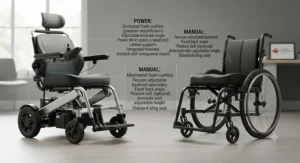
Independence and mobility device choice go hand in hand. The “best” chair is the one that lets you do what matters to you. Here are three realistic profiles.
Profile 1: Margaret, 74, Halifax — living with COPD
Margaret can walk short distances but gets breathless quickly. Budget: moderate, with some provincial support. Use: grocery runs, church, her daughter’s house.
Best match: the Vive Health Folding Power Wheelchair (MOB1029L). It conserves her limited energy, folds into her daughter’s SUV and fits a mid-range budget. A manual chair would force someone to push her everywhere — trading her independence for convenience.
Profile 2: Daniel, 38, Calgary — spinal cord injury, 12 years of manual use
Daniel is strong but has developing shoulder pain. Budget: good workplace coverage. Use: daily commute, office, hockey games.
Best match: keep a lightweight manual chair like the Karman S-Ergo 115 for the office and home, and add the EZ Lite Cruiser Deluxe DX10 for long days and travel. This hybrid approach protects his shoulders without giving up the exercise and simplicity he values.
Profile 3: Priya, 61, Mississauga — recovering from a stroke
Priya needs a chair while she rebuilds strength. Budget: tight, with ADP support. Use: mostly home and short outings with her husband.
Best match: the Drive Medical Silver Sport 2 set at the lower seat height so she can foot-propel with her stronger side. If recovery plateaus, a power upgrade can come later.
Independence and mobility device choice isn’t just about specs. It’s about which chair keeps you saying “yes” to invitations.
How to Choose a Compact Power Wheelchair vs Manual Wheelchair
Use these seven steps to narrow down the compact power wheelchair vs manual wheelchair decision fast.
- Measure your daily distance. Under 2 km on flat ground favours manual; longer or hillier routes favour power.
- Assess your upper-body health honestly. Existing shoulder pain is a strong reason to add power.
- Check who lifts the chair. If you lift it alone, stay under about 20 kg — manual, or a power chair with a separate battery.
- Confirm your weight capacity. Choose a chair rated at least 10-15% above your body weight.
- Measure doorways and your car trunk. Folded dimensions matter more than brochure photos.
- Check funding eligibility first. Provincial programs can cover up to 75% or more.
- Consider travel plans. Airlines generally require lithium batteries to meet watt-hour limits, so check with your airline before booking.
These steps turn a vague compact power wheelchair vs manual wheelchair debate into a checklist you can act on this week.
Long-Term Cost and Maintenance: The Real Price of Each Option
Sticker price is only the opening bid. Here’s how costs play out over five years.
| Cost Factor | Compact Power (e.g., Vive Health Folding Power Wheelchair (MOB1029L)) | Manual (e.g., Drive Medical Silver Sport 2) | Best For |
|---|---|---|---|
| Upfront cost | ~C$2,000-C$2,800 | ~C$250-C$400 | Manual on budget |
| Battery replacement | Every 1-3 years, several hundred dollars | None | Manual for low running cost |
| Tires/casters | Occasional | Occasional | Tie |
| Repairs | Controller/motor can be costly | Low | Manual for simplicity |
| Hidden cost | Charging, lifts, possible ramp | Your shoulders and energy | Power for long-term health |
On paper, a manual chair is dramatically cheaper over five years. But the table’s last row matters: if pushing leads to a shoulder injury, costs like physiotherapy, lost work time and reduced independence can quickly exceed the price gap. Long-term value depends on your body, not just your wallet.
Maintenance tips that extend chair life
- Store power chairs indoors, ideally above 10°C
- Charge lithium batteries regularly and avoid full discharges
- Wipe road salt off frames and wheels after winter outings
- Check manual wheel bearings and brakes every few months
Common Mistakes When Choosing Between Power and Manual
Even careful buyers make these mistakes in the compact power wheelchair vs manual wheelchair decision.
Mistake 1: Choosing on price alone
A C$300 chair that causes shoulder pain isn’t a bargain. Weigh total cost, including your health.
Mistake 2: Ignoring lift weight
Many buyers forget someone has to lift the chair into a car. A 66 kg Drive Medical Cirrus Plus EC is a very different lifestyle than an 11 kg Karman S-Ergo 115.
Mistake 3: Skipping the professional assessment
Seating problems cause pressure sores, posture issues and pain. An OT fitting is worth it — and often required for funding.
Mistake 4: Assuming “compact” means featherweight
Compact power chairs are lighter than rehab bases, but most still weigh 27-31 kg even with lithium batteries.
Mistake 5: Forgetting winter
Cold reduces battery range, and slush is tough on manual pushing. Plan routes, pack a charger and consider indoor storage.
Mistake 6: Thinking you must choose only one
Many users do best with both. Keep a light manual chair and add power for longer outings.
Features That Actually Matter (And Those That Don’t)
Features that matter ✅
- Weight capacity and seat width — fit and safety come first
- Removable battery — lighter lifting and easier airline handling
- Real-world range — plan for 60-70% of advertised range in cold weather
- Flat-free tires — fewer breakdowns on gravel and salted roads
- Flip-back or detachable arms — easier transfers, less shoulder stress
- Lightweight manual frame — less effort per push, fewer injuries
Features that matter less than marketing suggests ❌
- ❌ Top speed beyond 6-8 km/h — sidewalk safety matters more
- ❌ Flashy colours or LED lights — nice, but not decision-makers
- ❌ “All-terrain” claims on small wheels — compact chairs still prefer pavement
- ❌ Remote-control folding — handy, but adds weight and repair risk
The best chair is the one with the right fit and a realistic range — not the one with the longest feature list.

FAQ
❓ Is a compact power wheelchair worth it for seniors?
❓ Can I take a folding power wheelchair on a plane in Canada?
❓ How long do power wheelchair batteries last?
❓ Can I use a power wheelchair indoors?
❓ Where can I buy a compact power wheelchair in Canada?
Conclusion
The compact power wheelchair vs manual wheelchair decision isn’t about which technology is superior. It’s about matching a chair to your body, your budget and the life you want to lead.
If you’re strong, pain-free and mostly travel short distances, a lightweight manual chair like the Karman S-Ergo 115 or a budget-friendly Drive Medical Silver Sport 2 can serve you well for years. If transfers are frequent, the Drive Medical Blue Streak makes daily life easier.
If fatigue, pain or distance limits your day, a compact power chair can open doors again. The EZ Lite Cruiser Deluxe DX10 leads for travel and capacity, the Pride Jazzy Passport offers trusted brand support, the Vive Health Folding Power Wheelchair (MOB1029L) provides the best value, and the Drive Medical Cirrus Plus EC suits van owners who need a sturdier chair.
Above all, protect your shoulders, check funding before you buy and consider owning both types. The goal isn’t just getting from point A to point B — it’s arriving with energy left for everything that matters.
🚀 Ready to Find Your Perfect Chair? 👉
Explore the highlighted models above, compare current prices on amazon.ca and choose the mobility solution that keeps you independent, comfortable and confident all year long!
Recommended for You
- Indoor Power Wheelchair For Seniors: 7 Safe Picks (2026)
- 7 Best Compact Power Wheelchairs For Apartment Living (2026)
- Compact Power Wheelchair: 7 Best Picks For Tight Spaces (2026)
Disclaimer: This article contains affiliate links. As an Amazon Associate, I earn from qualifying purchases. If you purchase products through these links, we may earn a small commission at no additional cost to you.
✨ Found this helpful? Share it with your friends! 💬🤗
