
In This Article
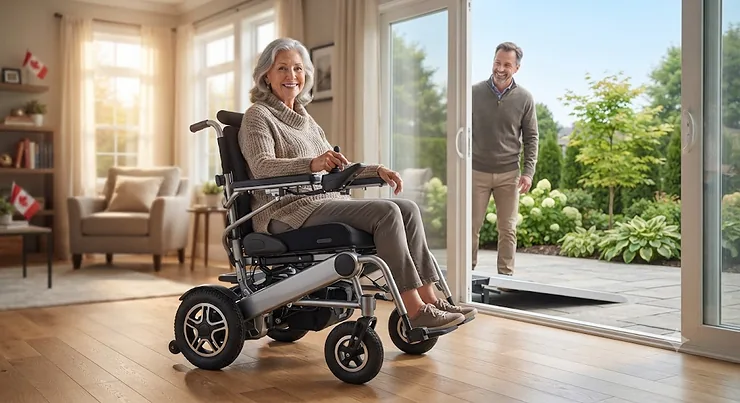
A compact power wheelchair is a battery-powered mobility chair built with a narrower frame, a foldable or disassembling design, and a lighter overall weight than a standard power chair — made specifically to fit through apartment doorways, small elevators, and the trunk of a compact car. If you’ve ever watched someone wrestle a full-size power chair through a condo hallway in Toronto or Vancouver, you already understand why “compact” isn’t a marketing word here — it’s the whole point.
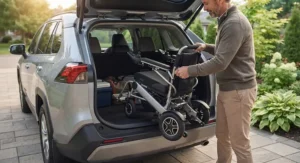
Canada’s population is aging fast, and mobility devices are following right along with it. Wheelchair and cane use among Canadian seniors has been climbing for years, and a lot of that demand isn’t for the big, heavy chairs you picture in a hospital hallway — it’s for something a person can fold, lift, and take with them. That shift toward smaller, lighter, apartment-and-car-friendly chairs is exactly what’s driving interest in the compact power wheelchair category on Amazon.ca right now.
This guide breaks down seven real, currently available compact power wheelchairs — budget, mid-range, and premium — with actual specs, honest analysis of what those specs mean day to day, and the practical stuff Amazon listings tend to skip: warranty fine print, return policy quirks, and what actually happens when you try to get one through a doorway that’s narrower than you thought. We’ll also walk through how to choose one, what mistakes trip people up, and what Canadian rules apply once you’re ready to take yours out the front door.
Quick Comparison Table: 7 Compact Power Wheelchairs at a Glance
| Chair | Best For | Weight Capacity | Folded/Portable Design | Price Range (CAD) |
|---|---|---|---|---|
| Pride Jazzy Passport | Trusted brand, dealer support | 113 kg (250 lb) | Rigid frame, no fold | C$2,400–C$3,000 |
| Golden Buzzaround CarryOn | Smallest folded footprint | 136 kg (300 lb) | Folds to 25 cm (10 in) tall | C$2,200–C$2,700 |
| ComfyGO Majestic IQ-7000 | Hands-free auto-fold | 159 kg (350 lb) | Remote-controlled auto-fold | C$2,500–C$2,900 |
| Merits P321 EZ-GO | Best value, easy disassembly | 113–136 kg (250–300 lb) | 3-piece disassembly | C$1,600–C$2,000 |
| eWheels EW-M45 | Highest weight capacity | 181 kg (400 lb) | Folds to 58 cm (23 in) long | C$2,000–C$2,500 |
| ComfyGO X-7 Ultra-Lightweight | Lightest overall chair | 120 kg (265 lb) | Folds flat, quick-release battery | C$2,100–C$2,600 |
| Vive Health Compact | Budget starter chair | 100 kg (220 lb) | Folds to 76 x 72 x 41 cm | C$1,700–C$2,100 |
Looking at the spread, there’s a clear pattern: the chairs with the smallest folded footprint (the Buzzaround CarryOn and ComfyGO Majestic IQ-7000) sit in the mid-to-premium price band, while the best value pick, the Merits P321 EZ-GO, trades a bit of folding convenience for a genuinely lower price. If your top priority is raw weight capacity, the eWheels EW-M45 is the standout, and if budget is the deciding factor, the Vive Health Compact gets you into a power chair for meaningfully less.
💬 Just one click — help other gift-givers find the right glass too! 😊
Top 7 Compact Power Wheelchairs: Expert Analysis
1. Pride Mobility Jazzy Passport — trusted brand with real dealer support
The Pride Mobility Jazzy Passport earns the top spot mostly on reputation, and that reputation is earned honestly. Pride is one of the oldest names in power mobility, and that matters more than it sounds like it should when something breaks two years in and you need a part, not a Reddit thread.
Specs-wise, the seat measures 44.5 x 41.9 cm (17.5 x 16.5 in), the chair supports up to 113 kg (250 lb), and it weighs 27.1 kg (59.8 lb) without batteries. The dual-motor, rear-wheel-drive setup gives it a genuinely tight 61.6 cm (24.25 in) turning radius — useful in a galley kitchen or a narrow apartment hallway. Battery choice matters here: the standard 18 Ah pack gets roughly 13.8 km (8.6 mi) per charge, while the lighter travel battery drops that to about 8 km (5 mi).
Based on the spec sheet, this is the chair for someone who values long-term support over the absolute lightest folded weight. What most buyers overlook is that the Jazzy Passport doesn’t fold flat like some rivals — it stays rigid, which actually helps stability but means trunk storage takes a bit more planning. Reviewers and retailer feedback on Pride products consistently mention responsive local dealer networks as a reason people stick with the brand after their first chair.
Pros:
- ✅ Backed by Pride Mobility’s extensive North American dealer network
- ✅ Dual-motor rear-wheel drive holds a stable line outdoors
- ✅ 5-year frame warranty is among the longest in this category
Cons:
- ❌ Doesn’t fold flat, so trunk loading takes more effort
- ❌ Travel battery version cuts range down to about 8 km (5 mi)
At the time of research, the Jazzy Passport sits in the C$2,400–C$3,000 range on Amazon.ca — prices may vary, so check current price before buying. For the dealer-network peace of mind alone, it’s a fair value verdict for anyone planning to keep the chair five-plus years.

2. Golden Technologies Buzzaround CarryOn — folds to a 25 cm stack for tight trunks
If storage space is your actual constraint — a studio apartment, a hatchback, a closet that’s already full — the Buzzaround CarryOn (model GP130) is worth studying closely. Its headline trick is folding down to just 25.4 cm (10 in) tall, which is genuinely unusual in this class.
The seat runs 43.2 x 40.6 cm (17 x 16 in), weight capacity tops out at a solid 136 kg (300 lb), and the fully assembled chair weighs 33.6 kg (74 lb) — though it breaks down into a 20.9 kg (46 lb) base plus a lighter seat and battery for anyone loading it solo. The 12 Ah lithium battery delivers about 20.1 km (12.5 mi) per charge, and center-wheel drive with independent 4-wheel suspension is what gives it that smoother ride over uneven sidewalks and door thresholds. Here’s what to weigh: center-wheel drive turns tighter than rear-wheel drive, but it also handles a little differently at first, and new users sometimes need an afternoon to adjust.
Aggregated feedback on travel-class power chairs like this one tends to praise the suspension and portability while noting that the smaller 12 Ah battery isn’t built for marathon outings — it’s a run-errands-and-recharge chair, not an all-day-at-the-fair chair.
Pros:
- ✅ Folds to a 25 cm (10 in) stack, the smallest footprint here
- ✅ Independent 4-wheel suspension smooths out cracked pavement
- ✅ 136 kg (300 lb) capacity beats most other travel-class chairs
Cons:
- ❌ Center-wheel drive has a short learning curve indoors
- ❌ 12 Ah battery means shorter range than the heavier-duty options
Expect a price in the C$2,200–C$2,700 range at the time of research. For anyone who genuinely needs the smallest possible folded size, that premium over the Merits P321 is money well spent.
3. ComfyGO Majestic IQ-7000 — auto-folds itself with one remote button
The ComfyGO Majestic IQ-7000 is the chair for someone who has, quite reasonably, decided that manually folding a power wheelchair every single day sounds exhausting. Its auto-fold system collapses and expands the chair at the press of a remote control button — no bending, no lifting the frame into a trunk before it’s folded.
The seat area measures 48.3 cm (19 in) wide, weight capacity reaches an impressive 159 kg (350 lb), and the chair itself weighs 27.2 kg (60 lb) without a battery, climbing to around 30.4–30.8 kg (67–68 lb) once a battery is installed. Dual 250 W motors give it real climbing ability — Amazon-listed specs put it at a 6° maximum grade — and the 20 Ah battery option extends range to roughly 30.6 km (19 mi), nearly 50% further than the base 12 Ah pack’s 20.9 km (13 mi). On paper, this is the chair built for someone whose daily route includes a driveway slope or a gently sloped ramp, not just flat sidewalk.
The trade-off is mechanical complexity: an auto-fold motor is one more moving part that, eventually, might need attention — a reasonable trade for many buyers, but worth knowing going in rather than discovering it in year three.
Pros:
- ✅ Remote-controlled auto-fold means zero manual lifting to store it
- ✅ Dual 250 W motors comfortably handle a 6° grade
- ✅ 20 Ah battery option stretches range to about 31 km (19 mi)
Cons:
- ❌ One of the pricier chairs in this compact class
- ❌ Auto-fold mechanism adds a part that can eventually need service
At the time of research, this one runs C$2,500–C$2,900 on Amazon.ca. If your hands, back, or shoulders make manual folding genuinely difficult, the auto-fold feature alone can justify the premium.
4. Merits Health P321 EZ-GO — breaks into three airline-ready pieces
The Merits Health P321 EZ-GO is the value pick in this lineup, and it earns that title without cutting corners on the frame — Merits backs it with a limited lifetime frame warranty, which is genuinely rare at this price.
Seat dimensions come in at 43.2 x 38.1 cm (17 x 15 in), and the chair is offered in two capacity tiers: a standard 113 kg (250 lb) version weighing 45.4 kg (100 lb), and a deluxe 136 kg (300 lb) version at 51.3 kg (113 lb). Both disassemble into three pieces for trunk transport, with the heaviest single piece topping out at just 15.9 kg (35 lb) — genuinely manageable for one person. The standard 12V/14Ah batteries deliver about 14.5 km (9 mi) per charge; stepping up to the deluxe 22Ah batteries pushes that to roughly 19.3 km (12 mi).
What the spec sheet won’t tell you, but user reports on comparable budget-tier power chairs suggest, is that solid 8-inch tires (rather than pneumatic ones) transmit more feel from rough pavement — a fair trade for never worrying about a flat.
Pros:
- ✅ Disassembles into 3 pieces, heaviest at just 16 kg (35 lb)
- ✅ Limited lifetime frame warranty is rare at this price tier
- ✅ Deluxe battery option extends range to 19 km (12 mi)
Cons:
- ❌ Solid tires transmit more bump feel than pneumatic tires
- ❌ Standard 12 Ah battery limits range for longer daily routes
Pricing sits in the C$1,600–C$2,000 range at the time of research — the lowest in this roundup. For anyone prioritizing budget without sacrificing frame durability, this is the value verdict winner.
5. eWheels EW-M45 — carries 181 kg in a 27 kg frame
Most compact power wheelchairs top out around 113–136 kg (250–300 lb) of capacity. The eWheels EW-M45 breaks that pattern with a 181 kg (400 lb) weight rating — the highest of any chair in this article — while still folding down for transport.
The seat measures a roomy 48.3 x 43.2 cm (19 x 17 in), the chair weighs just 26.8 kg (59 lb) with batteries installed, and it folds to 58.4 x 33 x 78.7 cm (23 x 13 x 31 in) for the trunk. Two 12V/6Ah lithium batteries (removable for indoor charging, a genuinely nice touch) power dual 180W brushless motors for about 24.9 km (15.5 mi) of range. Based on the spec comparison, that combination of high capacity and long range in a foldable chair is unusual — most manufacturers sacrifice one for the other. The trade-off shows up in top speed: at 6 km/h (3.7 mph), it’s on the slower end of this group, and it disassembles into pieces rather than folding in one motion.
It’s also worth noting the EW-M45 is FDA-cleared and confirmed airline/TSA-compliant, which reviewers researching travel-friendly options tend to flag as a genuine plus over unrated import chairs.
Pros:
- ✅ 181 kg (400 lb) capacity, the highest of any chair reviewed here
- ✅ FDA-cleared and confirmed airline/TSA compliant for travel
- ✅ Removable batteries allow charging indoors, off the chair
Cons:
- ❌ Disassembles rather than folding in one motion
- ❌ Top speed of 6 km/h (3.7 mph) is slower than most rivals here
Expect C$2,000–C$2,500 CAD at the time of research. For larger users who’ve been told “sorry, that chair isn’t rated for you,” this is often the first one that actually fits.
6. ComfyGO X-7 Ultra-Lightweight — the featherweight at just 20 kg
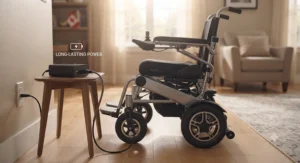
If you’re the one who has to actually lift the chair into a trunk, the ComfyGO X-7 Ultra-Lightweight deserves a serious look. At just 20 kg (44 lb) fully assembled with its battery, it’s meaningfully lighter than every other chair on this list — some by a factor of two.
The seat is 47 cm (18.5 in) wide, weight capacity sits at 120 kg (265 lb), and dual 250 W brushless motors power the rear wheels up to 6 km/h (4 mph) with a 9° climbing angle. The standout feature, though, is battery flexibility: a single 24V 7.5Ah battery is standard, but a dual-battery configuration extends range to an outstanding 37 km (23 mi) — the longest range of any chair in this roundup, foldable or not. Quick-release batteries also make airline check-in simpler, since airlines typically want batteries detached and hand-carried separately.
Here’s what to weigh: that low overall weight comes partly from a narrower frame and a lighter-duty 1-year warranty on electronics and motors, versus the 3-year frame coverage. It’s a reasonable trade for the portability, but one to go in aware of.
Pros:
- ✅ One of the lightest frames in this segment at 20 kg (44 lb)
- ✅ Dual-battery setup pushes range to about 37 km (23 mi)
- ✅ Quick-release batteries simplify airline check-in
Cons:
- ❌ 47 cm (18.5 in) seat may feel snug for larger users
- ❌ Electronics and motor warranty runs just 1 year
At the time of research, this chair runs roughly C$2,100–C$2,600 on Amazon.ca. For frequent flyers or anyone who travels solo, the weight-to-range ratio here is hard to beat.
7. Vive Health Compact Power Wheelchair — the budget-friendly starter chair
Not everyone needs 181 kg of capacity or a 37 km range on day one. The Vive Health Compact Power Wheelchair is built for the person who wants to try a power chair without committing to premium pricing, and it delivers a surprising amount of chair for that lower price point.
Seat dimensions run 40.6 x 45.7 cm (16 x 18 in), weight capacity is rated at 100 kg (220 lb) — the lowest ceiling in this lineup, worth flagging up front — and the chair weighs 43.1 kg (95 lb) including its battery. A 24V/10Ah battery pairs with dual 250 W motors (more motor power than the price tag suggests) for up to 19.3 km (12 mi) of range at 6 km/h (4 mph) top speed. An onboard charger is a small but genuinely useful detail: fewer separate cables to lose or forget.
Reviewers consistently note that entry-level compact chairs like this one trade shorter component warranties for the lower sticker price — here, the battery and controller are covered for just 6 months, versus multi-year coverage on pricier chairs. That’s a real consideration for anyone planning to keep a chair long-term.
Pros:
- ✅ Lower entry price makes it an accessible starter chair
- ✅ Dual 250 W motors are strong power for this price tier
- ✅ Onboard charger means one less cable to track down
Cons:
- ❌ 100 kg (220 lb) capacity is the lowest ceiling in this lineup
- ❌ Battery and controller warranty run just 6 months
At the time of research, pricing lands around C$1,700–C$2,100. For a first power chair on a tighter budget, it’s a genuinely solid value verdict — just go in aware of the lower weight ceiling and shorter warranty windows.
Setting Up and Living With Your Compact Power Wheelchair
Getting a new compact power wheelchair right in the first 30 days makes a real difference in how much you actually use it. Start by fully charging the battery before first use — most manufacturers recommend an initial 8-hour charge even if the indicator shows full sooner, which helps the battery management system calibrate properly. Next, measure your home’s tightest doorway and hallway before you even unfold the chair for the first time; a chair rated at 58–66 cm wide on paper can still bind on a 71 cm doorway once your elbows and the joystick controller are factored in.
A common first-month mistake is over-tightening the seat and folding mechanisms “to be safe” — most compact chairs are engineered with specific torque tolerances, and over-tightening quick-release levers actually accelerates wear. Instead, follow the manufacturer’s fold/unfold demonstration video closely for the first week or two until it becomes muscle memory.
Maintenance-wise, wipe down contacts on removable batteries monthly (corrosion is the single most common cause of “my chair won’t turn on” service calls), check tire pressure on any pneumatic-tired model like the eWheels EW-M45‘s rear wheels, and inspect the frame’s fold hinges for grit buildup if you’re using the chair outdoors regularly. None of this is complicated, but skipping it is exactly how a chair that should last five years starts needing repairs at year two.
Real-World Scenarios: Matching a Compact Power Wheelchair to Your Life
The apartment-dwelling retiree in Ottawa: limited storage, one elevator, occasional trips to the grocery store four blocks away. This profile fits the Golden Buzzaround CarryOn almost perfectly — its 25 cm folded height slides under most beds or into a closet, and the 20 km range comfortably covers a round trip with errands in between.
The frequent traveller who flies twice a year to visit family: airline battery rules and overall chair weight matter more than raw range. The ComfyGO X-7 Ultra-Lightweight, at 20 kg with quick-release batteries, is built exactly for this use case — it’s light enough to lift into an overhead bin category of car trunk and its batteries detach cleanly for airline check-in.
The larger-frame user who’s been turned away by standard chairs’ weight limits: this is where the eWheels EW-M45‘s 181 kg capacity solves a problem most compact chairs simply can’t. It costs a bit more in top speed, but for someone who’s struggled to find a chair rated for their weight at all, that’s a fair trade.
The budget-conscious first-time buyer testing whether a power chair fits their routine: rather than starting with a C$2,500+ premium chair, the Vive Health Compact offers a legitimately capable entry point, letting a new user confirm how often they’ll actually use a power chair before investing more.
How to Choose a Compact Power Wheelchair
A compact power wheelchair is chosen correctly by matching five specific factors — capacity, seat size, portability, range, and warranty — to your actual daily routine, not to the longest spec sheet. Here’s the step-by-step reasoning:
- Confirm your weight capacity with margin. Don’t buy a chair rated exactly at your weight — manufacturers recommend leaving 10–15% headroom for clothing, bags, and normal weight fluctuation.
- Measure your tightest doorway and turning space. A hallway corner is usually the real bottleneck, not the front door — measure both before comparing turning radius specs.
- Decide how the chair needs to travel. Folding, disassembling, and auto-folding are genuinely different experiences — someone with limited grip strength should weight auto-fold options like the ComfyGO Majestic IQ-7000 more heavily.
- Match range to your actual daily distance, doubled. Battery ranges are tested under ideal conditions; plan for roughly half the advertised range in cold weather or on inclines.
- Check the warranty structure, not just the length. A 5-year frame warranty with a 6-month battery warranty is common — know which parts are actually covered long-term.
- Factor in Canadian winter realities. Battery range drops noticeably in cold temperatures, and solid tires (like on the Merits P321) handle slush and salt differently than pneumatic tires.
- Confirm return eligibility before ordering. Mobility equipment often has stricter return terms than typical Amazon purchases — more on that below.

Seat Width and Weight Capacity: What the Numbers Actually Mean
Seat width and weight capacity are the two specs buyers most often misread. Seat width isn’t just about comfort — a seat that’s too narrow forces uneven weight distribution, which can strain hips and shoulders over months of daily use, while a seat that’s too wide reduces stability in tight turns. Across this roundup, seat widths range from 40.6 cm (16 in) on the Vive Health Compact up to 48.3 cm (19 in) on the eWheels EW-M45 and ComfyGO Majestic IQ-7000 — a meaningful difference for anyone above an average build.
Weight capacity, meanwhile, isn’t just “how much the chair can hold before it breaks.” It directly affects motor strain, battery drain, and top speed under real load — a chair loaded near its rated maximum will climb slower and drain its battery faster than the same chair carrying half that weight. This is exactly why the eWheels EW-M45‘s 181 kg rating and dual 180W motors pair well together, while a lighter-duty chair like the Vive Health Compact is better suited to lighter users who won’t be pushing its 100 kg ceiling regularly.
| Chair | Seat Width | Weight Capacity | Best For |
|---|---|---|---|
| Vive Health Compact | 40.6 cm (16 in) | 100 kg (220 lb) | Lighter users, budget entry |
| Merits P321 EZ-GO | 43.2 cm (17 in) | 113–136 kg (250–300 lb) | Average build, best value |
| ComfyGO X-7 | 47 cm (18.5 in) | 120 kg (265 lb) | Average-to-larger build, travel |
| eWheels EW-M45 | 48.3 cm (19 in) | 181 kg (400 lb) | Larger users, highest capacity |
The takeaway from this table is straightforward: buyers should treat seat width and weight capacity as a matched pair, not separate checkboxes — a wider seat with a low capacity rating, or a high capacity rating on a narrow seat, both undermine the comfort and stability the chair is supposed to provide.
Compact Power Wheelchair Comparison: How the Top 7 Stack Up
Putting all seven chairs side by side on core performance specs makes the trade-offs much easier to see than scrolling through seven separate listings.
| Chair | Range | Top Speed | Turning Radius | Frame Warranty |
|---|---|---|---|---|
| Pride Jazzy Passport | Up to 13.8 km (8.6 mi) | 5.8 km/h (3.6 mph) | 61.6 cm (24.25 in) | 5 years |
| Golden Buzzaround CarryOn | Up to 20.1 km (12.5 mi) | 6.2 km/h (3.85 mph) | 53.3 cm (21 in) | 5 years |
| ComfyGO Majestic IQ-7000 | Up to 30.6 km (19 mi) | 6.4 km/h (4 mph) | Not specified | 3 years |
| Merits P321 EZ-GO | Up to 19.3 km (12 mi) | 6.4 km/h (4 mph) | 58.4 cm (23 in) | Limited lifetime |
| eWheels EW-M45 | Up to 24.9 km (15.5 mi) | 6.0 km/h (3.7 mph) | 78.7 cm (31 in) | 3 years |
| ComfyGO X-7 | Up to 37 km (23 mi) | 6.4 km/h (4 mph) | Not specified | 3 years |
| Vive Health Compact | Up to 19.3 km (12 mi) | 6.4 km/h (4 mph) | 119.4 cm (47 in) | 3 years |
Reading this table, two things stand out immediately: the ComfyGO X-7 dominates on pure range thanks to its dual-battery option, while the Merits P321 EZ-GO quietly wins on warranty terms despite being the least expensive chair here. If maneuverability in tight spaces is the priority, the Golden Buzzaround CarryOn‘s 53.3 cm turning radius edges out the competition, but if long-term durability coverage matters more than turning tightness, the Merits chair’s lifetime frame warranty is genuinely hard to match at any price in this group.
What to Expect: Real-World Performance From Top Rated Compact Electric Wheelchairs
Advertised specs and everyday performance don’t always line up, and that gap matters more with mobility equipment than almost any other product category. Top rated compact electric wheelchairs typically advertise range figures tested on flat, dry, room-temperature pavement at a consistent moderate load — real-world Canadian conditions rarely match all three of those at once.
In practice, expect actual range to run 20–35% below the advertised figure once you factor in winter cold (lithium batteries lose capacity below roughly 0°C), inclines like driveway ramps or curb cuts, and carrying groceries or a bag. A chair advertised at 20 km should realistically be planned around 13–15 km for daily errands in shoulder-season weather, dropping further in deep winter. Reviewers who track their chairs across seasons consistently mention this seasonal range drop as the single biggest gap between the spec sheet and daily reality — not a defect, just physics.
Top speed tells a similar story: the 6 km/h (roughly 4 mph) rating shared by most chairs in this roundup is a brisk walking pace, comfortable for sidewalks and grocery aisles, but noticeably slower than what a mobility scooter or a full-size power chair offers on open ground. For most indoor and short-outdoor-trip use cases that compact chairs are actually designed for, that’s a feature, not a limitation — slower top speeds mean tighter, safer control in crowded spaces.
Compact Power Wheelchair Buying Guide Canada: Cost, Funding and Climate
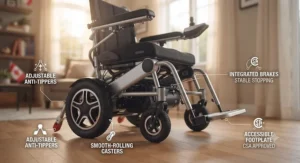
Buying a compact power wheelchair in Canada involves more than comparing Amazon.ca listings — provincial funding programs, GST/HST, and climate all factor into the real cost of ownership. Most provinces run an Assistive Devices Program that can cover a meaningful percentage of an approved power wheelchair’s cost when prescribed by an occupational therapist or physician; Ontario’s program, for example, is administered through the provincial government and typically requires a formal authorization before purchase, which is worth investigating before you buy outright on Amazon, since retail purchases generally aren’t retroactively eligible for reimbursement.
Beyond funding, long-term cost of ownership includes battery replacement (typically every 1–3 years depending on usage and the chair’s warranty terms), tire replacement on pneumatic-tired models, and the seasonal reality that Canadian winters shorten battery range and put more strain on motors climbing snow-packed curb cuts. Budgeting an extra C$150–C$300 annually for battery and tire upkeep is realistic across most chairs in this roundup, with lifetime-warranty frames like the Merits P321 EZ-GO reducing the risk of a major frame-related expense down the road.
✨ Ready to stop comparing and start shopping? 🔍
Tap any bolded chair above to check today’s Amazon.ca price and availability before your top pick sells out!
Warranty and After-Sales Support in Canada: What to Check Before You Buy
Warranty and after-sales support in Canada vary more between these seven chairs than almost any other factor, and it’s the one buyers most often skip reading closely. Frame warranties in this roundup range from a 1-year minimum baseline up to the Merits P321 EZ-GO‘s limited lifetime coverage, but frame coverage is only part of the picture — batteries, electronics, and motors are typically warrantied separately and for much shorter periods.
| Chair | Frame Warranty | Electronics/Motor | Battery Warranty |
|---|---|---|---|
| Pride Jazzy Passport | 5 years | 13 months | 13 months |
| Golden Buzzaround CarryOn | 5 years | 13 months | 12 months |
| Merits P321 EZ-GO | Limited lifetime | 1 year | 1 year (included in electronics) |
| eWheels EW-M45 | 3 years | 1 year | 6 months |
| ComfyGO X-7 | 3 years | 1 year | 1 year |
| ComfyGO Majestic IQ-7000 | 3 years | 1 year | 1 year |
| Vive Health Compact | 3 years | 1 year | 6 months |
What most buyers overlook is that after-sales support in Canada often depends on whether the manufacturer has Canadian-based distribution or ships parts from the US — a longer paper warranty is worth less if replacement parts take six weeks to clear customs. Before buying, it’s worth searching the manufacturer’s name plus “Canada” to confirm a local distributor or service network exists, particularly for battery replacements, which most buyers need well before the frame warranty expires.
Amazon.ca Return Policy for Mobility Equipment: What You Need to Know
Amazon.ca’s return policy for mobility equipment isn’t identical to its standard 30-day return window for most products, and this trips up more buyers than any other part of the purchase process. Power wheelchairs typically ship as “oversized” or “bulky” items, and depending on the seller, some listings carry modified return terms, restocking fees, or require the item to be shipped back in original packaging — which is genuinely difficult to preserve once a 25–35 kg wheelchair has been unpacked and assembled.
Before ordering, check the specific listing’s return policy section rather than assuming standard Amazon.ca terms apply — third-party sellers fulfilling their own mobility equipment orders sometimes set different return windows than Amazon-fulfilled listings. It’s also worth photographing the packaging and chair condition immediately on arrival, since damage claims for bulky freight items generally need to be filed within a short window, often 48 hours. If a chair arrives with an issue, contacting the seller directly through Amazon’s messaging system first — rather than initiating a standalone return — often resolves warranty-covered defects faster than a full return-and-reorder cycle, especially for made-to-order or drop-shipped mobility items.
Common Mistakes When Buying a Compact Power Wheelchair
Even careful shoppers trip up on a few predictable mistakes with this category. First, buying based on weight capacity alone without checking seat width — a chair can technically support your weight while still being too narrow for genuine comfort, as covered above. Second, underestimating folded dimensions relative to actual trunk or closet space; “folds compactly” is subjective, and the real numbers (like the eWheels EW-M45‘s 58 x 33 x 79 cm folded size) should be measured against your specific vehicle or storage spot before ordering.
Third, ignoring battery chemistry and cold-weather performance — lead-acid batteries (still used in a few budget chairs) lose capacity faster in cold storage than the lithium packs used in most chairs in this roundup. Fourth, skipping the manufacturer’s Canadian support check described above, which becomes a real problem only when something breaks and replacement parts are suddenly a cross-border shipping issue. And fifth, not confirming whether a doctor’s prescription or occupational therapy assessment is needed for provincial funding before buying outright — a mistake that can mean paying full price for a chair that could have been partially subsidized with the right paperwork filed first.
Safety, Regulations and Compliance for Power Wheelchairs in Canada
Power wheelchairs sold in Canada fall under Health Canada’s medical device regulations, and legitimate manufacturers carry an active device licence — buyers can check a specific chair’s licensing status through Health Canada’s public device listing if verification matters for insurance or funding purposes. This matters more than it might seem: an unlicensed device can complicate both provincial funding applications and insurance claims if something goes wrong.
Beyond device licensing, national accessibility standards for barrier-free design influence building codes for ramps, doorways, and elevators — useful context for understanding why some public spaces remain difficult to navigate even with a compact chair. On the travel front, airlines and Canadian transportation authorities have specific rules for carrying power wheelchairs and their lithium batteries; travellers should review official guidance on travelling with mobility aids and assistive devices well before a flight, since battery type and capacity directly affect whether a chair can be checked, carried, or requires advance airline notification.
Locally, most municipalities treat power wheelchairs as pedestrian devices rather than vehicles, meaning sidewalk use is generally permitted without licensing — but rules on road use, bike lane access, and maximum speed classifications can vary by province, so a quick check of local bylaws is worth the ten minutes it takes.

Frequently Asked Questions
❓ What is the best compact power wheelchair for small apartments in Canada?
❓ How much does a compact power wheelchair cost in Canada?
❓ Can I return a power wheelchair bought on Amazon.ca?
❓ Do I need a prescription to buy a compact power wheelchair in Canada?
❓ How long does the battery last on a compact power wheelchair?
Conclusion
Choosing among these seven compact power wheelchairs really comes down to matching your specific constraints — storage space, weight capacity needs, travel plans, and budget — rather than chasing the single “best” chair on paper. The Pride Jazzy Passport rewards buyers who value dealer support and long-term reliability, the Golden Buzzaround CarryOn wins on pure portability, the ComfyGO Majestic IQ-7000 solves the physical strain of manual folding, the Merits P321 EZ-GO delivers the strongest value-to-warranty ratio, the eWheels EW-M45 opens the category to larger users who’ve been shut out elsewhere, the ComfyGO X-7 is unmatched for lightweight travel, and the Vive Health Compact offers a genuinely capable entry point for a first power chair.
Whichever direction fits your life, the research-first approach here — real specs, honest trade-offs, and Canadian-specific considerations like funding programs and winter battery performance — should make the decision considerably less overwhelming than scrolling through Amazon listings alone.
Recommended for You
- Compact Power Wheelchairs: 7 Best Picks For Canadians In 2026
- Canadian Winter Wheelchair for Icy Sidewalks: 7 Rugged Picks (2026)
- Wheelchair Snow Attachment for Wheels: 7 Proven Picks (2026)
Disclaimer: This article contains affiliate links. As an Amazon Associate, I earn from qualifying purchases. If you purchase products through these links, we may earn a small commission at no additional cost to you.
✨ Found this helpful? Share it with your friends! 💬🤗
