
In This Article
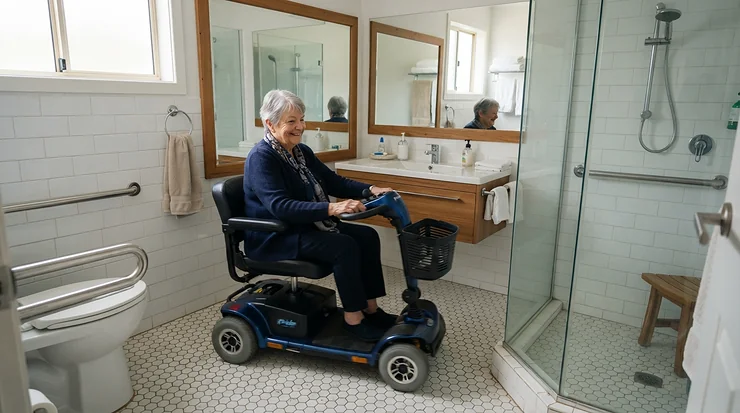
A small turning radius power wheelchair for home use is a compact, usually mid-wheel-drive powered chair that can pivot within roughly 50–62 cm (20–24 inches) of radius. That lets it rotate inside hallways, bathrooms and kitchens where a full-size power chair would need a three-point turn and a prayer. You give up some outdoor bulk and gain real indoor agility.
Here’s the thing most spec sheets bury: in a home, top speed is irrelevant. Nobody has ever been late because their chair topped out at 6 km/h in the hallway. What costs people their independence (and their door frames) is a chair that can’t turn around in the bathroom. Every centimetre of turning radius decides which rooms you can actually use.
I spent this research round digging through manufacturer spec sheets, Canadian dealer listings, accessibility standards and clinician-oriented guidance to find the best small turning radius power wheelchair for home use in 2026. Power wheelchairs have a surprisingly Canadian pedigree, by the way. The first production electric-powered wheelchair came from George Klein of the National Research Council of Canada.
A quick honesty note. Power chairs are prescription-style medical devices, and I can’t verify large pools of independent owner reviews for most of them. So instead of inventing “customer feedback,” this guide leans on real specs, real standards and clear reasoning. Where review data was thin, I say so. Prices are ballpark CAD ranges for planning, not quotes.
Quick Comparison: 7 Compact Power Wheelchairs at a Glance
| Model | Turning radius | Base width | Drive | Best For |
|---|---|---|---|---|
| Quickie Q300 M Mini | 56 cm (22 in) | 52 cm (20.5 in) | Mid-wheel | Tiny condos and galley kitchens |
| Pride Jazzy EVO 613 | 56 cm (22 in) | 56 cm (22 in) | Mid-wheel | Best all-round narrow home chair |
| Quantum Q6 Edge 2.0 | 52 cm (20.5 in) | 62 cm (24.4 in) | Mid-wheel | Active users who go out too |
| Quantum Q6 Edge 3 | 52 cm (20.5 in) | 62 cm (24.4 in) | Mid-wheel | Smoother ride, ADP-style funding routes |
| Drive Titan AXS | 51 cm (20 in) | Confirm on sheet | Mid-wheel | Budget shoppers (stock may be limited) |
| Invacare Pronto M41 | About 50–54 cm (19.5–21 in) | Confirm on sheet | Centre-wheel | Transport-friendly, compact use |
| Pride Jazzy Air 2 | 62 cm (24.25 in) | 59 cm (23.25 in) | Mid-wheel | Seat lift for counters and desks |
Look at the table and you’ll notice the widest chairs aren’t the worst turners. The Quantum Q6 Edge 2.0 is wider than the Quickie Q300 M Mini by 10 cm, yet its listed radius is actually tighter. So the narrowest base isn’t automatically the best fit; it depends whether your problem is doorways or pivot space. Meanwhile the Pride Jazzy Air 2 gives up a few centimetres of turning radius in exchange for a seat that rises 30 cm.
💬 Just one click — help others make better buying decisions too!😊
Top 7 Small Turning Radius Power Wheelchairs for Home Use: Expert Analysis
1. Quickie Q300 M Mini — narrowest true mid-wheel base
If floor space were money, the Quickie Q300 M Mini would be the thriftiest chair in this lineup. Sunrise Medical designed the base for people who live in small places.
The listed turning radius is 56 cm (22 in). The launch announcement touted 43 cm (17 in) without footplates, but a reader comment under New Mobility’s coverage rightly noted that figure excludes the footplates, so plan around 56 cm. Length is about 106 cm (42 in), the seat starts at roughly 42 cm (16.5 in), and an optional elevator adds 30 cm (12 in).
Mid-wheel drive pivots near your hips instead of swinging a tail, so the useful number is the circle: about 112 cm (44 in). Inside a 1,500 mm test circle, that leaves roughly 19 cm of margin on every side. That’s tight but workable, and it’s why this suits kitchenettes and one-bedroom condos.
I couldn’t verify a meaningful pool of owner reviews, so treat this as spec-sheet reasoning rather than a crowd verdict.
Pros:
- ✅ Narrowest true mid-wheel base in this group
- ✅ Low seat height slides under tables
- ✅ Optional 30 cm seat elevator
Cons:
- ❌ Premium price for a compact chair
- ❌ Footplates add length beyond the quoted radius
Price: roughly C$10,500–C$15,000 depending on seating. Verdict: the most expensive way to buy centimetres, but worth it if your floor plan is genuinely tight.

2. Pride Jazzy EVO 613 — best all-round narrow mid-wheel pick
The Pride Jazzy EVO 613 is the sensible middle child: Pride’s narrowest Jazzy, with a 56 cm (22 in) base and a matching 56 cm turning radius.
It carries 136 kg (300 lb), runs up to 8.2 km/h (5.1 mph), and rides on 13-inch drive wheels with Active-Trac suspension. Length is about 89 cm (35 in) without the footplate and 104 cm (41 in) with it. Pride’s Canadian brochure, issued from Beamsville, Ontario, lists a standard lead-acid version and a lithium version. The lithium weighs about 73 kg (160.5 lb) versus 86 kg (189 lb), and claims about 28 km (17.6 mi) of range against 22.5 km (14 mi).
Here’s what the spec sheet won’t tell you at a glance: Pride notes that armrests add roughly 8–10 cm (3–4 in) to seat width. So test your tightest doorway with the arms on, not just the base measurement.
Independent owner-review data wasn’t verifiable for this model, so I’m not quoting ratings.
Pros:
- ✅ Narrow 56 cm base with matching tight radius
- ✅ Lithium option cuts weight noticeably
- ✅ Wide seat-size range (16 to 20 inches)
Cons:
- ❌ No power seat elevation option listed
- ❌ Radius is not the tightest here
Price: roughly C$4,500–C$7,800. Verdict: strong value for most Canadian homes.
3. Quantum Q6 Edge 2.0 — most proven tight-turning rehab base
The Quantum Q6 Edge 2.0 is built for people who want one chair for the living room and the sidewalk.
Its radius is 52 cm (20.5 in) with 6-inch casters, and the base is 62 cm (24.4 in) wide. Top speed reaches 9.6 km/h (6 mph), with 14-inch drive wheels, ATX suspension and 136 kg (300 lb) capacity. The optional iLevel seat lifts up to 30 cm (12 in) at walking speed. One Canadian dealer even lists it among ADP-relevant models, which is useful if you’re in Ontario.
Now the catch. That 52 cm figure assumes 6-inch casters; a Canadian dealer listing gives 59 cm (23.25 in) with 8-inch casters. That’s a 7 cm penalty for a bigger front wheel, which matters more than most buyers expect.
Verified owner reviews were not available for me to aggregate, so this is analysis, not applause.
Pros:
- ✅ Tighter radius than chairs with narrower bases
- ✅ Seat elevation available
- ✅ Wide range of seating configurations
Cons:
- ❌ 62 cm base is tighter on older doorways
- ❌ Heavy: base alone is about 63 kg (139 lb)
Price: roughly C$8,000–C$14,000 depending on seating and electronics. Verdict: premium, but it earns it for mixed indoor and outdoor use.
4. Quantum Q6 Edge 3 — smoothest suspension in this lineup
The Quantum Q6 Edge 3 keeps the 52 cm (20.5 in) radius and 62 cm base of the Quantum Q6 Edge 2.0, then upgrades the ride.
Quantum’s newer SRS (Smooth Ride Suspension) is the headline, plus LED fender lights and a USB charger. A Canadian dealer sheet lists up to 10 km/h, about 82 cm (32 in) of length without front riggings, and iLevel at up to 7 km/h with 30 cm of lift. Warranty on that sheet: lifetime frame, two years on electronics and motors, 12 months on batteries.
On pure turning, nothing changes from the 2.0, which is exactly the point. If your floors are old hardwood with transition strips, or your carpet-to-tile thresholds are lumpy, ride quality becomes part of “manoeuvrability.” A UK retailer also lists a narrower Edge 3 Stretto variant with a base from 520 mm, so ask Canadian dealers whether it’s available here.
No verified aggregate reviews were available for this model.
Pros:
- ✅ Same tight 52 cm radius as the 2.0
- ✅ Upgraded suspension smooths thresholds
- ✅ Canadian warranty terms are clearly published
Cons:
- ❌ Highest price tier in this guide
- ❌ Base width unchanged at 62 cm
Price: roughly C$9,000–C$15,000. Verdict: choose it over the 2.0 only if ride quality matters daily.
5. Drive Titan AXS — budget mid-wheel with a 20 inch turn
The Drive Titan AXS is the budget route to a mid-wheel turn: 51 cm (20 in) radius on a chair that’s far cheaper than the rehab bases above.
Specs: 10-inch drive wheels, 6-inch casters, a pair of 12V 33Ah batteries, a 4A charger, up to 19 miles (about 30 km) estimated range, 136 kg capacity and a base weight of 87 lb (39 kg). Seven captain’s-seat width and depth combinations run from 16 to 20 inches, and the seat swivels in 45° steps. Warranty is limited lifetime on the frame, 24 months on electronics and 12 months on batteries.
The honest flag: a Canadian dealer notes that Drive’s current Canadian and US catalogues no longer list the Titan AXS as a factory-order model. So check remaining stock, the seller’s parts support and warranty handling before you commit. A cheap chair you can’t service isn’t cheap.
I didn’t find verifiable aggregated reviews for it.
Pros:
- ✅ Lowest entry price among mid-wheel options
- ✅ Swivelling captain’s seat helps transfers
- ✅ Light 39 kg base weight
Cons:
- ❌ Factory availability appears limited in Canada
- ❌ Basic electronics compared with rehab bases
Price: roughly C$2,800–C$4,000. Verdict: great value if you can confirm service and parts.

6. Invacare Pronto M41 — compact, dismantles for transport
The Invacare Pronto M41 is the veteran: a centre-wheel base that Invacare pitches as compact enough for a tight turning radius.
Sources disagree slightly, which is itself useful. A European database lists a turning circle of 1,075 mm (about a 54 cm radius), while a used-dealer listing quotes 19.5 inches (about 50 cm). Treat it as roughly 50–54 cm. Capacity is 136 kg, length about 103 cm, and the chair dismantles for transport, which suits people with a car and a limited trunk.
What this means in practice: the Invacare Pronto M41 won’t beat the Quantum chairs on radius, but its transport-friendly design suits someone who takes the chair between a home and a cottage. The SureStep suspension keeps six wheels down for stability.
Owner reviews weren’t something I could verify and aggregate.
Pros:
- ✅ Dismantles for car transport
- ✅ Six-wheel stability on thresholds
- ✅ Seat widths from roughly 38 to 53 cm
Cons:
- ❌ Turning figure varies by source
- ❌ Older platform; confirm Canadian availability
Price: roughly C$3,500–C$5,500. Verdict: a sensible mid-budget pick if portability matters.
7. Pride Jazzy Air 2 — seat lift for kitchens and desks
The Pride Jazzy Air 2 is the outlier: a 62 cm (24.25 in) radius, the largest here, in exchange for a seat that rises 30.5 cm (12 in) in about 11 seconds.
It’s 59 cm (23.25 in) wide, rides on 10-inch drive wheels and 6-inch casters, and keeps full speed (up to 6.4 km/h) while elevated. Range is up to 24 km (15 mi) at 300 lb. The redesigned lift sits 5 cm lower than before, so you can tuck under a standard table or desk.
That elevator changes what “small room” means. A chair that can reach upper cupboards or sit eye-level with a counter solves problems that a tighter turn simply can’t. If you work from home or cook often, the extra radius may be the better bargain.
I couldn’t verify aggregated reviews for it.
Pros:
- ✅ 30.5 cm lift reaches cupboards and counters
- ✅ Keeps full speed while elevated
- ✅ Lower seat height than the first-generation Air
Cons:
- ❌ Widest turning radius in this guide
- ❌ Higher price than the non-lifting Pride Jazzy EVO 613
Price: roughly C$5,800–C$8,500. Verdict: pay for it only if you’ll use the lift daily.
Turning Circle Measurement Explained: Radius, Diameter and Real Rooms
Manufacturers love the word “radius,” but your floor plan cares about diameter. Double the radius to get the circle you need. A 56 cm radius means a 112 cm circle, and a 52 cm radius means 104 cm.
Next, the footplate trap. Many sheets, including Quantum’s, quote radius “without front riggings,” and Sunrise’s 43 cm claim excluded footplates. Add footplates, a joystick on a swing-away arm, a wide hip or a long-legged user, and your real circle grows.
Accessibility standards give the benchmark. Building guidance commonly uses a clear circle of about 1,500 mm (60 in) for wheelchair turning, and CMHC’s accessibility criteria for funded housing reference CSA B651 and a 1,500 mm clear turn space or T-turn in bathrooms. The international ISO 7176-5 method defines how turning diameter and minimum space are measured, and older Canadian standard CAN/CSA-Z323.4.2 covered similar ground but is now listed as withdrawn.
One more wrinkle from US guidance: a 60-inch turning space is “usually satisfactory,” yet many users still need repeated tries and bump into things. A smooth U-turn needs about 78 by 60 inches (1,965 by 1,525 mm). So a chair with a 104 cm circle doesn’t guarantee a graceful turn in a 1.5 m room; it guarantees you won’t be doing a rodeo.
Tightest Turning Circle Power Wheelchair: What the Numbers Really Say
If the goal is the tightest turning circle power wheelchair, the shortlist is clear: Drive Titan AXS at 51 cm, Quantum Q6 Edge 2.0 and Quantum Q6 Edge 3 at 52 cm, and the Invacare Pronto M41 at roughly 50–54 cm. The Quickie Q300 M Mini and Pride Jazzy EVO 613 follow at 56 cm.
| Model | Radius | Circle needed | Seat lift | Range (maker claim) | Price (CAD) | Best For |
|---|---|---|---|---|---|---|
| Drive Titan AXS | 51 cm | About 102 cm | Not listed | Up to 30 km | C$2,800–C$4,000 | Value |
| Quantum Q6 Edge 2.0 | 52 cm | About 104 cm | Optional 30 cm | Up to 26 km | C$8,000–C$14,000 | Mixed use |
| Quantum Q6 Edge 3 | 52 cm | About 104 cm | Optional 30 cm | See Canadian sheet | C$9,000–C$15,000 | Ride quality |
| Invacare Pronto M41 | 50–54 cm | About 100–108 cm | Not listed | About 21–27 km | C$3,500–C$5,500 | Portability |
| Pride Jazzy EVO 613 | 56 cm | About 112 cm | None | 22.5–28 km | C$4,500–C$7,800 | Narrow doors |
| Quickie Q300 M Mini | 56 cm | About 112 cm | Optional 30 cm | About 27 km | C$10,500–C$15,000 | Smallest footprint |
| Pride Jazzy Air 2 | 62 cm | About 123 cm | Standard 30.5 cm | Up to 24 km | C$5,800–C$8,500 | Counters, desks |
The gap between first and last is only about 11 cm of radius. In a 1.5 m room that’s the difference between “easy” and “fiddly,” but in a 2 m room it barely registers. Rank by your tightest room, not by bragging rights. And remember that maker-quoted ranges are theoretical, so budget a margin.
Caster Wheel Design and Tight Turns: The Small Wheels Doing Big Work
Everyone obsesses over drive wheels. The casters quietly decide how a chair turns, and Quantum’s own figures prove it: the Quantum Q6 Edge 2.0 lists 52 cm with 6-inch casters but 59 cm with 8-inch casters.
Why? A caster swivels around a pivot offset from its axle. A larger wheel needs more clearance to swing around, so the effective footprint grows. Wikipedia’s caster entry notes that turning effort depends on caster amount and wheel diameter, and clinical guidance from a wheelchair maker adds that smaller casters give more precision in turning radius while larger ones roll over obstacles more easily.
Then there’s flutter, the shopping-cart shimmy. Flutter depends on the load on the caster and the distance between axle and steering axis, and it can slow the chair and shift weight forward. A larger-diameter caster tends to start fluttering at slower speeds than a smaller one. That’s guidance written mostly for manual chairs, but the physics carries over.
Mid-wheel chairs add one more twist: they use casters at both front and rear for a six-wheel layout. Sunrise says the Quickie Q300 M Mini lets its front caster arms move independently so the drive wheel keeps traction. For home use, solid casters of 5–6 inches, as on the Pride Jazzy EVO 613, suit smooth floors. If you have thick area rugs, ask a dealer about tread and diameter before ordering.
How to Choose a Small Turning Radius Power Wheelchair for Home Use
- Measure your tightest room, not your biggest. Find the narrowest doorway and the smallest turning area (usually the bathroom), then compare against the chair’s circle, not just its base width.
- Convert radius to a circle and add margin. Double the quoted radius, then add 10–15 cm for footplates, elbows and imperfect steering.
- Check the width with armrests on. Pride notes armrests add roughly 8–10 cm to seat width, so measure the full chair.
- Prefer mid-wheel drive for pivot turns. It pivots near your hips, whereas front- and rear-wheel chairs swing wider.
- Ask which caster size the quoted radius uses. A change from 6-inch to 8-inch casters added 7 cm on one model.
- Decide whether you need a seat lift. If you cook or work at a desk, a 30 cm lift may beat a 5 cm tighter turn.
- Get an assessment. An occupational therapist or authorized assessor can match seating, controls and size to your body and home.
Power Wheelchair for Small Rooms Canada: Doors, Halls and Condo Reality
Canadian homes aren’t built to one template. A 1950s bungalow, a downtown condo and a new build each have different door widths and hall turns, which is why a power wheelchair for small rooms Canada shoppers choose needs real measurements.
CMHC’s accessible-housing guidance, as summarized in published copies, suggests main interior doors of at least 810 mm (32 in) and hallways of at least 1,220 mm (48 in) with turn-around space at entrances and hallway ends. Older homes often fall short, which is where your chair’s width and radius earn their keep.
There’s also a moving target in the building code. In its response to a public review of the National Building Code, March of Dimes Canada noted a proposal to raise the washroom turning circle from 1,500 mm to 1,650 mm to accommodate large power wheelchairs and a support person. That’s a proposal, not a rule, but it signals that 1,500 mm is a floor, not a luxury.
Winter adds a Canadian wrinkle: bulky boots, a coat and a walker in the vestibule all eat turning space. Measure the entrance as you’ll actually use it in January.
Furniture Layout for Power Wheelchair Use: A Floor-Plan Playbook
A great chair in a badly arranged room still performs like a bad chair. Furniture layout for power wheelchair use starts with one tool: painter’s tape.
- Tape the circle. Mark the chair’s turning circle on the floor (radius doubled), then add 10–15 cm for margin. Drive around it; if you clip furniture, move the furniture.
- Create one 1,500 mm zone per key room. Living room, bedroom and kitchen each need a clear circle or T-shaped turning space.
- Float, don’t wall-hug. Pull sofas a bit off the wall so you can approach at an angle and pivot rather than reverse out.
- Rethink swing doors. A door swinging into your turning space can be re-hung, replaced with a pocket or barn door, or fitted with offset hinges that widen the opening by a couple of centimetres.
- Keep pathways at least 1,000 mm clear and strip away loose throw rugs that bunch under casters.
Think of it as choreography. The goal is a loop you can drive without reversing: kitchen to table to sofa to hallway, with one pivot point per room.
Best Maneuverable Power Wheelchair Indoors: What to Expect Day to Day
The best maneuverable power wheelchair indoors isn’t the one with the smallest number; it’s the one that makes your daily routes boring. Expect fewer corrections, less wall-kissing and less fatigue.
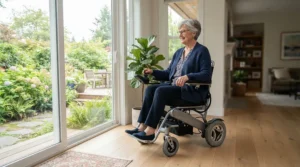
Mid-wheel drive makes the turn feel natural. Quantum, Pride and Sunrise all use six-wheel layouts with suspension so all six wheels stay planted, and the practical result is a chair that doesn’t pitch on thresholds. Speed profiles matter too. Most chairs let a clinician program a slower indoor mode, which makes tight spaces calmer.
Floors change everything. Low-pile carpet rarely troubles a six-wheel mid-wheel base, but shag rugs drag casters and old threshold strips can catch small front wheels. A 5–6 inch caster will generally be gentler on floors than an 8-inch one.
Battery range, finally, is a non-issue for most indoor use: the Drive Titan AXS claims up to 19 miles and even the shortest range here is about 14 miles. For home use, you’re more likely to run out of patience than battery.
Mid-Wheel Drive vs Front-Wheel and Rear-Wheel Drive
| Drive type | Turning behaviour | Stability | Best For |
|---|---|---|---|
| Mid-wheel (Quickie Q300 M Mini, Pride Jazzy EVO 613) | Pivots near the user | Six wheels on the floor | Small rooms, pivot turns |
| Front-wheel | Rear swings wide | Good over thresholds | Mixed terrain, more space |
| Rear-wheel | Front swings wide | Intuitive steering at speed | Outdoor-leaning use |
Sunrise Medical describes the trade-off bluntly: rear- and front-wheel-drive chairs have to “swing” around a drive wheel, which widens the turning circle, while true mid-wheel chairs turn on the spot. A Canadian dealer lists Drive’s front-wheel Titan with a 25-inch turn versus the mid-wheel Drive Titan AXS at 20 inches, a 13 cm radius gap from drive layout alone.
For a home with tight rooms, mid-wheel is the safer bet. Front- and rear-wheel chairs have their place: more traditional outdoor behaviour and, in some designs, better obstacle climbing. But if your life is mostly indoors, mid-wheel wins on turning radius.
Real-World Scenarios: Three Home Profiles
The condo renter. A person in a 600 sq ft condo with a narrow bathroom door and a galley kitchen, using the chair daily indoors and for short building trips. The Quickie Q300 M Mini fits best: the 52 cm base and 112 cm circle give the margin. Budget is high, but nothing else here is narrower.
The bungalow couple. Older home, 28–30 inch interior doors in places, a long hallway, moderate budget. The Pride Jazzy EVO 613 balances width, radius and cost. With 300 lb capacity and up to 8.2 km/h, it handles the yard too. Measure those doors with armrests on.
The remote worker who cooks. Medium-sized apartment, a standing desk and open shelves. The Pride Jazzy Air 2 gives up some turning radius but gains 30.5 cm of lift for the counter and a normal table height. If the lift gets used daily, the larger radius is a fair price.
If you also leave the house often, the Quantum Q6 Edge 2.0 is the one that handles both worlds without feeling like a compromise.
Problem → Solution Guide: The First 30 Days
Problem: scuffed door frames. Approach doorways straight on, slow the chair’s indoor profile, and consider offset hinges or removable door stops. Corner guards are cheap insurance.
Problem: the chair can’t turn in the bathroom. Check whether the footplate is the culprit, since many “tight” radii exclude it. Swap a swing door for a pocket or curtain, or remove a vanity.
Problem: wobbly or noisy front wheels. That may be caster flutter. Ask your dealer to check swivel friction and wheel wear; adjustable swivel bearings exist precisely to prevent it.
Problem: rugs and thresholds. Remove loose rugs, add low ramps to threshold strips, and pick solid casters suited to your floors.
Problem: charging habits. Plug in nightly. Batteries last longer when treated consistently, and an indoor-only user will rarely drain them anyway.
Common Mistakes When Buying a Compact Power Wheelchair
The first mistake is buying on width alone. Width gets you through the door; radius gets you out of the corner. Second, trusting a radius without asking about casters or footplates. Third, ignoring the chair’s weight: base weights range from about 39 kg for the Drive Titan AXS to well over 60 kg for the Quantum bases, and a heavy chair complicates transport.
Fourth, skipping the assessment. Seating, controls and posture matter as much as turning, and an occupational therapist can save you from an expensive mismatch. Fifth, forgetting the tape test: lay out the real circle at home before you sign anything.
Finally, buying a chair whose model is being phased out. The Drive Titan AXS is a good example: great spec, but confirm parts and service first.
Funding, Licensing and Safety in Canada
Funding varies by province. In Ontario, the Assistive Devices Program helps eligible residents with long-term physical disabilities pay for equipment like wheelchairs. It requires an Ontario resident with a valid health card, an assessment by an authorized assessor, and a registered vendor. Depending on the equipment it may cover up to 75% of the approved price, and it does not cover batteries or repairs.
If you live elsewhere, check your provincial health ministry, workers’ compensation board or veterans’ benefits; programs differ. Several dealers also list Veterans Affairs Canada, March of Dimes and WSIB among accepted funders.
On safety, powered wheelchairs are regulated as medical devices in Canada, so ask your dealer to confirm the model’s Health Canada licensing status. Also confirm crash-test or transit ratings if you travel in an adapted vehicle, and make sure a tie-down system is compatible.
Long-Term Cost and Maintenance
Sticker price is only the start. Batteries wear out, and under Ontario’s program they aren’t covered, so budget for replacement. Pride’s lithium option trades higher upfront cost for lower weight and quicker charging.
Repairs are common across the category. A 2014 study of 945 spinal cord injury users reported that 54.5% to 73.9% required at least one repair in a six-month period, depending on manufacturer. That doesn’t mean your chair will break; it means service access matters as much as spec.
| Tier | Models | Price range (CAD) | Value note |
|---|---|---|---|
| Budget | Drive Titan AXS, Invacare Pronto M41 | C$2,800–C$5,500 | Verify parts and availability |
| Mid | Pride Jazzy EVO 613, Pride Jazzy Air 2 | C$4,500–C$8,500 | Best balance of cost and features |
| Premium | Quantum Q6 Edge 2.0, Quantum Q6 Edge 3, Quickie Q300 M Mini | C$8,000–C$15,000 | Custom seating and suspension |
The takeaway: cost per year of use is lower for a well-serviced premium chair than a cheap one you can’t repair. Warranty terms matter. Quantum’s Canadian sheet lists a lifetime frame warranty and two years on electronics, while the Drive Titan AXS lists 24 months on electronics.
Frequently Asked Questions
❓ How much does a small turning radius power wheelchair cost in Canada?
❓ Is mid-wheel drive really better for small apartments?
❓ Can I get funding for a power wheelchair in Canada?
❓ How wide should my doorways be for a power wheelchair?
❓ Where can I buy a compact power wheelchair in Canada?
Conclusion
A small turning radius power wheelchair for home use isn’t about winning a spec race. It’s about making your own home work again. The numbers that matter are the circle your chair needs, the width of your tightest doorway with armrests on, and the caster size behind that quoted radius.
If you want the narrowest footprint and have the budget, the Quickie Q300 M Mini is the standout. For most Canadian homes, the Pride Jazzy EVO 613 balances width, turning and cost best. If you also head outdoors, the Quantum Q6 Edge 2.0 or Quantum Q6 Edge 3 deserve a close look. On a tighter budget, the Drive Titan AXS and Invacare Pronto M41 are worth checking, provided you verify availability and service. And if reaching counters matters more than a few centimetres, the Pride Jazzy Air 2 earns its place.
Whatever you choose, tape out the real turning circle on your floor, get an assessment, and check current prices and availability on amazon.ca or through authorized Canadian dealers before you buy.
✨ Ready to find the chair that fits your home?
🔍 Compare your shortlist, check current pricing and availability, and take the first step toward moving freely through every room. Your floor plan is waiting! 🏡
Recommended for You
- Mid-Wheel Drive Vs Rear-Wheel Drive Power Wheelchair: 7 Best Of 2026
- Mid-Wheel Drive Power Wheelchair: 7 Best Picks For Canada 2026
- Lightweight Foldable Power Wheelchair For Indoor Transport 2026
Disclaimer: This article contains affiliate links. As an Amazon Associate, I earn from qualifying purchases. If you purchase products through these links, we may earn a small commission at no additional cost to you.
✨ Found this helpful? Share it with your friends! 💬
