
In This Article
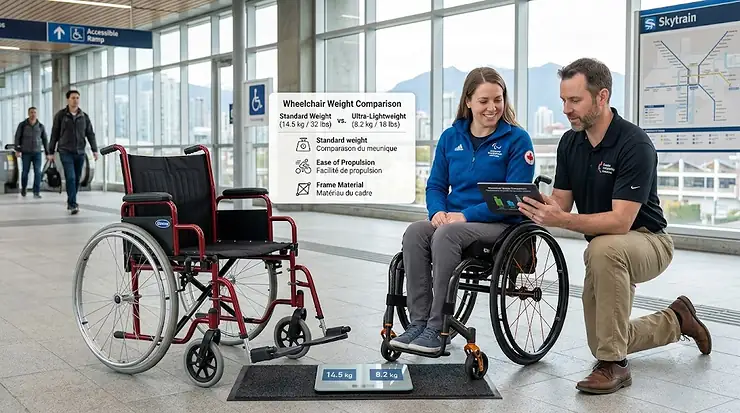
Here’s the thing nobody tells you before you buy a wheelchair: the number on the spec sheet matters almost as much as the chair itself. A manual wheelchair weight comparison isn’t some nerdy afterthought for engineers — it’s the difference between a caregiver who can lift a folded chair into a Corolla trunk with one arm, and one who’s calling in a favour from a neighbour every single outing. Weight decides who gets to travel, who gets to shop solo, and who ends up housebound because the chair itself became the barrier.

So, what is a manual wheelchair weight comparison? In plain terms, it’s an evaluation of how much different non-motorized wheelchair models weigh — frame, wheels, and accessories — measured against their weight capacity, portability, and price, to help you match the right chair to the right user and lifestyle.
A manual wheelchair typically weighs somewhere between 13 and 45 lbs (6-20 kg), while its weight capacity can range from 250 lbs on a standard frame to over 350 lbs on a reinforced bariatric build. That’s a wide spread, and the “right” number depends entirely on who’s pushing, who’s lifting, and where the chair is headed. Below, we’ve pulled together seven real, currently available manual wheelchairs — from ultra-featherweight travel chairs to heavy-duty bariatric frames — with honest, sourced commentary on what each one’s weight actually means day to day. If you’re weighing options for funding, the Ontario government’s Assistive Devices Program covers a share of eligible mobility aid costs for residents who qualify, which is worth knowing before you commit to a purchase.
We’re not going to pretend every chair here has been personally tested — that would be dishonest, and Amazon’s own content policies frown on invented experience anyway. Instead, every claim below is grounded in manufacturer specifications and aggregated, publicly available review sentiment, clearly labelled as such. What you’re getting is analysis, not fabricated anecdotes: exactly the kind of research you’d want before spending several hundred dollars on equipment that has to work correctly the first time.
Quick Comparison Table: Manual Wheelchair Weight at a Glance
| Wheelchair | Weight (w/o footrests) | Weight Capacity | Best For |
|---|---|---|---|
| Karman S-Ergo 115 | 25 lbs (11.3 kg) | 250 lbs | Best all-around ergonomic pick |
| FeatherMobility Featherweight | 13.5 lbs (6.1 kg) | 300 lbs | Lightest overall |
| Karman Ergo Flight K-2512 | 19.8 lbs (9 kg) | 250 lbs | Premium ultralight |
| Drive Medical Silver Sport 1 | 37.6 lbs (17 kg) | 250 lbs | Budget-friendly standard |
| Medline K4 Lightweight | 31.5 lbs (14.3 kg) | 300 lbs | Mid-range value |
| Karman LT-980 | 24 lbs (10.9 kg) | 250 lbs | Best price-per-pound |
| Karman KM-8520X Bariatric | 35 lbs (15.9 kg) | 352 lbs | Best heavy-duty/bariatric |
Looking at the spread above, there’s roughly a 24-lb (11-kg) gap between the lightest and heaviest chairs on this list, which is a bigger deal than it sounds — that’s the difference between a caregiver lifting a chair one-handed into a trunk and needing both arms and a bent back to do it. Weight capacity doesn’t track neatly with total weight either: the KM-8520X carries 100+ lbs more capacity than the Silver Sport 1 while weighing roughly the same, purely because of frame engineering. Budget-conscious buyers should note the LT-980 delivers a strong weight-to-price ratio without stepping into aircraft-aluminum pricing territory.
💬 Just one click — help others make better buying decisions too!😊
Top 7 Manual Wheelchairs by Weight: Expert Analysis
1. Karman S-Ergo 115 — best-selling ergonomic all-rounder
Karman’s S-Ergo 115 has been the brand’s flagship for years, and the reason is simple: it’s genuinely lightweight without giving up the ergonomic seating that prevents pressure sores. The frame alone comes in at 25 lbs (11.3 kg) without footrests, built from aircraft-grade aluminum rather than the steel that weighs down budget chairs.
The patented S-shaped seating frame keeps the knees at roughly a 100-degree angle and the legs slightly elevated relative to the hips, which is more than a comfort gimmick — that posture reduces forward sliding and evens out pressure distribution across the seat. Paired with a 250-lb weight capacity, the chair suits users in the average adult weight range who need daily self-propulsion rather than occasional transport use.
Based on the spec comparison, this is the chair for someone who self-propels multiple times a day and needs a frame light enough to avoid shoulder strain, but doesn’t want to pay premium-tier pricing for a rigid-frame chair. Reviewers consistently report that the mesh backrest and removable, washable cushions are a meaningful upgrade over vinyl-upholstered budget models, particularly for anyone sitting in the chair for extended stretches.
Pros:
- ✅ Genuinely light 25-lb aluminum frame for daily self-propulsion
- ✅ Ergonomic S-shape seating reduces pressure and slippage
- ✅ Removable, washable antimicrobial-treated cushions
Cons:
- ❌ 250-lb capacity limits larger-bodied users
- ❌ Quick-release wheels are an optional upgrade, not standard
Expect this chair to sit in the mid-C$400s to low-C$600s range depending on seat width and accessories at the time of research — always check current pricing before ordering, since options like quick-release axles add to the base cost.

2. FeatherMobility Featherweight — lightest chair on this list
If raw weight is your priority, this is the chair that keeps showing up at the top of independent lightweight-wheelchair roundups, and for good reason: at 13.5 lbs (6.1 kg), it’s roughly half the weight of a standard steel-frame chair while still rated to a 300-lb capacity.
What most buyers overlook about ultra-featherweight chairs is that hitting this weight usually means sacrificing something — smaller wheel diameter, thinner tubing, or reduced adjustability. The Featherweight manages a 300-lb capacity despite its low mass, which on paper suggests a genuinely reinforced alloy build rather than just thin-walled tubing cutting corners on strength.
This chair is built for one specific use case: someone (often a senior or a caregiver with limited lifting strength) who needs to load and unload a wheelchair from a vehicle multiple times per outing, or who’s flying and wants to minimize checked-baggage weight. Reviewers consistently note that anti-tippers and quick-release wheels come standard, which is unusual at this weight class and adds real safety value without adding real mass.
Pros:
- ✅ Half the weight of typical steel-frame manual chairs
- ✅ 300-lb capacity despite the ultra-low weight
- ✅ Anti-tippers and quick-release wheels included standard
Cons:
- ❌ Premium engineering pushes it toward the higher end of pricing
- ❌ Narrower frame tubing may feel less rigid on rough terrain
Price-wise, expect this model in the C$900-C$1,150 range at the time of research, reflecting the aerospace-grade materials needed to hit that weight without sacrificing capacity — a genuine case where the lighter number costs real money.
3. Karman Ergo Flight K-2512 — premium ultralight with quick-release wheels
The K-2512 (also sold as the S-2512 Ergo Flight) splits the difference between the featherweight travel chairs and the ergonomic daily-use models. At 19.8 lbs (9 kg) without footrests — and reportedly as low as 14.5 lbs in fully stripped transport mode — this chair uses T6-grade aircraft aluminum engineered specifically to undercut titanium-chair weight at a fraction of the price.
Here’s what the spec sheet won’t tell you outright: aluminum-vs-titanium weight parity used to require paying a four-figure premium for titanium frames. Karman’s geometry-first approach to the K-2512 claims to close roughly 71% of that price gap while landing in a similar weight class, which — if the manufacturer’s claims hold up under real-world use — represents genuine value engineering rather than marketing spin.
This is the chair for an active, long-term wheelchair user who self-propels for real distances daily and wants the lightest frame available without committing to a fully custom rigid chair costing two to three times as much. The 220- to 250-lb capacity (depending on configuration) does narrow the buyer pool somewhat compared to bulkier steel alternatives.
Pros:
- ✅ Among the lightest non-custom wheelchairs on the market
- ✅ Quick-release rear wheels for one-hand vehicle loading
- ✅ Ergonomic hand rims reduce wrist strain on long pushes
Cons:
- ❌ Lower weight capacity than steel-framed alternatives
- ❌ Premium materials mean a higher price point
At the time of research, this model typically lands around C$650-C$850, positioning it as a mid-premium option rather than an entry-level purchase — worth it primarily for users who propel themselves daily rather than occasional users.
4. Drive Medical Silver Sport 1 — dependable budget standard
Drive Medical’s Silver Sport 1 is the wheelchair equivalent of a Honda Civic: not flashy, not the lightest, but reliable, widely stocked, and inexpensive enough that hospitals and rehab centres buy it by the pallet. At 37.6 lbs (17 kg), it’s the heaviest chair on this list, built from powder-coated steel rather than aluminum.
Reviewers consistently note the steel frame is nearly bulletproof for short-term recovery use or occasional transport, and the 250-lb capacity plus full-length padded armrests make transfers easier for users with limited upper-body strength. What the spec sheet doesn’t emphasize: that extra steel weight translates directly into caregiver strain during loading, so this chair suits home or facility use far better than frequent car-trunk transport.
Based on the spec comparison, this is squarely a budget-first, occasional-use chair — ideal for a family keeping one wheelchair on hand for doctor’s visits or short-term post-surgical recovery rather than a daily driver for an active self-propelling user.
Pros:
- ✅ Rock-bottom pricing among manual wheelchairs
- ✅ Steel frame withstands heavy, frequent institutional use
- ✅ Full-length padded armrests ease transfers
Cons:
- ❌ Heaviest chair here at 37.6 lbs, tough for solo lifting
- ❌ Basic vinyl or nylon upholstery, no ergonomic seating
Expect a price in the C$270-C$400 range at the time of research, making it one of the most affordable entries into manual mobility on amazon.ca — though the weight trade-off is real.
5. Medline K4 Lightweight Wheelchair — mid-range value with 300-lb capacity
Medline’s K4 series threads the needle between the Silver Sport 1’s affordability and the Karman ergonomic line’s lighter frames. At 31.5 lbs (14.3 kg) with a 300-lb capacity, the TIG-welded steel-and-aluminum hybrid frame is noticeably lighter than comparable all-steel chairs while undercutting most aluminum-only frames on price.
The dual-axle hemi-height adjustment is a detail that’s easy to skim past on a spec sheet but matters enormously in practice: it lets a caregiver or clinician adjust seat height without buying a different chair as a user’s needs change, which reduces long-term cost of ownership. Reviewers praise the quick-release axles for tool-free wheel removal, a feature usually reserved for pricier ultralight models.
This chair fits a fairly broad buyer profile — anyone who wants better capacity than the entry-level steel chairs offer, without the price jump into ergonomic aluminum territory. It’s a sensible middle-ground pick for households unsure whether they need daily heavy use or occasional transport.
Pros:
- ✅ 300-lb capacity beats most chairs in its weight class
- ✅ Adjustable hemi-height accommodates changing needs
- ✅ Quick-release axles for tool-free wheel removal
Cons:
- ❌ Heavier than dedicated ultralight aluminum models
- ❌ Nylon upholstery lacks the ergonomic contouring of premium lines
At the time of research, pricing tends to sit in the C$300-C$420 range, making it a strong value pick for buyers who want more capacity without paying ultralight-tier prices.
6. Karman LT-980 — best price-per-pound value
The LT-980 is Karman’s answer to “how light can we go without charging ultralight prices?” At 24 lbs (10.9 kg) without footrests, it undercuts the S-Ergo 115’s weight while typically pricing lower, thanks to a simpler (non-ergonomic-shaped) seat pan.
What most buyers overlook about the LT-980 is that it still includes features usually reserved for pricier chairs: height-adjustable footplates that fit users from roughly five feet to six feet tall, a padded desk-length armrest, and solid, flat-free 22-inch rear wheels that eliminate the flat-tire maintenance headache entirely. Reviewers consistently flag this as one of the best “no-frills but still comfortable” lightweight options on the market.
This chair suits budget-conscious buyers who still want a genuinely light frame — students, part-time users, or anyone outfitting a second wheelchair for a vehicle or vacation property without duplicating a premium ergonomic chair’s cost.
Pros:
- ✅ 24-lb frame at a below-ultralight price point
- ✅ Flat-free polyurethane tires need zero maintenance
- ✅ Height-adjustable footplates fit a wide range of user heights
Cons:
- ❌ Flat (non-contoured) seat lacks ergonomic pressure relief
- ❌ 250-lb capacity is average, not class-leading
Pricing at the time of research typically runs C$340-C$470, making it arguably the best pounds-saved-per-dollar-spent chair in this entire comparison.
7. Karman KM-8520X Bariatric — best heavy-duty and high-capacity pick
Not every buyer needs the lightest chair — some need the strongest one that still doesn’t feel like moving furniture. The KM-8520X solves that specific problem: at 35 lbs (15.9 kg), it weighs barely more than several “lightweight” chairs on this list, yet carries a 352-lb weight capacity, roughly 40% more than the standard 250-lb ceiling most manual chairs top out at.
Here’s what the spec sheet undersells: bariatric-capacity chairs traditionally weighed 45-60+ lbs because manufacturers simply added steel to reinforce the frame. The KM-8520X’s aluminum-hybrid construction achieves its higher capacity through geometry and reinforcement placement rather than brute material mass, which is a genuinely different engineering approach from older heavy-duty designs.
This is the chair for a larger-bodied user, or a caregiver supporting one, who’s been told by every “lightweight” chair on the market that they don’t qualify due to weight limits. Reviewers highlight the anti-tippers and standard seatbelt as thoughtful inclusions for a category that doesn’t always prioritize safety extras.
Pros:
- ✅ 352-lb capacity in a frame lighter than many standard chairs
- ✅ Anti-tippers and seatbelt included standard
- ✅ Flip-back, height-adjustable armrests ease transfers
Cons:
- ❌ Wider seat dimensions require more storage and trunk space
- ❌ Higher price reflects the reinforced engineering
Expect pricing in the C$550-C$750 range at the time of research — genuinely competitive given that most bariatric-capacity chairs cost considerably more once you factor in the specialized frame work.
Lightest Manual Wheelchairs Ranked: Our Weight-by-Weight Countdown
For readers who landed here specifically hunting for the lightest manual wheelchairs ranked by weight, here’s the countdown from the models above, lightest to heaviest, without footrests attached:
- FeatherMobility Featherweight — 13.5 lbs (6.1 kg)
- Karman Ergo Flight K-2512 — 19.8 lbs (9 kg)
- Karman LT-980 — 24 lbs (10.9 kg)
- Karman S-Ergo 115 — 25 lbs (11.3 kg)
- Karman KM-8520X Bariatric — 35 lbs (15.9 kg)
- Medline K4 Lightweight — 31.5 lbs (14.3 kg) (note: lighter than the KM-8520X but ranked after it here due to lower capacity relative to weight — see analysis below)
- Drive Medical Silver Sport 1 — 37.6 lbs (17 kg)
On paper this means the gap between the lightest chair (Featherweight) and the heaviest (Silver Sport 1) is 24.1 lbs — more than the weight of an entire second, ultralight wheelchair. What’s worth noting is that raw ranking by weight alone can mislead: the KM-8520X is heavier than the K4 but earns its spot by carrying 52 more pounds of capacity, which changes the calculus for anyone shopping by pounds-of-capacity-per-pound-of-chair rather than weight in isolation. If portability is your only concern, trust the ranking above; if capacity matters too, revisit the comparison table further up.
Practical Usage Guide: Getting Started with a New Lightweight Manual Wheelchair
Unboxing a new manual wheelchair is straightforward, but the first 30 days set the tone for how well it actually serves you. Start by adjusting the footplate height before the first use — most lightweight models like the LT-980 and S-Ergo 115 have tool-free height adjustment, and getting this wrong is the single most common first-week complaint, since it throws off both posture and pressure distribution.
Next, practice the fold-and-lift motion at home, on carpet, before attempting it in a parking lot. Bend at the knees, not the back, and hold the folded chair close to your core rather than at arm’s length — this single habit prevents the majority of caregiver back injuries associated with wheelchair transport. If your model has quick-release wheels (like the K-2512 or Featherweight), practice removing and reattaching them a few times; it becomes second nature after three or four repetitions but feels fiddly the first time.
Maintenance-wise, wipe down the frame with a damp cloth weekly and check tire pressure (on models with pneumatic tires) monthly — flat-free polyurethane tires like those on the LT-980 skip this step entirely. Inspect the folding hinges every few months for looseness, since that’s typically the first component to wear on a chair used daily. A common first-month mistake is over-tightening quick-release axles out of an abundance of caution; this actually accelerates wear on the release mechanism, so a firm click is sufficient.
✨ Find the Right Fit — Compare Current Options Now!
🔍 Ready to narrow down your shortlist? Click through on any of the models above to check current pricing, seat-width options, and availability on amazon.ca. A few extra minutes comparing configurations now saves a return-and-reorder headache later.
Real-World Scenarios: Matching Wheelchair Weight to Your Life
If you’re a caregiver managing daily transfers for an aging parent between a car and multiple appointments, prioritize the lightest chair with adequate capacity for your parent’s weight — the Karman K-2512 or Featherweight, loaded and unloaded five or six times a week, will spare your back in ways a heavier chair simply won’t, even if it costs more upfront.
If you’re an active, long-term wheelchair user who self-propels for real distances — errands, work commutes, campus travel — the S-Ergo 115’s ergonomic seating and 25-lb frame balance daily comfort against weight better than an ultralight chair that sacrifices seat contouring for a few extra pounds saved. Budget matters here too: at roughly half the price of the premium K-2512, it’s the more sustainable daily-use choice for most people.
If you’re outfitting a vacation property, a second vehicle, or a facility that needs one dependable chair for occasional visitor use, the Drive Medical Silver Sport 1 or Medline K4 make more financial sense than an ultralight chair that will spend most of its life sitting in a closet. Occasional use doesn’t justify paying a portability premium you’ll rarely benefit from.
Problem → Solution: Common Wheelchair Weight Complaints, Solved
Problem: “The chair is too heavy for me to lift into my trunk.” Solution: look specifically at chairs under 25 lbs like the K-2512 or Featherweight, and confirm the model has quick-release wheels, since removing the rear wheels before lifting typically cuts the load in half.
Problem: “My chair meets the weight I need, but the user exceeds the capacity.” Solution: don’t downsize a bariatric need to save pounds — a chair like the KM-8520X proves you can get high capacity without the old-school 50-lb-plus bariatric frame; check capacity first, weight second.
Problem: “The armrests and footrests add noticeable bulk when transporting.” Solution: most manufacturer-listed weights exclude these components; if portability is the priority, choose a model with removable, swing-away footrests (all seven chairs above qualify) and detach them before loading.
Problem: “The chair feels tippy on uneven ground despite being lightweight.” Solution: confirm anti-tippers are installed — they come standard on the Featherweight and KM-8520X, and are usually available as a low-cost add-on for the others.
Problem: “I don’t know if a lighter chair will actually hold up to daily use.” Solution: reviewers consistently report aluminum-frame chairs like the S-Ergo 115 and K-2512 hold up as well as steel over years of daily use — the weight savings come from geometry and alloy choice, not thinner, weaker tubing, on reputable brands.
How to Choose a Manual Wheelchair by Weight
- Start with the user’s body weight, not the lightest chair available. Add a buffer of at least 20-30 lbs above actual body weight when checking capacity ratings, since posture shifts and added accessories reduce the effective margin.
- Decide who’s doing the lifting. If a caregiver with limited strength handles transport, prioritize sub-25-lb frames even at a higher price point — the ergonomic cost of a heavier chair compounds over years of daily lifting.
- Separate “self-propelled” from “transport-only” needs. Self-propelling users benefit more from ergonomic seating (like the S-Ergo 115’s S-shape) than from shaving the last few pounds off the frame.
- Check whether footrest and wheel weights are included in the advertised number. Manufacturer listings vary — some quote frame-only weight, others include footrests, which can create an apples-to-oranges comparison across brands.
- Match seat width to body width, not just to available stock sizes. An oversized seat adds unnecessary width and weight; most brands offer 16-, 18-, and 20-inch options for exactly this reason.
- Factor in your vehicle’s trunk dimensions before ordering. A chair that’s technically light can still be too bulky folded if your trunk opening is narrow — check folded width, not just total weight.
- Budget for accessories separately from the base chair price. Quick-release wheels, upgraded cushions, and anti-tippers are often optional add-ons that meaningfully change both price and real-world weight.
Wheelchair Weight Classification Explained
The mobility equipment industry generally splits manual wheelchairs into four rough weight classes, though there’s no single universally binding Canadian standard governing the terminology, so manufacturers apply these labels somewhat loosely. “Standard” chairs, typically steel-framed like the Silver Sport 1, run 35-45+ lbs. “Lightweight” chairs, in the 28-34 lb range, usually swap some steel for aluminum components — the Medline K4 sits here. “Ultra lightweight” chairs, generally under 28 lbs, are aluminum-dominant builds like the S-Ergo 115 and LT-980. “Featherweight” or ultra-premium chairs dip below 20 lbs, often into the mid-to-high teens, using T6 aircraft-grade aluminum geometry engineered specifically to compete with far pricier titanium frames — the K-2512 and FeatherMobility model both live in this tier.
It’s worth noting that “bariatric” isn’t a weight class at all — it’s a capacity class, describing chairs built to support 300+ lbs regardless of the frame’s own weight, which is why the KM-8520X can be simultaneously “heavy-duty” by capacity and “mid-weight” by frame mass. For general background on wheelchair design and terminology, Wikipedia’s overview of wheelchair types is a useful starting reference, though always confirm capacity and weight figures directly against the specific manufacturer’s current spec sheet before purchasing, since designs and models change over time.
Wheelchair Specifications That Actually Matter (And Those That Don’t)
Frame material matters — a lot. Aluminum-vs-steel isn’t just a weight difference; it affects long-term corrosion resistance and how the chair feels being pushed over uneven pavement. Seat-to-floor height matters too, since it determines whether a user can comfortably reach the ground with their feet for foot-propulsion or safely transfer from a bed or car seat.
What matters less than marketing suggests: the specific brand of upholstery fabric, assuming it’s a reputable manufacturer, rarely affects durability meaningfully within the first few years. Similarly, cosmetic frame colour has zero functional impact, despite sometimes carrying a price premium.
Weight capacity buffer is a spec that’s easy to underweight in decision-making (pun intended) but shouldn’t be — chairs rated right at a user’s body weight put unnecessary stress on welds and axles over years of daily use, shortening the chair’s functional lifespan even if it technically “fits” on day one.
Wheelchair Weight Capacity Guide: Matching Chair to User
Weight capacity ratings aren’t marketing fluff — they’re safety engineering limits, and manufacturers test frames, axles, and cross-braces to those specific numbers. Most standard manual wheelchairs, including the Silver Sport 1, S-Ergo 115, and LT-980 in this comparison, top out at 250 lbs. Mid-tier lightweight models like the Medline K4 and FeatherMobility Featherweight stretch that to 300 lbs, usually through reinforced axle placement rather than added bulk. True bariatric chairs, like the KM-8520X, start around 350 lbs and climb into the 500-800 lb range for specialized heavy-duty models from brands like Karman’s KN series.
A practical rule: never buy right at the limit. If a user weighs 240 lbs, a 250-lb-capacity chair leaves almost no margin for the added weight of clothing, bags, or shifting posture — bump up to a 300-lb model instead. This buffer isn’t about doubting the manufacturer’s testing; it’s about accounting for real-world variables the lab test doesn’t simulate, like uneven terrain impact loads or transferring in and out multiple times daily.
How Much Does a Wheelchair Weigh? Averages by Type
Across the market, manual wheelchairs average 15-50 lbs (7-23 kg), a range wide enough to be almost meaningless without segmenting by type. Standard steel chairs like the Silver Sport 1 average 35-45 lbs. Lightweight aluminum-hybrid chairs like the Medline K4 average 28-34 lbs. Ultra lightweight aluminum chairs like the S-Ergo 115 and LT-980 average 22-28 lbs. Premium ultralight and featherweight chairs — the K-2512 and FeatherMobility model included — can dip as low as 13-20 lbs. Bariatric chairs, despite their reinforced frames, now average 35-50 lbs thanks to modern alloy engineering, a meaningful drop from the 55-65+ lbs bariatric chairs commonly weighed just a decade ago.
For comparison, electric wheelchairs weigh considerably more — typically 50-250 lbs depending on battery and motor size — which is exactly why manual chairs remain the default choice for anyone prioritizing portability over powered assistance.
Manual Wheelchair vs Power Wheelchair Weight Comparison
| Factor | Manual Wheelchair | Power Wheelchair |
|---|---|---|
| Typical weight | 13-45 lbs (6-20 kg) | 50-250 lbs (23-113 kg) |
| Vehicle transport | One person can usually lift/load | Often requires a ramp or lift |
| Daily propulsion effort | User or caregiver-powered | Motor-powered, minimal user effort |
| Best for | Active self-propellers, caregivers who transport often | Users with limited arm strength or endurance |
The weight gap here isn’t subtle — even the heaviest manual chair on our list, the Silver Sport 1 at 37.6 lbs, weighs less than the lightest standard power wheelchairs on the market. What the table doesn’t show is the trade-off: power wheelchairs eliminate propulsion fatigue but demand a vehicle with a ramp, lift, or a trunk large enough for disassembly, which manual chairs simply don’t require. For anyone who can still self-propel or has a caregiver available to push, a manual chair under 30 lbs typically offers more day-to-day flexibility than a power chair, even a “lightweight” one.
Wheelchair Portability Ratings: What They Mean for Travel
Portability isn’t a single number — it’s a combination of total weight, folded width, and whether wheels detach without tools. A chair like the K-2512, which folds to a reported 14.5 lbs in stripped transport mode, effectively earns a higher real-world portability rating than its 19.8-lb “as configured” weight suggests, because most users will remove the wheels for car loading anyway.
If you’re flying, airline and cross-border travel rules for mobility aids differ from everyday car transport, and it’s worth checking current regulations before booking — the Canadian Transportation Agency publishes guidance on transporting wheelchairs and mobility aids that’s specific to Canadian carriers and worth a read well before departure day, since policies and equipment allowances can change. As a general rule, manual wheelchairs under roughly 25 lbs with detachable wheels tend to qualify for gate-check or even overhead-bin storage on smaller aircraft, while heavier bariatric chairs typically require cargo-hold handling regardless of how they fold.
Long-Term Cost & Maintenance of Lightweight vs Standard Wheelchairs
It’s tempting to treat the sticker price as the whole cost story, but wheelchairs have a total cost of ownership that plays out over years. A budget steel chair like the Silver Sport 1 costs less upfront but carries more weight-related wear on tires, axles, and folding hinges if it’s transported frequently — components under a heavier chair’s own mass fatigue faster than the same parts on an aluminum frame under lighter daily stress.
Conversely, premium ultralight chairs like the K-2512 cost more initially but tend to need fewer structural repairs over a five-year span, since aircraft-grade aluminum resists the metal fatigue that steel frames accumulate under repeated folding and loading. Flat-free polyurethane tires, standard on the LT-980 and several others here, also eliminate a recurring cost most buyers don’t budget for: pneumatic tire replacement and puncture repair, which can add up to a meaningful sum over a chair’s lifespan.
The practical takeaway: if a chair will be folded, loaded, and transported daily, the higher upfront cost of a lighter aluminum frame often pays for itself in reduced maintenance and a longer functional lifespan. If a chair will mostly stay in one location with occasional use, a steel-frame budget chair’s lower upfront cost is harder to argue against.
Safety, Regulations & Funding for Manual Wheelchairs in Canada
Manual wheelchairs sold in Canada aren’t subject to a single dedicated national weight-and-capacity standard the way vehicles or car seats are, but accessibility and equipment design more broadly are shaped by standards from CSA Group’s accessibility standards program, which influences everything from built-environment accessibility to the equipment specifications facilities are expected to accommodate. When shopping, look for manufacturers who reference recognized testing protocols in their spec sheets — reputable brands typically note compliance with international frame-strength and fatigue-testing benchmarks, even where Canada doesn’t mandate a specific manual-wheelchair standard.
On funding, provincial programs vary meaningfully. Ontario residents with long-term physical disabilities may qualify for partial funding through the Assistive Devices Program referenced earlier, which typically covers a substantial share of an approved device’s cost once an occupational therapist or physiotherapist confirms medical necessity. Other provinces run comparable programs under different names, so it’s worth checking your provincial health ministry’s site directly rather than assuming Ontario’s rules apply nationwide. Never compromise on a weight capacity rating to save money — using a wheelchair above its rated capacity is a genuine structural safety risk, not just a comfort issue.
Frequently Asked Questions
❓ How much does a manual wheelchair weigh on average?
❓ What is the lightest manual wheelchair available?
❓ What weight capacity should I look for in a manual wheelchair?
❓ Are lightweight wheelchairs less durable than standard ones?
❓ Does Ontario's Assistive Devices Program cover manual wheelchairs?
Conclusion
Weight isn’t a vanity metric on a wheelchair spec sheet — it’s the variable that determines whether a chair genuinely fits into someone’s daily life or ends up gathering dust in a closet because it’s too heavy to load solo. Across the seven models compared here, the honest takeaway is that there’s no single “best” weight, only the best match for who’s pushing, who’s lifting, and where the chair needs to go. A caregiver loading a trunk five times a week has fundamentally different priorities than a facility keeping one chair on hand for occasional visitors, and the C$270 Silver Sport 1 and C$1,000-plus Featherweight both make complete sense — for different people.
If you take one thing from this comparison, let it be this: check the capacity buffer as carefully as the weight number, confirm whether footrests are included in the advertised figure, and don’t assume the lightest chair is automatically the right chair. Match the spec sheet to real life, not the other way around.
🔍 Take your mobility comparison to the next level — check current listings, seat sizing, and availability for any model above before you decide. The right chair is only a click away.
Recommended for You
- Best Wheelchair for Seniors in Canada 2026: 7 Expert-Reviewed Picks
- Best Manual Wheelchair in Canada 2026: 7 Top-Rated Picks
- Fixed Frame Wheelchair vs Folding: 7 Best Picks for Canadians (2026)
Disclaimer: This article contains affiliate links. As an Amazon Associate, I earn from qualifying purchases. If you purchase products through these links, we may earn a small commission at no additional cost to you.
✨ Found this helpful? Share it with your friends! 💬🤗
