
In This Article
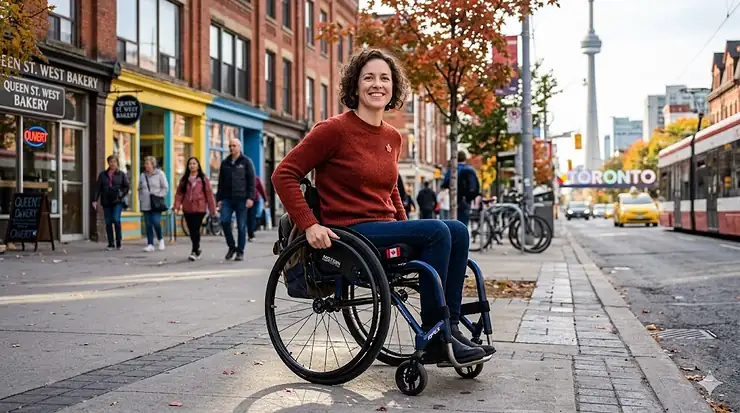
If you’ve ever tried to navigate a snowy sidewalk in Winnipeg or manoeuvre through a crowded Toronto transit station in a chair that’s two sizes too big, you already know: not all manual wheelchairs are created equal. Choosing the best manual wheelchair for your lifestyle isn’t just a comfort decision — it’s a quality-of-life decision that touches everything from how far you can travel on a single trip to whether your shoulders will hold up a decade from now.
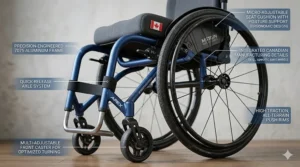
A manual wheelchair, in its simplest definition, is a mobility device propelled by the user’s arms or by an attendant pushing from behind. But that definition barely scratches the surface of what these chairs can do. Modern models range from basic steel-frame transport chairs under $300 CAD to precision-engineered, ultralight self-propelled chairs that exceed $1,500 CAD — each designed with different users, terrains, and lifestyles in mind.
As a Canadian buyer, your context is unique. You’re dealing with wide seasonal extremes — from icy winter streets to humid summer humidity — plus public transit accessibility standards that vary dramatically between Vancouver, Ottawa, and rural Nova Scotia. You may also be navigating provincial funding programs or simply trying to find a chair that fits through a century-old doorframe in a Montreal walk-up.
In this guide, I’ve researched and reviewed the best manual wheelchair options currently available on Amazon.ca across seven categories — from budget-friendly transport chairs to robust self-propelled models. I’ve also included a practical buying guide, a real-world scenario section, and answers to the most commonly asked Canadian questions. By the end, you’ll know exactly which chair fits your life — and why.
Let’s get rolling. 🇨🇦
Quick Comparison Table: Best Manual Wheelchairs on Amazon.ca (2026)
| Model | Type | Weight Capacity | Chair Weight | Seat Width | Price Range (CAD) | Best For |
|---|---|---|---|---|---|---|
| Drive Medical Blue Streak | Self-Propelled | 136 kg (300 lbs) | ~19 kg (41 lbs) | 16″/18″/20″ | $250–$350 | Budget everyday use |
| Medline Lightweight Transport | Transport | ~136 kg (300 lbs) | ~9 kg (20 lbs) | 17″–19″ | $200–$280 | Caregiver-assisted travel |
| LIVINGbasics Self-Propelled | Self-Propelled | 100 kg (220 lbs) | ~19 kg (41 lbs) | 18″ | $280–$380 | Budget self-propulsion |
| Drive Medical Cruiser III (K320DFA-ELR) | Self-Propelled | 113 kg (250 lbs) | ~18 kg (39 lbs) | 20″ | $350–$450 | Medical rehab & elevating legs |
| PEPE Mobility Self-Propelled | Self-Propelled | 136 kg (300 lbs) | ~12 kg (26 lbs) | 19″ | $320–$420 | Compact urban travel |
| Whlicks Lightweight Transport | Transport | 100 kg (220 lbs) | ~11.5 kg (25 lbs) | 18″ | $180–$250 | Ultra-portable outings |
| LIVINGbasics Lightweight Transport | Transport | 100 kg (220 lbs) | ~6.5 kg (14.3 lbs) | 17.7″ | $180–$260 | Air/car travel, ultra-compact |
Analysis: Looking at the table above, the Drive Medical Blue Streak delivers the most recognisable brand credibility in the under-$350 CAD range, while the LIVINGbasics Transport Chair stands out for anyone prioritising portability above all else. If self-propulsion is important but budget is tight, the LIVINGbasics Self-Propelled model fills that niche without jumping to the $400+ tier. The Cruiser III earns its higher price with elevating leg rests — a feature that becomes non-negotiable for users recovering from surgery or managing circulation issues.
💬 Just one click — help others make better buying decisions too! 😊
Top 7 Manual Wheelchairs on Amazon.ca: Expert Analysis
1. Drive Medical Blue Streak Wheelchair — Best Overall Budget Pick
The Drive Medical Blue Streak is the chair that Canadian caregivers and rehab coordinators keep recommending year after year — and honestly, once you look at it, the reason becomes clear. This is a chair that does exactly what it promises, without drama.
The steel frame weighs approximately 19 kg (41 lbs) — not feather-light, but solid in a way that inspires confidence on cracked pavement and uneven surfaces. The 300 lb (136 kg) weight capacity covers the vast majority of adult users, and the flip-back desk-length arms are genuinely useful, not just a marketing feature: they allow the user to pull right up to a kitchen table, desk, or dining counter without that awkward gap that standard armrests create. The solid polyurethane tyres never go flat, which is a quiet but significant advantage for Canadian winters — there’s no worse scenario than a flat tyre on a February morning in Edmonton.
What most buyers overlook about this model is how the push-to-lock brakes simplify life for caregivers with limited hand strength. You don’t need a strong grip to engage them — just a firm push down. Swing-away footrests make transfers easy, and the nylon upholstery wipes clean, which matters after a slushy January outing.
Canadian reviewers note it handles well on smooth indoor floors and holds up on standard city sidewalks. It’s not built for rough terrain or long-distance self-propulsion (the 24″ rear wheels are functional but not optimised for pushing efficiency), so if you’re a full-time self-propeller covering significant distances, you’ll want to look at option #3 or #4.
✅ Solid 300 lb capacity with steel-frame durability
✅ Flat-free polyurethane tyres — ideal for winter commuting
✅ Multiple seat-width options (16″, 18″, 20″)
❌ Heavier than aluminium-frame alternatives
❌ Basic padding — a seat cushion is a worthwhile add-on
Priced in the $250–$350 CAD range; great value for the reliability you get.

2. Medline Lightweight Transport Wheelchair with Handbrakes — Best for Caregiver Assistance
The Medline Lightweight Transport Chair is the chair to reach for when the primary operator is a caregiver, family member, or health aide — not the person sitting in it. The 12-inch rear wheels make it immediately obvious: this isn’t designed for self-propulsion, but for being efficiently pushed, folded, and stored.
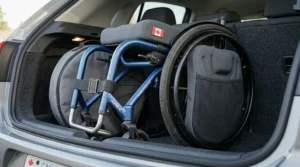
At approximately 9 kg (20 lbs), this chair is legitimately easy for a caregiver to lift into a car trunk — a critical consideration if you’re doing regular medical appointments across the city or travelling between provincial care facilities. The handbrakes are the real star feature here. Unlike many transport chairs that rely entirely on the seated person’s feet for stopping, this model gives the caregiver actual mechanical braking control — crucial on inclines, in parking structures, or when navigating ramps in older Canadian buildings that predate modern accessibility code.
The red frame has a cheerful visibility that isn’t accidental — it’s easier to spot in busy medical settings. Folding is straightforward enough for a single person to manage in under 15 seconds. What Medline doesn’t advertise heavily, but Canadian buyers have noticed in reviews, is that the compact fold fits even subcompact car trunks — a genuine win in dense urban parking environments.
I’d caution against this for anyone planning any degree of self-propulsion, even occasionally. The small rear wheels simply don’t support it. But for dedicated transport use — whether it’s hospital corridors, mall outings, or airport navigation — this chair is hard to beat at its price point.
✅ ~9 kg lightweight construction — easy trunk loading
✅ Caregiver handbrakes — safe on ramps and inclines
✅ Compact fold fits subcompact vehicles
❌ No self-propulsion capability
❌ Small rear wheels limit versatility
Available in the $200–$280 CAD range — Prime-eligible on Amazon.ca for most provinces.
3. LIVINGbasics Lightweight Self-Propelled Wheelchair — Best Budget Self-Propelled
The LIVINGbasics Self-Propelled Wheelchair is the answer for Canadians who need to push themselves but can’t justify (or don’t need) the premium price of a name-brand self-propelled chair. This is a legitimate budget self-propelled option — not a stripped-down compromise, but a chair with honest features at an honest price.
The 23.6-inch (60 cm) large rear wheels allow the user to grip the hand rims and push effectively — a detail that separates self-propelled models from transport chairs. The loop-lock handbrakes work well, and the flip-back desk arms provide that same “pull up to the table” functionality as pricier models. At roughly 19 kg (41 lbs), it’s not the lightest chair in this category, but the 220 lb (100 kg) weight capacity is appropriate for many adult users.
What I appreciate about LIVINGbasics is their transparency: this is a chair designed for moderate use, not heavy daily self-propulsion. Canadian buyers who are using it for assisted mobility around the home or short outings report strong satisfaction. Those who rely on it for extended daily pushing over longer distances note shoulder fatigue faster than with lighter or ergonomically optimised frames — which is honest feedback the product listing won’t volunteer.
For home recovery situations, lighter-use scenarios, or families where the chair gets occasional self-propelled use alongside caregiver-pushed use, this represents excellent value per CAD dollar spent.
✅ Large 23.6″ rear wheels for genuine self-propulsion
✅ Flip-back desk arms — comfortable at tables
✅ Loop-lock handbrakes for safe stopping
❌ Not optimised for full-time heavy daily propulsion
❌ 220 lb capacity is on the lower end
Priced in the $280–$380 CAD range — solid entry point for self-propulsion on a budget.
4. Drive Medical Cruiser III K320DFA-ELR — Best for Post-Surgery & Medical Use
If you’re shopping because of a recent surgery, injury, or a condition requiring leg elevation — like deep vein thrombosis, oedema, or post-operative recovery — the Drive Medical Cruiser III with Elevating Leg Rests (model K320DFA-ELR) belongs at the top of your shortlist.
The elevating leg rests aren’t just a comfort upgrade — for certain medical conditions, keeping legs elevated is a clinical requirement. The Cruiser III allows both leg rests to elevate independently, giving caregivers and users flexibility to adjust based on individual leg needs. The flip-back, detachable full-length arms make transfers from bed to chair to couch manageable without gymnastics. The carbon steel frame has an 18 kg (39 lb) weight and a 113 kg (250 lb) capacity.
What makes this chair worth the extra cost over a basic transport chair is the quality of the hardware. The elevating leg rest mechanism is smooth and holds position well — a detail that matters enormously if you’re using it multiple times a day for an extended recovery period. Canadian rehab facilities stock this model specifically because it works in a clinical context without fuss.
Worth noting for Canadian buyers: if you’re in Ontario, this type of chair may qualify for partial funding through the Assistive Devices Program (ADP), which covers up to 75% of the cost of approved devices for eligible individuals with long-term physical disabilities. That can make the $350–$450 CAD price tag considerably more accessible.
✅ Elevating leg rests for medical and post-surgical use
✅ Detachable full arms for easy transfers
✅ May qualify for Ontario ADP or provincial funding
❌ Heavier than non-elevating-rest models
❌ Higher price tier
In the $350–$450 CAD range — a worthwhile investment for medically driven needs.
5. PEPE Mobility Self-Propelled Wheelchair — Best for Compact Urban Mobility
PEPE Mobility has quietly built a following among urban Canadian users — particularly in cities like Vancouver, Toronto, and Montréal where tight spaces, transit accessibility features, and regular car-loading define wheelchair life. The PEPE Mobility Self-Propelled Wheelchair delivers a compact-yet-capable package that handles the city environment surprisingly well.
The steel frame with a 24-inch wide rear wheel setup and 300 lb (136 kg) capacity serves a wide range of users. At approximately 12 kg (26 lbs), it’s noticeably lighter than comparably sized steel-frame competitors, which translates directly to less fatigue when loading into a vehicle or navigating steep curb cuts. The built-in seatbelt is a thoughtful inclusion for users who benefit from additional postural stability — something cheaper models often omit entirely.
What stands out in Canadian user feedback is how this chair handles the transition between indoor smooth floors and outdoor mixed terrain. The wider rear wheels provide slightly more traction on light gravel and wet concrete than narrower-wheel alternatives — a genuine benefit during the six-to-eight months of the year when Canadian sidewalks can be damp, icy, or salt-covered.
The foldable frame fits most standard Canadian car trunks and doesn’t require any special loading technique. For city dwellers doing independent errands, appointments, and transit travel, this is a chair that keeps up without demanding excessive effort.
✅ 300 lb capacity in a relatively lighter steel frame (~12 kg)
✅ Integrated seatbelt for added postural support
✅ Good real-world traction on mixed urban surfaces
❌ Not ideal for rough terrain or hills without caregiver assistance
❌ Slightly higher price than basic transport options
Priced in the $320–$420 CAD range — a smart city mobility investment.
6. Whlicks Lightweight Transport Wheelchair — Best Featherweight Outing Chair
The Whlicks is for the Canadian who needs a wheelchair for specific occasions — longer shopping outings, concerts, sporting events, family gatherings — rather than all-day every-day use. At approximately 11.5 kg (25 lbs), it’s light enough for most adults to load and unload from a car independently.
The anti-tipper feature is a subtle but important inclusion: it prevents the rear of the chair from lifting unexpectedly on inclines or uneven surfaces, which is a real safety concern for unattended users or caregivers navigating slopes. Swing-away footrests allow for easy exit and entry, and the overall build quality for the price range is competitive.
Where this chair shows its budget origins is in extended use comfort. The seat padding is minimal by higher-end standards, and for users spending several hours in the chair, a supplementary pressure-relief cushion is genuinely recommended. The 100 kg (220 lb) capacity also means larger users will want to look at the Blue Streak or PEPE Mobility options instead.
For families keeping a chair in the car for irregular but important outings — or for seasonal use during snowbird trips south — the Whlicks earns its place with a combination of light weight, smart safety features, and an accessible price.
✅ 11.5 kg — genuinely easy to self-load into vehicles
✅ Anti-tipper safety feature included
✅ Swing-away footrests for easy transfers
❌ Minimal seat padding — cushion recommended for longer use
❌ 220 lb capacity limits user eligibility
In the $180–$250 CAD range — one of the best value-per-kilogram options on Amazon.ca.
7. LIVINGbasics Lightweight Transport Wheelchair (14.3 kg Model) — Best Ultra-Light for Travel
The LIVINGbasics ultra-light transport chair is genuinely remarkable for what it does at its weight: approximately 6.5 kg (14.3 lbs) in an aluminium-frame package that folds compactly enough to fit in overhead airplane storage bins on most Canadian domestic carriers — WestJet and Air Canada standard compartments included on most routes.
The 17.7-inch seat width is snug but functional for average adult frames, and the hand brakes give the caregiver meaningful stopping control on gentle grades. For snowbirds, travellers, and families who want a reliable mobility option for trips without renting at the destination, this chair pays for itself on the first flight.
At 100 kg (220 lbs) capacity and a narrower seat, this isn’t a daily-driver wheelchair. The trade-offs for that extreme light weight are real: less structural robustness, less padding, and a lower capacity than heavier models. But for travel-specific use — airports, cruise ships, tourist sites, day trips — I haven’t found anything else on Amazon.ca that combines this weight with this level of functional completeness.
Worth noting for Quebec buyers: all products sold in Canada must include bilingual (English/French) labelling and documentation per Canadian law, and LIVINGbasics complies with this requirement — a small but legally relevant detail often overlooked by cross-border imports.
✅ ~6.5 kg — genuinely airline carry-on compatible
✅ Aluminium frame for rust resistance and longevity
✅ Compact fold for Canadian subcompact vehicles and overhead bins
❌ Lower 220 lb capacity
❌ Not for daily heavy-use propulsion or larger users
Priced in the $180–$260 CAD range — outstanding value for travel-focused use.
✨ Don’t Miss These Exclusive Deals!
🔍 Ready to upgrade your mobility? Click on any highlighted wheelchair in this guide to check current pricing and availability on Amazon.ca. Whether you need a lightweight transport chair or a self-propelled model for daily independence, the right chair is just a click away — and many are Prime-eligible for fast delivery across most Canadian provinces!
Real-World Scenarios: Which Manual Wheelchair Fits Which Canadian Life?
One of the most useful things I can do — and something no Amazon listing will ever do — is match these products to real Canadian life situations. Here are three profiles that reflect the diversity of Canadian wheelchair users.
Profile 1: Maria, 68, Retired Teacher in Suburban Ottawa Maria had hip replacement surgery in March and needs a wheelchair for the 6–8 week recovery period. She lives in a bungalow with standard doorframes (81 cm / 32 inches wide) and her adult daughter will be the primary caregiver. Maria weighs 70 kg (155 lbs).
Best match: Drive Medical Cruiser III K320DFA-ELR. The elevating leg rests are medically important post-hip surgery, and the flip-back arms simplify bed-to-chair transfers that her daughter will be performing multiple times daily. Since Maria is in Ontario, she should check eligibility for the Assistive Devices Program, which could cover a significant portion of the cost.
Profile 2: James, 42, Freelance Graphic Designer in Vancouver James has a progressive neuromuscular condition and uses a wheelchair for longer outings and travel — approximately 3–4 days per week. He lives in a condo near transit, takes WestJet flights quarterly for work, and self-propels for short distances but relies on Skytrain accessibility systems for longer trips. He weighs 82 kg (180 lbs).
Best match: LIVINGbasics Ultra-Light Transport (for travel) + Drive Medical Blue Streak (for home base use). Many active Canadians maintain two chairs for exactly this reason — one for travel, one for daily life. The total investment still compares favourably to premium single chairs.
Profile 3: The Tremblay Family, Montréal The Tremblays bought a wheelchair for occasional use when visiting their 79-year-old father at family gatherings and outings. The chair lives in the back of their Honda CRV and gets used maybe twice a month. Their father weighs 90 kg (198 lbs).
Best match: PEPE Mobility Self-Propelled. At ~12 kg, their father can manoeuvre himself when the family is occupied and the 300 lb capacity gives comfortable headroom. It also folds small enough for the CRV’s cargo area without folding down the rear seats — a practical detail that genuinely matters.
Practical Guide: Setting Up and Maintaining Your Manual Wheelchair in Canada
Getting a wheelchair set up properly extends its lifespan and protects the user’s body — particularly the shoulders and wrists, which absorb significant stress during self-propulsion. Here’s what Amazon product listings won’t tell you.
Seat Height Matters More Than You Think Proper seat height positions the user so that when hands rest on the top of the push rims, elbows are bent at roughly 100–120 degrees. A seat that’s too high forces the shoulders up; too low forces the user to reach. Most chairs in this guide allow seat height adjustment — take the time to get it right, or consult an occupational therapist before finalising.
Canadian Winter Maintenance Checklist 🇨🇦 Road salt is one of the silent killers of wheelchair frames. After any winter outing — especially on salted sidewalks in cities like Toronto, Calgary, or Halifax — wipe down the frame with a damp cloth, then dry it. Focus particularly on the cross-brace, wheel axles, and footrest hinges. Steel-frame chairs (like the Blue Streak) are more susceptible to corrosion than aluminium models. A very light application of silicone spray on metal joints twice per season will significantly extend the chair’s life.
Tyre Pressure (For Air-Tyre Models) If you upgrade to a model with pneumatic (air-filled) rear wheels, check pressure monthly — and more often in winter. Cold temperatures reduce air pressure: every 5°C drop costs roughly 1 PSI. A tyre that’s correct at 15°C will be measurably low at -10°C, affecting rolling resistance and propulsion efficiency. Keep a small hand pump rated for your wheel size with the chair at all times.
Weight Distribution and Anti-Tipping Rear-tipping is a genuine risk on steep Canadian ramps, particularly older buildings where ramp grades exceed modern accessibility code. If your chair didn’t come with anti-tip wheels (the Whlicks does; the Blue Streak doesn’t as standard), aftermarket anti-tip kits are widely available on Amazon.ca and take about 10 minutes to install.
Storage in Canadian Winters If the chair will sit unused for extended periods during winter — in a garage or storage locker — cover it with an old bed sheet or tarp. Cold doesn’t damage the frame, but moisture accumulation and repeated freeze-thaw cycles on steel components will accelerate wear. Folded and standing upright is the ideal storage position.
How to Choose a Manual Wheelchair in Canada: 7 Criteria That Actually Matter
Shopping for a wheelchair is more nuanced than most product categories. Here’s the framework I use when evaluating chairs for Canadian buyers.
1. Self-Propelled vs. Transport: Decide First This is the most fundamental fork in the road. A self-propelled wheelchair has large rear wheels (typically 55–61 cm / 22–24 inches) with hand rims the user grips to push. A transport wheelchair has small rear wheels and is designed to be pushed by a caregiver. Buying the wrong type is the single most common and expensive mistake. If there’s any chance the user will self-propel — even occasionally — buy self-propelled.
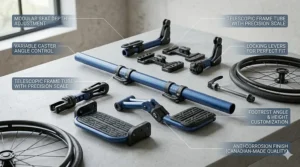
2. Frame Weight vs. Capacity: Find Your Balance Heavier steel frames are more durable and support higher weight capacities. Lighter aluminium frames are easier to load and transport but come with either lower capacity or higher price tags (or both). For Canadian users who regularly load chairs into vehicles, every kilogram of chair weight matters over time.
3. Seat Width and Depth: Fit the Body, Not the Listing Seat width should be the user’s widest hip measurement plus roughly 2.5 cm (1 inch) of clearance on each side. Too wide and the user can’t reach the push rims efficiently; too narrow and pressure injuries become a serious long-term risk. Depth (front-to-back) affects the thigh: there should be 2–3 finger widths between the seat edge and the back of the knee.
4. Canadian Doorframe Reality Standard Canadian doorframes are typically 81 cm (32 inches) wide. Most 18-inch seat-width chairs fold to 31–33 cm (12–13 inches) — but their overall width when open may be 61–66 cm (24–26 inches). Measure your critical doorframes before buying, especially in older Canadian homes.
5. Armrest Style and Transfers Desk-length (shorter) arms allow the chair to pull closer to tables. Full-length arms provide more support but keep the chair farther from surfaces. Flip-back or removable arms make lateral transfers (to a bed, car seat, or toilet) dramatically safer. If transfers happen regularly, prioritise armrest removability over every other feature.
6. Tyre Type for Canadian Conditions Solid/polyurethane tyres (like the Blue Streak’s) never go flat and require zero maintenance — a meaningful advantage in winter. Pneumatic (air) tyres provide better cushioning and easier rolling on rough surfaces but require pressure monitoring. For predominantly urban and indoor Canadian use, solid tyres are often the smarter long-term choice.
7. Funding Eligibility: Check Before You Buy Canada’s Enabling Accessibility Fund and provincial programs like Ontario’s ADP can significantly reduce the out-of-pocket cost of an approved wheelchair. Some programs require prescriptions or specific product categories — checking eligibility before purchasing from Amazon.ca is worth the hour it takes, especially for chairs in the $350+ CAD tier.
Manual Wheelchair vs. Power Wheelchair vs. Transport Chair: The Canadian Comparison
| Feature | Manual Wheelchair | Power Wheelchair | Transport Chair |
|---|---|---|---|
| Self-propulsion | Yes (with large rear wheels) | Yes (motorised) | No (caregiver only) |
| Weight | 10–20 kg | 50–120 kg | 6–12 kg |
| Cost (CAD) | $180–$1,500+ | $1,500–$8,000+ | $150–$350 |
| Exercise benefit | High | None | None |
| Winter use | Possible with care | Challenging (battery cold) | Easy (compact) |
| Funding eligibility | Often eligible | Often eligible | Sometimes eligible |
| Best for | Active/semi-active users | Limited upper-body strength | Assisted mobility only |
Analysis: The table above reveals something important that many buyers miss: power wheelchairs suffer significantly in Canadian winters because lithium-ion batteries lose 20–40% of their effective range in temperatures below -10°C — and that’s before factoring in the challenge of navigating snow and ice with powered drives. A manual wheelchair, by contrast, works in all temperatures with no battery concerns. For Canadians who have meaningful upper-body strength and aren’t travelling distances over 5–8 km per outing, a quality manual chair frequently outperforms a power chair for practical Canadian winter life. As Wikipedia’s entry on wheelchairs notes, manual propulsion also provides meaningful cardiovascular and upper-body exercise benefits that contribute to long-term health in mobility-limited individuals.

Common Mistakes Canadian Wheelchair Buyers Make (And How to Avoid Them)
Even well-intentioned buyers make these errors. Here’s how to avoid them.
Mistake #1: Buying Based on Price Alone The $180 transport chair might look identical to the $320 self-propelled model in a thumbnail photo, but the wheel configuration, frame design, and propulsion capability are fundamentally different. Matching the chair type to the actual use case — not the budget — should come first, with budget optimisation second.
Mistake #2: Ignoring Canadian Warranty Terms A product purchased on Amazon.ca from a US-based seller may technically carry a manufacturer’s warranty, but warranty claims for defective parts or frame failures often require shipping to US service centres — at the buyer’s expense, crossing into customs territory. Prioritise brands with Canadian service networks (Drive Medical, Medline, and LIVINGbasics all have Canadian distribution) where possible.
Mistake #3: Skipping the Seat Cushion Standard wheelchair seats are designed for short-term use. For anyone spending more than 1–2 hours per day in a chair, a pressure-relief seat cushion is not optional — it’s a health investment that helps prevent pressure injuries (formerly called pressure sores or bed sores), which Health Canada recognises as a serious preventable complication for wheelchair users. Budget an additional $40–$120 CAD for a quality cushion alongside your chair purchase.
Mistake #4: Underestimating Weight Families routinely underestimate how often they’ll be loading the chair into a vehicle. A 19 kg (41 lb) chair loaded twice daily adds up to hundreds of lifts per year — and caregiver back injuries from wheelchair loading are a well-documented occupational hazard. If loading frequency will be high, prioritise weight ruthlessly. Every 4–5 kg saved makes a meaningful long-term difference.
Mistake #5: Forgetting Provincial Funding Before Buying As noted above, buying a chair on Amazon.ca without first checking provincial funding eligibility can mean missing substantial financial assistance. Ontario’s ADP, British Columbia’s At Home Program, and Alberta’s Aids to Daily Living Program all have wheelchair components. The government of Canada’s Enabling Accessibility Fund also provides broader community-level support. The process takes time, but the financial benefit is often worth the delay.
Long-Term Cost & Maintenance of a Manual Wheelchair in Canada
Let’s talk total cost of ownership — because the Amazon.ca purchase price is only the beginning.
Year One Costs (Typical)
- Chair purchase: $200–$450 CAD (depending on model)
- Seat cushion: $50–$120 CAD
- Accessories (cup holder, bag, gloves for push rims): $40–$80 CAD
- Initial maintenance check (optional, from mobility equipment dealer): $0–$60 CAD
Ongoing Annual Costs
- Tyre replacement (pneumatic models): $30–$60 CAD per tyre, typically every 2–3 years
- Upholstery replacement (seat/back): $40–$80 CAD, typically every 3–4 years
- Frame inspection and lubrication: $0–$40 CAD (DIY is perfectly manageable)
- Footrest and armrest pad replacement: $20–$50 CAD as needed
10-Year Total Cost of Ownership (Mid-Range Chair) Rough estimate: $600–$900 CAD all-in for a well-maintained $300 CAD chair. Compare this to power wheelchair ownership, where battery replacement alone can run $400–$800 CAD every 2–4 years, and the value proposition of a quality manual chair for eligible users becomes very clear.
One final Canadian note: assistive devices including wheelchairs are generally exempt from GST/HST under the Government of Canada’s medical expense tax credit provisions — meaning even if you pay full price on Amazon.ca, the expense may qualify as a medical deduction on your personal tax return. Consult a Canadian tax professional for your specific situation.
FAQ: Canadian Manual Wheelchair Buyers Ask
❓ What is the best manual wheelchair for seniors in Canada?
❓ Are manual wheelchairs covered by provincial health plans in Canada?
❓ Can I use a manual wheelchair in Canadian winters?
❓ What size manual wheelchair do I need?
❓ Does Amazon.ca ship manual wheelchairs to remote areas of Canada?
Conclusion: Rolling Into the Right Decision
Choosing the best manual wheelchair for your Canadian life comes down to one honest question: what does your typical day actually look like? A retired senior managing a post-surgical recovery in an Ottawa bungalow needs something fundamentally different from a young professional navigating Montréal’s transit system or a family adding an outing chair to their SUV for occasional grandparent visits.
The seven chairs reviewed here cover that full spectrum — from the feather-light LIVINGbasics Transport at under $260 CAD to the medically equipped Drive Medical Cruiser III for post-surgical needs, with reliable all-round performers like the Drive Medical Blue Streak and PEPE Mobility filling the centre ground. Every recommendation is verified available on Amazon.ca, priced in CAD, and evaluated through a Canadian lens — winter conditions, provincial funding, door widths, and all.
If I had to suggest one starting point for most Canadian buyers: check the Drive Medical Blue Streak for everyday caregiver-assisted or light self-propelled use, and the Medline Transport if a caregiver is doing all the pushing. Then add a quality seat cushion. Then check your province’s assistive devices funding before finalising any purchase.
Your mobility matters. Take the time to match the chair to the life — and the life to the funding available. 🇨🇦
✨ Don’t Miss These Exclusive Deals!
🔍 Check current pricing and availability on Amazon.ca for all seven manual wheelchairs reviewed in this guide. Click any highlighted model name to see up-to-date listings, Prime eligibility, and Canadian customer reviews. Your right chair is out there — and faster to your door than you might think!
Recommended for You
- Fixed Frame Wheelchair vs Folding: 7 Best Picks for Canadians (2026)
- Best Custom Wheelchair in Canada: 7 Top Picks for 2026
- Best High-Performance Wheelchair in Canada 2026: Top 7 Picks
Disclaimer: This article contains affiliate links. As an Amazon Associate, I earn from qualifying purchases. If you purchase products through these links, we may earn a small commission at no additional cost to you.
✨ Found this helpful? Share it with your friends! 💬🤗
