

In This Article
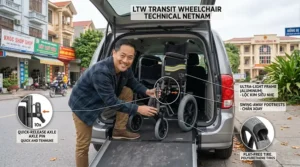
Here’s a scene that plays out in driveways across the country every single day: a caregiver hoists a 30-pound steel wheelchair into a trunk, throws out their back a little more each time, and wonders if there’s a better way. There is. A lightweight transit wheelchair — sometimes called a transport chair — is a compact, caregiver-propelled chair built around four smaller wheels instead of the large self-propelling wheels you’d find on a standard manual wheelchair. That difference in wheel size is exactly what shaves ten, fifteen, even twenty pounds off the frame.

If you’re shopping for a parent who’s recovering from hip surgery, a spouse who tires quickly on long outings, or you’re a caregiver who needs something you can lift solo, the lightweight category is where you want to be looking. This guide breaks down seven real, currently available options — from a 13.5-pound featherweight frame to a dependable 24-pound budget pick — with honest analysis of who each one actually suits. We’ll also cover how Canada’s medical and assistive devices are treated for tax purposes, what “attendant weight limit” really means on a spec sheet, and the mistakes that trip up first-time buyers. No fluff, no invented reviews — just what the research actually shows.
What Is a Lightweight Transit Wheelchair?
A lightweight transit wheelchair is a folding, caregiver-pushed mobility chair with four small wheels (typically 6-8 inches front, 8-12 inches rear) and a frame weight usually under 25 lbs, designed for short trips, appointments, and travel rather than full-time independent use. Unlike standard wheelchairs, the occupant cannot self-propel; a companion pushes from behind.
That last point trips a lot of first-time buyers up. If the person using the chair wants to wheel themselves around the block, a transit chair isn’t the right tool — you’d want a self-propelling lightweight wheelchair with 22-24 inch rear wheels instead (the FeatherMobility Feather Chair further down this list actually straddles both categories). But for getting someone from the parking lot to a restaurant table, or through an airport terminal, the transit chair’s smaller footprint and lighter build win every time.
Quick Comparison Table
| Product | Frame Weight | Weight Capacity | Price Range (CAD) | Best For |
|---|---|---|---|---|
| Karman LT-980 | 13 lb frame / 24 lb total | 250 lb | C$550–C$680 | Tightest budget |
| Medline Ultralight Transport Chair | 14.8 lb | 300 lb | C$400–C$520 | Best value overall |
| Drive Medical Fly-Lite | 16.2–16.8 lb | 300 lb | C$430–C$560 | Trusted mid-range brand |
| NOVA Ultra Lightweight 330R | 18.75 lb | 300 lb | C$380–C$500 | Everyday reliability |
| Vive Lightweight Folding Transport Wheelchair | 23 lb | 300 lb | C$300–C$420 | Wider 19″ seat |
| FeatherMobility Feather Chair | 13.5 lb frame / 19 lb total | 250–300 lb | C$950–C$1,250 | Ultra-premium, lightest overall |
| Journey So-Lite C2 | 14–24 lb (see notes) | 240–250 lb | C$850–C$1,150 | Active seniors, curb climbing |
A quick scan of this table tells a useful story: the lightest frame weight doesn’t always come with the lowest price tag, and the two products claiming “13-something pounds” measure that figure differently — one as a bare frame, one including wheels. Budget-focused buyers will find the Medline Ultralight hard to beat on a pounds-per-dollar basis, while anyone prioritizing raw portability over cost should look toward the Feather Chair or Journey So-Lite C2. We’ll unpack exactly why in the sections below.
💬 Just one click — help others make better buying decisions too!😊
Top 7 Lightweight Transit Wheelchairs: Expert Analysis
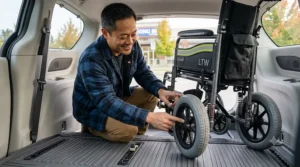
1. Karman LT-980 Ultra Lightweight Wheelchair — lightest frame at the lowest price
The LT-980’s headline number is its 13-pound frame weight, though the fully assembled chair with footrests and wheels lands closer to 24 lbs — a distinction Karman is upfront about, and one buyers should factor into any “under 20 lbs” comparison.
Built from aircraft-grade aluminum with an 18-inch seat, the LT-980 keeps costs down by limiting adjustability: footrest height is about the only thing you can customize, and taller users (over roughly six feet) may find legroom tight even at maximum extension. The non-marking polyurethane wheels are optimized for indoor and carpeted use rather than gravel driveways or rough sidewalks.
Based on the spec comparison, this chair earns its keep as an entry point into the ultralight category rather than a do-everything solution. It’s best suited to buyers who need occasional, short-distance transport — a chair that lives in a closet and comes out for doctor visits — rather than daily heavy use. Reviewers on retailer sites consistently describe the brakes and hardware as solid for the price, while a recurring theme in aggregated feedback is that comfort tapers off after four to five hours of continuous sitting, which lines up with its “light-to-moderate duty” positioning from the manufacturer itself.
Pros:
- ✅ Among the lightest frames in its price tier
- ✅ Lifetime warranty on the main frame
- ✅ Simple, low-maintenance design with few failure points
Cons:
- ❌ Limited adjustability beyond footrest height
- ❌ Comfort declines on extended outings
Expect the LT-980 to fall in the C$550–C$680 range at the time of research; check current price before buying, as availability shifts. For the money, it’s a reasonable entry-level pick if your trips are short and your budget is firm.
2. Medline Ultralight Transport Chair — best all-around value
At roughly 14.8 lbs, the Medline Ultralight undercuts nearly every competitor on this list for weight while still carrying a 300-lb capacity — a combination that’s genuinely hard to find elsewhere. The 19-inch-wide seat with 16-inch depth accommodates a broader range of body types than the narrower Karman above.
What most buyers overlook about this model is the restaurant-style permanent desk arms, which let the seated person roll right up to a table or countertop — something swing-away armrests on cheaper transit chairs don’t do as gracefully. The rear storage pouch (holding a wallet, phone, or keys) is a small but genuinely useful touch that Amazon listings rarely highlight as a selling point, even though it solves a real daily annoyance.
Aggregated customer feedback across major retailers repeatedly praises how easy it is to lift into a trunk — several reviewers specifically mention it replacing a much heavier chair after a caregiver’s back gave out. On the downside, the smaller 6-inch front and 8-inch rear wheels aren’t built for gravel, grass, or anything beyond smooth pavement and indoor flooring.
Pros:
- ✅ Lightest frame-to-capacity ratio on this list
- ✅ Desk-length arms for comfortable table seating
- ✅ Built-in storage pouch for essentials
Cons:
- ❌ Small wheels struggle on rough terrain
- ❌ No hand brakes on some colour variants — check the listing
Pricing typically sits in the C$400–C$520 range at the time of research. Given the weight-to-capacity numbers, this is our pick for buyers who want the single best value in the category.
3. Drive Medical Fly-Lite Aluminum Transport Chair — best-known brand, dependable middle ground
Drive Medical has been manufacturing mobility equipment for more than two decades, and the Fly-Lite reflects that maturity: a 16.2–16.8 lb aluminum frame, tool-free height-adjustable swing-away footrests, and a limited lifetime warranty that’s meaningful precisely because the company has the longevity to honour it.
Here’s what the spec sheet won’t tell you outright: the “deluxe back release” mechanism — which lets the backrest fold down independently of the seat — genuinely does make the folded footprint noticeably smaller than competitors without it, which matters if trunk space is tight. Reviewers consistently mention that the plaid nylon upholstery, while polarizing stylistically, wipes clean easily and holds up to years of outdoor use without fraying.
A recurring criticism in aggregated review sentiment is that the hand brakes can feel stiff out of the box, though several users note this eases with a few weeks of regular use. For a caregiver who needs one competent chair from a company that will still be around in five years for parts and warranty service, the Fly-Lite is a safe, well-reasoned choice — neither the cheapest nor the lightest, but arguably the most balanced.
Pros:
- ✅ Strong brand reputation with 20+ years in mobility equipment
- ✅ Deluxe fold-down back for compact storage
- ✅ Limited lifetime warranty
Cons:
- ❌ Brakes can feel stiff initially
- ❌ Plaid upholstery styling won’t suit every taste
Price typically runs C$430–C$560 at the time of research. This is the chair to buy if brand trust and parts availability matter as much as raw weight.
4. NOVA Ultra Lightweight Transport Chair (330R) — reliable everyday workhorse
NOVA’s 330R lands at roughly 18.75 lbs, comfortably under the 20-lb threshold many attendant-chair shoppers use as their cutoff. The 18-inch seat and 8-inch wheels keep the profile compact, while padded swing-away footrests with heel loops add a comfort touch that budget competitors sometimes skip.
Based on the spec comparison, NOVA’s real differentiator is the quick-release fold-down back, which collapses the chair into a genuinely small package — useful for anyone with a compact car or limited closet space. The company also sells a 12-inch rear-wheel variant (the 353 model) for buyers who expect rougher terrain like gravel paths or uneven sidewalks, which is worth knowing about even though it’s a slightly heavier alternative within the same product family.
Aggregated feedback across retailers is generally positive on durability, with a common thread being that the chair “feels sturdier than its weight suggests” — a meaningful data point since light doesn’t always mean flimsy in this category. A minority of reviews flag the 300-lb weight capacity as optimistic for the frame’s actual build quality at the upper end of that range, so heavier users may want to size up to a bariatric-rated chair instead.
Pros:
- ✅ Solid sub-19-lb weight with 300 lb capacity
- ✅ Quick-release fold-down back for compact storage
- ✅ Padded footrests with heel loops
Cons:
- ❌ Small front wheels limit rough-terrain use
- ❌ Weight capacity feels optimistic near the upper limit
NOVA’s 330R generally sits in the C$380–C$500 range at the time of research, making it a strong middle-tier pick for everyday errands and appointments.
Attendant Chairs and Caregiver Reality
Before continuing through the remaining three chairs, it’s worth pausing on who’s actually doing the pushing. A caregiver push wheelchair lightweight enough to load solo isn’t a luxury — for family caregivers managing this without professional training, Canada’s occupational health authority publishes lifting guidance that applies just as much to loading a folded chair into a trunk as it does to a warehouse job. Bending at the knees rather than the waist when lifting a folded 15-lb chair sounds like overkill until you’re doing it twice a day, every day, for years.
5. Vive Lightweight Folding Transport Wheelchair — widest standard seat in this lineup
At around 23 lbs, the Vive model isn’t the lightest chair here, but it earns its spot with a 19-inch seat that’s roughly two inches wider than the Medline and Karman options above — a meaningful difference for larger-framed users who find narrower seats uncomfortable on longer outings.
The aluminum-frame version (distinct from Vive’s heavier steel model, so double-check the listing) ships pre-assembled, which reviewers repeatedly cite as a genuine time-saver compared to competitors that arrive partially disassembled. What the spec sheet doesn’t fully convey is how the 12-inch rear wheels compare to the 8-inch wheels on the Medline or NOVA: the larger diameter noticeably smooths out the ride over sidewalk cracks and door thresholds, at the cost of a few extra pounds.
Aggregated review sentiment highlights the padded armrests and backrest as more comfortable than typical entry-level chairs, with one recurring caregiver comment being that the extra seat width made a noticeable difference for a larger family member who found narrower transit chairs uncomfortable within twenty minutes.
Pros:
- ✅ Wider 19-inch seat for larger users
- ✅ Ships pre-assembled, no tools required
- ✅ Larger 12″ rear wheels smooth out the ride
Cons:
- ❌ Heavier than the Medline or NOVA options
- ❌ Steel-frame variant is easy to confuse with the lighter aluminum one
Expect C$300–C$420 at the time of research, positioning it as one of the more affordable options despite the wider seat and smoother ride.
6. FeatherMobility Feather Chair — the lightest chair money can buy
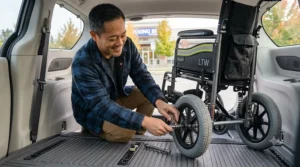
This is the chair that redefines what “lightweight” even means in this category. The frame alone weighs 13.5 lbs, and even with the quick-release rear wheels attached, total weight is about 19 lbs — genuinely close to half the weight of a traditional steel wheelchair, which typically runs 38-50 lbs.
Here’s what separates the Feather Chair from every other product on this list: it isn’t purely a transit chair. With its quick-release 20-24 inch rear wheels installed, the occupant can self-propel, making this a hybrid that functions as both an attendant-pushed transport chair and an independent manual wheelchair depending on the day’s needs. That flexibility explains the premium price tag. The magnesium-alloy-adjacent construction (proprietary aerospace materials, per the manufacturer) is genuinely a different engineering approach than the aluminum frames used by every other chair reviewed here.
Aggregated customer sentiment is strikingly consistent: reviewers across multiple retail sites describe it as transformative for caregivers in their 70s and 80s who could no longer manage a standard chair’s weight. One recurring theme is appreciation for how “practically anyone can lift this into a trunk,” a claim that lines up with the actual sub-20-lb spec rather than reading as marketing hyperbole.
Pros:
- ✅ Lightest chair in this entire comparison, by a wide margin
- ✅ Hybrid design allows both attendant push and self-propel
- ✅ Quick-release wheels for ultra-compact storage
Cons:
- ❌ Premium price relative to standard transit chairs
- ❌ Lower weight capacity (250-300 lb) than some steel-frame rivals
Pricing generally falls in the C$950–C$1,250 range at the time of research — a genuine investment, but one that reviewers consistently frame as worth it for the caregivers who need it most.
7. Journey So-Lite C2 Ultra Lightweight Wheelchair — lesser-known pick with active-senior features
Rounding out the list is a brand that flies under the radar compared to Medline or Drive Medical, but deserves consideration. Journey markets the So-Lite C2’s frame at 14 lbs using a military-grade magnesium alloy, though it’s worth noting — in the interest of honest reporting — that at least one verified buyer review flagged the fully assembled weight (with footrests) closer to 21.6 lbs, a discrepancy worth confirming directly with the retailer before purchase.
What genuinely sets this chair apart are the built-in curb climbers, a feature none of the other six chairs on this list offer. They let a caregiver tilt the chair back and roll over a curb or raised threshold with noticeably less effort than muscling a standard transit chair up the same obstacle — a detail that matters enormously for anyone navigating older sidewalks without curb cuts. The 20-inch rear wheels also allow limited self-propulsion, similar in spirit to the Feather Chair above.
Real-world traveller feedback (including a detailed account from a buyer who used the chair across cobblestone streets in Rome) consistently praises the smoother ride from the larger wheels, while flagging that front caster wheels can occasionally catch in wider gaps or uneven surfaces — worth knowing if your city still has a lot of older cobblestone or brick sidewalks.
Pros:
- ✅ Unique curb-climbing mechanism not found elsewhere on this list
- ✅ Magnesium frame construction
- ✅ 20-inch rear wheels support limited self-propulsion
Cons:
- ❌ Marketed frame weight and assembled weight differ meaningfully
- ❌ Front casters can catch on uneven or cobblestone surfaces
Expect C$850–C$1,150 at the time of research. This is a strong pick for active seniors who still navigate real-world obstacles like curbs and older sidewalks regularly.
How to Choose a Lightweight Transit Wheelchair
Narrowing seven solid options down to one comes down to a handful of decision points, roughly in priority order:
- Confirm who’s pushing, not just who’s sitting. If the occupant needs to self-propel occasionally, only the Feather Chair or Journey So-Lite C2 support that; the other five are strictly attendant-propelled.
- Weigh the folded chair yourself before assuming “lightweight” means “liftable.” A 24-lb chair with an awkward fold can feel heavier in practice than a well-balanced 19-lb chair.
- Match seat width to the person’s actual hip width, not a guess. An 18-inch seat that’s too narrow causes real discomfort on trips over 30 minutes.
- Check terrain realistically. Smooth sidewalks and indoor flooring favour 6-8 inch wheels; gravel, grass, or older neighbourhoods favour 12-inch rear wheels or curb-climbing designs.
- Decide your true budget ceiling before comparing features, since premium picks like the Feather Chair cost two to three times more than budget options for legitimate engineering reasons, not marketing markup.
- Verify weight capacity against the occupant’s actual weight with margin, not right at the limit — frames perform best well under their rated maximum.
- Ask about warranty length and parts availability, since a chair used several times a week will eventually need a wheel, brake cable, or upholstery replacement.
Practical Usage Guide: Setup, Maintenance & the First 30 Days
Most transit chairs arrive mostly assembled, but a few first-use habits prevent early problems. On day one, unfold the chair fully and engage both hand brakes before the first transfer — a step several manufacturers bury in step four or five of their instructions despite its safety importance. Check that swing-away footrests lock securely; a loose footrest is one of the more common early-ownership complaints in aggregated reviews.
For the first 30 days, inspect wheel bolts weekly, since new frames can loosen slightly as materials settle. Wipe down nylon upholstery with a mild soap solution rather than harsh cleaners, which can degrade the fabric’s water resistance over time. A mistake several first-time buyers make is folding the chair with the footrests still attached and extended, which stresses the hinge mechanism unnecessarily — always swing footrests away or remove them first.
Longer term, lubricate wheel axles every few months if the chair sees regular outdoor use, and store it somewhere dry; aluminum frames resist corrosion well, but steel-frame variants (like the standard Vive model, as opposed to its aluminum sibling) can develop surface rust in damp Canadian basements or garages over a few winters.
Real-World Scenarios: Matching the Chair to the Person
The caregiver who pushes daily. Consider a caregiver in their 60s managing a parent with limited mobility, using the chair for grocery trips and medical appointments several times a week, budget around C$500. The Medline Ultralight or NOVA 330R both fit this profile well — light enough to load solo, inexpensive enough that a warranty claim doesn’t sting, and simple enough to not require a learning curve.
The frequent flyer. Picture a retired couple who travel twice a year and need something that survives airport gate-checking without damage, budget flexible. The Drive Medical Fly-Lite’s proven durability and known brand recognition at airline counters make it a sensible pick; its deluxe fold-down back also minimizes bulk in overhead compartments or trunk space during ground transport.
The active senior navigating a real neighbourhood. For someone still fairly mobile but tiring on longer walks, living somewhere with older sidewalks, uneven curbs, or cobblestone areas, budget C$900-plus, the Journey So-Lite C2’s curb climbers or the Feather Chair’s hybrid self-propel capability both address terrain challenges that a basic transit chair simply can’t handle gracefully.
Problem → Solution: Common Transit Wheelchair Pain Points
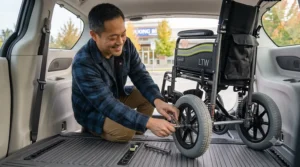
Problem: the chair is technically “lightweight” but still hard to lift into a trunk. Solution: prioritize chairs under 20 lbs with a genuinely compact folded footprint — the Medline Ultralight and Drive Fly-Lite both fold to under 11 inches wide, which matters as much as raw weight for an easy-to-lift wheelchair experience.
Problem: the occupant complains of discomfort after 20-30 minutes. Solution: check seat width against actual hip measurement, not the manufacturer’s general “adult sizing,” and consider an aftermarket gel cushion, which every chair here accepts without modification.
Problem: brakes feel stiff or unreliable. Solution: several models (notably the Fly-Lite) loosen up with regular use, but if stiffness persists past a few weeks, it typically indicates a cable adjustment issue covered under warranty rather than a design flaw.
Problem: the chair struggles on grass, gravel, or uneven sidewalks. Solution: upgrade to 12-inch rear wheels (Vive, NOVA 353) or a curb-climbing design (Journey So-Lite C2) rather than fighting a small-wheeled chair over terrain it wasn’t built for.
Problem: caregiver back strain from repeated lifting. Solution: beyond simply choosing a lighter chair, proper lifting technique matters as much as equipment choice — bend at the knees, keep the folded chair close to the body, and avoid twisting motions when loading a trunk.
Lightweight Transit Wheelchairs vs Traditional Wheelchairs
The core distinction comes down to wheel size and who does the propelling. Traditional manual wheelchairs use large 22-24 inch rear wheels with hand rims, letting the occupant move independently — but that same wheel size adds significant weight and bulk, typically pushing total chair weight to 35-50 lbs for a standard steel frame. Transit chairs trade that independence for portability: smaller wheels, lighter frames, and a design built around a caregiver pushing from behind.
| Feature | Lightweight Transit Wheelchair | Traditional Wheelchair |
|---|---|---|
| Typical weight | 13-24 lb | 35-50 lb |
| Self-propel capability | No (two hybrid exceptions above) | Yes |
| Best for | Short trips, travel, occasional use | Daily independent mobility |
| Folded footprint | Compact, trunk-friendly | Bulkier, often needs a larger vehicle |
The practical upshot: a transit chair genuinely isn’t a downgrade from a traditional wheelchair, it’s a different tool for a different job. Someone using a power wheelchair or standard manual chair full-time at home might still benefit from keeping a transit chair in the trunk specifically for outings where the primary chair is too heavy or bulky to bring along.
Common Mistakes When Buying a Lightweight Transit Wheelchair
The single most common error is fixating on the lowest advertised weight number without checking whether it refers to the bare frame or the fully assembled chair — as we saw with the Karman LT-980 and Journey So-Lite C2, those numbers can differ by 7-10 lbs. A second mistake is buying based on price alone and ending up with a seat too narrow for comfortable use, which often means the “bargain” gets replaced within a year anyway.
Buyers also frequently underestimate how much wheel size affects real-world usability; a chair that looks identical on a spec sheet to a competitor can feel dramatically different rolling over a door threshold or a slightly uneven sidewalk if the wheel diameter differs by even two inches. Finally, skipping the weight-capacity math is a recurring issue — buying a chair rated right at the occupant’s current weight, with no margin for winter coats or future weight changes, sets buyers up for premature wear or an uncomfortable fit.
Lightweight Attendant Wheelchairs Under 20 lbs: What the Weight Limits Really Mean
Two different weight numbers matter here, and manufacturers aren’t always consistent about which one they lead with. The frame weight (sometimes called dry weight) describes the bare chair without footrests, cushions, or occasionally even wheels — it’s the number brands use in marketing because it’s the smallest. The assembled weight, which is what you’ll actually lift, includes everything and is typically 15-30% heavier.
Of the seven chairs reviewed here, only the Medline Ultralight (14.8 lb) and the NOVA 330R (18.75 lb) genuinely qualify as a lightweight attendant wheelchair under 20 lbs using their real, assembled weight — a meaningful distinction for shoppers specifically hunting in that category. The Drive Fly-Lite comes close depending on which variant you buy (16.2 lb without footrests, 18.9 lb with them attached), so it’s worth checking the exact SKU before assuming it clears the 20-lb bar.
Separately, the attendant chair weight limit refers to occupant capacity, not frame weight — a different spec entirely, and one buyers occasionally confuse. Most chairs here cap out at 250-300 lbs of occupant capacity. As a rule of thumb, don’t buy right up to that ceiling; a chair rated for 300 lbs performs and lasts best when the actual user weight sits comfortably below that number, since manufacturers build in a safety margin rather than an everyday-use buffer.
Aluminum Transit Wheelchairs: Why Frame Material Matters
Every chair in this comparison except the Feather Chair and Journey So-Lite C2 (which use magnesium-alloy construction) is built from aluminum, and that’s not a coincidence. An aluminum transit wheelchair strikes the best available balance of strength-to-weight ratio at a manufacturing cost that keeps retail prices reasonable — magnesium is lighter still but considerably more expensive to work with, which is exactly why the two magnesium-frame chairs on this list carry premium price tags.
Steel-frame transit chairs still exist (Vive sells one alongside its aluminum model), and they’re worth mentioning honestly: steel is more dent-resistant and often cheaper, but the weight penalty — typically 8-10 lbs heavier than an equivalent aluminum design — usually outweighs the durability benefit for anyone prioritizing easy lifting. Reviewers consistently note that aluminum frames handle years of trunk-loading and outdoor exposure well, provided the chair isn’t stored somewhere consistently damp, which can eventually lead to minor surface corrosion at weld points even on aluminum.
Lightweight Transit Chairs for Seniors: What to Prioritize
Seniors shopping for themselves or a spouse have a slightly different priority list than caregivers buying for someone else. Ease of self-loading matters more if the senior is still doing some of their own driving and lifting, which pushes the Medline Ultralight or Feather Chair toward the top of the list purely on weight. Seat height also deserves attention: a chair that sits too low can make standing transfers genuinely difficult for someone with knee or hip arthritis, so checking the seat-to-floor measurement against a senior’s current chair or bed height is worth the extra five minutes.
Comfort over price becomes a more reasonable trade-off for seniors using the chair several times a week rather than a few times a year — the wider Vive seat or the Journey So-Lite C2’s curb-climbing capability may justify the extra cost if daily neighbourhood walks are part of the routine. For a senior who occasionally needs support at family gatherings or medical visits, a lightweight transit chair for seniors doesn’t need to be the premium tier; the Medline or NOVA options handle occasional use just as reliably at a fraction of the cost.
Long-Term Cost & Maintenance
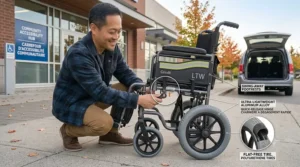
Sticker price only tells part of the story. Aluminum-frame chairs in the C$400-C$560 range typically need minimal upkeep beyond occasional wheel lubrication and upholstery cleaning, with most owners reporting five-plus years of service before any major part replacement. Premium magnesium-frame chairs, despite the higher upfront cost, often include stronger warranties (Journey and FeatherMobility both offer meaningful frame coverage) that offset some of that price gap over a multi-year ownership period.
Replacement parts — wheels, brake cables, upholstery — generally run C$20-C$80 depending on the component and brand, with better-known manufacturers like Drive Medical and Medline typically offering easier parts sourcing through Canadian medical supply retailers than smaller or newer brands. When calculating true cost of ownership, factor in roughly one minor repair every two to three years of regular use, and weigh that against how often the chair will actually leave the closet — a chair used weekly justifies a higher upfront investment far more readily than one used four times a year.
Safety, Regulations & Air Travel Compliance in Canada
Health Canada classifies manual wheelchairs, including transit chairs, as Class I medical devices — the lowest-risk category, alongside items like canes and reaching aids — which means manufacturers aren’t required to obtain a full medical device licence before selling them, though Health Canada still monitors the category through establishment licensing. Practically, this means the products reviewed here don’t carry the same regulatory hurdles as, say, a power wheelchair or ventilator, but it’s still worth buying from established brands with a Canadian sales presence for warranty and parts reasons.
For travel, Canada’s Accessible Transportation for Persons with Disabilities Regulations require airlines and terminal operators to transport mobility aids as priority baggage and provide curbside and terminal assistance to travellers using wheelchairs. If you’re planning to fly with any of the chairs above, the Canadian Transportation Agency’s guide to travelling with mobility aids is worth a read beforehand, since it outlines what carriers can and can’t refuse, and what documentation (if any) they can request. On the tax side, transit wheelchairs specially designed for use by a person with a disability are zero-rated for GST/HST purposes in Canada, which is worth mentioning to a pharmacy or retailer at checkout if it isn’t automatically applied.
✨ Don’t Miss These Exclusive Deals!
🔍 Take your mobility shopping to the next level with these carefully selected picks. Click on any highlighted item to check current pricing and availability on amazon.ca. These chairs will help you create safer, easier outings your family will genuinely appreciate!
Features That Actually Matter (And Those That Don’t)
Genuinely worth paying for: a fold-down back mechanism (drastically reduces storage footprint), padded desk-length armrests (real comfort gain for anyone eating or sitting at a table), and locking hand brakes rather than push-lever-only brakes (meaningfully safer on any slope). A low weight mobility aid designation is also worth prioritizing broadly, since the difference between an 18-lb chair and a 28-lb chair compounds every single time it’s lifted.
Less essential than marketing suggests: cup holders (nice, but rarely a deciding factor), colour variety (functionally irrelevant, though it does affect resale), and “all-terrain” branding on wheels that are still only 8 inches in diameter — true rough-terrain capability comes from wheel size and curb-climbing mechanisms, not marketing language alone. Reclining backrests, found on some competitor chairs not covered in this review, add meaningful weight and cost for a feature most transit-chair buyers use rarely, since full recline is typically more relevant to a dedicated reclining wheelchair than a transport chair.
FAQ
❓ What is the lightest transit wheelchair available?
❓ How much should a lightweight transit wheelchair cost in Canada?
❓ Can a lightweight transit wheelchair go on an airplane?
❓ What's the difference between a transit wheelchair and a regular wheelchair?
❓ Is a lightweight transit wheelchair covered by insurance in Canada?
Conclusion
Choosing among seven genuinely solid lightweight transit wheelchairs comes down to matching real priorities to real trade-offs rather than chasing the single lightest number on a spec sheet. For most Canadian caregivers managing occasional appointments and outings, the Medline Ultralight strikes the best balance of weight, capacity, and price. Those needing daily reliability from an established brand should lean toward the Drive Medical Fly-Lite, while anyone prioritizing raw portability above all else — particularly caregivers with their own physical limitations — will find the FeatherMobility Feather Chair worth the premium.
Whichever direction you go, keep the frame-weight-versus-assembled-weight distinction in mind, size the seat to the actual person rather than a generic “adult” label, and don’t skip the safe-lifting habits that protect the caregiver as much as the equipment protects the occupant. A lightweight transit wheelchair should make outings easier for everyone involved — that’s the whole point.
✨ Ready to find your fit? Compare current prices on amazon.ca and pick the transit wheelchair that matches your exact needs today!
Recommended for You
- Manual Wheelchair Weight Comparison: 7 Top Picks for 2026 (Ranked)
- Best Wheelchair for Seniors in Canada 2026: 7 Expert-Reviewed Picks
- Best Manual Wheelchair in Canada 2026: 7 Top-Rated Picks
Disclaimer: This article contains affiliate links. As an Amazon Associate, I earn from qualifying purchases. If you purchase products through these links, we may earn a small commission at no additional cost to you.
✨ Found this helpful? Share it with your friends! 💬🤗
