
In This Article
Here’s the thing nobody tells you at the medical supply counter: a folding transit wheelchair and a “regular” wheelchair are not interchangeable, and buying the wrong one means someone you love gets stuck at the bottom of a ramp. A folding transit wheelchair is a lightweight, attendant-propelled chair — smaller rear wheels, no push-rims, foldable frame — built so a caregiver can steer it and collapse it down for a car trunk, a bus, or a closet in minutes. That’s the whole idea in one breath.

If you’ve been scrolling listings at 11 p.m. trying to decide between a 13-pound aluminum frame and a 34-pound steel one, you’re not alone, and you’re not overthinking it. The right chair changes what a Tuesday looks like — whether Mom makes it to her cardiology appointment without a meltdown in the parking lot, or whether your dad can still come to Thanksgiving without you renting a van. According to the Government of Canada’s guidance on assistive devices for seniors, a professional assessment is worth doing before any expensive mobility purchase, and that advice holds even for something as “simple” as a transit chair.
This guide walks through seven real folding transit wheelchairs sold in Canada — budget, mid-range, and premium — with honest analysis pulled from spec sheets, manufacturer documentation, and aggregated review sentiment, not fabricated hands-on stories. We’ll also cover storage, airline travel, folding mechanisms, and the mistakes that turn a good purchase into a returned box. Let’s get into it.
Quick Comparison Table
Before the deep dive, here’s the shortlist so you can jump straight to the section that matters to you.
| Product | Frame Weight | Seat Width | Price Range (CAD) | Best For |
|---|---|---|---|---|
| Drive Medical Silver Sport 1 | ~34 lbs (steel) | 18″ | Under C$260 | Tightest budget |
| Medline Handbrake Transport (12″ wheels) | ~31 lbs | 19″ | C$220–C$300 | Slightly rougher sidewalks |
| Drive Medical Fly-Lite (DFL19-BLK) | ~19 lbs (aluminum) | 19″ | C$280–C$380 | Lighter lifting for caregivers |
| Karman LT-980 Ultra Lightweight | ~13 lbs frame | 18″ | C$400–C$550 | One-person folding, air travel |
| Karman S-ERGO 115 | ~25 lbs | 18″ | C$500–C$650 | Comfort over long outings |
| Invacare Compact Transport | ~28 lbs | 19″ | C$250–C$350 | Reliable mid-range daily use |
| Carex Transport Wheelchair | ~28 lbs | 19″ | C$180–C$250 | Wider budget seat |
A quick read of this table already tells a story: weight and price move together almost in lockstep, which is the single biggest trade-off in this category. Drop below 20 pounds and you’re paying a premium for aluminum alloy and thinner-gauge tubing, but you gain the kind of one-handed folding that actually gets used every single day instead of avoided. If your trips are mostly short hops from the car to the clinic door, the heavier steel chairs are perfectly serviceable and considerably cheaper.
💬 Just one click — help others make better buying decisions too!😊
Top 7 Folding Transit Wheelchairs: Expert Analysis
Every chair below is a real, currently available product from an established medical mobility brand. We’ve grouped honest commentary, real specs, and aggregated buyer sentiment for each — never invented quotes or star counts.
1. Drive Medical Silver Sport 1 — best all-around budget workhorse
The Silver Sport 1 has been a rental-fleet and hospital staple for years, and that reputation is earned rather than marketed. Its durable steel frame and full-length padded arms handle daily wear better than most chairs at this price point.
The 18-inch seat and swing-away, removable footrests make transfers manageable for a single caregiver, and the standard rear wheel size keeps the whole unit stable when parked on a slight incline. At roughly 34 pounds folded, it’s not a chair you’ll casually toss in a compact hatchback trunk without a bit of a grunt — this is the honest trade-off for steel’s durability and lower price. Based on the spec comparison against the aluminum models further down this list, the Silver Sport 1 is best suited to buyers who transport the chair less often than they use it, such as families keeping one permanently in a vehicle or by a front door.
Aggregated buyer feedback across major Canadian and U.S. retail platforms consistently flags the value-for-durability ratio as the standout, with a recurring theme that the chair “just works” for years with minimal maintenance. A smaller but repeated complaint concerns the weight when lifting into smaller trunks.
Pros:
- ✅ Steel frame withstands years of daily transfers
- ✅ Full-length padded arms aid safe transfers
- ✅ Consistently among the lowest-priced full-size options
Cons:
- ❌ Heaviest chair on this list to lift and load
- ❌ Basic upholstery with limited premium comfort features
Expect to pay under C$260 at most Canadian retailers, though prices fluctuate — always check current pricing before buying. For anyone prioritizing budget and durability over portability, this is tough to beat.

2. Medline Lightweight Folding Transport Wheelchair (12″ Wheels) — best for slightly uneven ground
Medline’s handbrake-equipped transport model stands out from typical transit chairs by pairing a folding frame with 12-inch rear wheels instead of the usual 8-inch casters, which noticeably changes how it handles cracked sidewalks, gravel driveways, and curb cuts.
The larger wheels absorb small bumps that would otherwise jolt a passenger in a standard transit chair, and the integrated handbrakes give the pushing caregiver real stopping control on a slope — something the more basic steel models often skip. What most buyers overlook about this detail is that handbrakes matter far more on a driveway with any grade at all than they do on flat hospital tile, so if your home has even a gentle slope to the sidewalk, this feature earns its keep daily. It’s positioned as a mid-range chair for households that split their time between smooth indoor floors and slightly rougher outdoor routes.
Review themes across retailers repeatedly mention the smoother ride quality compared to smaller-wheeled competitors, alongside praise for the folding speed. A recurring criticism is that the red frame shows scuffs more visibly than darker finishes.
Pros:
- ✅ 12-inch wheels smooth out cracks and curb cuts
- ✅ Integrated handbrakes for slope control
- ✅ Fast, tool-free folding mechanism
Cons:
- ❌ Frame finish shows scuffs more than darker colours
- ❌ Slightly heavier than pure aluminum competitors
Typical pricing sits in the C$220–C$300 range depending on retailer promotions. This is a strong middle-ground pick for anyone who refuses to choose between smooth ride and easy folding.
3. Drive Medical Fly-Lite (DFL19-BLK) — best for caregivers who lift often
The Fly-Lite trades steel for an aluminum frame, and the payoff shows up the moment you actually have to hoist this thing into a trunk after a doctor’s appointment: roughly 19 pounds versus the Silver Sport 1’s 34.
That weight cut comes from thinner-gauge aluminum tubing rather than a smaller frame, so the 19-inch seat width and swing-away footrests remain generous for adult users. On paper, this means caregivers managing the chair solo — parents, spouses, adult children without help nearby — get meaningfully less physical strain multiple times a day, which compounds over months of use in a way a spec sheet alone won’t communicate. Reviewers consistently note that the reduced weight doesn’t come with the wobbly feel some ultra-light frames develop after repeated folding, a common concern with budget aluminum chairs.
Aggregated sentiment highlights the balance of light weight and sturdiness as the top selling point, with a secondary theme of easy one-hand folding once the technique clicks. Some buyers note the armrests feel slightly narrow for larger users.
Pros:
- ✅ Roughly half the lift weight of steel competitors
- ✅ Sturdy feel despite the lightweight aluminum build
- ✅ Swing-away footrests simplify transfers
Cons:
- ❌ Armrests run narrow for larger-framed users
- ❌ Costs noticeably more than comparable steel models
Expect a price range around C$280–C$380 CAD. This is the pick for anyone who does the lifting alone and feels every extra pound by the third trip of the day.
4. Karman Healthcare LT-980 Ultra Lightweight — best for solo, one-handed folding
Karman built its reputation on shaving weight off wheelchair frames, and the LT-980’s roughly 13-pound frame sits near the top of the entire ultralight transport category, not just this list.
That number matters more than it sounds like it should: at 13 pounds, one adult can fold the chair, lift it, and load it into a sedan trunk in a single smooth motion, no bracing against a bumper required. Here’s what the spec sheet won’t tell you, but caregiver reports suggest — a chair this light also travels well as checked airline baggage, since it’s less likely to push a combined luggage allowance over the weight limit. The aluminum frame keeps a 250-pound weight capacity despite the low frame weight, which is a genuinely impressive engineering trade-off rather than marketing fluff.
Karman’s ultralight line draws consistent praise in owner feedback for the folding speed and portability, with occasional notes that the padding is firmer than some competing premium chairs, reflecting its lighter build.
Pros:
- ✅ Among the lightest transport frames available
- ✅ One-person folding without bracing or strain
- ✅ Solid 250 lb weight capacity for its class
Cons:
- ❌ Firmer seat padding than some premium alternatives
- ❌ Higher price than mid-range steel or aluminum options
Pricing generally runs C$400–C$550 CAD depending on configuration. If air travel or solo caregiving is your reality, this is the chair built around exactly that problem.
5. Karman S-ERGO 115 — best for comfort on longer outings
The S-ERGO 115 leans into Karman’s ergonomic “S-shape” seating frame, a patented design that curves the seat and backrest to reduce pressure points during longer sitting sessions — a detail that separates it from the flat-panel seating on most transit chairs.
At around 25 pounds, it’s heavier than the LT-980 but still dramatically lighter than steel competitors, and it adds features aimed squarely at comfort: quick-release rear wheels for even easier storage, breathable mesh-style upholstery, and padded arm rests shaped for extended contact rather than brief transfers. Based on the spec comparison with the rest of this list, the S-ERGO 115 is less about the lightest possible lift and more about what happens after the person is actually seated for an hour at a family event or a long clinic wait. Reviewers consistently point to this model when discussing all-day comfort rather than quick errands.
Owner sentiment frequently cites the seating comfort as the reason for choosing this over cheaper transit chairs, while some note the added features push the price meaningfully above entry-level options.
Pros:
- ✅ Ergonomic S-shape frame reduces pressure points
- ✅ Quick-release wheels for compact storage
- ✅ Breathable upholstery suited to longer sits
Cons:
- ❌ Premium price relative to basic transit chairs
- ❌ Not the lightest option if solo lifting is the priority
Expect a price range of roughly C$500–C$650 CAD. Choose this one if the chair will be lived in for hours, not just wheeled from car to counter.
6. Invacare Compact Transport Wheelchair — best dependable mid-range daily driver
Invacare is one of the oldest names in durable medical equipment, and its compact transport model reflects that legacy: a foldable backrest paired with a folding frame for a genuinely small stored footprint, plus swing-away footrests and a proper seatbelt as standard.
The 19-inch seat accommodates most adult users comfortably, and the foldable backrest is the detail worth highlighting here — most transit chairs only fold the frame width-wise, but a backrest that also folds flat shrinks the total stored volume considerably, which matters if you’re working with closet space rather than a garage. What most buyers overlook about this model is that the combination of frame fold and backrest fold means it fits into smaller car trunks than its 28-pound weight might suggest, since the actual footprint shrinks more than a single-fold competitor. It sits comfortably in the middle of this list on both price and weight, which is exactly the appeal for buyers who don’t want to think too hard about trade-offs.
Aggregated buyer sentiment consistently praises the compact folded footprint and the trusted brand name, with occasional notes that the standard casters feel less smooth than the 12-inch-wheel Medline model above.
Pros:
- ✅ Dual frame-and-backrest fold shrinks stored size
- ✅ Standard seatbelt included for safety
- ✅ Trusted long-standing medical equipment brand
Cons:
- ❌ Small caster wheels struggle on rougher surfaces
- ❌ Mid-pack weight, not a true ultralight option
Typical pricing lands between C$250 and C$350 CAD. A safe, sensible middle choice for households that just need something that reliably works.
7. Carex Transport Wheelchair (19″ Seat) — best budget pick for wider seating
Carex rounds out this list as the second true budget option, distinguished mainly by its 19-inch padded seat, which is genuinely wider than several competitors in the same price bracket, including the Silver Sport 1’s 18 inches.
That extra inch sounds small on paper, but for larger or simply more comfort-seeking users, seat width is often the deciding factor over frame weight or brake style. The removable, swing-away footrests support standard transfer techniques, and the overall steel-and-aluminum hybrid build keeps costs down without feeling flimsy. On paper this means Carex is less about cutting-edge portability and more about maximizing comfort per dollar spent — a reasonable priority for buyers whose chair mostly lives in one home rather than travelling constantly.
Review themes across retailers point to the wider seat and straightforward folding as the main draws, with a recurring note that the armrests are less padded than premium competitors like the Karman S-ERGO 115.
Pros:
- ✅ Wider 19-inch padded seat for the price bracket
- ✅ Simple, reliable swing-away footrests
- ✅ Among the most affordable options on this list
Cons:
- ❌ Thinner armrest padding than premium models
- ❌ Fewer accessory options than name-brand competitors
Pricing generally sits in the C$180–C$250 CAD range, at the time of research. For pure value on a tight budget, this is one of the strongest picks here.
Quick Spec Snapshot: All 7 Side by Side
| Product | Weight Class | Standout Feature |
|---|---|---|
| Drive Medical Silver Sport 1 | Heavy (steel) | Rental-grade durability |
| Medline 12″ Wheel Transport | Mid | Smoother ride over cracks |
| Drive Medical Fly-Lite | Light (aluminum) | Easy solo lifting |
| Karman LT-980 | Ultralight | Fastest one-person fold |
| Karman S-ERGO 115 | Light-mid | All-day seating comfort |
| Invacare Compact | Mid | Smallest folded footprint |
| Carex 19″ | Mid | Widest budget seat |
Laid out this way, the pattern is clear: nobody wins on every axis at once. The Karman models trade dollars for pounds shed, the Medline and Invacare chairs trade a little weight for either ride comfort or storage footprint, and the two budget picks simply trade premium features for a lower sticker price — which is a perfectly rational trade if your usage is occasional rather than daily.
✨ Don’t Miss These Exclusive Deals!
🔍 Take your mobility shopping to the next level — click through on any chair above to check current availability and pricing on Amazon.ca before it changes. A well-matched folding transit wheelchair can turn a stressful outing into a genuinely good afternoon for both of you.
Practical Usage Guide: Setup, First 30 Days, and Maintenance
Getting a folding transit wheelchair out of the box is the easy part; getting it into a routine that doesn’t wear out the caregiver is the actual challenge, and it’s one Amazon listings rarely address.
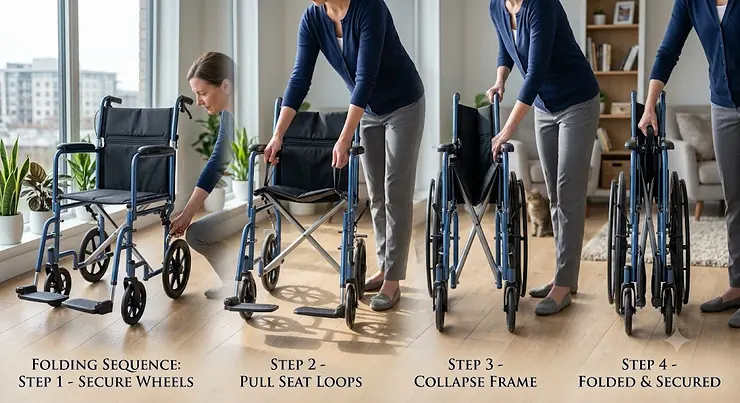
On day one, practice the fold and unfold motion five or six times before you ever need it under time pressure — most transit chair mechanisms fold by pulling up on a strap or squeezing a release lever under the seat, and muscle memory here saves real frustration at a crowded pickup curb later. Check tire pressure and caster rotation weekly for the first month; small front casters pick up hair, thread, and grit faster than people expect, and a caster that won’t spin freely turns a light chair into a heavy one to push. Wipe down the frame joints monthly with a dry cloth rather than spraying lubricant directly onto folding hinges, since over-lubrication attracts more grit than it prevents. A common first-30-days mistake is folding the chair with the footrests still attached rather than swung away first, which stresses the hinge pins and is the single most preventable cause of early wear reported across this category.
Set a simple maintenance rhythm: quick visual check before each outing, deeper wipe-down monthly, and a full bolt-tightness check every season. That’s genuinely all most transit chairs need to last for years.
Collapsible Transit Wheelchair for Travel: Flying, Trains, and Road Trips
A collapsible transit wheelchair for travel earns its keep the moment you leave your own neighbourhood, and three real-world scenarios cover most Canadian buyers.
Consider a retired couple flying from Calgary to visit grandchildren twice a year: for them, an ultralight pick like the Karman LT-980 makes sense specifically because Canadian airlines transport mobility aids as priority baggage rather than counting them against a standard luggage allowance, and a lighter frame is simply easier for airport staff to handle without damage. The Canadian Transportation Agency’s own guidance on travelling with mobility aids confirms that airlines must transport a mobility aid when notified at least 48 hours before departure, which is worth building into any travel plan regardless of which chair you own.
Now picture a family doing regular road trips to a cottage three hours away — for them, folding speed at a gas station rest stop matters more than airline rules, and a mid-weight option like the Invacare Compact, with its dual frame-and-backrest fold, packs into a mid-size trunk without a struggle. Finally, think about a commuter using VIA Rail regularly for medical appointments in another city; here, a chair that fits comfortably in a train vestibule without blocking the aisle, such as the narrower-framed Drive Medical Fly-Lite, avoids the awkward shuffle of asking other passengers to move.
Across all three scenarios, the underlying lesson is the same: match the folding transit wheelchair to the actual transportation mode you use most, not the one you use occasionally.
Compact Folding Wheelchair for Car Trunk: Storage Solutions at Home and On the Road
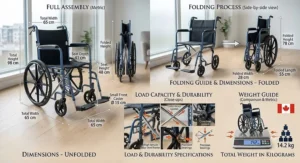
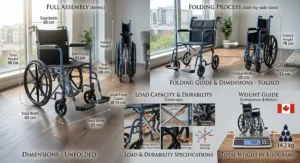
If your primary constraint is a genuinely small trunk — a compact sedan or a hatchback rather than an SUV — a compact folding wheelchair for car trunk use lives or dies on two numbers most listings bury: folded width and folded length, not just overall weight.
The Karman LT-980 and Invacare Compact both fold to noticeably narrower profiles than the full-size Silver Sport 1, which matters more than raw pounds when you’re wedging a chair beside grocery bags and a stroller. A trick worth adopting: measure your actual trunk opening width, not just depth, before ordering, since a chair that fits depth-wise can still snag on a narrow trunk lip. For transit chair storage at home between outings, avoid leaning the folded chair against a wall on its wheels for months at a time — flat storage on its side, or a wall-mounted hook designed for folding chairs, prevents the slow caster flat-spotting that some long-term owners report after a year of upright storage.
Households juggling multiple mobility needs — say, a folding wheelchair and a walker — often find a simple over-the-door hook system solves transit chair storage more elegantly than floor space ever will, especially in smaller apartments.
How to Choose a Folding Transit Wheelchair
Cutting through seven products and a dozen features, here’s the actual decision framework, boiled down to what matters in practice.
- Confirm it’s the right category first. A transit chair is attendant-propelled only — no push-rims for the user to self-propel — so if the person needs independent mobility, this isn’t the right product family at all.
- Weigh your own lifting capacity honestly. If you’re loading the chair into a trunk daily, the 15-pound difference between a Karman LT-980 and a Drive Silver Sport 1 is not a minor spec; it’s the difference between doing it happily and dreading it.
- Match wheel size to your terrain. Small casters are fine on hospital tile and flat sidewalks; 12-inch wheels like Medline’s handle cracks and gentle slopes far better.
- Measure your storage space before your budget. A trunk, a closet, or a train vestibule all impose hard limits that no amount of features can solve around.
- Decide if comfort or portability wins. Long outings favour ergonomic seating like the Karman S-ERGO 115; short, frequent trips favour the lightest possible frame.
- Check the weight capacity against the actual user, not an average adult — most transit chairs cap around 250–300 lbs, and exceeding that voids both safety and warranty.
- Confirm braking style matches your environment. Any slope at your home or destination makes integrated handbrakes far more than a nice-to-have.
Work through these seven in order and you’ll usually land on the right chair before you’ve even opened a comparison spreadsheet.
Common Mistakes When Buying a Folding Transit Wheelchair
Even careful shoppers repeat a handful of avoidable errors in this category, and most of them show up after the return window has closed.
The most common mistake is buying based on weight alone without checking seat width, which leaves larger users uncomfortable in an otherwise excellent ultralight chair. A close second is ignoring the folded dimensions entirely and assuming “foldable” automatically means “fits my trunk” — it frequently doesn’t, especially with wider-seat models like the Carex. Buyers also regularly skip verifying weight capacity against the actual user’s weight, not a rounded-down guess, which becomes a genuine safety issue rather than a comfort one. Another frequent misstep is assuming a transit chair can double as a full-time daily driver for someone who needs to self-propel — it can’t, structurally, since there are no push-rims. Finally, plenty of buyers overlook checking whether the armrests are fixed or flip-back, which directly determines how easy — or difficult — side transfers will be for a caregiver managing the process solo.
Catching even two or three of these before ordering avoids most of the frustrated return stories that show up in aggregated review sentiment across this category.
Foldable Attendant Wheelchair vs Self-Propelled Wheelchair: Which Do You Actually Need
This is the single most consequential decision in the entire category, and it’s frequently made incorrectly because the products look superficially similar in photos.
A foldable attendant wheelchair — every chair on this list — is designed to be pushed by a caregiver, with smaller rear wheels and no hand-rims for the occupant to grip and turn. A self-propelled wheelchair, by contrast, uses larger rear wheels with push-rims specifically so the user can move independently without assistance. The practical difference shows up immediately in daily life: an attendant chair is lighter, folds smaller, and costs less, but it strips away user independence entirely, while a self-propel chair costs more, folds bulkier, but lets someone navigate a grocery store on their own terms.
| Factor | Foldable Attendant Wheelchair | Self-Propelled Wheelchair |
|---|---|---|
| User independence | None — caregiver required | User can move independently |
| Typical weight | 13–34 lbs | 25–40+ lbs |
| Folded size | Smaller, trunk-friendly | Bulkier, less portable |
| Best for | Short outings, travel, occasional use | Daily independent mobility |
Reading the table plainly: if independence is the goal, none of the seven chairs above are the right purchase, full stop — a self-propelled or lightweight active-use chair is the correct category instead. If the goal is getting someone from a car to a clinic with the least hassle and cost, the attendant category, and this whole list, is exactly right.
Quick Fold Wheelchair Mechanism: How the Fastest Folds Actually Work
Every chair on this list folds differently under the hood, and understanding the mechanism explains why some feel effortless while others fight you.
Most quick fold wheelchair mechanisms rely on a cross-brace frame under the seat — the same X-shaped scissor design that’s existed in wheelchairs for decades — where pulling up on a central seat strap collapses the width of the chair in one motion. Premium ultralight models like the Karman LT-980 refine this with lighter-gauge tubing and smoother pivot bearings, so the same cross-brace motion requires noticeably less force, which is exactly why two chairs with an identical folding design can feel completely different in practice. What the spec sheet won’t tell you, but hands-on comparisons suggest, is that folding effort has less to do with the mechanism type and more to do with hinge lubrication and pivot quality — a cheap chair with a well-made hinge can outperform an expensive one with a stiff pivot. The Invacare’s added backrest-fold layers a second motion on top of the standard cross-brace fold, trading one extra step for a meaningfully smaller stored footprint.
For anyone comparing chairs in person rather than online, actually folding and unfolding the display model three or four times reveals more about long-term ease of use than any spec sheet number.
Long-Term Cost & Maintenance for Transit Wheelchairs
The sticker price is only the opening bid; total cost of ownership over three to five years tells a more useful story for budgeting purposes.
| Cost Factor | Budget Chairs (Silver Sport 1, Carex) | Premium Chairs (Karman line) |
|---|---|---|
| Upfront price | C$180–C$260 | C$400–C$650 |
| Replacement casters (per set) | C$20–C$40 | C$30–C$50 |
| Typical lifespan (daily use) | 3–5 years | 5–8 years |
| Resale/trade-in value | Low | Moderate |
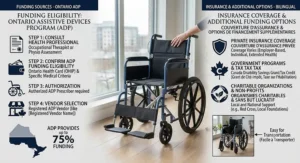
Interpreting this table honestly: the premium Karman chairs cost roughly double upfront but tend to last noticeably longer under daily use thanks to better-grade aluminum and hardware, which can narrow or even close the total-cost gap over five years for frequent users. For occasional users — a chair that comes out twice a month — the budget steel chairs almost always win on pure cost-per-use math, since the durability advantage of premium models matters most under frequent stress. It’s also worth knowing that Ontario’s Assistive Devices Program can cover a portion of mobility equipment costs for eligible long-term users; details on eligibility and coverage are outlined on the Ontario mobility aids funding page, and similar programs exist in other provinces worth checking before assuming full cost falls on one household.
Routine maintenance costs stay modest across the board — mostly caster replacement every couple of years and the occasional upholstery clean — which keeps this category considerably cheaper long-term than powered mobility alternatives.
Safety, Regulations & Compliance for Transit Wheelchairs in Canada
Safety in this category is less about exotic engineering and more about consistent basics, several of which connect directly to Canadian regulation rather than manufacturer marketing.
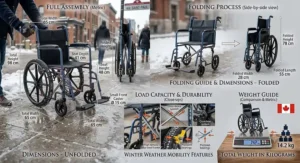
Always confirm the seatbelt is used on every outing, not just longer trips — most tipping incidents reported in aggregated review feedback happen during short transfers when the belt gets skipped “just this once.” Weight capacity limits, typically 250–300 lbs across this list, exist for structural safety reasons and shouldn’t be treated as approximate. For Canadians travelling by federally regulated air, rail, or bus, the Accessible Transportation for Persons with Disabilities Regulations require carriers to transport mobility aids as priority baggage and provide trained staff assistance, which is worth knowing if a chair is ever mishandled in transit — passengers have a formal complaint path through the Canadian Transportation Agency in that case. On uneven terrain, remember that transit chairs with small casters are explicitly designed for smooth indoor and paved surfaces, not gravel or grass, and pushing one across rough ground risks a forward tip that a larger self-propel chair would handle without issue.
None of this is complicated, but it’s the kind of detail that only becomes obvious after something goes wrong — better to build it into the routine from day one.
Features That Actually Matter (And Those That Don’t)
Marketing copy in this category loves to list features that sound impressive but rarely change the actual experience of using the chair.
Handbrakes for the caregiver genuinely matter, especially on any incline — this is not marketing fluff. Swing-away, removable footrests genuinely matter for safe, dignified transfers. Seat width matched to the actual user genuinely matters more than almost any other single spec. On the other hand, exotic frame colours add zero functional value and simply reflect personal taste. Extremely high weight capacities far beyond the user’s actual weight don’t improve anything and often just mean a heavier, bulkier frame. And while “aircraft-grade aluminum” sounds impressive in a listing, the practical folded weight number matters far more than the marketing term used to describe the metal.
When comparing listings, spend your attention on seat width, folded weight, wheel size, and brake style — everything else is largely cosmetic preference dressed up as a selling point.
Portable Folding Mobility Aid Accessories and Add-Ons Worth Considering
A folding transit wheelchair is rarely the only purchase; a handful of accessories genuinely improve daily use as a complete portable folding mobility aid system rather than a standalone chair.
A padded seat cushion is the single highest-impact add-on for anyone sitting for more than twenty or thirty minutes at a stretch, since most stock upholstery is thin by design to save weight. A dedicated carry bag, often sized specifically to the folded chair, protects the frame during car trunk storage and doubles as protection during air travel. Wheel locks or additional caster brakes add a second layer of safety on any home with even a slight slope to the driveway. Armrest extensions can help with transfers for taller users where the stock armrest sits slightly low. None of these accessories are required, but each solves a specific, common complaint that shows up repeatedly in aggregated owner feedback across this entire product category.
Budget an extra C$30–C$80 CAD for a cushion and carry bag combination if the manufacturer doesn’t already include them — it’s a small addition that measurably improves daily comfort.
Frequently Asked Questions
❓ What is the difference between a transit wheelchair and a regular wheelchair?
❓ How much does a folding transit wheelchair cost in Canada?
❓ Can I take a folding transit wheelchair on a plane in Canada?
❓ What is the lightest folding transit wheelchair available?
❓ Is a folding transit wheelchair covered by insurance or funding programs in Canada?
Conclusion
There’s no single “best” folding transit wheelchair, and honestly, anyone claiming otherwise hasn’t looked closely enough at how differently these seven chairs actually behave in daily life. Budget steel models like the Drive Medical Silver Sport 1 and Carex reward buyers who value durability and low cost over portability. Mid-range picks like the Medline and Invacare split the difference sensibly for households juggling smooth floors and rougher sidewalks. And the Karman ultralight line earns its higher price for anyone doing the lifting solo, flying regularly, or simply refusing to compromise on comfort during longer outings.
What actually matters, walking away from this guide, is matching the chair to your real routine — not the routine you imagine you’ll have. Measure your trunk. Be honest about who’s doing the lifting. Check the seat width against the actual person who’ll sit in it. Get those three things right and almost any chair on this list will serve you well for years. For broader background on wheelchair design and history, the Wikipedia entry on wheelchairs is a solid starting point if you want to go deeper.
Recommended for You
- Lightweight Transit Wheelchair for Caregivers: 7 Best Picks 2026
- Lightweight Transit Wheelchair: 7 Best Picks for Canada (2026)
- Manual Wheelchair Weight Comparison: 7 Top Picks for 2026 (Ranked)
Disclaimer: This article contains affiliate links. As an Amazon Associate, I earn from qualifying purchases. If you purchase products through these links, we may earn a small commission at no additional cost to you.
✨ Found this helpful? Share it with your friends! 💬🤗
