
In This Article
There’s a moment every power wheelchair hockey player in Canada knows well — the squeak of an indoor court, the clatter of plastic sticks, and the electric hum of a power chair accelerating toward a loose ball. If you’ve ever watched a game of wheelchair hockey in a gymnasium in Toronto, Ottawa, or Calgary, you’ll understand immediately: the right wheelchair hockey chair setup isn’t just equipment. It’s the difference between playing and competing.
A wheelchair hockey chair, in the Canadian adaptive sports context, refers to the electric power wheelchair — and its associated protective and performance accessories — used by players in both power wheelchair hockey (also called powerchair hockey) and the broader category of adaptive ice hockey including sledge hockey (para ice hockey). These are two distinct sports with very different chair requirements, and that distinction matters enormously when you’re shopping.
What is a wheelchair hockey chair? Simply put, it is a motorized or specially designed manual chair that allows an athlete with a physical disability to participate in hockey — whether on a basketball court in an adapted powerchair format or on ice in the Paralympic sledge hockey tradition. In powerchair hockey, the electric wheelchair is the player’s primary instrument of speed and force, used by individuals with conditions like muscular dystrophy, cerebral palsy, or spinal cord injuries who require power mobility in daily life.
Canada has one of the most active adaptive hockey communities in the world. The Ottawa Power Wheelchair Hockey League, for example, recently received a $25,000 CAD donation from the NHLPA Goals & Dreams fund through Amazon Canada’s expanded community partnership — a signal that wheelchair hockey in Canada is gaining serious momentum and visibility. Organizations like the Canadian Electric Wheelchair Hockey Association (CEWHA) and leagues affiliated with Parasport Ontario are building thriving communities coast to coast.
In this guide, I’ll walk you through the 7 best wheelchair hockey chair setups and adaptive hockey equipment picks available to Canadian buyers — including what’s realistically purchasable on Amazon.ca versus what requires specialist procurement — plus expert guidance on safety features, specifications, Canadian regulations, and how to match the right gear to your needs and budget in CAD. Whether you’re a first-timer in Winnipeg or a seasoned player in Vancouver, this is your 2026 resource.
Quick Comparison: Wheelchair Hockey Chair Types & Key Gear at a Glance
| Category | Best For | Key Spec | Est. Price Range (CAD) | Amazon.ca Available? |
|---|---|---|---|---|
| Power Wheelchair (Daily-Use) | Power hockey players (MDs, CP, SCI) | Speed 6–10 km/h, 300W–600W motors | $5,000–$30,000+ | Via clinician/specialist |
| Para Ice Hockey Sledge | Ice sledge hockey | Carbon fibre frame, dual blade mount | $800–$3,000+ | Specialty retailers |
| Wheelchair Bumper Guard Kit | All hockey chair users | ABS/foam padding, universal fit | $40–$120 | ✅ Yes |
| Hockey Stick Holder/Mount | Power hockey players | Adjustable clamp, 360° rotation | $20–$55 | ✅ Yes |
| Adaptive Hockey Gloves (Open Palm) | Sledge/power hockey | Lightweight, grip-enhanced palm | $45–$130 | ✅ Yes |
| Wheelchair Protective Sleeve Guards | Powerchair hockey | Nylon/urethane, DWR coating | $25–$65 | ✅ Yes |
| Adaptive Hockey Helmet & Face Shield | All adaptive hockey | CSA-certified, cage/shield option | $60–$200 | ✅ Yes |
Analysis: The table above reveals something important that most articles gloss over: the primary wheelchair hockey chair itself — the power wheelchair — is a prescribed medical device not sold direct-to-consumer on Amazon.ca. However, the essential accessories, protective gear, and adaptive hockey equipment that transform a daily-use chair into a competition-ready hockey machine are widely available on Amazon.ca at accessible price points. This guide covers both dimensions. If you’re just entering the sport, start with the accessory and safety gear column; if you’re upgrading your chair, the specialist procurement section later in this article will save you significant time and money in CAD.
💬 Just one click — help others make better buying decisions too! 😊
✨ Don’t Miss These Exclusive Deals!
🔍 Take your wheelchair hockey setup to the next level with these carefully selected products. Click on any highlighted item to check current pricing and availability on Amazon.ca. These tools will help you compete with confidence and stay safe on the court or ice!
Top 7 Wheelchair Hockey Chair Equipment Picks: Expert Analysis
1. Drive Medical Blue Streak Lightweight Sport Wheelchair — Best Entry-Level Manual Chair for Floor Hockey Beginners
If you’re stepping into wheelchair floor hockey for the first time and don’t require a power chair for daily mobility, the Drive Medical Blue Streak is one of the most accessible starting points available on Amazon.ca. This is a manual self-propelled chair, not a powerchair — an important distinction — and it suits players with sufficient upper body strength to self-propel during recreational play.
The Blue Streak features an 18-inch wide seat, flip-back desk-length arms for easy transfers, and swing-away footrests. What matters for hockey is the aluminium frame, which weighs around 16 kg (35 lbs) — light enough to handle direction changes on a gym floor without the sluggishness you’d get from a steel-frame chair. The dual rear 24-inch wheels provide a turning radius that won’t leave you spinning helplessly while the play moves on.
Expert commentary: This isn’t a purpose-built hockey chair, and I wouldn’t recommend it for competitive powerchair hockey leagues. But for recreational floor hockey, school programs, or community inclusive hockey events across Canada — the kind run by organizations affiliated with Sport Canada and provincial adaptive sports bodies — it’s a practical, affordable entry point. It’s particularly suitable for players with lower limb disabilities who have strong arm and shoulder function.
Canadian reviews note that the chair ships quickly to Ontario and BC, though buyers in northern Alberta or remote communities should factor in extra delivery time. Prime members on Amazon.ca tend to get it within 3–5 business days to major urban centres.
✅ Reliable aluminium frame holds up well to court use
✅ Wide availability and replacement parts on Amazon.ca
✅ Flip-back arms improve access to ball/puck positioning
❌ Not suitable for powerchair hockey leagues — requires self-propulsion
❌ No front bumper protection included for collision scenarios
Price range: In the $250–$400 CAD range. Good value for recreational, non-competitive use.
2. Medline Strong and Sturdy Transport/Sport Wheelchair (K1166N22S) — Best Caregiver-Assisted Hockey Practice Chair
The Medline K1166N22S is a heavier-duty option for players who participate in supervised adaptive hockey programs where a caregiver or coach guides the chair. It features desk-length arms, swing-away leg rests, and a 16-inch seat — slightly narrower than the Blue Streak, which actually helps with court manoeuvrability when someone else is steering.
The key practical spec here is the reinforced steel frame with a 250-pound (roughly 113 kg) capacity. In adaptive hockey environments, chairs frequently absorb incidental contact — another chair bumps yours, you brake hard against a board or wall. The Medline’s frame construction handles that stress considerably better than lighter transport chairs, and the rubber-coated rear handles give a push assistant a firm grip even with hockey gloves on.
Expert commentary: What most buyers overlook about this model is how well it serves as a training/development chair for younger players or adults entering adaptive hockey who aren’t yet matched with a full assistive technology assessment. In Canada, getting your primary power wheelchair approved through provincial assistive devices programs (like Ontario’s ADP — Assistive Devices Program) can take months. The Medline gives you something practical to use while you wait. It’s also a popular backup chair for programs that loan equipment during tryouts.
Canadian buyers should note that this chair is typically Prime-eligible on Amazon.ca and ships to most provinces without issue.
✅ Solid steel frame handles court contact better than lightweight alternatives
✅ Comfortable desk-length arms allow closer positioning to the ball
✅ Good value for adaptive hockey programs and community clubs in CAD
❌ Heavier than sport-specific chairs — harder for self-propelled play
❌ No side bumper protection standard — add foam guards separately
Price range: Approximately $200–$350 CAD on Amazon.ca.
3. LIVINGbasics Self-Propelled Wheelchair with 23.6″ Large Rear Wheels — Best for Active Upper-Body Players in Recreational Hockey
The LIVINGbasics self-propelled model punches above its weight class for recreational adaptive hockey players with strong upper body function. The 23.6-inch rear wheels are the standout feature — significantly larger than standard 20-inch wheels — which gives you more momentum per push stroke and a more natural propulsion rhythm during play. For players covering larger indoor gym floors, that efficiency difference is real and noticeable within the first five minutes.
The chair weighs about 18.8 kg (41.4 lbs), which is on the moderate end. The flip-back desk-length arms allow you to get your elbows in closer to your body for more powerful pushing. The 18-inch seat width is generous enough for most adult players without creating the kind of lateral slipping that narrower seats cause during sharp turns.
Expert commentary: I’d frame the LIVINGbasics as the “active player’s budget option.” The larger wheels are genuinely functional for hockey — not just a spec sheet boast. If you’re playing in a weekly community floor hockey league in Edmonton or Saskatoon and you self-propel, the extra wheel diameter saves your shoulders over the course of a season. That matters in Canadian winters when you’re also pushing hard on snow and ice surfaces outside the rink — shoulder fatigue accumulates fast.
The chair ships across Canada via Amazon.ca with Prime shipping in most cases, and the manufacturer offers decent English and French customer support.
✅ Large 23.6-inch rear wheels improve propulsion efficiency for hockey
✅ Flip-back arms aid puck/ball access and positioning
✅ Loop-lock handbrakes provide quick stopping on gym floors
❌ At 41.4 lbs, heavier than competitive sport chairs
❌ Not reinforced for regular body contact — add side guards for league play
Price range: Around $300–$450 CAD. Strong value for the active recreational player.
4. Universal Wheelchair Bumper Guard Kit (Foam or ABS, Multi-Brand Compatible) — Best Safety Upgrade for Any Hockey Chair
Here’s where the practical value really kicks in. Whatever chair you’re using for wheelchair hockey in Canada, you need bumper protection — full stop. In powerchair hockey especially, where the chair is the primary contact vehicle, unprotected wheel hubs, footrest brackets, and frame edges can damage other chairs, injure other players, and cause premature wear on your own equipment.
Universal foam or ABS bumper guard kits available on Amazon.ca typically include padded foam wrap for front caster forks and side frame rails. The better kits use high-density closed-cell foam that doesn’t compress flat under repeated impact — the cheap open-cell foam versions you’ll find at the low end of the price range are essentially useless after a few games.
Expert commentary: What most Canadian buyers overlook about bumper guards for hockey chairs is the league requirement dimension. The Canadian Electric Wheelchair Hockey Association (CEWHA) has guidelines about chair safety in competitive play. If your chair’s wheels or footrests are exposed metal, you may be asked to modify before stepping onto the court. Foam guard kits from Amazon.ca are the most cost-effective solution — far cheaper than having a custom fabricator build guards, and they install in under 20 minutes with basic strapping or adhesive.
For Canadian winter storage: store foam guards indoors. Extended exposure to sub-zero temperatures (-20°C and below) causes standard foam to harden and crack, reducing its impact-absorption capacity significantly.
✅ Compatible with most manual and power wheelchair frames
✅ Easy DIY installation — no tools required for most models
✅ Affordable upgrade that may be required by Canadian league rules
❌ Foam quality varies significantly by brand — inspect before buying
❌ Some kits don’t include protection for rear wheel hubs
Price range: $40–$120 CAD depending on kit size and material quality.
5. Metal Cane/Stick Holder for Mobility Scooters & Power Chairs (Amazon.ca) — Best Stick-Mounting Solution for Powerchair Hockey Players
This is one of those products that’s not marketed for hockey at all, but serves powerchair hockey players remarkably well. Metal stick or cane holders — the type designed for mobility scooters and power chairs — clip securely to the armrest tube or side frame of most electric wheelchairs, providing a quick-release holster for your hockey stick during stoppages of play, timeouts, or when navigating to your bench position.
The best versions on Amazon.ca feature 360° rotation, a rubberized interior to prevent scratching the stick shaft, and a universal clamp range of 2.5 cm to 3.5 cm tube diameter — which fits the majority of armrest tubing on power wheelchairs like those from Permobil, Quantum, and Jazzy product lines.
Expert commentary: The spec sheet won’t tell you this, but a stick holder is arguably the most overlooked piece of equipment in power wheelchair hockey. Without one, you’re balancing your stick on your lap during defensive set plays or dropping it on the floor during transitions. In a fast-paced powerchair hockey game — where the chairs are moving and the ball never really stops — that kind of fumble costs your team possession. Stick holders are cheap, lightweight, and take about two minutes to install.
For players with limited hand function (common in powerchair hockey due to the disability profiles of participants), look for stick holders with a wider mouth opening so the stick can be retrieved with a wrist motion rather than a fine-grip pinch.
✅ Easy 360° adjustable positioning — find your ideal stick angle
✅ Universal tube clamp fits most major powerchair armrest dimensions
✅ Inexpensive solution that meaningfully improves in-game stick management
❌ Not all models accommodate the thicker shafts of some floor hockey sticks
❌ Cheaper versions use plastic clamps that can crack in cold environments
Price range: $20–$55 CAD on Amazon.ca. One of the best dollar-for-dollar hockey upgrades available.
6. Wright Stuff Sleeve Guards for Wheelchair Users — Best Arm Protection for Powerchair Hockey Players
Available directly on Amazon.ca, the Wright Stuff Sleeve Guards are technically designed to protect forearms from wheel dirt and moisture — but wheelchair hockey players have repurposed them brilliantly as lightweight arm protection during contact situations. Made from moisture-resistant nylon with urethane weather backing and a DWR (Durable Water Repellent) outer coating, they slip over jackets or long sleeves and protect against incidental contact from other chairs, stray sticks, and gym floor scrapes.
The specs: 38 cm (15 inches) long, 23 cm (9 inches) wide at the top tapering to 13 cm (5 inches) at the wrist. Adjustable velcro straps at the top accommodate up to 38 cm width for bulkier coats or sweaters — useful for Canadian players who run cold during indoor play and prefer to keep a hoodie on under their jersey.
Expert commentary: In powerchair hockey, most contact is chair-to-chair, not player-to-player — but your arms are exposed when they’re on your joystick or resting on armrests. A stray plastic hockey stick shaft to the forearm stings. These sleeves add a meaningful layer of protection without the bulk of full elbow pads, which can actually interfere with joystick operation in power wheelchairs with tight armrest clearance. The DWR coating also repels the floor moisture that accumulates in Canadian rinks and gymnasium floors — an underappreciated benefit.
Canadian buyers: These ship with Amazon.ca Prime in most provinces. The moisture-resistant coating is genuinely useful for spring hockey when gyms in older community centres can have humidity issues.
✅ Specifically designed for wheelchair users — not an awkward adaptation
✅ DWR coating handles moisture from Canadian gym floors well
✅ Adjustable fit works over winter clothing layers
❌ Provides light protection only — not a substitute for full elbow pads in high-contact play
❌ One-size-fits-most may be loose on smaller players
Price range: Around $25–$65 CAD on Amazon.ca.
7. Adaptive Hockey Helmet with CSA-Certified Full Cage (Bauer/CCM Entry-Level) — Best Head Protection for All Adaptive Hockey Formats
Every adaptive hockey player — whether on a basketball court in a power wheelchair or on ice in a sledge — needs a CSA-certified helmet with a full cage face protector. This is non-negotiable from both a safety and a regulatory perspective. Hockey Canada’s equipment guidelines, which govern adaptive hockey programs in Canada, require helmets meeting Canadian Standards Association (CSA) certification for all sanctioned play.
Entry-level helmets from Bauer and CCM available on Amazon.ca — such as the Bauer Re-Akt 55 and CCM Tacks 70 — offer CSA-certified protection in the $60–$200 CAD price range. For powerchair hockey played on a basketball court, a full cage (rather than a visor) is strongly recommended because the chair-level play means a hockey ball or stick can travel at unusual angles compared to stand-up hockey.
Expert commentary: Here’s something the spec sheet won’t tell you: in powerchair hockey, your head positioning is different from stand-up hockey. You’re seated, which means the cage geometry matters for your sightlines in a joystick-driving context. Too-deep a cage profile can obstruct peripheral vision when scanning for passes while also managing your joystick. A shallower cage profile — common on entry-level CCM and Bauer helmets — tends to work better for powerchair hockey players specifically.
Canadian buyers: Always verify the CSA certification mark (CSA Standard CAN3-Z262.1) on the helmet before purchase. As noted in a Hockey Canada safety recall, some third-party helmets on Amazon.ca have been recalled due to missing CSA certification. Stick with established brands.
✅ CSA certification meets Hockey Canada and provincial league standards
✅ Wide availability on Amazon.ca with Prime shipping
✅ Cage protects against ball/stick contact at powerchair hockey angles
❌ Sizing can vary between brands — always check size charts before purchasing
❌ Some third-party helmets lack CSA certification — verify before buying
Price range: $60–$200 CAD. Don’t cut corners here — this is your head.
Practical Usage Guide: Setting Up Your Wheelchair Hockey Chair in Canada
Step 1: Know Which Hockey Format You’re Playing
Before buying a single piece of equipment, understand the distinction between power wheelchair hockey (played indoors on a basketball court with plastic balls and sticks, for daily electric wheelchair users) and sledge/para ice hockey (played on ice, for athletes with lower body disabilities who have strong upper body function). These sports have different chair requirements, different equipment lists, and different governing bodies in Canada.
Power wheelchair hockey is an adaptive sport designed specifically for individuals who require the use of a motorized wheelchair in daily life, and it differs fundamentally from sled hockey — a Paralympic sport played by people with good to great upper body strength. Getting this distinction right saves you from buying the wrong gear.
Step 2: Access Your Power Wheelchair Through Provincial Programs
If you need a power wheelchair for daily use, accessing one in Canada typically goes through provincial Assistive Devices Programs (ADP in Ontario, PhysioExtra in Quebec, etc.) rather than Amazon.ca. These programs subsidize clinician-assessed power wheelchairs — the Permobil M3 Corpus, Quantum Q6 Edge, and Invacare TDX SP2 NB are among the common models used by Canadian powerchair hockey players. Budget approximately $8,000–$30,000+ CAD for a clinical-grade power wheelchair before subsidies.
Step 3: Add Hockey Modifications to Your Daily Chair
Once you have your chair, the Amazon.ca-accessible modifications make it hockey-ready:
- Bumper guards on front casters and side frame rails (priority #1)
- Stick holder mounted on the dominant-side armrest
- Anti-tip rear guards if not already standard on your model
Step 4: Get Safety-Certified Hockey Gear
Helmet (CSA certified), arm protection, and eye protection are minimum requirements. In power hockey, the use of protective equipment such as shin guards or eye protection is encouraged, yet remains optional in many leagues — but most Canadian programs strongly recommend a full package for beginners.
Step 5: Canadian Climate Considerations for Chair Maintenance
Power wheelchairs used in hockey take extra punishment. After court sessions:
- Wipe down joystick modules — sweat and gym floor moisture can accelerate corrosion
- Store batteries at room temperature (not in a cold garage in a Winnipeg winter — lithium batteries lose 20–30% capacity at -10°C)
- Check wheel drive belts seasonally if your chair uses belt-drive motors
Canadian Player Profiles: Matching the Right Chair Setup to Your Situation
Profile 1: The Toronto Parent Shopping for Their Teen
Your 16-year-old has muscular dystrophy and uses a Quantum Q6 Edge power wheelchair daily. They’ve been invited to join a CEWHA-affiliated league in the GTA. Budget for hockey modifications: around $200–$350 CAD.
Recommendation: Start with a bumper guard kit ($40–$80 CAD), a metal stick holder for the armrest ($20–$40 CAD), a CSA-certified helmet with full cage ($80–$120 CAD), and the Wright Stuff Sleeve Guards ($30–$50 CAD). Total outlay: approximately $170–$290 CAD. You’re not buying a new wheelchair — you’re adapting the one your teen already depends on. All of these ship via Amazon.ca Prime to Ontario addresses within 2–4 business days.
Profile 2: The BC Newcomer to Sledge Hockey
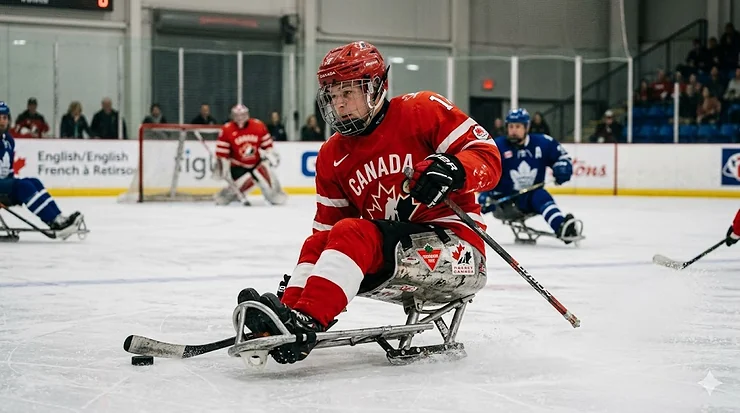
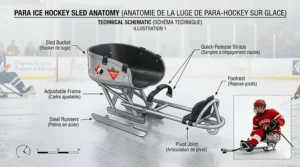
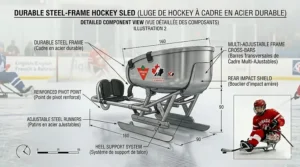
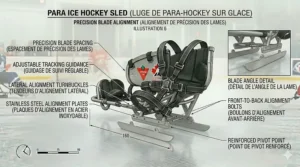
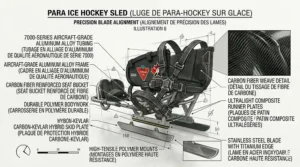
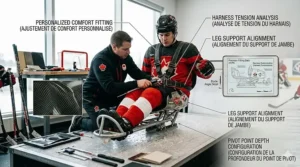
You’ve had a sports-related spinal cord injury, you have strong upper body strength, and you want to try sledge (para ice hockey). You don’t use a power wheelchair daily. The sledge itself — a purpose-built sled with two skate blades — needs to come from a specialty adaptive sports retailer rather than Amazon.ca. Players in para ice hockey sit on specially designed sleds that rest on two skate blades attached under the seat, and use two sticks equipped with metal picks on the ends to maneuver on the ice. Contact Wheelchair Sports Alberta or BC Wheelchair Sports for sledge rental programs — many leagues loan equipment for your first season.
From Amazon.ca, invest in a CSA-certified hockey helmet ($100–$180 CAD), hockey gloves ($45–$90 CAD), elbow pads ($40–$80 CAD), and shoulder pads ($60–$130 CAD). Total estimated gear budget from Amazon.ca: $245–$480 CAD.
Profile 3: The Rural Manitoba Community Club Coordinator
You’re setting up a new powerchair hockey program and need equipment for 8–12 players with varying chair types. Focus your Amazon.ca budget on helmets and bumper guards first — the highest priority safety items. An order of 10 foam bumper guard kits (approx. $50 CAD each = $500 CAD) and 10 CSA-certified helmets (approx. $80 each = $800 CAD) gives your league a viable foundation for under $1,500 CAD. Note that Amazon.ca shipping to remote Manitoba addresses may take 7–14 days; plan orders well before your season start.
Sledge Hockey vs. Wheelchair Hockey Chair: Key Differences Explained
This is the most frequently misunderstood distinction in the Canadian adaptive hockey space, and it’s worth addressing directly because the equipment requirements — and the Amazon.ca shopping journey — are completely different.
Power Wheelchair Hockey (what most people mean by “wheelchair hockey chair”):
- Played on a basketball court or gymnasium floor
- The player’s daily-use electric power wheelchair IS the sport vehicle
- Players have limited upper body strength/mobility (muscular dystrophy, cerebral palsy, high-level spinal cord injury)
- Equipment includes all-plastic hockey sticks, as many players are unable to lift wooden hockey sticks, and a plastic ball rather than a puck for greater movement during the game
- Governed in Canada by the Canadian Electric Wheelchair Hockey Association (CEWHA)
Para Ice Hockey (Sledge/Sled Hockey):
- Played on an ice hockey rink
- Players use a purpose-built sledge (sled) with two skate blades underneath — NOT their daily wheelchair
- Requires good to excellent upper body strength for propulsion with dual sticks
- Equipment includes carbon fibre sledge hockey sticks, a helmet with facemask, shoulder pads, elbow pads, shin guards, and hockey gloves
- Was invented in the early 1960s at a physical rehabilitation centre in Stockholm, Sweden and has been a Paralympic sport since 1994
- Governed internationally by World Para Ice Hockey; in Canada by Hockey Canada’s para hockey program
| Feature | Power Wheelchair Hockey | Para Ice Hockey (Sledge) |
|---|---|---|
| Playing Surface | Gymnasium / basketball court | Ice rink |
| Chair/Sled | Daily-use power wheelchair | Specialized sledge with skate blades |
| Upper Body Requirement | Minimal (chair does the work) | High — propels sled via stick picks |
| Puck/Ball | Plastic ball | Ice hockey puck |
| Paralympic Status | Not yet (aspiring) | Yes — since 1994 |
| Amazon.ca Equipment | Accessories, guards, helmets | Helmets, pads, gloves |
Analysis: Understanding this table changes your shopping strategy entirely. Para ice hockey players need hockey-standard protective gear and can buy most of it on Amazon.ca. Power wheelchair hockey players primarily need chair modification accessories and safety gear — also available on Amazon.ca. The chair itself in each case comes from outside the Amazon ecosystem, which is why this guide focuses on the equipment layer rather than pretending you can buy a Permobil on Amazon.ca.
How to Choose Wheelchair Hockey Chair Equipment in Canada: Expert Framework
Choosing the right wheelchair hockey chair setup in Canada comes down to five key criteria, each with Canadian-specific considerations:
1. Identify Your Sport Format First Are you playing indoor powerchair hockey or ice sledge hockey? This single decision determines whether you need power wheelchair accessories or sledge hockey gear. Don’t conflate the two — they require fundamentally different equipment paths.
2. Work Within Canadian Assistive Technology Channels for the Chair Itself For primary power wheelchairs, work with your occupational therapist and your provincial ADP (Assistive Devices Program). Ontario’s ADP covers up to 75% of the cost of approved power wheelchairs. Alberta, BC, and Quebec have equivalent programs. This is not an Amazon.ca purchase — and that’s perfectly fine.
3. Prioritize Safety Certification All helmets must carry CSA certification for sanctioned Canadian play. Check the helmet sticker before purchasing — Hockey Canada maintains a list of approved equipment that gets updated as recalls occur. A $60 CAD CSA-certified helmet from a trusted brand beats a $40 uncertified import every time.
4. Budget Realistically in CAD Chair modifications for powerchair hockey (bumper guards, stick holders, arm guards, helmet): $150–$350 CAD from Amazon.ca. Para ice hockey protective gear (helmet, gloves, elbow pads, shoulder pads): $250–$600 CAD. Budget buyers who compromise on helmets are making a false economy — the rest of the gear can be moderate quality, but head protection should be at the top of the quality ladder.
5. Factor in Canadian Climate and Storage If you’re in Saskatchewan or Manitoba, store all foam padding and battery-powered equipment indoors during winter. Sub-zero temperatures harden foam materials and reduce battery performance by 20–30%. For powerchair hockey players who bring their chair to an outdoor transfer before entering a gym, consider a neoprene battery sleeve cover (available on Amazon.ca under $30 CAD) to buffer the cold during the transition.
Common Mistakes When Buying Wheelchair Hockey Chair Equipment in Canada
Mistake 1: Assuming Any Helmet Is Legal for Canadian Play
Not all hockey helmets on Amazon.ca carry CSA certification. Some third-party imports — often priced attractively under $50 CAD — have been recalled by Health Canada and Hockey Canada for missing or counterfeit CSA marks. Always look for the CSA sticker inside the helmet and cross-reference with Hockey Canada’s approved equipment list. Saving $30 CAD on a helmet is not worth the risk of disqualification from your league — or, more importantly, inadequate protection.
Mistake 2: Buying a Standard Wheelchair Instead of a Power Chair for Powerchair Hockey
I see this mistake constantly in Canadian online forums for adaptive sports. People read “wheelchair hockey” and order a self-propelled manual wheelchair on Amazon.ca — then discover their league requires a powered motorized chair because players have conditions like muscular dystrophy or high-level spinal cord injury that preclude self-propulsion. Power wheelchair hockey is literally built around the electric wheelchair as the sport vehicle. If you’re entering this sport, verify whether your league is a powerchair hockey league (electric chairs only) or a broader inclusive hockey program before buying.
Mistake 3: Ignoring Provincial Funding Programs
Canadian buyers routinely spend their own money on adaptive sports equipment that provincial programs would have covered — or partially covered. Ontario’s ADP, BC’s ISBC equipment funding, and Alberta’s AADL program all have provisions for adaptive sports equipment in some categories. Check with your provincial health authority or contact the Canadian Paralympic Committee before reaching for your credit card. What looks like a $200 CAD purchase might have been funded.
Mistake 4: Not Accounting for Canadian Pricing vs. US Pricing
Many Amazon.ca listings for mobility and adaptive equipment run 15–25% higher than Amazon.com equivalents after exchange rate conversion. That’s often still better than cross-border shopping once you factor in customs duties, brokerage fees (which Canada Post and UPS charge on US imports), and the headache of returning a defective product across the border. Canadian pricing is higher, but the total cost of ownership — warranty, shipping, returns — typically favours Amazon.ca for adaptive equipment.
Mistake 5: Skipping the Bumper Guard Step
In powerchair hockey, unprotected metal frame edges are not just a safety hazard — they’re often a league disqualifier. Many Canadian CEWHA-affiliated leagues inspect chairs before the season and will not allow players on the court without adequate bumper protection. Installing a $50–$80 CAD foam bumper kit from Amazon.ca before your first practice avoids an embarrassing last-minute scramble and, more importantly, protects other players.
Wheelchair Hockey Safety Features: What Canadian Regulations Require
Hockey Canada’s safety framework — which extends to adaptive hockey programs — is governed through a combination of provincial hockey associations and the national body. Here’s what’s required or strongly recommended for wheelchair hockey in Canada in 2026:
Mandatory (Sanctioned Play):
- CSA-certified helmet (CAN3-Z262.1 standard)
- Full cage face protector for power wheelchair hockey (ball trajectory is unpredictable at chair height)
- Chair bumper protection on front casters and side frame edges (CEWHA leagues)
Strongly Recommended:
- Shoulder/arm protection (sleeve guards minimum)
- Eye protection (full cage preferred over visor for floor hockey)
- Gloves — lightweight open-palm adaptive hockey gloves for players with limited hand dexterity
Chair-Specific Safety Features to Look For:
- Anti-tip rear wheels (standard on most clinical power wheelchairs, critical for hockey manoeuvres)
- Stable wheelbase — mid-wheel drive power wheelchairs (like the Quantum Q6 series) offer the tightest turning radius for hockey, which is both a performance feature and a safety feature
- Joystick protection — a simple rubber bumper around the joystick module prevents damage during incidental contact
For para ice hockey specifically, Wheelchair Sports Alberta notes that there is only one classification requirement to play para ice hockey: athletes must have a physical disability to their lower body that prevents them from playing able-body hockey. This simplicity in classification makes the sport accessible — but safety equipment requirements align with standard Hockey Canada guidelines for all sanctioned ice play.
The Government of Canada’s Accessible Canada Act reinforces the principle that adaptive sport infrastructure should meet the same safety standards as mainstream sport — meaning there’s no regulatory carve-out that reduces safety requirements for wheelchair hockey formats. When in doubt, err on the side of CSA-certified, Hockey Canada-approved equipment.
Long-Term Cost & Maintenance of Wheelchair Hockey Chair Setup in Canada
Let’s talk real numbers, because the CAD investment in wheelchair hockey equipment is one area where clarity saves Canadian families significant stress.
Year 1 Setup Costs (Powerchair Hockey, Amazon.ca items only):
- CSA Helmet + Cage: $80–$180 CAD
- Bumper Guard Kit: $50–$80 CAD
- Stick Holder Mount: $20–$40 CAD
- Sleeve Guards/Arm Protection: $30–$60 CAD
- Total: ~$180–$360 CAD
Year 1 Setup Costs (Para Ice Hockey, Amazon.ca items):
- CSA Helmet + Cage: $100–$200 CAD
- Gloves: $50–$130 CAD
- Elbow Pads: $40–$80 CAD
- Shoulder Pads: $60–$130 CAD
- Shin Guards: $40–$80 CAD
- Total: ~$290–$620 CAD
Annual Maintenance:
- Foam bumper replacement (compresses over a season): $30–$60 CAD
- Helmet replacement (if involved in significant impact): $80–$180 CAD
- Glove replacement (every 1–2 seasons depending on use): $50–$130 CAD
Total Cost of Ownership (3 Years, Powerchair Hockey, CAD): Approximately $350–$650 including equipment refresh. That’s remarkable value for a full season sport participation — especially when you consider that sledge hockey programs often loan sledges to new players for their first year, and powerchair hockey players already own their primary chair.
One Canada-specific note: keep all receipts. Adaptive sports equipment purchased for individuals with disabilities may be eligible as a medical expense deduction under the CRA (Canada Revenue Agency) guidelines. Consult with a tax professional about T2201 disability tax credit interactions with adaptive sports equipment costs.
FAQ: Wheelchair Hockey Chair in Canada
❓ Can I use my daily power wheelchair in a Canadian wheelchair hockey league?
❓ Is wheelchair hockey equipment available with free shipping on Amazon.ca?
❓ What is the difference between sledge hockey and power wheelchair hockey in Canada?
❓ Are Canadian wheelchair hockey helmets required to be CSA certified?
❓ Can I get funding to help pay for wheelchair hockey equipment in Canada?
Conclusion: Hockey Is for Everyone — Including Every Canadian Wheelchair User
Canada is one of the greatest hockey nations on earth, and that tradition belongs to every Canadian — including those who experience the game from a wheelchair. The growth of organizations like the Ottawa Power Wheelchair Hockey League, the Canadian Electric Wheelchair Hockey Association, and para ice hockey programs supported by Hockey Canada proves that wheelchair hockey in this country is not a niche afterthought. It is a vibrant, competitive, passionate sporting community.
The good news for 2026 shoppers is that most of the equipment you need to get started — the safety gear, the chair modifications, the protective accessories — is accessible on Amazon.ca at reasonable CAD price points, with Prime shipping to most Canadian addresses. The primary wheelchair itself, for powerchair hockey players, comes through provincial assistive technology channels — and that’s exactly as it should be, ensuring clinical fit and funding support.
If you’re a parent in Mississauga shopping for a teen with cerebral palsy, a newly injured hockey fan in Calgary exploring para ice hockey, or a community centre coordinator in Moncton building a new inclusive program: this guide has the foundation you need. Start with a CSA-certified helmet, add bumper protection, grab a stick holder, and get on the court.
Hockey doesn’t care what kind of wheels get you there. 🇨🇦
✨ Don’t Miss These Exclusive Deals!
🔍 Ready to build your wheelchair hockey setup? Click on any of the highlighted products in this guide to check current pricing and availability on Amazon.ca. Whether you’re just getting started or upgrading an existing setup, these carefully selected products will help you compete confidently and safely. Your best season starts here!
Recommended for You
- 7 Best Wheelchairs for Active Seniors in Canada 2026 — Stay Independent
- Best Tennis Wheelchair Canada 2026: 7 Expert Picks
- Best Racing Wheelchair Canada 2026: Top 7 Expert Picks
Disclaimer: This article contains affiliate links. As an Amazon Associate, I earn from qualifying purchases. If you purchase products through these links, we may earn a small commission at no additional cost to you.
✨ Found this helpful? Share it with your friends! 💬🤗
