
In This Article
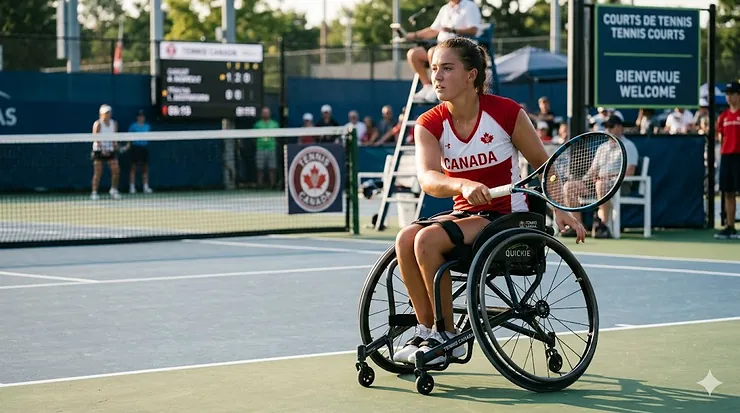
If you’ve ever watched a wheelchair tennis match — even just on TV — you’ve probably noticed that the athletes aren’t rolling around in a standard hospital chair. They’re flying. Spinning. Pivoting on a dime. And the reason they can do that? It’s almost entirely down to the best tennis wheelchair they’re sitting in.
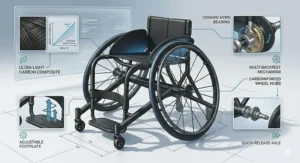
A tennis wheelchair is a purpose-engineered piece of adaptive sports equipment designed specifically for the explosive, multidirectional demands of court play. In its simplest definition: a tennis wheelchair is a rigid-frame, lightweight manual chair with a cambered rear wheel configuration, anti-tip protection, and a low seat profile — all built to maximize speed, agility, and stability during competitive or recreational wheelchair tennis. That 40-60 word description is the kind of clarity Google loves for featured snippets, so keep it in mind as you read.
For Canadian players, the stakes are even higher than you might think. Canada’s wheelchair tennis community is growing fast — Tennis Canada’s National High Performance Program now fields athletes competing globally, with names like Thomas Venos, Shawn Courchesne, and Frédérique Bérubé Perron representing the maple leaf on the ITF circuit. Whether you’re a beginner looking to get on court in Mississauga or a competitive player aiming for the ITF tour, choosing the right chair makes an enormous difference.
Here’s what most Canadian buyers overlook: not every “sport wheelchair” sold on Amazon.ca is designed for tennis. Many are general-purpose active chairs that will leave you spinning out on quick volleys. In this guide, I’ve done the research to separate the genuine tennis-ready performers from the marketing fluff — with honest commentary on what each chair means for you, in Canadian conditions, at Canadian prices in CAD. Let’s get into it. 🎾🇨🇦
Quick Comparison: Top Tennis Wheelchairs Available to Canadian Buyers (2026)
| Chair | Frame Material | Starting Weight | Camber Range | Best For | Price Range (CAD) |
|---|---|---|---|---|---|
| Quickie GP/GPV | Aluminium | ~9.7 kg (21.5 lbs) | 0°–12° | First rigid chair, dual sport/daily | $2,500–$4,500 |
| Quickie Match Point | Aluminium/Titanium | 9–11 kg (20–24 lbs) | Fixed court camber | Dedicated tennis competitors | $4,000–$6,500 |
| Invacare Top End Pro Tennis | Aluminium | ~10 kg (22 lbs) | Adjustable | Recreational to competitive | $3,500–$5,500 |
| TiLite ZRa Series 2 | Titanium | ~4.9 kg (10.7 lbs) | Adjustable | Ultralight active users | $5,000–$8,000 |
| Karman S-Ergo ATX | Aluminium | ~8.2 kg (18 lbs) | Moderate camber | Budget-conscious beginners | $1,200–$2,000 |
| Colours Zephyr Sport | Aluminium | ~6.6 kg (14.5 lbs) | Custom | Custom-fit sport players | $2,000–$3,500 |
| Drive Medical Blue Streak | Steel | ~14 kg (31 lbs) | None | Casual/transition users | $400–$700 |
Reading the table: The gap between the Karman S-Ergo ATX and the Quickie Match Point isn’t just $2,000 CAD — it’s a completely different performance category. The Karman suits someone just discovering adaptive tennis and wanting an active chair that won’t embarrass them on court. The Match Point is what you buy when you’re serious about competing. The TiLite ZRa’s featherweight titanium frame is genuinely in a class of its own for experienced players, but that price tag reflects it. For most recreational Canadian players, the $2,500–$4,500 aluminium sweet spot hits the right balance of performance and value.
💬 Just one click — help others make better buying decisions too! 😊
✨ Don’t Miss These Exclusive Deals!
🔍 Take your tennis game to the next level with these carefully selected chairs. Click on any highlighted item to check current pricing and availability on Amazon.ca. These picks will help you get on court faster and perform better!
Top 7 Tennis Wheelchairs: Expert Analysis for Canadian Buyers
1. Quickie GP/GPV Ultralight Rigid Wheelchair — Best Overall for Canadian Tennis Players
The Quickie GP/GPV is arguably the most iconic rigid-frame wheelchair in adaptive sports history, and it earns that reputation on the tennis court every day. The GPV variant features a V-tapered front end that holds the legs in a tighter position — and in practice, that translates to noticeably snappier pivots when you’re scrambling for a wide forehand at the baseline.
Key specs, interpreted for Canadian players: The aluminium one-piece welded frame starts at around 9.7 kg (21.5 lbs) — light enough to load into most Canadian vehicle trunks without wrecking your shoulder after a two-set match. The wheel camber adjusts from 0° to 12° in two-degree increments, which matters enormously: at 7°–9°, the chair becomes significantly more stable during lateral pushes, and you get better knuckle clearance so you’re not skinning your hands mid-rally. Optional Quickie performance wheels are sport-oriented and designed specifically for basketball and tennis court surfaces. The adjustable axle plate lets you dial in your centre of gravity — crucial for aggressive net play where your upper body lunges forward repeatedly.
The Quickie GP/GPV is best suited for Canadian players who want one chair that does everything — tennis three times a week, a grocery run on Saturday, and a trail path in a Toronto ravine on Sunday. Motion Cares, a Canadian authorized dealer with locations across the country, carries this chair, which means you get proper fitting and post-purchase support — a significant advantage over ordering blind online.
Customers consistently praise the frame’s durability through harsh use; one long-term user described it as “the Honda Civic of wheelchairs — you just keep driving it.” The main cons are that it’s heavier than titanium alternatives at a similar price point, and customization lead times can run 8–12 weeks through Canadian dealers.
✅ One-piece welded frame — exceptional long-term rigidity
✅ 0°–12° adjustable camber for tennis and daily use
✅ Available through Canadian dealers (Motion Cares national network)
❌ Heavier than titanium alternatives at similar price
Long customisation lead time (8–12 weeks typical in Canada)
Price range: $2,500–$4,500 CAD depending on configuration. While Canadian pricing runs slightly higher than US equivalents, you avoid cross-border shipping fees, customs delays, and warranty headaches — all very real pain points for Canadians who’ve tried importing specialty equipment.
2. Quickie Match Point Tennis Wheelchair (Aluminium & Titanium versions) — Best for Competitive Canadian Tennis
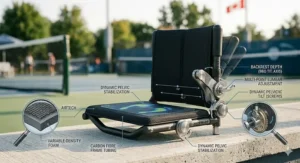
This is the chair that means business. The Match Point was designed from the ground up for one thing: tennis. The extra-wide front caster footprint (casters set further apart than any other sports chair) means the chair resists tipping sideways when you lunge — and on a hardcourt surface, that stability margin is the difference between an incredible get and landing on the floor.
What the specs actually mean: At 9–11 kg (20–24 lbs) depending on whether you go aluminium or titanium, the Match Point sits in a competitive weight range for tournament play. The patented centre-of-mass adjustment system provides 8.9 cm (3.5 inches) of centre-of-gravity adjustment and up to 12.7 cm (5 inches) of vertical seat height adjustment — in plain English, you can tune this chair to your exact body mechanics rather than adapting your game to the equipment. It ships standard with 60 cm (24-inch) rear wheels, 7.6 cm (3-inch) micro casters, and an integral anti-tip. The integral anti-tip is not just a safety feature — it’s a confidence feature that lets you lean aggressively into shots without the mental brake of “am I going to flip?”
The titanium Match Point shaves roughly 1.1 kg (2.5 lbs) off the aluminium version. If you’re competing in ITF-sanctioned events — and Canadian players like Thomas Venos are showing that’s absolutely within reach — those saved grams compound over a three-hour match into real energy savings. For Canadian players in the ITF circuit, note that the ITF Wheelchair Tennis Competition Regulations don’t restrict chair specifications beyond safety and the two-bounce rule, so you have full freedom to customise.
Customer feedback from competitive players is overwhelmingly positive about the front caster placement specifically — it’s the thing users mention first. The downside? This is a specialist chair, not an everyday chair, and Canadian buyers will typically need to source it through specialty adaptive sports dealers or import from US suppliers like How iRoll Sports with appropriate duty planning.
✅ Extra-wide front caster footprint — anti-tip confidence on aggressive shots
✅ 3.5″ centre-of-mass adjustment — tune to your exact body mechanics
✅ Titanium option saves ~1.1 kg for competitive match play
❌ Not ideal as a dual sport/daily chair
❌ Import from US often required; factor in customs duty and lead time
Price range: $4,000–$6,500 CAD (aluminium to titanium). The titanium premium is worth it for players competing more than twice a week.
3. Invacare Top End Pro Tennis Wheelchair — Best for Recreational-to-Competitive Transition
The Invacare Top End Pro Tennis is the chair that bridges the gap between “I’m getting serious about this” and “I’m ready to compete.” It’s a dedicated tennis chair — not a dual-purpose active chair — built with a lower seat position and pronounced camber that immediately changes how you experience the court.
Practical interpretation of specs: The aluminium frame comes in around 10 kg (22 lbs), with seat widths from 30 cm to 46 cm (12″–18″) — an important range for Canadian players who’ve found generic imported chairs simply don’t fit their frame. The adjustable camber is a standout feature at this price tier, because most chairs in the $3,500–$5,500 CAD range lock you into a fixed angle. Being able to experiment between 5° and 9° of camber while you’re still developing your game is genuinely valuable; you learn what works for your body before committing to a custom build.
In my view, this is the ideal chair for a Canadian player who’s joined a local wheelchair tennis club (Tennis Canada has programs from BC to Nova Scotia), is playing once or twice a week, and wants equipment that won’t cap their development. It’s also a sensible choice if you’re exploring adaptive sport for rehabilitation — the lower risk profile compared to ultra-aggressive racing geometry means a physiotherapist won’t cringe when they see you on it.
User reviews highlight the chair’s consistent performance on both indoor and outdoor hardcourt surfaces — relevant in Canada where most club play shifts indoors from October through April. The cons are limited colour customisation compared to RGK or TiLite, and Canadian availability typically requires going through an Invacare Canada distributor.
✅ Dedicated tennis geometry — not a repurposed active chair
✅ Adjustable camber at a mid-range price point
✅ Wide seat range (30–46 cm) fits more body types
❌ Limited colour/custom options vs. premium brands
❌ Canadian distributor required; not directly on Amazon.ca
Price range: $3,500–$5,500 CAD. Check Invacare Canada’s dealer network for the closest fitting centre to your province.
4. TiLite ZRa Series 2 Ultralight Titanium Wheelchair — Best Premium Pick for Serious Athletes
If the Quickie Match Point is a serious competition chair, the TiLite ZRa is what some of the world’s most accomplished wheelchair athletes ride when they absolutely cannot afford to carry extra weight. The ZRa’s mono-tube titanium frame starts at just 4.9 kg (10.7 lbs) in the standard edition — and the SL (Super Light) edition drops to a mind-bending 4.0 kg (8.7 lbs). For context, that’s lighter than most tennis racket bags.
Why the weight matters for Canadian conditions: Playing an outdoor ITF-level event at Toronto’s Wheelchair Tennis Canada Open during a humid July afternoon is tiring enough. Every gram you’re not pushing translates into preserved energy for the shots that matter in the third set. The ZRa’s large-diameter 3.2 cm (1.25-inch) tubing provides a mono-tube frame with superior rigidity — meaning energy transfer on each push stroke goes into forward motion, not frame flex. TiLite’s Precision Lock Technology allows fine adjustability in minutes without tools, which matters when you arrive at an outdoor court in Vancouver and the surface plays differently than your indoor training facility.
TiLite is a well-established manufacturer that has been producing custom ultralight titanium wheelchairs since 1988, with a TiFit personalisation process that tailors every chair to exact user measurements. That legacy is worth something. The downside for Canadian buyers: TiLite chairs are typically sourced through Canadian specialty dealers or US suppliers, and at this price point you want proper fitting — a transactional Amazon purchase is the wrong approach for an $8,000 CAD chair.
✅ 4.0–4.9 kg frame — lightest option at this performance level
✅ Precision Lock Technology — field-adjustable without tools
✅ TiFit custom measurement process for exact body fit
❌ Premium price puts it out of reach for most recreational players
❌ Requires specialist fitting; not suited for online-only purchase
Price range: $5,000–$8,000 CAD. This is a long-term investment — most TiLite owners keep their chair for 7–10 years, which makes the per-year cost much more reasonable.
5. Karman S-Ergo ATX Ultra Lightweight Wheelchair — Best Budget Entry for Beginner Canadian Players
Here’s a chair that most reviews overlook because it’s not a “pure” tennis chair — and that’s exactly why it deserves a spotlight. The Karman S-Ergo ATX is an active-user aluminium wheelchair with an ergonomic frame, available through Amazon.ca and several Canadian medical suppliers, in the $1,200–$2,000 CAD range that genuinely hurts nobody’s budget.
Real-world meaning of the specs: The S-Ergo series weighs around 8.2 kg (18 lbs) and features Karman’s proprietary S-shape ergonomic frame, which reduces pressure points during extended sitting — something you’ll appreciate after two hours of recreational tennis. The moderate camber isn’t as aggressive as a dedicated tennis chair, but for a new player who’s still learning the two-bounce rule and basic court positioning, a less extreme geometry is actually helpful. You’re not fighting the chair’s tendency to spin when all you want to do is roll forward and hit a ball.
What I recommend for budget-conscious Canadian players: use the Karman S-Ergo ATX as your “getting started” chair, play for six months, and then invest in a purpose-built tennis chair once you know you love the sport. This staged approach saves you from buying a $5,000 CAD chair before you’re ready to use it effectively. Karman products are available on Amazon.ca and typically qualify for Prime shipping — relevant for Canadian players outside major cities who face longer standard delivery times.
✅ Available on Amazon.ca — easy Canadian purchasing and returns
✅ Ergonomic S-frame reduces pressure during long sessions
✅ Affordable entry point for new adaptive tennis players
❌ Not a dedicated tennis chair — limited camber for serious court play
❌ Heavier steel components in some configurations reduce agility
Price range: $1,200–$2,000 CAD depending on configuration. Excellent starting point; budget to upgrade within 12–18 months as your game develops.
6. Colours Zephyr Sport Wheelchair — Best Customisable Chair for Canadian Players Who Know Their Measurements
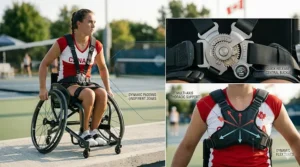
There’s something deeply satisfying about a chair built to your exact specifications, and the Colours Zephyr Sport delivers that at a price point significantly below TiLite’s premium tier. At just 6.6 kg (14.5 lbs), the Zephyr Sport is one of the lightest aluminium chairs available, and Colours in Motion builds each one by hand to your personal measurements with over a dozen custom options.
What this means for Canadian court performance: The “you design it, you build it” philosophy sounds like marketing copy until you realise how much difference a correctly-sized seat makes. A seat that’s 2.5 cm too wide shifts your centre of gravity, makes pushes less efficient, and fatigues your shoulders 20% faster — a real problem when you’re playing at a Canadian indoor club through a five-month winter season. The Zephyr’s quick-release rear axles make loading into a car straightforward, a practical Canadian priority when you’re hauling gear through a snowy arena parking lot in February.
The chair works equally well for tennis and everyday use, meaning you don’t need two separate chairs if budget is a consideration. The trade-off is that Colours chairs typically ship from the US, and with Canadian import duty and exchange rate considerations, you should factor roughly 15–20% onto the US base price when budgeting in CAD. Lead times are typically 4–8 weeks from order to delivery at a Canadian address.
✅ 6.6 kg (14.5 lbs) — among lightest aluminium options available
✅ Fully custom to your measurements — no compromises on fit
✅ Dual-purpose (tennis + daily use) value
❌ US-manufactured; factor in import costs and lead time for Canada
❌ Sizing process requires knowing your exact measurements (consult a therapist first)
Price range: $2,000–$3,500 CAD including import/shipping to Canada. Worth every dollar once you experience a truly custom-fit chair.
7. Drive Medical Blue Streak Wheelchair — Best Transitional Chair for Casual Adaptive Recreation
I’m including the Drive Medical Blue Streak not because it’s a tennis chair — it’s not — but because it’s often the first chair a Canadian player adapts when they try wheelchair tennis for the first time at a community program. The Blue Streak is a standard folding wheelchair that’s widely available on Amazon.ca in the $400–$700 CAD range, is Prime-eligible (free shipping for Prime members, free shipping on orders over $35 CAD for non-members), and can serve as a starting point for someone who hasn’t been assessed for a sports chair yet.
Honest commentary: The Blue Streak’s steel frame sits at around 14 kg (31 lbs), its fixed camber means next to zero lateral stability during fast direction changes, and the desk-length flip-back arms will absolutely get in your way during a backhand stroke. These are not complaints — they’re physics. What the Blue Streak is good for is: showing up to a first-ever adaptive tennis clinic, getting a feel for the sport, and confirming this is something you want to invest in before spending $3,000+ CAD.
If you’re a recreational player, a caregiver, or someone running an adaptive sports program on a limited budget, the Blue Streak will get people on court. Just don’t expect competitive performance from it. The Drive Medical brand is well-supported in Canada, with replacement parts and servicing widely available — including in smaller communities in Saskatchewan, Manitoba, and Atlantic Canada where specialty mobility dealers are sparse.
✅ Widely available on Amazon.ca with Prime shipping
✅ Drive Medical support available across Canada including remote areas
✅ Lowest cost of entry for adaptive tennis exploration
❌ Steel frame at ~14 kg — significantly heavier than sport chairs
❌ No camber adjustment; poor lateral stability for serious tennis
Price range: $400–$700 CAD. Think of it as your “test drive” budget before investing in a purpose-built tennis wheelchair.
How to Get Started: A Real-World Guide to Playing Wheelchair Tennis in Canada
Step 1: Contact Tennis Canada’s Adaptive Program
Before you buy any chair, reach out to Tennis Canada’s wheelchair tennis program. They can connect you with local clubs across every province, seasonal clinics, and coaches who understand adaptive equipment. Many Canadian clubs have loaner chairs available so you can try the sport before investing. This is the single most overlooked step by new players.
Step 2: Get a Seating Assessment
Visit a certified ATP (Assistive Technology Professional) or occupational therapist through your provincial health program. In Ontario, ADP (Assistive Devices Program) can subsidize up to 75% of the cost of a prescribed sports wheelchair for eligible residents. BC and Alberta have similar programs through their provincial health authorities. A proper seating assessment tells you your exact seat width, depth, and back height — the measurements that make or break a custom chair order.
Step 3: Understand the ITF Two-Bounce Rule
Wheelchair tennis uses standard tennis courts, rackets, and balls — the only major rule difference is that the ball may bounce twice before being returned, with the second bounce permitted even outside the court boundaries. This is worth knowing before your first session because it completely changes court positioning and strategy. The ITF governs wheelchair tennis globally, and Tennis Canada’s official rulebook aligns with ITF standards.
Step 4: Rent Before You Buy
Several Canadian adaptive equipment dealers — including Motion Cares in Ontario, BC, and Alberta — offer short-term rentals on sports wheelchairs. A one-month rental at around $150–$300 CAD is genuinely worth it to test a specific chair before committing thousands.
Step 5: Budget for the Full Kit
Beyond the chair itself, budget for court gloves (around $30–$80 CAD on Amazon.ca), strapping systems for players who need trunk support, and a lightweight tennis racket with a larger head size for easier swing clearance from a seated position. These accessories add $100–$300 CAD to your initial investment but make a meaningful difference in your first months of play.
Canadian Player Profiles: Which Chair Is Right for You?
Profile 1 — The Urban Beginner (Toronto, Ottawa, Vancouver)
Meet Priya: 34, recently active again after a spinal injury, interested in trying wheelchair tennis through her Toronto rehab centre’s adaptive sports program. Budget: around $1,500–$2,500 CAD. She plays indoors, has access to the city’s accessible transit, and wants something versatile enough for daily errands too.
Best match: Karman S-Ergo ATX (~$1,200–$2,000 CAD). Available on Amazon.ca, ergonomic for extended use, and versatile enough for both tennis and daily mobility. When Priya is ready to compete in 12 months, she upgrades to a Quickie GP/GPV through a Toronto-area dealer.
Profile 2 — The Competitive Club Player (Calgary, Winnipeg, Edmonton)
Meet Marcus: 28, plays tennis three times a week at his city’s adaptive sports club, has competed in provincial tournaments, and is eyeing ITF-level events in the next 18 months. Budget: $4,000–$6,000 CAD. Plays outdoors in summer, indoors from October to April.
Best match: Quickie Match Point (aluminium) (~$4,000–$5,000 CAD). The extra-wide front caster footprint and centre-of-mass adjustment system are exactly what Marcus needs to optimise for competitive play. He sources it through a Canadian adaptive sports dealer and budgets for a professional fitting session.
Profile 3 — The High-Performance Player (National/ITF Competitor)
Meet Sarah: 22, part of a provincial development program, trains five days a week, and has competed in ITF junior events. Budget: $6,000+ CAD with potential provincial sports funding.
Best match: TiLite ZRa Series 2 (SL titanium) or Quickie Match Point Titanium. At this level, every saved kilogram matters over a full match. Sarah applies for Sports Canada’s Athlete Assistance Program and provincial sport funding, both of which can partially offset the cost.
Tennis Wheelchair vs. Regular Wheelchair: Why You Can’t Just Roll Onto the Court
This is the question I get most often from families looking to support a new adaptive tennis player, so let’s break it down properly.
A standard everyday wheelchair — even a good lightweight model — is designed for linear movement: going from A to B in a straight line. A tennis wheelchair is engineered for explosive multidirectional movement: sprinting, spinning, braking, pivoting, and then sprinting again in 30 seconds.
Here’s the key difference:
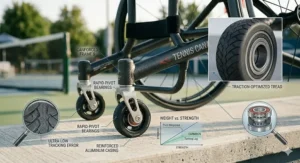
Camber. Standard wheelchairs have rear wheels that are vertical (0° camber) or very slight. Tennis wheelchairs typically run 7°–12° camber. That outward lean of the wheel base dramatically increases lateral stability — the chair won’t tip sideways when you lean hard into a cross-court sprint. It also brings the wheel rim closer to your hands at resting position, reducing the reach needed for each push stroke. The trade-off is that cambered chairs are wider overall, which matters in narrow doorways but is irrelevant on a tennis court.
Frame rigidity. Standard wheelchairs often use folding cross-brace frames that absorb shock by flexing slightly. That flex is comfortable for daily use but catastrophic for tennis — every push loses energy to frame movement rather than forward propulsion. Tennis wheelchairs use rigid welded frames where 100% of push energy goes into movement. In practice, a rigid-frame chair at the same weight as a folding chair will feel 15–20% faster on court.
Seat height and position. Tennis chairs sit lower and tilt the seat forward slightly (called “dump angle”), which transfers your weight slightly forward for better core engagement during lateral movements. This geometry feels strange at first and is completely wrong for everyday mobility — it’s tuned for sport.
Anti-tip protection. Standard wheelchairs may not have anti-tip wheels. Tennis chairs always do — positioned to prevent backward falls when you’re leaning back to reach a high ball.
For a new Canadian player, the takeaway is clear: use a standard chair to try the sport at a club with loaners, then invest in a purpose-built tennis wheelchair once you’re committed.
How to Choose a Tennis Wheelchair in Canada: 7 Criteria That Actually Matter
Choosing the best tennis wheelchair isn’t about finding the flashiest frame — it’s about matching equipment to your body, your game, and your Canadian context. Here are the criteria I’d apply:
- Frame material. Aluminium is durable, affordable, and the standard for most competitive players. Titanium saves significant weight (often 2–4 kg) but costs 40–60% more. Carbon fibre is emerging but not yet widely supported through Canadian dealers. For most Canadians, aluminium in the $3,000–$5,000 CAD range hits the sweet spot.
- Adjustable camber. If you’re still developing your game, prioritise adjustable camber (0°–12°) so you can experiment. Fixed camber chairs at 7°–9° are appropriate once you know your preference.
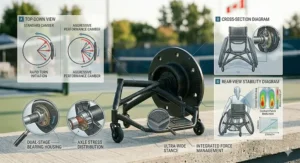
- Centre-of-gravity adjustment. This is underrated by beginners and obsessed-over by competitive players. The ability to shift the axle position forward (more agile, less stable) or backward (more stable, slightly slower) lets you tune handling to your playing style.
- Anti-tip design. Integral anti-tip (built into the frame) is more reliable than bolt-on accessories. For any player working on an aggressive aggressive playing style, this is non-negotiable.
- Seat dimensions. Width, depth, and dump angle all affect how connected you feel to the chair during movement. Never buy a tennis chair without a proper seating assessment — a provincial ADP or similar program can often provide this at low or no cost.
- Canadian dealer support. Specialty chairs need fitting, maintenance, and periodic adjustment. Buying from a dealer with Canadian service locations (Motion Cares, 1800wheelchair.ca, specialized rehab dealers) protects your investment in the long run. Remote and northern Canadians should specifically ask about warranty service availability before purchasing.
- Funding eligibility. Before paying full price, check with your provincial assistive devices program. Ontario’s ADP, BC’s Health Supplement program, Alberta’s AHS Equipment program, and others may cover a significant portion of costs for medically prescribed sports wheelchairs. This step alone can save thousands of CAD.
Common Mistakes Canadian Buyers Make When Choosing a Tennis Wheelchair
Mistake 1: Buying a “Sport Wheelchair” Without Verifying Tennis Suitability
Not all sport wheelchairs are created equal. A basketball wheelchair, for instance, has a significantly different geometry than a tennis chair — higher anti-tip wings, different seat dump, different caster placement. Always confirm the chair is specifically cleared for court tennis use. If a product listing doesn’t mention tennis explicitly, assume it’s not optimised for it.
Mistake 2: Ignoring Canadian Winter Storage and Its Effects on the Chair
This is a uniquely Canadian issue. Aluminium frames are generally unaffected by cold, but rubber components — caster wheels, push rim grips, seat upholstery — can harden and crack if stored in an unheated garage through a Canadian winter. Store your chair in a dry, temperature-controlled space (ideally above 5°C / 41°F) during the off-season. Silicone spray on rubber components before winter storage extends their life significantly.
Mistake 3: Overlooking Cross-Border Warranty Issues
Many premium tennis wheelchairs are manufactured in the US or Europe. If you import one directly to save cost, you may find that warranty claims require shipping the chair internationally — a $300–$500 CAD cost before any repair begins. Purchasing through a Canadian dealer typically extends domestic warranty protection and makes service claims far simpler.
Mistake 4: Skipping the Seating Assessment to Save Time
I’ve seen this go wrong more times than I can count. A player buys a $4,000 CAD tennis chair, receives it, and discovers the seat is 5 cm too wide for their frame. At that point, the chair either needs expensive modification or replacement. An occupational therapy seating assessment costs $0–$150 CAD depending on provincial programs — a trivial investment compared to the alternative.
Mistake 5: Choosing a Chair That’s Too Aggressive for Your Current Skill Level
An extremely low seat height and 12° camber sounds like peak performance — and it is, for an athlete who’s been playing for years. For a beginner, that geometry makes the chair harder to control during basic movement, increases the learning curve, and can actually slow your development. Match the chair’s aggressiveness to your current skill level, not your aspirational level.
What to Expect: Real-World Tennis Wheelchair Performance in Canadian Conditions
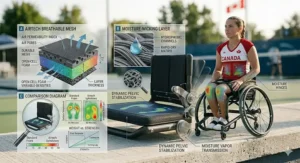
Outdoor hardcourt (summer, May–September): Most purpose-built tennis wheelchairs perform at their best on hardcourt surfaces. The micro casters on chairs like the Quickie Match Point roll efficiently on standard acrylic hardcourt paint, and heat doesn’t affect aluminium frame performance meaningfully. UV exposure can fade seat upholstery over a Canadian summer — a UV-resistant seat cover is a worthwhile $30–$50 CAD investment.
Indoor hardcourt (October–April): The vast majority of Canadian wheelchair tennis club play happens indoors during this period. Hard gymnasium floors and sport court tiles are ideal for tennis wheelchair casters and provide consistent grip. Many players actually prefer the predictable surface — you know exactly how the chair will respond.
Outdoor clay (rare in Canada but growing): Clay courts are present at some Canadian clubs and slow down caster movement significantly. If your club has clay courts, confirm your caster size and type are suitable — larger casters (9–10 cm / 3.5″–4″) handle clay better than the 7.5 cm (3″) micro casters optimised for hardcourt.
Rain and humidity: Aluminium frames are corrosion-resistant and handle Canadian spring rain without issue. Bearing quality matters here — sealed bearings (standard on most premium chairs) resist moisture infiltration far better than open ball bearings. Inspect and service bearings annually, especially if you play outdoors regularly through wet Canadian springs.
Cold-weather transport: Transporting a wheelchair in a cold vehicle trunk doesn’t harm the frame, but carbon parts (if present) should be brought to room temperature gradually before intense use to avoid any stress fractures. For most Canadian players on aluminium chairs, this isn’t a concern.
FAQ: Best Tennis Wheelchair in Canada
❓ What is the best tennis wheelchair for beginners in Canada?
❓ Can I use a regular wheelchair for wheelchair tennis in Canada?
❓ Does my provincial health plan cover a tennis wheelchair in Canada?
❓ What camber angle is best for wheelchair tennis?
❓ Are tennis wheelchairs available on Amazon.ca in Canada?
Conclusion: Choosing the Best Tennis Wheelchair for Your Canadian Game
The best tennis wheelchair in Canada isn’t a single answer — it’s the right match between your body, your game, your budget in CAD, and your access to Canadian dealer support. For beginners, starting with an accessible active chair from Amazon.ca while exploring the sport through Tennis Canada’s programs is smart and sustainable. For competitive players, investing in a purpose-built chair like the Quickie Match Point or TiLite ZRa — properly fitted through a Canadian dealer — is the move that separates recreational enjoyment from genuine athletic performance.
Canada’s wheelchair tennis community is growing. Players like Shawn Courchesne, Thomas Venos, and Frédérique Bérubé Perron are putting Canada on the global adaptive sports map. The right chair won’t make you a champion, but the wrong one can absolutely hold you back. Take the time to get assessed, connect with Tennis Canada’s programs, explore provincial funding options, and then invest with confidence.
The court is waiting. 🎾🇨🇦
✨ Ready to Take Your Game to the Next Level?
🔍 Explore the tennis wheelchairs and adaptive sports accessories highlighted in this guide. Click any product name to check current pricing and availability on Amazon.ca. Your best game starts with the right equipment!
Recommended for You
- Best Racing Wheelchair Canada 2026: Top 7 Expert Picks
- Best Basketball Wheelchair in Canada: 7 Expert Picks for 2026
- Best Sports Wheelchair in Canada 2026: Top 7 Picks Reviewed
Disclaimer: This article contains affiliate links. As an Amazon Associate, I earn from qualifying purchases. If you purchase products through these links, we may earn a small commission at no additional cost to you.
✨ Found this helpful? Share it with your friends! 💬🤗
