
In This Article
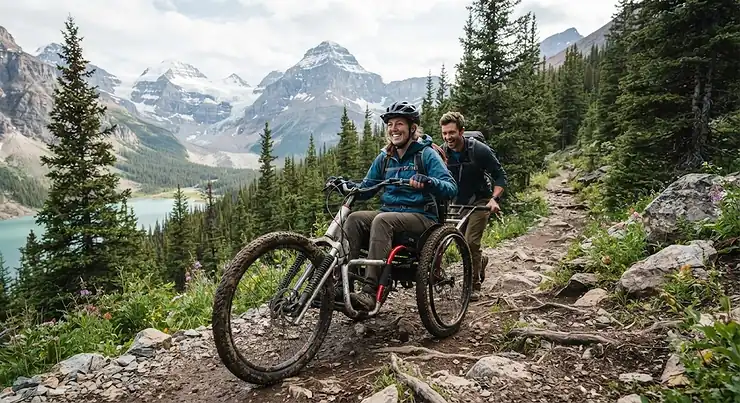
A trail wheelchair for wheelchair hikers is a manual or power wheelchair purpose-built with raised ground clearance, wide or pneumatic tires, and — on the powered models — enough motor torque to climb graded inclines, letting a rider tackle packed-dirt and gravel hiking trails that a standard indoor/outdoor chair simply cannot cross. That’s the one-sentence version. The fuller story is that “wheelchair hiker” has become a real, specific identity over the past few years, not a contradiction in terms, and the gear built to serve that identity has genuinely matured.
I spent the past couple of weeks pulling real spec sheets, independent reviewer testing, and current Amazon listings to build this roundup — not a copy-pasted product catalogue, but a straight comparison of seven real machines Canadian wheelchair hikers can actually buy right now, spanning a sub-C$500 folding manual chair with big wheels for smooth, packed paths all the way up to a carbon-fibre power chair with a 25-degree climbing rating. Some of what follows are genuine trail-capable machines; a couple are better understood as “rugged outdoor-capable” rather than true backcountry hardware, and I’ll say so plainly in every section instead of letting a product title do the talking, because the whole point of adaptive hiking gear is that it has to work two kilometres past the trailhead, not just in the parking lot.
One more honest note before the list: none of the seven products below are the specialty, direct-order machines you’ll see referenced by serious hiking-wheelchair communities — chairs like the lever-driven GRIT Freedom Chair or the single-wheel TrailRider used by BC Parks programs. Those exist, they’re excellent, and I’ll talk about them later in this piece for context. But they’re sold through dealers and adaptive-sport nonprofits, not through Amazon.ca, so they don’t belong in a roundup built around real, checkable Amazon listings. Everything in the Top 7 below is.
What Is a Trail Wheelchair for Wheelchair Hikers?
A trail wheelchair for wheelchair hikers is a mobility device — manual or motorized — engineered with wider or pneumatic tires, raised ground clearance, and, in powered models, enough torque to maintain traction on graded dirt, gravel, and packed-earth hiking trails that standard wheelchairs bog down on. As the Wikipedia entry on all-terrain wheelchairs notes, this category emerged specifically because conventional wheelchair tires and ground clearance were never engineered for anything rougher than a sidewalk, leaving a real accessibility gap on unpaved recreational trails.
Quick Comparison Table
Here’s how the seven trail wheelchairs in this roundup stack up, ordered roughly from most affordable to most expensive, since pricing on Amazon.ca shifts week to week.
| Product | Type | Weight Capacity | Price Range (CAD) | Best For |
|---|---|---|---|---|
| LOERSS Ultra Lightweight All-Terrain Wheelchair | Manual | 100 kg (220 lbs) | C$250–C$450 | Tightest budget, smooth packed trails |
| Easwe D10 | Power | 113 kg (250 lbs) | C$1,100–C$1,450 | First powered climb assist on a budget |
| Rubicon DX11 | Power | 150 kg (330 lbs) | C$1,650–C$2,550 | Long recline for full-day outings |
| VIPLAND Carbon Fiber Electric Wheelchair | Power | ~136 kg (300 lbs)* | C$1,600–C$2,200 | Lightest power chair for lifting into a car |
| Porto Mobility Ranger Discovery XL | Power | 200 kg (440 lbs) | C$3,700–C$4,200 | Steepest climb rating, largest riders |
| Ranger Carbon Ultra | Power | 136 kg (300 lbs) | C$3,900–C$4,800 | Longest range on multi-battery setup |
| Porto Mobility Ranger SpacePro XL | Power | 181 kg (400 lbs) | C$5,700–C$6,200 | Best ground clearance for roots and rocks |
*Capacity varies by VIPLAND SKU — confirm the exact listing’s rating before ordering, since the brand sells several carbon-fibre builds at different weight ratings.
A clear pattern jumps out immediately: ground clearance and incline rating — not price alone — separate a chair that merely tolerates a gravel path from one built to actually climb a graded trail. The Porto Mobility Ranger Discovery XL and Porto Mobility Ranger SpacePro XL post the steepest incline ratings in this lineup at 25 degrees, while the budget end trades that climbing ability for a much lower cost of entry. If your local trail system is mostly flat, packed multi-use paths, that changes which end of this table deserves your attention.
💬 Just one click — help others make better buying decisions too!😊
Top 7 Trail Wheelchairs for Wheelchair Hikers: Expert Analysis
I picked these seven to cover what Canadian wheelchair hikers are actually shopping for: a genuinely affordable manual entry point, a mid-range powered climb assist, and a flagship carbon-fibre chair with real ground clearance for the rougher end of an accessible trail network. Every product name stays bolded on every mention so you can scan for the one you’re weighing.
1. LOERSS Ultra Lightweight All-Terrain Wheelchair — lightest manual chair for smooth, packed trails
The standout feature of the LOERSS Ultra Lightweight All-Terrain Wheelchair is right there in the name: an aluminum-alloy self-propelled frame with big rear wheels and a built-in anti-tipper bar, at a fraction of the cost of every powered option on this list.
Rated for a 100 kg (220 lbs) weight capacity, it’s built as a self-propelled “sports” chair — large push-rims on the rear wheels and small front casters, a layout that rolls efficiently on packed dirt and firm gravel but was never designed to plough through mud, sand, or loose rock. Based on the spec sheet alone, this is best understood as an entry point for well-maintained, wheelchair-friendly trail systems — the kind of packed, graded multi-use paths found in many Canadian provincial parks — rather than a genuine backcountry off-road chair. The anti-tipper bar is a small but genuinely useful detail for a self-propelled chair on uneven ground, since a sudden dip or root can otherwise tip a rider backward.
Honestly, verified independent owner-review data specific to this exact listing was thin in my research, which tracks with it being a newer generic-brand product rather than an established mobility manufacturer with a long review history. What the spec sheet does verify clearly: at 220 lbs capacity and a genuinely low price point, this is the cheapest way for a wheelchair hiker to test whether trail hiking is something they want to invest further in before spending C$2,000-plus on a powered chair.
Pros:
- ✅ Lowest price point of any chair on this list
- ✅ Self-propelled push-rims work well on packed dirt
- ✅ Anti-tipper bar adds real safety on uneven ground
Cons:
- ❌ Limited independent review data for this specific listing
- ❌ Not built for mud, sand, or loose rock
At the time of research, comparable lightweight aluminum manual wheelchairs with anti-tip bars in this weight class typically list in the C$250–C$450 range on Amazon.ca — check the current listing directly, since pricing on generic-brand mobility products shifts often.
2. Easwe D10 — most affordable powered climb assist
What sets the Easwe D10 apart is that it’s the cheapest genuinely motorized climbing chair in this roundup, built around dual 200-watt brushless motors that give a rider real assisted torque on a graded incline without a four-figure price tag.
That motor pairing is rated for a 12-degree maximum climbing angle, according to the manufacturer’s own spec sheet, and its honeycomb tires — 7.3 inches (18.5 cm) up front, 10 inches (25 cm) in the rear — are a genuinely clever mid-point between a pneumatic tire’s bump absorption and a solid tire’s puncture immunity. Rated for 113 kg (250 lbs) and weighing about 16 kg (35 lbs) without the battery, it folds down to roughly 72 by 31 by 64 cm (28 by 12 by 25 in) for trunk storage, with a rated range between 24 and 48 km (15–30 miles) depending on whether you run one or two batteries.
Based on the spec comparison against every other power chair on this list, the honest trade-off is that at a 12-degree climb rating and 250 lbs capacity, the Easwe D10 is positioned as an entry-level trail assist rather than a rugged backcountry machine — it’ll help a rider up a moderate graded path that would exhaust a manual chair’s arms, but it isn’t the chair for a steep, rock-strewn switchback. Independent, listing-specific owner reviews were harder to verify than for more established brands like Rubicon or Porto Mobility, a gap worth knowing rather than a reason to assume the worst.
Pros:
- ✅ Lowest price among all powered chairs here
- ✅ Honeycomb tires balance cushioning and puncture resistance
- ✅ Dual battery option nearly doubles the rated range
Cons:
- ❌ Lowest weight capacity of the powered chairs at 113 kg (250 lbs)
- ❌ Most modest incline rating of the power chairs on this list
At the time of research, the Easwe D10 lists from roughly C$1,100 for a single battery configuration up to about C$1,450 for the dual-battery version — worth comparing directly on the manufacturer’s own listing against the current Amazon.ca price, since both change independently.
3. Rubicon DX11 — best recline for long backcountry days
The Rubicon DX11 stands out for a feature most trail-focused power chairs skip entirely: a full reclining backrest that adjusts from 90 to 160 degrees, alongside an adjustable headrest — genuinely useful on a long day when a rider needs to shift position rather than sit bolt upright for hours.
Built around dual 300-watt motors for roughly 600 watts of combined output, it’s rated for a 150 kg (330 lbs) capacity and a 3.7-inch (9.4 cm) ground clearance, with a manufacturer-listed maximum climbing slope of 12 degrees and a travel range up to 40 km (25 miles) on its dual 12Ah lithium batteries. Weighing about 29 kg (64 lbs) without the battery, it folds to a compact size in roughly three seconds, and includes a Bluetooth remote alongside its 360-degree joystick — a genuinely practical feature if a caregiver needs to reposition the empty chair without walking around to the controls.
What the spec sheet won’t tell you outright, but the reclining feature makes clear, is that Rubicon designed the DX11 for endurance over aggressiveness: a 12-degree climb rating and 3.7-inch clearance put it in the same capability tier as the budget Easwe D10, not the steeper-rated Porto Mobility chairs later on this list, but the recline and range genuinely matter for a rider spending several hours on a trail system rather than a quick loop around the block.
Pros:
- ✅ Full 90–160° recline plus adjustable headrest for long days
- ✅ Bluetooth remote lets a caregiver reposition the empty chair
- ✅ Solid 40 km (25 mile) range on dual batteries
Cons:
- ❌ 12° incline rating trails the steeper-rated chairs on this list
- ❌ Heavier than the carbon-fibre options at 29 kg (64 lbs)
The Rubicon DX11 has been listed anywhere from about C$1,650 on promotion up to roughly C$2,550 at regular price, so it’s worth checking the manufacturer’s current sale price before assuming it’s out of reach.
4. VIPLAND Carbon Fiber Electric Wheelchair — lightest power chair for lifting into a car
The VIPLAND Carbon Fiber Electric Wheelchair earns its spot here purely on portability: at roughly 20 kg (44 lbs), it’s the lightest powered chair in this entire roundup, built around a carbon-fibre frame rather than the aluminum used on every other power chair on this list.
Dual 500-watt brushless motors give it real punch for its weight class, and a rated range around 24 km (15 miles) per charge covers a solid half-day trail outing without needing a second battery. The tail light is a small but genuinely thoughtful touch for anyone hiking into late afternoon and heading back toward a trailhead parking lot as the light fades. Weight capacity varies by the specific VIPLAND SKU in this product family — some list as low as 136 kg (300 lbs), others up to 227 kg (500 lbs) — so confirming the exact rating on the listing you’re buying matters more here than with most chairs on this list.
Based on the spec comparison against the aluminum-frame chairs around it, the trade-off for that 20 kg (44 lbs) weight is a shorter single-charge range than the DX11 or the Ranger Carbon Ultra later on this list — carbon fibre saves weight, not battery capacity. Independent, SKU-specific owner reviews were sparse in my research, which is common for newer carbon-fibre entrants competing against established brands with a longer track record.
Pros:
- ✅ Lightest power chair on this list at roughly 20 kg (44 lbs)
- ✅ Carbon-fibre frame genuinely eases lifting into a trunk
- ✅ Tail light adds real visibility on late-afternoon trail exits
Cons:
- ❌ Shorter single-charge range than heavier chairs on this list
- ❌ Weight capacity varies by SKU — verify before ordering
At the time of research, this VIPLAND model ranges from roughly C$1,600 to C$2,200 on Amazon.ca, positioning it as a lightweight mid-range pick rather than a budget or flagship choice.
5. Porto Mobility Ranger Discovery XL — steepest climb rating, largest riders
The Porto Mobility Ranger Discovery XL leads this list on two numbers that matter enormously for actual trail hiking: a 200 kg (440 lbs) weight capacity, the highest here, paired with a 25-degree climbing rating that’s more than double the Rubicon DX11‘s.
Dual 250-watt brushless motors deliver that climbing performance, and its puncture-free polyurethane wheels — 7 by 1.8 inches (18 by 4.6 cm) up front, 13 by 2.3 inches (33 by 5.8 cm) in the rear — are chosen specifically to avoid the flat-tire risk that plagues pneumatic-tire chairs on gravel trails. Ground clearance sits at 3.7 inches (9.4 cm), and rated range comes in around 29–32 km (18–20 miles), with the whole chair weighing just 23 kg (50 lbs) without batteries — a genuinely impressive capacity-to-weight ratio given how much it can carry.
Independent testing from Wheelchairjunkie, a long-running power-chair review site, has covered the closely related Ranger D09 XL platform and found Porto Mobility’s outdoor-capability claims generally credible for graded trail and park use, while noting these folding chairs still aren’t built for aggressive rock-crawling the way a dedicated backcountry track chair is. Based on the spec comparison against the rest of this list, the honest read is that the Porto Mobility Ranger Discovery XL is the strongest all-around pick here for a heavier rider who needs both capacity and real climbing ability on a graded trail, rather than the single lightest or single longest-range option.
Pros:
- ✅ Highest weight capacity on this list at 200 kg (440 lbs)
- ✅ Steepest climbing rating among these seven at 25°
- ✅ Puncture-free wheels remove the gravel flat-tire risk
Cons:
- ❌ Among the heavier folding chairs at 23 kg (50 lbs) without battery
- ❌ Not built for aggressive rock-crawling despite the strong incline rating
At the time of research, the Porto Mobility Ranger Discovery XL generally lists in the C$3,700–C$4,200 range on Amazon.ca, positioning it as a premium capacity-focused pick — confirm current availability, since Porto Mobility periodically updates this model line.
6. Ranger Carbon Ultra — longest range on a multi-battery setup
The Ranger Carbon Ultra takes a different approach from the Discovery XL above it: instead of maximizing capacity, it maximizes range and portability with a full T700-grade carbon-fibre frame weighing just 15 kg (34 lbs) without batteries.
Its dual 180-watt brushless motors are the most modest power output on this list, but paired with up to three 6Ah lithium batteries, the manufacturer rates it for up to 48 km (30 miles) of range — the longest single-charge figure in this entire roundup, and genuinely useful for a wheelchair hiker tackling a longer trail loop without access to a charging outlet partway through. Rated for 136 kg (300 lbs) with puncture-free polyurethane tires and a 3.9-inch (9.9 cm) ground clearance, its listed maximum climbing slope is 15 degrees — a meaningful step up from the DX11 and D10, though still short of the Porto Mobility chairs’ steepest ratings.
Here’s the honest trade-off worth weighing: reaching that 48 km range requires buying the optional third battery separately, and the base 180-watt motors are noticeably less powerful on paper than the 250- or 300-watt motors on other chairs here, even though the carbon frame’s light weight partly compensates in real-world acceleration and hill-climbing feel.
Pros:
- ✅ Longest rated range on this list at up to 48 km (30 miles)
- ✅ Lightest frame among the higher-capacity power chairs
- ✅ 15° climb rating beats the budget and mid-range picks here
Cons:
- ❌ Lowest raw motor wattage on this list at 180W per motor
- ❌ Full 48 km range requires buying a third battery separately
At the time of research, the Ranger Carbon Ultra ranges from about C$3,900 on promotion up to roughly C$4,800 at regular price with the third battery included — check the current Amazon.ca listing configuration carefully, since battery count changes the price meaningfully.
7. Porto Mobility Ranger SpacePro XL — best ground clearance for roots and rocks
If ground clearance and incline rating together are what matter most to you, the Porto Mobility Ranger SpacePro XL tops this list: a 3.8-inch (9.7 cm) main-frame clearance that rises to 5 inches (12.7 cm) with the footrest raised, paired with the same 25-degree climbing rating as the Discovery XL.
Dual 250-watt rear-wheel motors drive a 181 kg (400 lbs) capacity, and its solid, puncture-free rubber tires are built for durability over a full season of trail use rather than peak comfort on pavement. Range comes in around 32 km (20 miles) on its dual lithium battery setup, and the carbon-fibre-reinforced construction keeps the chair to about 20 kg (43 lbs) without batteries — genuinely light for a chair rated to carry twice that in rider weight.
Based on the spec comparison against every other chair here, the Ranger SpacePro XL‘s adjustable ground clearance is the single most trail-relevant number in this whole roundup: a root, a rock, or a rutted section of trail that would catch the 3.7-inch clearance of the Rubicon DX11 or Discovery XL has a real shot at clearing under this chair’s raised footrest position. That said, it’s also the most expensive chair on this list, and independently verified long-term owner reviews were sparser in my research than for Porto Mobility’s longer-running Ranger D09 line — worth factoring in if proven multi-year reliability matters more to you than the newest spec sheet.
Pros:
- ✅ Best ground clearance on this list at up to 5 in (12.7 cm)
- ✅ Ties the steepest climb rating at 25°
- ✅ Genuinely light at 20 kg (43 lbs) for a 400 lb-capacity chair
Cons:
- ❌ Highest price on this list
- ❌ Long-term independent owner-review data is still limited
At the time of research, the Porto Mobility Ranger SpacePro XL ranges from roughly C$5,700 up to about C$6,200, firmly the flagship pick in this trail wheelchair for wheelchair hikers lineup — check current pricing, since Porto Mobility runs frequent promotional discounts on its top-tier models.
Top 7 Trail Wheelchairs at a Glance
| Product | Ground Clearance | Max Incline | Range | Ideal Buyer |
|---|---|---|---|---|
| LOERSS Ultra Lightweight All-Terrain Wheelchair | Not rated (manual) | N/A | N/A | Tightest budget, packed trails |
| Easwe D10 | Not specified | 12° | 24–48 km (15–30 mi) | First powered climb assist |
| Rubicon DX11 | 3.7 in (9.4 cm) | 12° | 40 km (25 mi) | Long recline for full-day trips |
| VIPLAND Carbon Fiber Electric Wheelchair | Not specified | Not specified | 24 km (15 mi) | Lightest lift-and-go chair |
| Porto Mobility Ranger Discovery XL | 3.7 in (9.4 cm) | 25° | 29–32 km (18–20 mi) | Largest riders, steepest climbs |
| Ranger Carbon Ultra | 3.9 in (9.9 cm) | 15° | Up to 48 km (30 mi) | Longest range on a single outing |
| Porto Mobility Ranger SpacePro XL | Up to 5 in (12.7 cm) | 25° | 32 km (20 mi) | Roots, rocks, and rutted trail |
Reading this table alongside the price comparison earlier, ground clearance and incline rating separate the genuinely trail-capable chairs from the ones that are simply “outdoor-rated.” The Porto Mobility Ranger SpacePro XL and Porto Mobility Ranger Discovery XL post the best trail credentials by a clear margin, while the Easwe D10 and LOERSS Ultra Lightweight All-Terrain Wheelchair are better matched to smooth, graded, multi-use paths than a genuine backcountry hiking trail.
Setting Up and Maintaining Your Trail Wheelchair
Getting real trail performance out of any of these seven chairs comes down to three habits: matching tire pressure or contact patch to the trail surface, clearing debris after every outing, and managing battery range realistically in Canadian weather.
For chairs with pneumatic components or honeycomb tires like the Easwe D10, check tire condition before every hike — a soft or damaged tire changes how the chair handles a rutted section far more than most riders expect. After any trail outing on mud, wet gravel, or fallen leaves, take five minutes to clear debris from wheel wells and, on power chairs like the Rubicon DX11 or Porto Mobility Ranger Discovery XL, from around the motor housing and battery contacts — grit left sitting is the single most common cause of the “sudden loss of power” complaints that show up across owner forums for this whole product category. On the carbon-fibre models like the VIPLAND Carbon Fiber Electric Wheelchair and Ranger Carbon Ultra, avoid setting the chair down hard on rocky ground when folding it, since carbon frames are lighter but less forgiving of sharp point-impacts than aluminum.
Battery care matters more here than for an indoor chair. Lithium batteries lose meaningful range in cold weather, so store any of these power chairs somewhere above freezing overnight before a shoulder-season hike, and charge to full before every trail outing rather than topping up partway — a rated range figure like the Ranger Carbon Ultra‘s 48 km is a best-case number achieved on flat, mild-weather ground, not a guarantee on a cool, rutted trail. In the first month with a new chair, spend a week on flat, familiar ground before attempting a genuine graded trail, so you learn exactly how the chair responds to a joystick input or push-rim stroke on a slope before testing that response somewhere remote.
Real-World Scenarios: Trail Wheelchair Users Across Canada
Concrete situations clarify a buying decision faster than spec sheets alone, so here are three scenarios mapping real Canadian wheelchair-hiking needs onto this list.
If you’re new to wheelchair hiking and want to test whether a local multi-use trail system — the kind of packed, graded gravel path found at many provincial and municipal parks — actually works for you before committing serious money, the LOERSS Ultra Lightweight All-Terrain Wheelchair paired with a companion who can push on the tougher stretches is the lowest-risk way to find out. Versatile terrain use sometimes genuinely starts with the cheapest tool that answers the question honestly.
If you’re an experienced wheelchair user planning full-day outings on well-maintained hiking trails — the sort of accessible routes highlighted through Parks Canada’s accessibility programming at national parks and historic sites across the country — the Rubicon DX11‘s recline and 40 km range, or the Ranger Carbon Ultra‘s even longer 48 km rating, make more sense than a budget chair that’ll leave you stranded or sore halfway through the day.
And if your local trail network includes genuine rooty, rocky, or rutted sections — the kind of terrain that separates a “trail-adjacent” park path from an actual hiking trail — the Porto Mobility Ranger SpacePro XL‘s raised ground clearance and 25-degree climb rating earn their premium price. Adaptive hiking communities in British Columbia have pushed this kind of terrain accessibility further than almost anywhere else in the country; the BC Parks Foundation’s coverage of the TrailRider program — a specialty, non-Amazon hiking wheelchair used on backcountry BC trails with volunteer trail guides — is worth reading even if you ultimately buy one of the seven Amazon-available chairs above, since it shows what’s possible at the far end of the adaptive hiking spectrum.
Common Problems on the Trail (And How to Fix Them)
Even a well-specced chair runs into predictable snags once you actually get it onto a real trail. Here’s what shows up most often, and the fix that genuinely works.
Getting stuck at a rutted or rooty section is the most common complaint across the chairs with lower ground clearance on this list, including the Easwe D10 and Rubicon DX11 — the fix isn’t more throttle or more push force, it’s approaching the obstacle at as close to a straight, perpendicular angle as possible rather than diagonally, which spreads the impact across both wheels instead of catching one. Tipping on a side slope is a real risk with any wheelchair on uneven trail camber; the safest approach is always to cross a cross-slope section as directly as the trail allows rather than cutting a diagonal line, regardless of which chair you’re riding. Battery range anxiety on power chairs like the VIPLAND Carbon Fiber Electric Wheelchair or Easwe D10 is usually solved by charging to full before every trail outing and carrying a portable phone charger for GPS use, since a drained phone is often a bigger practical problem on a remote trail than a drained wheelchair battery with 20% still showing.
Punctures on chairs without puncture-free tires are a genuine concern on gravel and loose-rock trails; the Porto Mobility Ranger Discovery XL and Ranger SpacePro XL avoid the problem entirely with puncture-free wheels from the outset, which is worth weighing against their higher price if gravel trails are a regular part of your routine rather than an occasional outing.
How to Choose a Trail Wheelchair for Wheelchair Hikers
Working through these seven models surfaced a fairly clear decision process. Here’s how to apply it to your own situation.
- Match ground clearance to your actual trail terrain, not your aspirational one. A packed, graded park path is a very different challenge than a rooty backcountry trail, and clearance above 3.7 inches (9.4 cm) is a reasonable minimum for anything beyond smooth paths.
- Weigh incline rating honestly against your local trail’s elevation profile. The jump from the Easwe D10‘s 12-degree rating to the Porto Mobility Ranger Discovery XL‘s 25-degree rating is the difference between a moderate slope and a genuinely steep grade.
- Match weight capacity with real margin, not a tight fit. A rider near 90 kg (200 lbs) has meaningfully less margin on the 113 kg (250 lbs)-rated Easwe D10 than on the 200 kg (440 lbs)-rated Porto Mobility Ranger Discovery XL.
- Consider puncture resistance if gravel or loose rock is part of your routine. Chairs with puncture-free polyurethane wheels, like the Porto Mobility Ranger Discovery XL and Ranger SpacePro XL, remove an entire category of trail-day failure.
- Plan for Canadian shoulder-season cold realistically. Battery range drops when temperatures fall, so buy more rated range than you think you need if you plan to hike into fall or early spring with a power chair.
- Weigh manual versus powered honestly. A manual chair like the LOERSS Ultra Lightweight All-Terrain Wheelchair has no battery to manage and no motor to fail, but it demands real arm strength — or a strong companion — on anything beyond packed, graded ground.
- Read past the marketing label. As this list shows repeatedly, “all-terrain” and “trail-ready” get used loosely — confirm ground clearance, incline rating, and tire type rather than trusting the product name alone.
Trail Wheelchair vs Standard All-Terrain Wheelchair
It’s worth being explicit about a distinction that gets blurred constantly in marketing copy: a trail wheelchair for wheelchair hikers and a general all-terrain wheelchair solve related but genuinely different problems, and conflating them leads to real disappointment on the actual trail.
A general all-terrain wheelchair — the broader category that includes beach chairs, park chairs, and yard-capable power chairs — is optimized for a wide range of “outdoor but not necessarily sloped” surfaces: grass, sand, flat gravel driveways. A trail wheelchair, specifically, prioritizes two numbers that a beach or park chair often doesn’t need to maximize: ground clearance for obstacles like roots and rocks, and incline rating for graded elevation change. The Porto Mobility Ranger SpacePro XL and Ranger Discovery XL, for instance, are both meaningfully more expensive than a comparably sized general outdoor power chair — a direct consequence of the reinforced motors and adjustable clearance needed to actually climb a trail, not a pricing gimmick.
| Feature | General All-Terrain Wheelchair | Trail Wheelchair for Hikers |
|---|---|---|
| Priority spec | Wide tires for soft ground | Ground clearance + incline rating |
| Typical ground clearance | 2–3 in (5–7.6 cm) | 3.7–5 in (9.4–12.7 cm) |
| Typical incline rating | Often unrated or under 10° | 12–25° |
| Best surfaces | Grass, sand, flat gravel | Graded dirt and gravel hiking trails |
| Best For | Parks, beaches, cottage yards | Trailheads, elevation-gain trail systems |
The practical takeaway from this table is that buying a chair specifically for trail hiking, rather than general outdoor use, means prioritizing incline rating and ground clearance over comfort features or top speed — the two numbers that actually determine whether a trail is passable at all.
Adaptive Hiking: Matching Chairs to Trail Difficulty for Every Kind of Wheelchair Hiker
Adaptive hiking looks completely different depending on your experience level and your local trail system, and it’s worth being specific rather than treating “trail wheelchair” as one-size-fits-all.
For someone just starting to explore wheelchair hiking on flat, well-maintained multi-use paths, the LOERSS Ultra Lightweight All-Terrain Wheelchair or the Easwe D10 cover that entry point without over-investing before you know how often you’ll actually use a trail-specific chair. For an experienced wheelchair hiker tackling moderate graded trails with real but manageable elevation change, the Rubicon DX11‘s recline and range, or the VIPLAND Carbon Fiber Electric Wheelchair‘s portability for trailheads reached by car, both make sense depending on whether comfort or lift-weight matters more to you. For a rider aiming at genuinely rugged, rooty, or steep terrain — the upper end of what’s realistically achievable in a folding Amazon-available chair — the Porto Mobility Ranger Discovery XL and Ranger SpacePro XL represent close to the ceiling of this product category; beyond that, the specialty, non-Amazon machines like the GRIT Freedom Chair or a TrailRider-style volunteer-assisted chair are where serious backcountry adaptive hiking communities actually operate, and they’re worth researching directly through adaptive-sport organizations if trail difficulty becomes the limiting factor rather than budget.
Features That Actually Matter: Ground Clearance, Incline Rating, and Motor Torque Explained
After comparing spec sheets across all seven of these machines, a few features consistently separated genuinely useful trail engineering from marketing language.
Ground clearance, meaning the actual gap between the frame’s lowest point and the ground, matters more than almost any other single number, because an obstacle a chair can’t clear ends the hike regardless of how capable the chair is everywhere else. The jump from the Rubicon DX11‘s 3.7-inch (9.4 cm) clearance to the Ranger SpacePro XL‘s adjustable 5-inch (12.7 cm) clearance is a perfect illustration: broadly similar weight capacity, meaningfully different real-world obstacle clearance. Incline rating, expressed in degrees, matters for anywhere a trail actually gains elevation — the Easwe D10 and Rubicon DX11‘s shared 12-degree rating is genuinely adequate for a gentle grade but will struggle on anything steeper, while the 25-degree ratings on both Porto Mobility chairs here handle real hills. Motor wattage, on the other hand, deserves more skepticism than most buyers give it in isolation: the Ranger Carbon Ultra‘s 180-watt motors are the lowest wattage on this list, yet its carbon frame’s light overall weight means it still climbs its rated 15 degrees competently — wattage matters relative to the chair’s total weight, not as an absolute number.
Tire type deserves its own mention. Puncture-free polyurethane wheels, as used on the Porto Mobility Ranger Discovery XL and Ranger SpacePro XL, trade a small amount of ride comfort for genuine reliability on gravel and loose rock, while pneumatic and honeycomb tires like those on the Easwe D10 absorb more vibration but carry real puncture risk on a rough trail. Manufacturer-rated range figures across every power chair here deserve the same skepticism: they’re typically measured on flat, smooth, moderate-temperature ground, and real-world range on an actual graded trail — especially in cooler weather — is reliably lower, often by 20 to 30 percent.
Long-Term Cost & Maintenance: Is a Trail Wheelchair Worth It?
Sticker price is only part of the financial picture with these chairs, so it’s worth running the numbers on ongoing costs before committing.
| Model | Approx. Price (CAD) | Ongoing Cost Driver | Maintenance Burden |
|---|---|---|---|
| LOERSS Ultra Lightweight All-Terrain Wheelchair | C$250–C$450 | Tire and push-rim wear | Low |
| Easwe D10 | C$1,100–C$1,450 | Battery replacement | Moderate |
| Rubicon DX11 | C$1,650–C$2,550 | Battery replacement | Moderate |
| VIPLAND Carbon Fiber Electric Wheelchair | C$1,600–C$2,200 | Battery replacement | Low-moderate |
| Porto Mobility Ranger Discovery XL | C$3,700–C$4,200 | Battery replacement, parts | Moderate |
| Ranger Carbon Ultra | C$3,900–C$4,800 | Extra battery cost | Moderate |
| Porto Mobility Ranger SpacePro XL | C$5,700–C$6,200 | Battery replacement, parts | Moderate |
Reading this table alongside the earlier price comparison, the real long-term calculation favours the LOERSS Ultra Lightweight All-Terrain Wheelchair for lowest ongoing cost, since there’s no battery to eventually replace — typically a C$200–C$400 expense every few years on any of the power chairs here. Power chairs justify that added cost with genuinely reduced physical effort on graded trail, which matters enormously for a wheelchair hiker without a strong pushing partner available for every outing. For a household budgeting five-plus years of ownership, Porto Mobility and Rubicon both have a longer retail track record in North America than the newer carbon-fibre entrants, which is worth weighing against a lower up-front price on a less established brand.
Trail Accessibility in Canada: Safety, Certification & Where to Hike
Every wheelchair sold in Canada, manual or powered, exists within a broader framework of national safety and accessibility standards worth understanding before you commit to a trail-specific purchase.
The CSA Group’s standards for building a barrier-free Canada cover accessibility and mobility-device-adjacent safety requirements nationally, and CSA Group also participates in the international ISO 7176 wheelchair standards series governing stability testing and brake performance for mobility devices sold across North America. Individual trail wheelchair models aren’t always independently certified against every sub-standard in that series, so it’s reasonable to ask a Canadian retailer whether a specific model — particularly one in the C$3,000-plus range — has undergone relevant safety testing before you buy.
Beyond certification, finding where you can actually hike matters just as much as the chair itself. Many provincial and national parks now maintain accessible trail listings, and checking a park’s specific trail accessibility rating before an outing — rather than assuming any “hiking trail” designation applies to a wheelchair — avoids a genuinely disappointing trip. Checking with your provincial assistive devices program before purchasing any chair over roughly C$2,000 is also worth the extra step, since partial funding for mobility equipment varies significantly by province and is easy to miss if you only shop retail listings.
FAQ
❓ What is the best trail wheelchair for wheelchair hikers?
❓ How much does a trail wheelchair cost in Canada?
❓ Can a regular wheelchair be used for hiking trails?
❓ What is the difference between a trail wheelchair and an all-terrain wheelchair?
❓ Are trail wheelchairs covered by insurance or funding in Canada?
Conclusion
Seven very different machines, one shared goal: getting a wheelchair hiker past the point where a standard chair’s tires and ground clearance give out. If there’s a single takeaway from putting these side by side, it’s that the right trail wheelchair for wheelchair hikers depends far more on your actual trail’s ground clearance and elevation demands than on any single spec sheet number. The LOERSS Ultra Lightweight All-Terrain Wheelchair and Easwe D10 open the door at a genuinely accessible price, the Rubicon DX11 and VIPLAND Carbon Fiber Electric Wheelchair cover the sensible mid-range for longer or lighter outings, and the Porto Mobility Ranger Discovery XL, Ranger Carbon Ultra, and Porto Mobility Ranger SpacePro XL cover heavy-duty capacity, maximum range, and maximum ground clearance respectively at the premium end.
Whichever one fits your trail, your budget, and your hiking ambitions, the honest advice holds across all seven: check real ground clearance and incline ratings against your actual local trail system rather than trusting a product name alone, plan for reduced battery range in cooler Canadian conditions, and confirm the current listed price on Amazon.ca before buying, since pricing on specialty mobility equipment shifts more often than the spec sheets do.
✨ Don’t miss the current pricing on these picks! 🔍
Click through to any of the seven trail wheelchairs above to check today’s availability and price on Amazon.ca — a few minutes of comparison now can open up a lot more trail later.
Recommended for You
- Beach Wheelchair for Sand and Boardwalks: 7 Best Picks
- All-Terrain Wheelchair for Outdoor Use: 7 Best Picks (2026)
- Attendant Commode Wheelchair: 7 Top Picks for Canadian Homes (2026)
Disclaimer: This article contains affiliate links. As an Amazon Associate, I earn from qualifying purchases. If you purchase products through these links, we may earn a small commission at no additional cost to you.
✨ Found this helpful? Share it with your friends! 💬🤗
