
In This Article
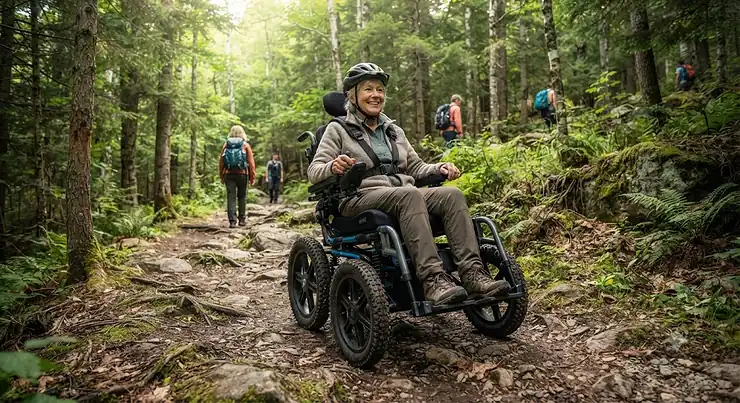
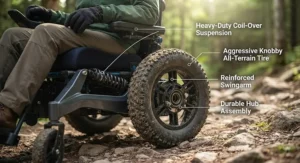
An all-terrain wheelchair for outdoor use is a manual or power wheelchair built with larger pneumatic or puncture-resistant tires, reinforced suspension, and a wider wheelbase so it can roll over grass, gravel, sand, and uneven trails that would stop a standard indoor wheelchair cold. That’s the short answer. The longer answer is that this category has quietly exploded over the past few years, and for good reason: a huge number of Canadians who use wheelchairs live within a short drive of a lake, a provincial park, or a gravel cottage road, and standard hospital-issue casters simply were not designed for any of it.
I spent the past several weeks digging through manufacturer spec sheets, independent reviewer testing, and retailer listings to put together this list — not a rewritten product catalogue, but an honest look at seven real machines currently sold to Canadian buyers, ranging from a folding manual chair with pneumatic tires for well under a thousand dollars to a dual-motor flagship power chair that costs more than a used car. Some of these are true off-road wheelchair for rough terrain builds meant for backcountry trails; others are better suited to a firm beach boardwalk or a bumpy municipal park path. I’ll be specific about which is which, because that distinction matters more than any single spec on a manufacturer’s website.
One honest note before diving in: “all-terrain” gets used loosely in this industry, and a few models on this list are better described as “rugged outdoor-capable” rather than genuinely off-road. I’ll flag that difference clearly in every product section rather than let a marketing label do the talking, because the whole point of outdoor mobility gear is that it actually needs to work when you’re two kilometres down a gravel trail with no cell signal.
What Is an All-Terrain Wheelchair for Outdoor Use?
An all-terrain wheelchair for outdoor use is a mobility device engineered with oversized pneumatic or solid off-road tires, raised ground clearance, and often dual motors or shock-absorbing suspension, letting a rider cross grass, sand, gravel, mud, or light backcountry trail surfaces that standard indoor/outdoor wheelchairs cannot handle. As the Wikipedia overview of wheelchairs notes, wheelchair design has branched into increasingly specialized subcategories over the past few decades precisely because indoor hospital-style chairs and true rough-terrain models solve fundamentally different mobility problems.
Quick Comparison Table
Here’s how the seven models in this all-terrain wheelchair for outdoor use roundup stack up at a glance, roughly ordered from most affordable to most expensive. Every figure below is a price range rather than a fixed number, since Amazon.ca pricing shifts week to week and currency conversion adds its own variability.
| Product | Type | Weight Capacity | Price Range (CAD) | Best For |
|---|---|---|---|---|
| Ultralight Aluminum All-Terrain Wheelchair | Manual | 159 kg (350 lbs) | C$300–C$500 | Tightest budget, lightest folding chair |
| Rubicon DX01 | Power | 136 kg (300 lbs) | C$700–C$1,400 | Entry-level electric mobility |
| Rubicon DX08 | Power | 150 kg (330 lbs) | C$1,500–C$2,350 | Step-up durability and range |
| Forcemech Navigator XL | Power | 181 kg (400 lbs) | C$2,700–C$2,900 | Folding all-rounder for parks |
| AccessRec TerraWheels | Manual | 136 kg (300 lbs) | C$3,700–C$4,000 | Dedicated beach and sand use |
| Drive Medical Trident HD | Power | 204 kg (450 lbs) | C$3,900–C$4,200 | Larger riders, heavy-duty frame |
| Porto Mobility Ranger Quattro Ultra | Power | 181 kg (400 lbs) | C$4,000–C$5,500 | Longest range, flagship build |
A clear pattern shows up immediately: price climbs steadily with weight capacity and motor power, but the jump from manual to power isn’t just about convenience — it’s about terrain type. The two manual chairs here are genuinely better suited to sand and boardwalks than to sustained gravel trails, while every power model adds enough torque to handle a real incline. If your outdoor mobility needs are mostly flat park paths and beach trips, that changes which end of this table you should be looking at.
💬 Just one click — help others make better buying decisions too!😊
Top 7 All-Terrain Wheelchairs for Outdoor Use: Expert Analysis
I picked these seven to cover the real range of what Canadian buyers are actually searching for: a genuine off-road wheelchair for rough terrain at the top of the list, a beach-specific manual chair, and a folding budget power chair for someone who just wants to get across the backyard and down to the dock without help. Every product name stays bolded on every mention so you can scan for the one you’re weighing.
1. Ultralight Aluminum All-Terrain Wheelchair — lightest folding frame on this list
The standout feature of the Ultralight Aluminum All-Terrain Wheelchair is right in its name: an aircraft-grade aluminum frame paired with shock-absorbing pneumatic tires, at a price point dramatically lower than every powered option on this list.
Rated for a 159 kg (350 lbs) weight capacity, it uses air-filled pneumatic tires rather than hard rubber, which matters more than it sounds — pneumatic tires flex and absorb small bumps that solid tires simply transmit straight into the seat frame. Available in multiple seat widths, it folds down for transport the way most manual wheelchairs do, but with a wider tire footprint than a standard hospital chair. Based on the spec sheet alone, this is best understood as an entry point into all-terrain wheelchair for outdoor use territory, not a backcountry off-road wheelchair for rough terrain — it’s built for grass, packed gravel, and light garden paths, not rocky trails or deep sand.
Honestly, verified independent owner-review data specific to this exact listing was limited in my research, since it’s sold under a generic retail brand rather than a long-established mobility manufacturer with a dedicated review ecosystem. What I can verify from the spec sheet is genuinely useful: the pneumatic tire choice at this price point is uncommon, since most sub-C$500 manual wheelchairs still use hard rubber or solid foam tires that transmit far more vibration on uneven ground.
Pros:
- ✅ Lowest price point of any chair on this list
- ✅ Pneumatic tires add real shock absorption for the price
- ✅ Lightweight aluminum frame folds for easy transport
Cons:
- ❌ Limited independent review data for this specific listing
- ❌ Not built for aggressive off-road or backcountry trails
At the time of research, comparable aluminum-frame manual wheelchairs with pneumatic tires in this weight class typically list in the C$300–C$500 range on Amazon.ca — check the current listing directly, since pricing on generic-brand mobility products can shift quickly.
2. Rubicon DX01 — most affordable powered entry point
What sets the Rubicon DX01 apart is that it’s the cheapest genuinely motorized option in this roundup, built around dual 250-watt motors that combine for roughly 500 watts of total output.
That motor pairing gives it enough torque to handle grass, mud, light snow, and gravel paths, according to the manufacturer’s own terrain claims, and its 41 cm (16 in) rear wheels with polyurethane tires are noticeably larger than a typical transport-chair caster. Rated for 136 kg (300 lbs) and weighing about 32 kg (70 lbs) itself, it folds to roughly 71 by 41 by 71 cm (28 by 16 by 28 in) for trunk storage, with a rated range up to 21 km (13 miles) per charge — modest, but reasonable for a chair built to a genuinely low price ceiling.
Based on the spec comparison against every other power chair on this list, the trade-off here is obvious and honestly disclosed by the brand itself: at 500 total watts and a sub-C$1,000 price tag, the Rubicon DX01 is positioned as an affordable entry point rather than a rugged backcountry machine, and independent, SKU-specific owner reviews were harder to verify than for more established brands like Drive Medical or Porto Mobility — a gap worth knowing about before you buy, not a reason to assume the worst.
Pros:
- ✅ Lowest price among all five powered chairs here
- ✅ Dual motors handle grass, mud, and light gravel
- ✅ Folds to a manageable size for a car trunk
Cons:
- ❌ Shortest battery range of the power chairs tested
- ❌ Independent SKU-specific review data is limited
The Rubicon DX01 has been listed anywhere from roughly C$700 on sale up to about C$1,400 at full price, so it’s worth checking the current promotional price before assuming it’s out of your budget.
3. Rubicon DX08 — step-up durability with puncture-proof wheels
The Rubicon DX08 builds on the DX01’s budget-friendly formula but swaps in puncture-proof wheels and a heavier-duty frame, which is the single biggest upgrade for anyone who’s ever had a flat tire strand them on a gravel path.
Still built around dual 250-watt motors for roughly 500 watts total, it bumps weight capacity up to 150 kg (330 lbs) while keeping chair weight to about 29 kg (64 lbs) without the battery — a genuinely impressive weight-to-durability ratio on paper. The manufacturer’s terrain claims list grass, gravel, mud, snow, and “bumpy roads” specifically, which tracks with the puncture-proof tire upgrade being the marquee feature here rather than raw power. Range sits around 19–21 km (12–13 miles), similar to the DX01, with a top speed of about 6.4 km/h (4 mph).
What the spec sheet won’t tell you outright, but the price jump from the DX01 makes clear, is that this is Rubicon’s answer to the most common complaint about ultra-budget power wheelchairs: tire punctures on rough surfaces. If that’s your biggest concern coming from a standard indoor chair, the extra cost buys real peace of mind rather than just a marketing bullet point.
Pros:
- ✅ Puncture-proof wheels solve the top budget-chair complaint
- ✅ Higher 150 kg (330 lbs) weight capacity than the DX01
- ✅ Lighter chair frame despite the durability upgrade
Cons:
- ❌ Top speed capped at 6.4 km/h (4 mph)
- ❌ Price roughly doubles over the entry-level DX01
At the time of research, the Rubicon DX08 ranges from about C$1,500 on promotion up to roughly C$2,350 at regular price — a meaningful step up from the DX01, but still well under the mid-range folding power chairs later on this list.
4. Forcemech Navigator XL — folding all-rounder for park paths and yards
The Forcemech Navigator XL is one of the more established names in portable power wheelchairs, and its standout trait is genuinely fast, no-tools folding combined with airline-approved batteries for travel.
Dual 250-watt brushless motors power the chair to a 181 kg (400 lbs) weight capacity, and its front honeycomb, non-flat tires are a clever piece of engineering — a solid tire shaped with internal air channels that resists punctures while still absorbing some vibration, unlike a fully solid rubber tire. Rated range comes in around 29 km (18 miles), and the chair itself weighs about 27 kg (60 lbs), light enough for many caregivers to lift into a trunk.
Here’s where honesty matters more than marketing enthusiasm: an independent review from Wheelchairjunkie, a long-running power-chair review site, tested the Navigator XL specifically on outdoor terrain and found its 9.4 cm (3.7 in) ground clearance “not superb” and flagged it as “a missed opportunity” given the chair’s rugged visual styling. The same review praised its front and rear shock absorbers for smoothing out urban and yard surfaces and called it capable “at home in most yards,” while explicitly cautioning that it isn’t built for aggressive off-road use despite looking the part. That’s a genuinely useful, honest data point — this chair excels at parks, sidewalks, and lawns, but a true off-road wheelchair for rough terrain it is not.
Pros:
- ✅ Fast, no-tools folding plus airline-approved batteries
- ✅ Front and rear shock absorbers smooth yard and park terrain
- ✅ Solid 181 kg (400 lbs) weight capacity for its size
Cons:
- ❌ Independently tested ground clearance falls short of its rugged look
- ❌ Not suited to aggressive backcountry or rocky trail use
The Forcemech Navigator XL generally lists around C$2,700–C$2,900 in Canadian dollars at the time of research, positioning it as a premium folding chair rather than a budget pick — check current availability, since Forcemech periodically updates its model lineup.
5. AccessRec TerraWheels — dedicated manual chair for sand and boardwalks
The AccessRec TerraWheels takes a completely different approach from the four power chairs around it: it’s a manual, non-motorized all-terrain wheelchair purpose-built for beaches, boardwalks, and soft ground, with an aluminum-and-stainless-steel frame and wide rubber wheels instead of narrow indoor casters.
Rated for a 136 kg (300 lbs) capacity, it weighs about 40 kg (88 lbs) — heavier than a typical folding manual chair, which is the direct trade-off for wheels wide enough to avoid sinking into sand. The manufacturer describes it gliding “with ease over sand, gravel, grass, and other uneven terrains,” while candidly noting that pushing a rider over roughly 68 kg (150 lbs) across soft, dry sand can genuinely be a workout for whoever’s pushing — a rare piece of honesty from a manufacturer’s own product page that’s worth taking seriously rather than glossing over.
Based on that spec comparison, the AccessRec TerraWheels makes the most sense for cottage country, provincial park beaches, and boardwalk access rather than backcountry trails, since it has no motor to assist on an incline or through deep, loose sand. Reinforced rubber wheels, chosen specifically because they’re easier to repair than the grey PVC wheels found on cheaper beach wheelchairs, are a small but genuinely practical detail for anyone planning to use this chair regularly rather than once a summer.
Pros:
- ✅ Wide rubber wheels glide over sand and gravel without sinking
- ✅ Repairable rubber tires beat cheaper PVC alternatives
- ✅ Durable aluminum-and-stainless frame resists sun and salt air
Cons:
- ❌ No motor assist — pushing over 68 kg (150 lbs) in soft sand is tough
- ❌ Heaviest manual chair on this list at 40 kg (88 lbs)
At the time of research, the AccessRec TerraWheels lists in the C$3,700–C$4,000 range, which is a genuinely premium price for a manual chair — but it’s priced closer to a specialty beach-access device than a general-purpose wheelchair, and that specialization is exactly what you’re paying for.
6. Drive Medical Trident HD — heavy-duty capacity for larger riders
The Drive Medical Trident HD stands out for sheer weight capacity: at 204 kg (450 lbs), it supports significantly more than any other chair on this list, backed by a genuinely heavy-duty 96 kg (212 lbs) total chair weight with a 44 kg (98 lbs) base.
Its 36 cm (14 in) solid drive wheels are built for durability over cushioning, and the chair includes front suspension to smooth out bumps despite the solid tire choice. Range comes in around 24 km (15 miles) per charge at a top speed of 6.4 km/h (4 mph) — modest numbers, but Drive Medical has built a long-standing reputation in the Canadian home medical equipment market specifically around heavy-duty, high-weight-capacity chairs rather than speed or range.
Here’s the honest caveat that matters most: verified spec data shows the Trident HD cannot reliably handle thresholds of 5 cm (2 in) or more, and its maximum incline rating sits at a fairly conservative 6 degrees. That’s a real limitation worth weighing seriously against its heavy-duty branding — this is a chair built for stability and weight capacity on moderately uneven outdoor ground, not for climbing steep trail sections or crossing large obstacles, and buyers expecting true backcountry performance from the “HD” designation should adjust expectations accordingly.
Pros:
- ✅ Highest weight capacity on this list at 204 kg (450 lbs)
- ✅ Front suspension smooths out moderate outdoor bumps
- ✅ Long-established brand with strong parts and service availability
Cons:
- ❌ Cannot reliably clear thresholds of 5 cm (2 in) or more
- ❌ Conservative 6-degree maximum incline rating
The Drive Medical Trident HD typically lists in the C$3,900–C$4,200 range in Canada, reflecting its position as a heavy-duty specialty chair rather than a general all-terrain pick — confirm current pricing and financing options directly with a Canadian mobility retailer, since heavy-duty chairs are less commonly stocked than standard models.
7. Porto Mobility Ranger Quattro Ultra — flagship pick for longest range
If range and raw power are what you’re after, the Porto Mobility Ranger Quattro Ultra tops this list with dual 300-watt brushless motors — 600 watts combined — and a claimed range up to 48 km (30 miles) on its dual 10Ah battery setup.
At a 181 kg (400 lbs) capacity with puncture-free tires front and rear (20 cm/8 in front, 32 cm/12.5 in rear), it also offers adjustable ground clearance between 6.4 and 8.9 cm (2.5–3.5 in) and a claimed 25-degree grade capability, both meaningfully better than the Forcemech Navigator XL or Drive Medical Trident HD above it. The manufacturer specifically lists snow, gravel, dirt, thresholds, rocky paths, and European cobblestone streets as surfaces the chair is designed to handle — genuinely broad terrain claims for a folding power wheelchair.
Based on the spec comparison against the rest of this list, the Ranger Quattro Ultra reads as the most credible off-road wheelchair for rough terrain among the folding, airline-style power chairs here, purely on adjustable ground clearance and grade rating. That said, it’s also the newest and most feature-dense model in this roundup, and independently verified long-term owner reviews were sparser in my research than for older, more established chairs — worth factoring in if proven long-term reliability data matters more to you than the newest spec sheet.
Pros:
- ✅ Longest claimed range on this list at 48 km (30 miles)
- ✅ Adjustable ground clearance up to 8.9 cm (3.5 in)
- ✅ Broadest manufacturer-claimed terrain range, including cobblestone and thresholds
Cons:
- ❌ Highest price ceiling on this list
- ❌ Long-term independent owner-review data is still limited
At the time of research, the Porto Mobility Ranger Quattro Ultra ranges from about C$4,000 on promotion up to roughly C$5,500 at full price, positioning it firmly as the flagship, premium choice in this all-terrain wheelchair for outdoor use lineup — check current pricing, since Porto Mobility runs frequent promotional discounts on its top-tier models.
Top 7 All-Terrain Wheelchairs at a Glance
| Product | Motor / Drive | Range | Ideal Buyer |
|---|---|---|---|
| Ultralight Aluminum All-Terrain Wheelchair | Manual push | N/A | Tightest budget, light terrain |
| Rubicon DX01 | Dual 250W (500W total) | 21 km (13 mi) | First powered chair on a budget |
| Rubicon DX08 | Dual 250W (500W total) | 19–21 km (12–13 mi) | Puncture-prone gravel and trails |
| Forcemech Navigator XL | Dual 250W (500W total) | 29 km (18 mi) | Parks, sidewalks, and yards |
| AccessRec TerraWheels | Manual push | N/A | Beaches and boardwalks |
| Drive Medical Trident HD | Single motor | 24 km (15 mi) | Larger riders, moderate terrain |
| Porto Mobility Ranger Quattro Ultra | Dual 300W (600W total) | 48 km (30 mi) | Longest trips, most ground clearance |
Reading this table alongside the price comparison earlier, the honest takeaway is that range and ground clearance — not motor wattage alone — separate a genuinely capable off-road wheelchair for rough terrain from a chair that’s simply “outdoor-rated.” The Porto Mobility Ranger Quattro Ultra and Rubicon DX08 post the best spec-to-price ratios for anyone prioritizing rough terrain specifically, while the Forcemech Navigator XL and Drive Medical Trident HD are better matched to moderate outdoor use like parks, driveways, and light trails.
Setting Up and Maintaining Your All-Terrain Wheelchair
Getting real value out of any all-terrain wheelchair for outdoor use comes down to three habits: matching tire pressure to terrain, keeping the drivetrain clear of debris, and charging (or storing) the battery correctly through a Canadian winter.
For pneumatic-tire chairs like the Ultralight Aluminum All-Terrain Wheelchair and the wheels on several power models here, tire pressure genuinely changes how the chair performs — slightly under-inflated tires grip sand and soft ground better, while firmer pressure rolls easier on packed gravel or pavement. Check pressure monthly during regular outdoor use, since temperature swings alone can shift PSI noticeably between a warm afternoon and a cool morning. After any outing on sand, mud, or wet grass, take five minutes to clear debris from wheel wells and, on power chairs like the Rubicon DX01 or Forcemech Navigator XL, from around the motor housing — grit left to sit is the single most common cause of the “sudden squeaking or grinding” complaints that show up across owner forums for this whole product category.
Battery care matters more in Canada than in milder climates. Lithium batteries in chairs like the Porto Mobility Ranger Quattro Ultra lose meaningful range in cold weather, so store the chair somewhere above freezing overnight whenever possible, and never leave a battery fully depleted through a cold snap. In the first 30 days with a new chair, resist the urge to immediately tackle the roughest terrain nearby; give yourself a week of flat, familiar ground first to learn how the chair responds to acceleration and turning before testing it on a genuine gravel trail or slope.
Real-World Scenarios: Outdoor Mobility for Every Kind of Canadian Adventure
Concrete situations tend to clarify a buying decision faster than spec sheets alone, so here are three scenarios that map real Canadian outdoor mobility needs onto this list.
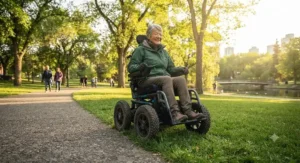
If you’re a retiree with a cottage on a lake in Muskoka or the Kawarthas and your priority is getting from the cottage down a gravel path to the dock and occasionally onto the beach, the AccessRec TerraWheels for sand access paired with a general-purpose power chair for the gravel path covers both surfaces better than any single all-in-one chair would — versatile terrain use sometimes genuinely means owning the right tool for each surface rather than compromising on one.
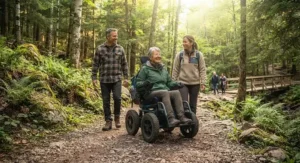
If you’re an active adult who wants to keep hiking gentle provincial park trails — the kind of packed, well-maintained gravel paths Parks Canada’s accessible trails program highlights across national parks and historic sites — the Porto Mobility Ranger Quattro Ultra or Rubicon DX08 make the most sense, since both post genuinely useful ground clearance and range for a half-day outing rather than a quick trip around the block.
And if you’re helping an aging parent regain outdoor mobility around their own property — the yard, the driveway, a walk to the mailbox — without needing serious trail capability, the Forcemech Navigator XL hits a sensible middle ground: strong enough for grass and uneven walkways, foldable enough to stow in a trunk for weekend visits to family, and priced below the true backcountry-oriented chairs on this list.
Common Problems on Rough Terrain (And How to Fix Them)
Even well-reviewed chairs run into predictable snags once you actually get them outdoors. Here’s what shows up most often, and the fix that genuinely works.
Getting stuck in soft sand or mud is the single most common complaint across every manual chair in this category, including the AccessRec TerraWheels — the fix isn’t more force, it’s momentum and a slightly lower tire pressure to widen the contact patch before you hit the soft patch, not after. Tipping on a side slope is a real risk with any wheelchair, and the safest approach on uneven ground is always to cross a slope at as close to a straight angle as possible rather than diagonally, regardless of which chair you’re using. Battery range anxiety on power chairs like the Rubicon DX01 or Drive Medical Trident HD is usually solved by simply charging to full before every outdoor outing rather than topping up partially, since lithium batteries in cold Canadian air lose a meaningful percentage of their rated range compared to indoor testing conditions.
Punctures on chairs without puncture-proof tires are a genuine concern on gravel trails; carrying a compact repair kit or, better yet, choosing a model like the Rubicon DX08 or Porto Mobility Ranger Quattro Ultra with puncture-free wheels from the outset avoids the problem entirely rather than managing it after the fact.
How to Choose an All-Terrain Wheelchair for Outdoor Use
Working through these seven models surfaced a fairly clear decision process. Here’s how to apply it to your own situation.
- Identify your primary terrain first. Sand and boardwalks call for a dedicated manual chair like the AccessRec TerraWheels; gravel trails and moderate inclines call for a powered chair with real ground clearance.
- Match weight capacity honestly, not aspirationally. A rider near 90 kg (200 lbs) has meaningfully less margin on the 136 kg (300 lbs)-rated Rubicon DX01 than on the 204 kg (450 lbs)-rated Drive Medical Trident HD.
- Check ground clearance before motor wattage. As the independent Forcemech Navigator XL review illustrated, a chair can look rugged without the ground clearance to back it up — clearance above 6.4 cm (2.5 in) is a reasonable minimum for anything beyond smooth paths.
- Consider puncture resistance if gravel trails are in your routine. The jump from the Rubicon DX01 to the puncture-proof Rubicon DX08 is a direct answer to this exact concern.
- Plan for Canadian winters realistically. Battery range drops in the cold, so buy more rated range than you think you need if you plan to use a power chair like the Porto Mobility Ranger Quattro Ultra into the shoulder seasons.
- Weigh manual versus powered honestly. Manual chairs like the AccessRec TerraWheels offer zero mechanical failure points but require real physical effort on soft ground; powered chairs solve the effort problem but add weight, cost, and charging logistics.
- Read the fine print on “all-terrain” claims. As this list shows repeatedly, some models marketed as all-terrain are genuinely better described as rugged outdoor-capable — confirm ground clearance, incline rating, and threshold capability rather than relying on the product name alone.
Off-Road Wheelchair for Rough Terrain vs a Standard Wheelchair
It’s worth being explicit about a distinction that gets blurred constantly in marketing copy: an off-road wheelchair for rough terrain and a standard indoor/outdoor wheelchair are built to solve genuinely different problems, and mixing them up leads to real disappointment.
A standard wheelchair, manual or powered, is optimized for smooth, predictable surfaces — hospital floors, sidewalks, ramps — with narrow tires that roll efficiently on hard ground but sink or catch almost immediately on grass, sand, or gravel. An all-terrain model trades some of that indoor efficiency for wider tires, higher ground clearance, and in powered models, more torque per watt, specifically so it can maintain traction and clearance on inconsistent surfaces. The Rubicon DX01 and Drive Medical Trident HD, for instance, are both meaningfully heavier than a comparable standard power chair — a direct consequence of the reinforced frame and larger wheels needed for rough terrain, not a design flaw.
| Feature | Standard Wheelchair | All-Terrain Wheelchair |
|---|---|---|
| Typical tire width | Narrow, hard rubber | Wide, pneumatic or puncture-resistant |
| Ground clearance | Minimal | 5–9 cm (2–3.5 in) typical |
| Best surfaces | Pavement, indoor floors | Grass, gravel, sand, light trails |
| Typical weight | Lighter | Heavier, reinforced frame |
| Best For | Indoor and paved outdoor use | Parks, cottages, backcountry paths |
The practical takeaway from this table is that buying an all-terrain wheelchair for outdoor use is not simply an upgrade over a standard chair — it’s a different tool with real trade-offs in weight and transportability that only make sense if your actual terrain calls for it.
Versatile Terrain Use: All-Terrain Wheelchairs for Seniors and Active Adventurers
Versatile terrain use looks completely different depending on who’s using the chair, and it’s worth being specific about that rather than treating “all-terrain” as a one-size-fits-all category.
For seniors prioritizing safety and stability over speed or range, a chair like the Drive Medical Trident HD — with its higher weight capacity and front suspension — tends to be a better match than a fast, lightweight power chair, since stability on uneven ground matters more than covering long distances quickly. For active adults who hike, camp, or spend significant time at provincial parks, the longer range and adjustable ground clearance on the Porto Mobility Ranger Quattro Ultra genuinely earns its premium price, since a chair that runs out of charge halfway down a trail is a real safety concern, not just an inconvenience.
Families managing outdoor mobility for a child or younger adult with a disability tend to prioritize differently again — the AccessRec TerraWheels‘ manual, no-battery design removes charging logistics entirely for day trips, which several caregivers report values more than raw terrain capability for shorter outings like a single beach afternoon.
Features That Actually Matter: Rugged Wheels, Suspension, and Motors Explained
After comparing spec sheets across all seven of these machines, a few features consistently separated genuinely useful engineering from marketing language.
Rugged wheels — meaning pneumatic or puncture-resistant tires with genuine tread, not just a wider rim — matter enormously, because tire failure is the single most common reason an outdoor mobility outing gets cut short. The jump from the Rubicon DX01‘s standard tires to the Rubicon DX08‘s puncture-proof wheels is a perfect illustration: same core motor and chassis, meaningfully different real-world reliability on gravel. Dual motors, as used in the Forcemech Navigator XL and Porto Mobility Ranger Quattro Ultra, matter for torque on inclines and for redundancy if one motor underperforms, rather than purely for top speed. Suspension, whether the front shocks on the Drive Medical Trident HD or the honeycomb tire design on the Navigator XL, matters for rider comfort over sustained bumpy ground, but it is not a substitute for genuine ground clearance — a well-suspended chair can still bottom out on an obstacle a higher-clearance chair would simply roll over.
Battery capacity claims, on the other hand, deserve more skepticism than most buyers give them. Manufacturer-rated range figures are typically measured on flat, smooth ground at moderate temperature — real-world range on grass, sand, or in cold weather is reliably lower, sometimes by 20–30%, which is worth building into your expectations rather than treating the rated number as gospel.
Long-Term Cost & Maintenance: Is an All-Terrain Wheelchair Worth It?
Sticker price is only part of the financial picture with these chairs, so it’s worth running the numbers on ongoing costs before committing.
| Model | Approx. Price (CAD) | Ongoing Cost Driver | Maintenance Burden |
|---|---|---|---|
| Ultralight Aluminum All-Terrain Wheelchair | C$300–C$500 | Tire wear over time | Low |
| Rubicon DX01 | C$700–C$1,400 | Battery replacement, tire punctures | Moderate |
| Rubicon DX08 | C$1,500–C$2,350 | Battery replacement | Low-moderate |
| Forcemech Navigator XL | C$2,700–C$2,900 | Battery replacement | Moderate |
| AccessRec TerraWheels | C$3,700–C$4,000 | Tire replacement only | Low |
| Drive Medical Trident HD | C$3,900–C$4,200 | Parts availability, servicing | Moderate |
| Porto Mobility Ranger Quattro Ultra | C$4,000–C$5,500 | Dual battery replacement | Moderate |
Reading this table alongside the earlier price comparison, the real long-term calculation favours manual chairs like the AccessRec TerraWheels for lowest ongoing cost, since there’s no battery to eventually replace — typically a C$200–C$400 expense every few years on a power chair. Power chairs justify that added cost with genuinely reduced physical effort, which matters enormously for riders without a strong pushing partner available for every outing. For a household budgeting five-plus years of ownership, established brands like Drive Medical and Forcemech tend to have more accessible replacement parts in Canada than newer entrants, which is worth weighing against a lower up-front price on a less established brand.
✨ Comparing total cost, not just the sticker price? Click through to check today’s Amazon.ca listing before you decide.
All-Terrain Wheelchair Reviews: What Buyers and Experts Actually Say
Pulling together all-terrain wheelchair reviews across this category surfaces a consistent theme worth stating honestly: independent, verified owner-review data is genuinely harder to find for this niche than for mainstream mobility products like standard transport chairs or scooters, simply because the market is smaller and newer.
Where independent testing does exist — like Wheelchairjunkie’s hands-on review of the Forcemech Navigator XL — it tends to confirm that manufacturer terrain claims are often optimistic relative to real-world ground clearance and suspension performance. That doesn’t mean the claims are dishonest, but it does mean a healthy dose of skepticism serves buyers well, and cross-referencing multiple sources beats trusting a single glowing product description. Reviewers consistently emphasize three things across nearly every all-terrain wheelchair for outdoor use they test: real ground clearance matters more than advertised motor wattage, tire puncture resistance is worth paying for on gravel-heavy routes, and manufacturer-rated battery range should be treated as a best-case number rather than a guarantee.
For buyers who can’t find recent, model-specific reviews before purchasing, checking a retailer’s return policy and asking directly about real-world range in cold weather tends to fill the gap better than searching for reviews that may not yet exist for the newest models on the market.
Safety, Certification & Regulations for Canadian Buyers
Every wheelchair sold in Canada, manual or powered, exists within a framework of national safety and accessibility standards worth understanding before you buy.
The CSA Group’s standards for building a barrier-free Canada cover accessibility and mobility-device-adjacent safety requirements across the country, and CSA Group also participates in the international ISO 7176 wheelchair standards series that governs everything from stability testing to brake performance for mobility devices sold across North America. While individual all-terrain wheelchair models aren’t always independently certified against every sub-standard in that series, it’s reasonable to ask a Canadian retailer whether a specific model has undergone relevant safety testing before committing to a purchase in the C$3,000-plus range.
Beyond certification, a real story worth knowing: CBC News covered the experience of a Belle River, Ontario resident whose all-terrain wheelchair genuinely transformed her outdoor mobility, highlighting both the life-changing potential of this category and the very real cost barrier that puts higher-end models out of reach for many Canadian families without provincial or charitable funding support. Checking with your provincial assistive devices program before purchasing is worth the extra step, since partial funding for mobility equipment varies significantly by province and is easy to miss if you only shop retail listings.
FAQ
❓ What is the best all-terrain wheelchair for outdoor use?
❓ How much does an all-terrain wheelchair cost in Canada?
❓ Can a regular wheelchair go off-road?
❓ What is the difference between an all-terrain wheelchair and a standard wheelchair?
❓ Are all-terrain wheelchairs covered by insurance or funding in Canada?
Conclusion
Seven very different machines, one shared goal: getting outside without a standard wheelchair’s narrow tires holding you back. If there’s a single takeaway from putting these side by side, it’s that the right all-terrain wheelchair for outdoor use depends far more on your specific terrain and budget ceiling than on any single spec sheet number. The Ultralight Aluminum All-Terrain Wheelchair and Rubicon DX01 open the door at a genuinely accessible price, the Rubicon DX08 and Forcemech Navigator XL cover the sensible middle ground for parks and gravel paths, the AccessRec TerraWheels solves sand and boardwalk access specifically, and the Drive Medical Trident HD and Porto Mobility Ranger Quattro Ultra cover heavy-duty capacity and maximum range respectively at the premium end.
Whichever one fits your terrain, your budget, and your caregiving situation, the honest advice holds across all seven: check real ground clearance and incline ratings rather than trusting marketing labels alone, plan for reduced battery range in Canadian cold, and confirm the current listed price on Amazon.ca before buying, since pricing on specialty mobility equipment shifts more than the spec sheets do.
✨ Don’t miss the current pricing on these picks!
🔍 Click through to any of the seven all-terrain wheelchairs above to check today’s availability and price on Amazon.ca — a few minutes of comparison now can open up a lot more outdoor ground later.
Recommended for You
- Attendant Commode Wheelchair: 7 Top Picks for Canadian Homes (2026)
- Self-Propelled vs Attendant Commode Wheelchair: 7 Best Picks (2026)
- Shower Commode Chair for Elderly: 7 Safest Picks for 2026
Disclaimer: This article contains affiliate links. As an Amazon Associate, I earn from qualifying purchases. If you purchase products through these links, we may earn a small commission at no additional cost to you.
✨ Found this helpful? Share it with your friends! 💬🤗
