
In This Article
If you’ve ever sat in one spot for three hours and felt that dull, nagging ache settle into your tailbone, multiply that by twenty-four hours a day, seven days a week, and you start to understand why a tilt-in-space wheelchair for pressure sores isn’t a luxury item — it’s closer to a piece of medical infrastructure. For anyone who spends most of their waking (and sometimes sleeping) hours seated, the surface underneath them is doing a job most of us never think about: keeping blood flowing to skin that’s being squeezed between bone and cushion. When that surface can’t move, the skin eventually gives out.
Here’s the thing nobody tells you at the outset: choosing a tilt-in-space wheelchair for pressure sores isn’t really about picking “the best chair.” It’s about matching a specific mechanism — one that shifts your entire seat-to-back angle instead of just reclining the backrest — to your body, your caregiver’s routine, and your budget. Get that match wrong, and even a C$4,000 chair can leave skin breakdown untouched. Get it right, and a more modest model can genuinely change someone’s quality of life.
We dug into real product specifications, aggregated customer and clinical feedback, and Canadian wound-care guidance to build this guide. You’ll find seven real, currently available models spanning lightweight budget options to fully customizable rehab-grade chairs, along with the comparison data, buying criteria, and practical positioning advice that most product listings simply skip over. Prices below are shown in Canadian dollar ranges rather than fixed figures, since Amazon.ca pricing shifts constantly — always check current price before buying.
What Is a Tilt-in-Space Wheelchair for Pressure Sores?
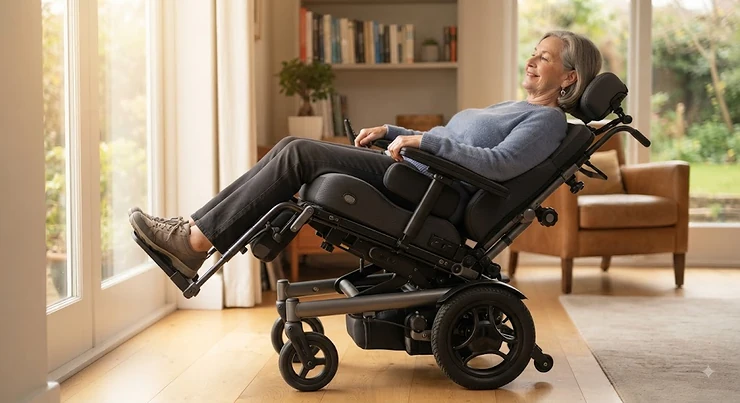
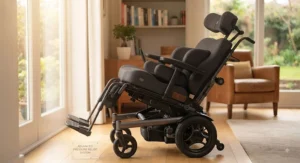
A tilt-in-space wheelchair for pressure sores is a mobility chair that tilts the entire seat-and-backrest unit backward as one fixed angle, rather than reclining just the backrest. This redistributes body weight away from the tailbone and ischial tuberosities toward the back and thighs, reducing sustained pressure and shear force on vulnerable skin.
That last part — shear force — is the detail most casual descriptions leave out, and it’s arguably the more important one. A standard recliner opens the hip angle while your bottom stays glued to the seat pan, which drags skin against fabric as the backrest moves. That dragging motion is shear, and shear is a major contributor to deep tissue injury, not just simple surface pressure. A true tilt-in-space design keeps the seat-to-back angle locked, so the whole unit rotates around a pivot point instead. Your skin moves with the chair rather than against it.
This matters enormously for anyone managing spinal cord injury, advanced neurological conditions, or long-term immobility in long-term care settings, where the Wounds Canada best practice recommendations for skin health and wound management note that the vast majority of pressure injuries are, in fact, preventable with the right equipment and repositioning routine.
Quick Comparison Table
| Product | Tilt Range | Weight Capacity | Price Range (CAD) | Best For |
|---|---|---|---|---|
| Karman VIP-515 | 0°–35° | 250 lbs | C$650–C$900 | Lightweight budget pick |
| Everest & Jennings PureTilt | 5°–40° self-tilt | 250 lbs | C$700–C$950 | Independent self-tilting |
| Drive Medical Kanga Adult | Up to 45° | 250 lbs | C$1,400–C$1,900 | Mid-range LTC/rehab |
| Karman VIP-515-TP-18 | 0°–35° + recline | 250 lbs | C$700–C$950 | Caregiver-assisted transport |
| Drive Medical Kanga 2G Pediatric | Up to 45° | Pediatric-rated | C$1,500–C$2,200 | Growing kids |
| Ki Mobility Focus CR | -5°–50° | Up to 400 lbs (config-dependent) | C$3,000–C$5,500+ | Fully custom premium rehab |
| Broda Elite Tilt | Up to 40° + 90° recline | 350 lbs | C$3,500–C$6,000 | Clinical no-restraint positioning |
Looking at the spread above, there’s a real gulf between the sub-C$1,000 folding chairs and the C$3,000+ rehab-grade options, and that gap isn’t just marketing — it reflects genuine differences in tilt range, bearing quality, and how precisely the chair can be fitted to an individual body. Budget models like the Karman VIP-515 trade custom fit for portability and price, while the Ki Mobility Focus CR and Broda Elite Tilt justify their cost through wider tilt ranges, sealed bearings, and clinical-grade seating systems. If your primary concern is occasional pressure relief and easy transport, the lower end of this table probably covers your needs; if you’re managing an existing pressure injury or complex spinal cord condition, the premium tier earns its price.
💬 Just one click — help others make better buying decisions too!😊
Top 7 Tilt-in-Space Wheelchairs for Pressure Sores: Expert Analysis
1. Karman VIP-515 — lightest folding tilt-in-space chair around
Weighing in at roughly 34 lbs, the Karman VIP-515 is marketed as one of the lightest folding adult tilt-in-space wheelchairs available, and that weight matters more than it sounds — a caregiver lifting this into a trunk daily feels the difference between 34 lbs and the 45–55 lbs typical of steel-framed alternatives. The aluminum frame supports up to 250 lbs, offers 0° to 35° of tilt, and comes with AEGIS anti-microbial upholstery, which resists odour and bacterial buildup better than standard vinyl.
Based on the spec comparison with other budget folding models, the Karman VIP-515 stands out for combining true tilt-in-space geometry (not just recline) with a genuinely foldable frame — a combination that’s rarer than it should be at this price point. It suits users or families who need pressure relief on a budget and who prioritize portability for appointments and outings over the deep customization of a rehab chair.
Reviewers consistently note the chair’s ease of folding and its lighter push weight compared to hospital-style recliners, though some aggregated feedback points to the armrests feeling less padded than premium alternatives — a reasonable trade-off given the price bracket.
Pros:
- ✅ Among the lightest true tilt-in-space frames on the market
- ✅ AEGIS anti-microbial upholstery resists odour and bacteria
- ✅ Folds compactly for transport and storage
Cons:
- ❌ 250 lb capacity limits use for larger-bodied users
- ❌ Armrest padding is thinner than premium rehab chairs
At around C$650–C$900 at the time of research, the Karman VIP-515 offers strong value for anyone whose primary need is basic, genuine tilt-in-space pressure relief without rehab-level customization.
2. Everest & Jennings PureTilt — best for independent self-tilting
The Everest & Jennings PureTilt distinguishes itself with a self-tilt mechanism offering 5° to 40° of adjustment, designed specifically so users with sufficient upper-body strength or mobility can shift their own position without waiting for a caregiver. That independence piece is genuinely underrated in most product descriptions — for someone who can self-propel but can’t always access help every fifteen minutes, being able to trigger a tilt themselves changes the entire pressure-relief routine.
What most buyers overlook about this model is that self-tilt capability doesn’t sacrifice the mechanical stability that makes tilt-in-space safe; the centre of gravity still shifts predictably as the seat unit rotates, so tipping risk stays comparable to caregiver-operated tilt chairs. The 250 lb weight capacity and mid-range dimensions make it a solid fit for adults with partial upper-limb function, including many users managing incomplete spinal cord injuries.
Aggregated user commentary around Everest & Jennings recliner and tilt products tends to highlight the brand’s long manufacturing history in the wheelchair space and generally reliable frame durability, though as with most self-tilt mechanisms, some reviewers flag a learning curve before the tilt lever feels intuitive.
Pros:
- ✅ Self-operated tilt supports user independence
- ✅ 5°–40° range covers most pressure-relief positioning needs
- ✅ Established brand with long manufacturing track record
Cons:
- ❌ Self-tilt requires adequate upper-body strength or dexterity
- ❌ Learning curve for first-time tilt-lever users
Priced around C$700–C$950, the Everest & Jennings PureTilt is a smart pick for anyone who wants pressure relief without giving up self-sufficiency.
3. Drive Medical Kanga Adult — best mid-range rehab and long-term-care pick
The Drive Medical Kanga Adult tilt-in-space wheelchair delivers up to 45° of tilt through a reinforced, crash-tested aluminum frame — meaning it’s rated to meet bus transit safety requirements, a detail that matters enormously for anyone who transports the chair regularly rather than leaving it stationary. The frame folds down to a 12-inch width for storage, and the seating system accepts custom rehab components including hip guides, lateral supports, and a five-point harness.
On paper, this means the Drive Medical Kanga Adult occupies a genuinely useful middle tier: more tilt range and more postural customization than the entry-level folding chairs, without stepping all the way up to the C$3,000+ fully bespoke rehab category. Based on the spec sheet, the 250 lb weight capacity and height-adjustable push handles make it particularly well suited to long-term care facilities and multi-user settings, where the chair needs to serve different caregivers of varying heights.
Reviewers and clinical users commonly cite the Kanga line’s adjustability — width and depth changes without extra hardware — as a standout feature that extends the chair’s useful life as a person’s needs evolve, though the trade-off is a heavier overall build than the ultralight folding models.
Pros:
- ✅ 45° tilt with crash-tested, bus-transit-rated frame
- ✅ Accepts custom rehab seating components
- ✅ Width and depth adjustable without extra parts
Cons:
- ❌ Heavier than lightweight folding alternatives
- ❌ Custom seating add-ons increase total cost
Expect a price in the C$1,400–C$1,900 range, positioning the Drive Medical Kanga Adult as a genuine middle ground between budget and full custom rehab chairs.
4. Karman VIP-515-TP-18 — best for caregiver-assisted transport
Built on the same lightweight aluminum platform as the standard VIP-515, the Karman VIP-515-TP-18 adds transport-chair styling with 14-inch rear wheels, flip-back armrests, and companion-operated brakes, combining tilt-in-space pressure relief with the compact footprint of a transport chair. This is a deliberately different use case from a self-propelled tilt chair: it’s built for caregivers pushing the user through appointments, hallways, and outings where a full-size wheelchair would be cumbersome.
Here’s what the spec sheet won’t tell you outright: the smaller 14-inch rear wheels mean this chair isn’t meant for self-propulsion over distance, but the trade-off buys significant manoeuvrability in tight spaces like clinic corridors or crowded family gatherings — somewhere a large-wheeled tilt chair struggles. The tilt-plus-recline combination lets caregivers fine-tune positioning for comfort during longer outings, not just at home.
Aggregated reviews of the Karman VIP-515 transport line tend to praise the ease of folding for car trunk storage and the desk-height adjustable arm pads for meal trays, while noting that the smaller wheel size does add rolling resistance on uneven outdoor surfaces.
Pros:
- ✅ Combines tilt-in-space with compact transport-chair sizing
- ✅ Companion-operated brakes for caregiver control
- ✅ Height-adjustable desk arm pads for meals and activities
Cons:
- ❌ Not designed for self-propulsion over distance
- ❌ Smaller wheels struggle on rough outdoor terrain
At an estimated C$700–C$950, the Karman VIP-515-TP-18 suits families and facilities that need portable, caregiver-managed pressure relief on the go.
5. Drive Medical Kanga 2G Pediatric — best for growing kids
Children with mobility impairments face the same pressure sore risks as adults, but with the added wrinkle that they outgrow equipment fast — which is exactly the problem the Drive Medical Kanga 2G Pediatric is built to solve. The frame grows from 10 to 14 inches in width without needing new hardware, and it offers up to 45° of tilt for pressure relief and gravity-assisted positioning, matched to a child’s changing body over several years of use.
What most buyers overlook about pediatric tilt chairs specifically is how much positioning support they provide beyond pressure relief alone — proper postural alignment early on can influence how a child’s spine and hips develop over time. The one-handed tilt-in-space control lets a single caregiver operate it smoothly, which matters a great deal during school pickups or clinic visits where extra hands aren’t always available.
Feedback gathered from pediatric rehab suppliers commonly highlights the crash-tested, folding frame as a practical win for families juggling school transport, though as with adult rehab chairs, additional seating components like cushions and contoured backrests are typically purchased separately.
Pros:
- ✅ Grows with the child from 10″ to 14″ width
- ✅ One-handed tilt control for single-caregiver use
- ✅ Crash-tested folding frame for school transport
Cons:
- ❌ Seating cushions and backrests sold separately
- ❌ Requires periodic refitting as the child grows further
Pricing typically falls around C$1,500–C$2,200, which reflects the specialized pediatric engineering behind the Drive Medical Kanga 2G Pediatric.
6. Ki Mobility Focus CR — best fully custom premium rehab chair
At the top end of adjustability sits the Ki Mobility Focus CR, offering an unusually wide -5° to 50° tilt range through what the manufacturer calls a Complex Rotation mechanism — two control paths and centres of rotation designed to minimize the misalignment that plagues cheaper single-pivot tilt systems. The frame itself weighs only about 33 lbs despite supporting configurations up to roughly 400 lbs, and the tilt mechanism runs on eight precision sealed bearings rather than the plastic bushings found in many competitors.
Here’s what the spec sheet won’t tell you, but reviewers and rehab clinicians note repeatedly: the inset tilt mechanism keeps the rear wheels closer to the seat, which noticeably improves self-propulsion efficiency compared to bulkier tilt-in-space designs — a genuinely useful advantage for users who still push themselves some of the time. Based on the spec comparison, the sealed-bearing tilt mechanism (backed by a lifetime warranty on the bearings themselves) is the clearest differentiator between this chair and the mid-range field; plastic components wear and develop play over years of daily tilting, while sealed bearings largely don’t.
Clinical seating specialists commonly recommend the Focus CR as a base for moulded seating systems, and aggregated feedback highlights its stability during tilting — the seat naturally settles to centre rather than slamming forward or back, an important safety detail for users who can’t brace themselves during transitions.
Pros:
- ✅ Industry-leading -5° to 50° tilt range
- ✅ Sealed bearings with lifetime warranty, minimal maintenance
- ✅ Highly customizable for moulded and complex rehab seating
Cons:
- ❌ Premium price reflects extensive customization
- ❌ Requires professional fitting for full benefit
Given the custom configuration options, expect pricing in the C$3,000–C$5,500-plus range, making the Ki Mobility Focus CR an investment best suited to complex, long-term seating needs.
7. Broda Elite Tilt Wheelchair — best for clinical, restraint-free positioning
The Broda Elite Tilt Wheelchair takes a different engineering approach entirely, built around a proprietary Comfort Tension Seating system — a network of adjustable tension straps rather than a rigid seat pan — combined with up to 40° of infinitely adjustable tilt and up to 90° of recline. The steel frame supports up to 350 lbs, and the front-pivot tilt design is specifically engineered to preserve the user’s line of sight during repositioning, which helps maintain social engagement rather than leaving someone staring at the ceiling mid-tilt.
Based on the spec comparison with rigid-seat rehab chairs, the tension-strap seating is the standout feature here: it molds to the body over time and improves airflow across the seating surface, which directly supports skin integrity by reducing the moisture buildup that often accompanies prolonged sitting. What most buyers overlook is the extended lay-flat capability, which allows safer supine transfers and makes catheter or incontinence care meaningfully easier for caregivers — a practical detail that matters daily in long-term care settings, not just occasionally.
Clinical facilities commonly cite the Elite Tilt’s restraint-free positioning as a major advantage for residents with dementia or agitation, since the tension seating and controlled tilt reduce the need for physical restraints while still preventing sliding or falls.
Pros:
- ✅ Tension-strap seating improves airflow and skin integrity
- ✅ Lay-flat capability simplifies transfers and care tasks
- ✅ Restraint-free positioning suitable for dementia care
Cons:
- ❌ Steel frame is heavier than aluminum rehab alternatives
- ❌ Premium clinical pricing reflects specialized seating tech
At roughly C$3,500–C$6,000, the Broda Elite Tilt Wheelchair is positioned squarely for clinical and complex home-care environments where restraint-free positioning is a priority.
How to Choose a Tilt-in-Space Wheelchair for Pressure Sores
Picking the right chair comes down to matching mechanical features to your actual daily routine, not just chasing the widest tilt range on the spec sheet. Here’s how to work through it:
- Confirm true tilt-in-space, not just recline. Check that the seat-to-back angle stays fixed while the whole unit rotates — this is what actually reduces shear, unlike a simple reclining backrest.
- Match tilt range to your risk level. A 30–35° range suffices for general comfort and mild risk; users with existing pressure injuries or complete spinal cord injury often need 45° or more for meaningful pressure redistribution.
- Weigh portability against customization. Lightweight folding frames like the Karman VIP-515 win on transport ease; rehab-grade chairs like the Ki Mobility Focus CR win on precise fit.
- Check weight capacity honestly. Don’t cut it close — a chair rated near a user’s actual weight sees more mechanical stress and less comfortable tilt performance over time.
- Consider who operates the tilt. Self-tilt models like the Everest & Jennings PureTilt support independence; caregiver-operated tilt suits users without the strength or dexterity to self-adjust.
- Factor in the seating surface, not just the frame. A rigid seat pan and a tension-strap system like Broda’s redistribute pressure very differently — the frame is only half the equation.
- Ask about funding before you buy. In Ontario, for example, the Assistive Devices Program helps cover mobility aids including tilt and recline systems, which can significantly offset cost.
Working through these seven criteria in order — mechanism, tilt range, portability, capacity, control method, seating surface, funding — tends to narrow a field of dozens of models down to one or two realistic contenders fairly quickly.
Pressure Relief Wheelchair for Elderly: What Changes With Age
A pressure relief wheelchair for elderly users needs to account for a few things that don’t apply as strongly to younger wheelchair users: thinner skin, reduced subcutaneous fat padding over bony prominences, and often slower healing if a pressure injury does develop. Skin that was resilient at 40 can break down under far less pressure and in far less time at 80, which is why clinical guidance for older adults tends to favour more frequent repositioning and wider tilt ranges rather than relying on a single daily adjustment.
Here’s what most general wheelchair guides miss: elderly users are also more likely to have multiple health conditions simultaneously — reduced mobility, cognitive changes, cardiovascular issues — which affects how much tilt they can tolerate comfortably. A steep, fast tilt can trigger dizziness or blood-pressure drops in some older users, so a chair with smooth, gradual tilt mechanics (like the sealed-bearing system in the Ki Mobility Focus CR) often suits this population better than a chair with an abrupt gas-strut motion.
Lighter frames also matter more here, since many elderly wheelchair users rely on a spouse or adult child as their primary caregiver rather than trained staff. A model like the Karman VIP-515, at roughly 34 lbs, is dramatically easier for a caregiver to lift into a vehicle than a 50-plus-pound steel-framed alternative — a difference that can determine whether outings happen at all.
Comfort Positioning Wheelchair for Spinal Injury: Special Considerations
For users with spinal cord injury, a comfort positioning wheelchair for spinal injury isn’t optional equipment — it’s frontline defence against one of the most common and serious secondary complications of SCI. Because spinal cord injury frequently eliminates or reduces sensation below the level of injury, the body loses its natural early-warning system: the discomfort that would normally prompt someone to shift position simply doesn’t register. That’s precisely why scheduled tilting, not just tilting when it feels necessary, becomes the standard of care.
Based on the spec comparison across our seven featured chairs, the wider tilt ranges — the Ki Mobility Focus CR‘s -5° to 50° and the Drive Medical Kanga Adult‘s 45° — tend to suit complete SCI better than the 30–35° range found on entry-level models, because complete SCI often requires more dramatic pressure redistribution to meaningfully offload the ischial tuberosities and sacrum. Clinical guidelines commonly recommend tilting to at least 45° for a sustained period to achieve meaningful pressure relief, rather than a shallow, brief tilt that doesn’t shift enough weight off the seated surface.
Lateral trunk support also becomes far more important for SCI users than for general mobility users, since reduced core control can lead to leaning and asymmetric pressure distribution even with a good tilt mechanism. This is where rehab-grade seating systems — the kind the Ki Mobility Focus CR and Broda Elite Tilt are built to accept — genuinely earn their higher price over simpler folding chairs.
Tilt-in-Space vs Recline: Which Wheelchair Type Actually Prevents Pressure Ulcers?
This comparison comes up constantly, and the honest answer is that the two mechanisms aren’t interchangeable, even though they’re often marketed as similar. A reclining wheelchair opens the angle between the seat and backrest while the seat pan itself stays roughly fixed under the user — which means the user’s body slides slightly against the seat surface as the backrest opens. That sliding motion is shear force, and shear force is a documented contributor to deep tissue injury, sometimes even more damaging than straightforward pressure alone.
A tilt-in-space wheelchair for pressure sores keeps that seat-to-back angle locked and instead rotates the entire seating unit backward around a pivot point. The user’s position relative to the seat and backrest doesn’t change — only their orientation to gravity does — which largely eliminates the shear component while still redistributing weight away from the tailbone. That’s the core mechanical reason clinicians generally recommend tilt-in-space over simple recline specifically for pressure ulcer prevention, even though recline chairs are often less expensive and more widely available.
That said, recline still has a place: many premium tilt chairs, including the Broda Elite Tilt, actually combine both tilt and recline, using tilt for regular pressure relief and adding recline for tasks like catheter care or full supine positioning where a flatter angle genuinely helps. The takeaway isn’t “tilt good, recline bad” — it’s that tilt should be the primary mechanism for routine pressure relief, with recline layered on top for specific care needs rather than substituted in its place.
Common Mistakes When Buying a Tilt-in-Space Wheelchair
Even well-researched buyers tend to trip over the same handful of pitfalls, and most of them are avoidable with a bit of foresight.
Buying on tilt range alone. A 50° tilt sounds impressive, but if the seating surface underneath is a hard, unpadded pan, the wide tilt range won’t compensate for poor pressure distribution at the skin-cushion interface.
Underestimating transport weight. Families frequently choose a heavier, more feature-rich chair without testing whether it actually fits in their vehicle or whether the primary caregiver can lift it — a mismatch that quietly limits how often the chair leaves the house.
Skipping professional fitting. Especially for rehab-grade chairs like the Ki Mobility Focus CR, ordering based on generic sizing rather than a clinical seating assessment often leads to a poor fit that undermines the chair’s pressure-relief benefits entirely.
Ignoring funding options before purchasing. According to Canadian nursing guidance from the Registered Nurses’ Association of Ontario on skin and wound care, properly prescribed seating systems are a recognized part of pressure injury prevention protocols — which often makes them eligible for provincial funding support that buyers overlook simply because they didn’t ask before purchasing.
Assuming all “tilt” chairs are equal. As covered above, plenty of listings blur the line between recline and true tilt-in-space; always confirm the mechanism explicitly before buying.
Practical Usage Guide: Getting the Most Pressure Relief From Day One
Owning a tilt-in-space wheelchair for pressure sores is only half the equation — using it correctly is what actually protects skin. In the first thirty days, focus on establishing a repositioning schedule rather than tilting only when discomfort sets in; many clinicians recommend tilting to at least 30–45° every hour, or more frequently for higher-risk users, regardless of whether the person feels the need yet.
Set up a simple routine: tilt fully, hold for a minimum of two minutes to allow real reperfusion of compressed tissue, then return to a functional upright position for activity. A common early mistake is tilting only partially and briefly, which feels like a change but doesn’t actually shift enough weight off the seated surface to matter clinically.
Maintenance-wise, check the tilt mechanism monthly for smooth operation — grinding or resistance often signals it’s time to inspect bearings or hardware, particularly on chairs using plastic bushings rather than the sealed bearings found in models like the Ki Mobility Focus CR. Wipe down upholstery weekly, paying particular attention to anti-microbial surfaces like the AEGIS treatment on the Karman VIP-515, which performs best when kept clean rather than allowed to accumulate moisture and skin oils. Inspect cushions and seating surfaces for compression or wear every few months, since a cushion that’s lost its loft can quietly undermine even the best tilt mechanism.
Real-World Scenarios: Matching the Right Chair to the Right User
Scenario one: an active retiree with early-stage pressure risk. A 74-year-old living independently, self-propelling short distances, and managing thinning skin but no active wounds. A lightweight, self-tilting option like the Everest & Jennings PureTilt fits well here — it supports independence while still delivering genuine pressure redistribution, and its 250 lb capacity and manageable weight suit home use without a full-time caregiver.
Scenario two: a young adult with complete spinal cord injury. Living in a shared apartment, attending school part-time, and requiring frequent, scheduled repositioning due to absent sensation below the injury level. Here, the wider tilt range and customizable lateral support of the Ki Mobility Focus CR makes clinical sense, even at a higher price point, because the pressure-relief stakes are significantly higher without sensory feedback to warn of building risk.
Scenario three: a long-term care resident with dementia and existing skin breakdown. Requires restraint-free positioning support and frequent supine access for wound care. The Broda Elite Tilt Wheelchair‘s lay-flat capability and tension-strap seating directly address both needs simultaneously, which is exactly the combination this chair was engineered for.
Matching a chair to a scenario like these — rather than shopping by price or tilt-range number alone — is the single biggest factor in whether a tilt-in-space wheelchair actually prevents further skin damage.
Pressure Ulcer Prevention & Skin Integrity: Problem → Solution Guide
Problem: pressure builds up faster than repositioning happens. Solution — set a phone or caregiver alarm for hourly tilts rather than relying on memory, and choose a chair with an easily accessible tilt lever so the routine doesn’t become a chore that gets skipped.
Problem: skin stays moist under the seating surface. Solution — prioritize breathable, tension-strap or airflow-oriented seating like Broda’s Comfort Tension Seating, and avoid letting anti-microbial upholstery like AEGIS sit unwiped after sweating or incontinence episodes.
Problem: shear damage from partial reclining instead of true tilt. Solution — confirm the chair is genuine tilt-in-space (fixed seat-to-back angle) rather than a simple recliner marketed loosely as “tilt,” since shear is a major driver of deep tissue injury even when surface pressure looks manageable.
Problem: existing pressure injury isn’t improving despite a tilt chair. Solution — this calls for a clinical seating reassessment, not just a schedule tweak; the tilt range, cushion type, or fit may need professional adjustment, and ongoing wounds should always involve a healthcare provider.
Problem: caregivers inconsistently follow the repositioning schedule. Solution — post a simple visual schedule near the chair and choose lighter, easier-to-operate tilt mechanisms so the physical effort of repositioning doesn’t discourage consistency over time.
Maintaining skin integrity ultimately comes down to consistency more than any single piece of equipment — even the best chair only helps if the tilt actually happens on schedule.
Seating Positioning System: More Than Just the Chair Frame
A seating positioning system refers to everything between the wheelchair frame and the user’s body — cushions, back supports, lateral trunk supports, headrests, and harnesses — and it’s frequently the piece that determines whether a tilt chair’s mechanical benefits actually reach the skin. Buying a premium frame like the Ki Mobility Focus CR with a worn-out or mismatched cushion undercuts the investment considerably, since pressure redistribution happens at the contact surface, not the frame itself.
What most buyers overlook is that seating systems and frames are often sold separately in the rehab world, particularly for chairs like the Drive Medical Kanga Adult and Ki Mobility Focus CR, which are explicitly designed as a base to accept third-party or custom seating components. This modularity is actually a strength — it means the frame can last years while the seating system gets updated as needs change — but it also means buyers need to budget for cushions and supports as a genuinely separate line item, not an afterthought.
For users with complex postural needs, moulded seating built specifically to their body contour offers the most precise pressure distribution available, and premium frames with sealed-bearing tilt mechanisms tend to be the recommended base for this kind of custom work, since they hold alignment more reliably over thousands of tilt cycles.
Long-Term Cost & Maintenance: What a Tilt-in-Space Wheelchair Really Costs Over Time
Sticker price only tells part of the story with a tilt-in-space wheelchair for pressure sores, because the mechanical complexity that enables tilt also introduces maintenance considerations a standard rigid wheelchair simply doesn’t have. Bearings, tilt springs or gas struts, and upholstery all see repeated stress over years of daily use, and how well a chair holds up affects total cost of ownership more than the initial purchase price alone.
| Cost Factor | Budget Chairs (e.g., Karman VIP-515) | Premium Chairs (e.g., Ki Mobility Focus CR) |
|---|---|---|
| Initial Price | C$650–C$950 | C$3,000–C$5,500+ |
| Tilt Mechanism Longevity | Moderate; plastic components may wear | High; sealed bearings, lifetime warranty |
| Seating Upgrades | Often required sooner | Built to accept custom seating long-term |
| Best For | Short-to-medium-term or budget-limited needs | Long-term, complex, or high-risk positioning needs |
Interpreting the table above, the lower upfront cost of budget chairs can be a false economy for users with long-term, high-risk pressure needs, since mechanism wear and the likely need for seating upgrades sooner can add up over several years. For lower-risk or shorter-term situations, though, the budget tier remains genuinely cost-effective, and there’s no reason to overspend on rehab-grade engineering nobody needs.
✨ Don’t Miss These Exclusive Deals!
🔍 Take your pressure relief routine to the next level with these carefully selected wheelchairs. Click on any highlighted item to check current pricing and availability. These tools will help you create genuine comfort and skin protection your loved one will benefit from every day!
Buyer’s Decision Framework: If This, Choose That
- If budget and portability matter most and pressure risk is low to moderate, choose a lightweight folding model like the Karman VIP-515, because it delivers genuine tilt-in-space relief without the cost or bulk of a rehab chair.
- If the user can partially self-manage repositioning, choose a self-tilt model like the Everest & Jennings PureTilt, because independence reduces caregiver burden without compromising pressure relief.
- If the setting is long-term care with multiple caregivers, choose an adjustable, crash-tested chair like the Drive Medical Kanga Adult, because it accommodates varied users and transport needs.
- If the user has complete spinal cord injury or existing pressure injury, choose a wide-tilt-range, fully customizable chair like the Ki Mobility Focus CR, because the stakes justify the investment in precision fit.
- If restraint-free positioning and lay-flat care access are priorities, choose the Broda Elite Tilt Wheelchair, because its tension-strap seating and recline combination directly address both needs.
Working through this checklist in order — budget, self-sufficiency, care setting, medical risk level, special care needs — tends to point clearly toward one of the seven chairs covered above.
Funding, Safety & Standards in Canada
Buying medical seating equipment in Canada comes with a few country-specific considerations worth knowing before you check out. Provincially, programs vary, but Ontario’s Assistive Devices Program is a useful example: it can cover a significant share of the approved cost for prescribed mobility and positioning devices, provided the equipment is authorized by a registered occupational therapist or physiotherapist and purchased through a registered vendor. Other provinces run comparable programs under different names, so it’s worth checking with a local rehab clinic before finalizing a purchase.
On the safety side, look for chairs that meet recognized transit and durability testing where relevant — several models in this guide, including the Drive Medical Kanga Adult, are explicitly crash-tested to bus transit standards, which matters if the chair will be transported regularly rather than staying in one location. For weight capacity, always leave a margin rather than buying right at the limit, since chairs under sustained load near their rated capacity tend to show mechanical wear faster and may tilt less smoothly over time.
Finally, remember that a tilt-in-space wheelchair for pressure sores is best selected alongside guidance from an occupational therapist, physiotherapist, or wound care nurse rather than purchased on spec sheets alone — clinical assessment catches positioning needs that a product listing simply can’t.
Frequently Asked Questions
❓ What is the difference between a tilt-in-space wheelchair and a reclining wheelchair?
❓ How often should someone tilt in a tilt-in-space wheelchair to prevent pressure sores?
❓ Can a tilt-in-space wheelchair fully prevent pressure sores?
❓ Is a tilt-in-space wheelchair covered by insurance or government funding in Canada?
❓ How much does a tilt-in-space wheelchair cost in Canada?
Conclusion
Choosing a tilt-in-space wheelchair for pressure sores really comes down to being honest about three things: how much tilt range the user’s risk level actually requires, who will be operating the chair day to day, and how much customization the seating system genuinely needs versus what would just be nice to have. The Karman VIP-515 and Everest & Jennings PureTilt cover most lower-risk, budget-conscious needs extremely well, while the Drive Medical Kanga Adult and Karman VIP-515-TP-18 bridge the gap for caregiver-assisted and long-term-care settings. For complex spinal cord injury, existing pressure injuries, or restraint-free clinical positioning, the Ki Mobility Focus CR and Broda Elite Tilt Wheelchair justify their premium pricing through precision engineering that genuinely protects vulnerable skin.
Whichever chair fits your situation, remember that the equipment is only one half of prevention — a consistent tilting routine, regular skin checks, and honest conversations with an occupational therapist or wound care professional matter just as much as the specs on the box. Pressure sores are stubborn, slow-healing, and genuinely preventable in most cases, and the right chair is the tool that makes prevention actually practical day after day.
✨ Don’t Miss These Exclusive Deals!
🔍 Take your pressure relief routine to the next level with these carefully selected wheelchairs. Click on any highlighted item to check current pricing and availability. These tools will help you create genuine comfort and skin protection your loved one will benefit from every day!
Recommended for You
- Junior Wheelchair for Active Kids: 7 Top Picks in Canada (2026)
- Growing Wheelchair for Kids With Disabilities: 7 Top Picks
- Paediatric Wheelchair for Toddlers: 7 Real Options Compared
Disclaimer: This article contains affiliate links. As an Amazon Associate, I earn from qualifying purchases. If you purchase products through these links, we may earn a small commission at no additional cost to you.
✨ Found this helpful? Share it with your friends! 💬🤗
