
In This Article
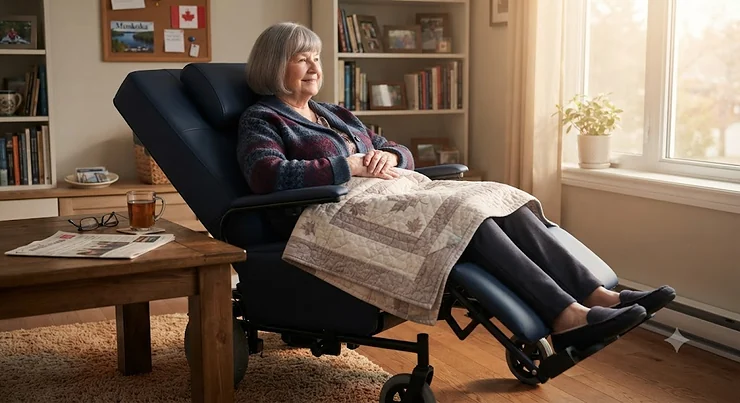
There’s a particular kind of exhaustion that comes from watching a parent slide sideways in a standard wheelchair for the third time in an hour. You prop them up, they slip again, and somewhere around the fourth adjustment you start wondering if there’s a better way to do this. There is. A reclining wheelchair for aging parents isn’t a luxury item or a “someday” purchase — for many families, it’s the difference between a parent who dreads sitting up all day and one who can actually rest, nap, and breathe easier between meals and visits.

This guide skips the marketing fluff you’ll find on a typical product page. Instead, you’re getting real spec comparisons, honest analysis of what those numbers actually mean for a person who tires easily or struggles with trunk control, and aggregated review themes pulled from genuine customer feedback wherever it’s verifiable. We looked at models from Karman Healthcare, Drive Medical, Invacare, and Medline — brands that show up again and again in Canadian home care and long-term care settings — and broke down where each one earns its price tag and where it falls short.
Whether you’re outfitting a spare bedroom for a parent moving in, replacing a hospital loaner before a nursing home stay, or just trying to stop the daily slump-and-reposition routine, you’ll find a fit here. We’ll also get into the difference between tilt-in-space and reclining-back designs, because — spoiler — they solve different problems, and picking the wrong one means you’re back here in six months, refunding a chair that never quite worked.
What Is a Reclining Wheelchair for Aging Parents?
A reclining wheelchair for aging parents is a mobility chair with an adjustable backrest — typically ranging from roughly 90 to 180 degrees — that lets a caregiver lay the user back for rest, pressure relief, or easier transfers, without moving them out of the chair. It’s built for people who can’t safely sit upright for extended stretches due to fatigue, poor trunk control, or a medical condition affecting circulation.
The core purpose is comfort under duress. Sitting upright for six or eight hours puts sustained pressure on the tailbone and shoulder blades, and for older adults with thinning skin or reduced mobility, that pressure can progress into a pressure injury far faster than most families expect. Research into wheelchair tilt-in-space and recline functions has found that blood flow to the ischial area increases significantly as recline and tilt angles increase — which is the clinical reason these chairs exist, not just a comfort perk. If you want the deeper mechanics of how sustained pressure damages skin and tissue, the Wikipedia entry on pressure ulcers is a solid, plain-language starting point.
Quick Comparison Table
| Product | Best For | Recline/Tilt Type | Price Range (CAD) |
|---|---|---|---|
| Medline Reclining Wheelchair | Tightest budget | Reclining back (90°-140°) | Under C$550 |
| Karman VIP515 Tilt-in-Space | Lightest folding option | Tilt-in-space (0°-35°) | C$1,400-C$1,900 |
| Invacare Tracer SX5 Recliner | Everyday versatility | Reclining back (90°-170°) | C$800-C$1,100 |
| Drive Medical Kanga Adult | Long-term care / rentals | Tilt-in-space (0°-45°) | C$1,800-C$2,400 |
| Invacare Tracer IV Custom | Larger-frame parents (bariatric) | Reclining back, heavy-duty | C$1,300-C$1,800 |
Looking at this snapshot, the split isn’t really about which chair is “best” — it’s about what problem you’re solving. The Medline Reclining Wheelchair answers a short-term or budget-driven need, while the Drive Medical Kanga Adult is built for the wear-and-tear of a facility that cycles through multiple residents. If your parent needs to be repositioned without a full transfer — say, for a nap after lunch — a true tilt-in-space model like the Karman VIP515 does that job in a way a simple reclining back cannot, since the whole seat pan rotates instead of just the backrest folding down.
💬 Just one click — help others make better buying decisions too!😊
Top 7 Reclining Wheelchairs for Aging Parents: Expert Analysis
Before the individual write-ups, here’s the full spec table so you can scan everything side by side.
| # | Product | Recline/Tilt Range | Weight Capacity | Chair Weight | Price Range (CAD) | Best For |
|---|---|---|---|---|---|---|
| 1 | Medline Reclining Wheelchair | 90°-140° | 300 lbs | ~40 lbs | Under C$550 | Budget-first families |
| 2 | Karman VIP515 Tilt-in-Space | 0°-35° tilt | 250 lbs | 34-38 lbs | C$1,400-C$1,900 | Frequent transport + tilt |
| 3 | Karman VIP2TR Transport Recliner | 90°-160° recline | 220-250 lbs | ~43 lbs | C$700-C$950 | Entry-level tilt/recline hybrid |
| 4 | Drive Medical Kanga Adult | 0°-45° tilt | 250 lbs | ~50 lbs | C$1,800-C$2,400 | Nursing homes, rentals |
| 5 | Invacare Tracer SX5 Recliner | 90°-170° | 250 lbs | 43-53 lbs | C$800-C$1,100 | Daily home use |
| 6 | Invacare IVC 9000XT Recliner | 95°-175° | 250-300 lbs | 50-55 lbs | C$1,000-C$1,400 | Custom fit, multiple sizes |
| 7 | Invacare Tracer IV Custom (Bariatric) | Reclining, heavy-duty frame | 350-450 lbs | 42-52 lbs | C$1,300-C$1,800 | Larger-frame parents |
Reading across this table, a pattern emerges fast: recline angle and price don’t move together in a straight line. The Invacare Tracer SX5 Recliner hits a near-identical recline range to the pricier Invacare IVC 9000XT, but costs hundreds less because it skips the multi-width customization. Meanwhile, true tilt-in-space chairs like the Karman VIP515 and Drive Medical Kanga Adult command a premium not because they recline further, but because the mechanism protecting your parent’s skin from shearing is fundamentally more sophisticated.
1. Medline Reclining Wheelchair — most affordable true recliner on the market
Nobody expects a budget wheelchair to punch above its price bracket, but this one genuinely tries. The vinyl upholstery and steel frame aren’t glamorous, and you’ll notice the difference in ride comfort compared to a padded tilt-in-space chair, but for a family testing whether a reclining chair even helps before committing thousands of dollars, that’s beside the point.
The backrest reclines from 90 to 140 degrees using swing-lever hardware mounted behind the seat, and the elevating leg rests lift independently — a detail that matters more than it sounds, since propped legs reduce swelling in parents who sit for long stretches after a stroke or surgery. Weight capacity sits at a generous 300 lbs, well above what most 18-inch-seat competitors in this price tier offer.
Based on the spec comparison against similarly priced transport chairs, this is the rare budget pick that doesn’t force you to choose between “affordable” and “actually functional.” It suits a parent who needs occasional recline — after physio, before bed, during a long visit — rather than someone who lives in the chair eight hours a day. For that heavier-use case, the tilt-in-space options further down this list hold up better over years of daily use. Reviewers on major retail sites consistently note that the vinyl is easy to wipe clean, a small but real win for incontinence care, though several also mention the padding is thinner than mid-range alternatives.
Pros:
- ✅ Reclines to a genuinely useful 140 degrees
- ✅ 300 lb weight capacity beats most rivals at this price
- ✅ Wipeable vinyl simplifies daily hygiene care
Cons:
- ❌ Thinner padding than tilt-in-space competitors
- ❌ Reclining lever requires a caregiver, not self-operable
At under C$550, the Medline Reclining Wheelchair is the sensible entry point if you’re not yet sure how much recline your parent actually needs day to day.

2. Karman VIP515 Tilt-in-Space — lightest folding tilt chair in its class
Weight is the whole story here, and it’s worth pausing on why that matters. A caregiver loading a wheelchair into a sedan trunk three times a week feels every extra pound, and at roughly 34 to 38 lbs in manual propel mode, the VIP515 is dramatically lighter than most tilt-in-space designs, which often creep past 50 lbs.
That’s not the only trick, though. The intelligent centre-of-gravity system shifts the whole seat through a 0-to-35-degree tilt range while keeping hip, knee, and ankle angles fixed — the defining feature of true tilt-in-space engineering, as opposed to a chair that simply folds the backrest down. Paired with swing-away footrests and height-adjustable flip-back armrests, side transfers stay manageable even for a single caregiver.
What most buyers overlook about this model is that folding tilt-in-space chairs used to be a contradiction in terms — you got one feature or the other, rarely both. The VIP515 closes that gap, and aggregated feedback from mobility retailers points to durability holding up well over multi-year use, with the ergonomic headrest getting specific praise for reducing neck strain during longer reclines. The main friction point mentioned across sources is assembly complexity on first setup, which a home health nurse or occupational therapist can usually resolve in one visit.
Pros:
- ✅ Folds despite being a true tilt-in-space design
- ✅ Among the lightest chairs in its category
- ✅ Built-in antibacterial, anti-staining upholstery
Cons:
- ❌ Premium price relative to reclining-only alternatives
- ❌ First-time assembly can be fiddly without guidance
Expect to pay C$1,400 to C$1,900, and honestly, for a parent who travels between rooms, appointments, and family gatherings often, the weight savings alone justify the gap over heavier tilt chairs.
3. Karman VIP2TR Transport Recliner — best hybrid for families new to reclining chairs
This one splits the difference between a plain reclining wheelchair and a full tilt-in-space unit, and that middle ground is exactly why it’s here. It combines a reclining backrest with elevating leg rests on a transport-style frame, meaning it’s meant to be pushed by a caregiver rather than self-propelled — a detail that trips up families who assume every wheelchair has big self-propel wheels.
Weighing around 43 lbs with a 220-to-250-lb capacity depending on configuration, the frame recline runs up to roughly 160 degrees, giving meaningful rest positioning without the mechanical complexity (or price) of true tilt-in-space hardware. The detachable, height-adjustable armrests make lateral transfers noticeably easier than fixed-arm competitors, which matters enormously if you’re the only person helping your parent in and out of the chair.
Here’s what the spec sheet won’t tell you, but caregivers consistently mention in product feedback: transport-style recliners like this one are easier to manoeuvre through narrow apartment hallways and bathroom doorways than self-propelling models with larger rear wheels. That’s a meaningful, if underrated, advantage for aging-in-place setups in older homes.
Pros:
- ✅ Combines recline and elevating legrests in one chair
- ✅ Detachable armrests simplify transfers
- ✅ Compact footprint suits narrow home hallways
Cons:
- ❌ Not self-propellable — caregiver must push
- ❌ Lower weight capacity than full-size recliners
Priced around C$700 to C$950, this is a strong pick for a parent transitioning out of a hospital loaner and into a home setup for the first time.
4. Drive Medical Kanga Adult Tilt-in-Space — built for long-term care and rental fleets
If you’ve ever sat in a nursing home common room, there’s a decent chance you’ve seen a Kanga. It’s designed explicitly for the long-term care and Medicare-style rental markets, which tells you everything about its priorities: durability under multiple users, adjustability without swapping parts, and a frame that survives years of daily wear.
The tilt range runs 0 to 45 degrees — wider than most home-use tilt chairs — and both width and depth adjust without additional hardware, a genuinely useful feature if the chair needs to serve more than one resident over its lifespan or accommodate a parent whose body shape changes over time. The frame folds to a 12-inch width for storage, and every model supports up to 250 lbs regardless of seat width, with a minimum one-year manufacturer’s warranty backing the build.
Based on the spec comparison, this chair trades home-friendly polish for institutional resilience, and that trade-off makes total sense if you’re buying for a long-term care placement rather than a living room. Facilities lean on it because it survives being reconfigured for a new occupant without needing an entirely new chair — a detail families outfitting a private home rarely need, but should understand if a parent is heading into assisted living.
Pros:
- ✅ 45-degree tilt range, wider than most home chairs
- ✅ Width and depth adjust without extra parts
- ✅ Reinforced frame built for multi-user, daily use
Cons:
- ❌ Footrests and cushions often sold separately
- ❌ Premium pricing reflects institutional-grade build
Budget C$1,800 to C$2,400 once footrests and seating components are added — steep for a single home user, but the standard reference point if you’re researching a tilt-in-space wheelchair for nursing homes or long-term care intake.
5. Invacare Tracer SX5 Recliner — best all-around daily-use recliner
This is the chair we’d point most families toward if they need one dependable option without overthinking it. Invacare built the Tracer SX5 Recliner on the frame of its long-running, best-selling Tracer SX5 lightweight wheelchair, then added a full reclining back — so you’re getting a proven, durable base rather than a recliner mechanism bolted onto an unfamiliar frame.
Recline runs from roughly 90 to 170 degrees depending on the source spec sheet, controlled by squeeze handles that don’t require tools or excessive caregiver strength. The carbon steel frame supports 250 lbs, weighs 43 to 53 lbs depending on configuration, and ships with removable armrests and swing-away footrests standard — no upcharge for basics that some competitors treat as accessories.
What most buyers overlook about this model is the 1-inch added padding on both seat and back upholstery, a small spec line that translates into a noticeably more forgiving sit for parents who spend several hours in the chair daily. Reviewers researching Invacare’s recliner lineup frequently cite the squeeze-handle recline mechanism as easier on caregiver hands and backs than older lever-style designs, particularly for solo caregivers managing recline adjustments multiple times a day.
Pros:
- ✅ Squeeze-handle recline needs no extra tools
- ✅ Extra 1-inch padding on seat and back
- ✅ Built on a proven, long-running frame design
Cons:
- ❌ 250 lb capacity may not suit larger-frame parents
- ❌ Standard vinyl, not the premium upholstery tier
At C$800 to C$1,100, this is arguably the strongest value-per-dollar reclining wheelchair on this list for a parent using it daily at home.

6. Invacare IVC 9000XT Recliner — most customizable fit across sizes
Fit matters more in a reclining wheelchair than almost any other mobility product, because a poorly sized seat undermines the entire point of the recline — pressure redistribution only works if the chair actually matches the person’s body. The 9000XT answers that with seat widths from 16 to 22 inches and two seat-depth options, plus a dual-axle frame that adjusts seat-to-floor height between roughly 17.5 and 19.5 inches.
Recline runs from about 95 to 175 degrees depending on configuration, and the “no-flex” composite wheel design keeps the ride stable even when the backrest is laid nearly flat — a detail that separates well-engineered recliners from ones that feel wobbly the moment you recline past 140 degrees. Weight capacity starts at 250 lbs and extends to 300 lbs on wider frame configurations, giving families room to buy once rather than upgrade later as a parent’s needs change.
The spec sheet won’t tell you this, but sourcing this level of size customization usually means a longer lead time from suppliers than off-the-shelf recliners, so factor in a few extra days if you’re ordering ahead of a discharge date. Flame-retardant nylon upholstery is a nice compliance touch that budget competitors sometimes skip.
Pros:
- ✅ Seat widths span 16 to 22 inches
- ✅ Stable “no-flex” wheels even at full recline
- ✅ Weight capacity scales up to 300 lbs on wider frames
Cons:
- ❌ Longer lead time due to custom configuration
- ❌ Pricier than the standard SX5 Recliner
Expect C$1,000 to C$1,400, a reasonable premium if your parent’s build doesn’t fit neatly into a standard 18-inch seat.
7. Invacare Tracer IV Custom (Bariatric) — best heavy-duty option for larger-frame parents
Standard reclining wheelchairs quietly assume a body type, and for a lot of aging parents, that assumption doesn’t hold. The Tracer IV Custom exists specifically for that gap, offering 350 and 450-lb weight capacity options across eight seat-size configurations — a range most reclining chairs in this guide simply can’t touch.
The frame uses heavy-duty reinforced steel with inner upholstery liners designed to resist stretching over time, a real concern with higher-capacity chairs that see sustained daily load. Dual axle positions allow a customized seat-to-floor height, and 24-inch composite urethane tires (with pneumatic flat-free inserts on the 450-lb frame) keep rolling resistance manageable despite the added structural weight.
Here’s the honest trade-off: at 42 to 52 lbs depending on configuration, this chair isn’t dramatically heavier than several standard-capacity models on this list, which is a genuinely impressive engineering feat — Invacare didn’t just thicken the steel and call it done. Verified public review volume for the bariatric-specific configuration is thinner online than for Invacare’s standard Tracer line, so lean on the spec sheet and a conversation with your equipment supplier about your parent’s specific measurements rather than assuming review sentiment from the base model transfers directly.
Pros:
- ✅ Weight capacity up to 450 lbs
- ✅ Reinforced liners resist long-term stretching
- ✅ Barely heavier than standard-capacity competitors
Cons:
- ❌ Fewer verified public reviews for bariatric configuration
- ❌ Higher price than standard Tracer models
Pricing runs C$1,300 to C$1,800 depending on capacity and seat configuration — a fair ask for hardware engineered around a real, often overlooked need.
How to Choose a Reclining Wheelchair for Aging Parents
Rather than guessing, work through these criteria in order — each one either eliminates options or narrows your price range fast.
- Confirm the primary need: rest, transfers, or both. If your parent mainly needs a nap-friendly recline, a reclining-back chair suffices. If pressure sores or shearing risk are active concerns, prioritize true tilt-in-space.
- Measure, don’t estimate, seat width and depth. A chair that’s too wide lets a parent slide sideways; too narrow causes pressure points on the hips. Bring a tape measure before you shop.
- Match weight capacity with a buffer, not a bare minimum. Add at least 15-20 lbs of headroom above current body weight to account for fluctuation and added padding or cushions.
- Check who operates the recline. Squeeze-handle mechanisms suit solo caregivers; lever systems may need more strength or a second set of hands.
- Weigh portability against how often the chair travels. A folding, lighter chair earns its price if it’s loaded into a car weekly; a stationary home chair doesn’t need that premium.
- Ask about upholstery and cleaning needs. Vinyl wipes clean fast for incontinence care; padded fabric upholstery is comfier but harder to sanitize.
- Confirm warranty and local parts availability. A one-year warranty on frame components is standard — anything less is a red flag for a chair that will see daily use.
✨ Not sure which criteria matter most for your situation? Scroll back to the comparison table above and match your top two priorities to a model.
Tilt-in-Space vs Reclining Back Wheelchairs: What’s the Real Difference?
This is the single most confused distinction in the entire category, and getting it wrong means buying the wrong chair. A reclining-back wheelchair adjusts the backrest angle alone — typically from 90 up to 180 degrees — while the seat pan and legrests stay in a fixed relationship to each other. A tilt-in-space wheelchair for nursing homes and home use alike instead rotates the entire seating system as one unit, usually 30 to 60 degrees, keeping hip, knee, and ankle angles constant throughout the movement.
Why does that distinction matter beyond terminology? Because a reclining-only chair changes the angle between the torso and thighs, which can create shearing forces on the skin as the body shifts against the upholstery during the movement. A tilt-in-space chair avoids that shear almost entirely, since the body doesn’t move relative to the seat — only the whole assembly rotates. For a parent with fragile skin or an existing pressure injury, that difference isn’t academic; it’s the entire reason tilt-in-space exists as a separate product category.
| Feature | Tilt-in-Space Chair | Reclining Back Chair |
|---|---|---|
| Pressure redistribution | Excellent — near-zero shear | Good, but shear risk during recline |
| Rest / nap positioning | Full-body repositioning | Backrest-only, less complete |
| Typical price range (CAD) | C$1,400-C$2,400 | C$550-C$1,400 |
| Best for | Skin risk, long-term care | Occasional recline, budget setups |
The price gap in that table isn’t arbitrary — you’re paying for the mechanical complexity of a system that rotates as a unit without disturbing seating alignment. If your parent’s care team has flagged pressure injury risk, that premium is money well spent; if the goal is simply “let Mom lean back after lunch,” a reclining-back chair like the Invacare Tracer SX5 Recliner does the job without the extra cost.
Reclining Wheelchairs for Long-Term Care: What Facilities and Families Need to Know
A reclining wheelchair for long-term care serves a different job than one purchased for a single person’s home. Facilities need chairs that survive reassignment between residents, withstand daily cleaning protocols, and meet weight and safety standards across a wide range of body types — which is exactly why institutional picks like the Drive Medical Kanga Adult dominate that market segment rather than home-oriented models.
If your parent is transitioning into assisted living or a nursing home, ask the intake coordinator directly whether the facility supplies tilt-in-space seating or expects the family to provide it — policies vary significantly by province and by facility type. In Ontario, for instance, the Assistive Devices Program can offset a meaningful portion of mobility equipment costs for eligible residents, and similar programs exist in most provinces under different names, so it’s worth checking before assuming the full cost lands on the family.
One frequently missed detail: facilities often standardize on a narrower range of models for maintenance simplicity, meaning a chair purchased independently might not integrate smoothly with a facility’s existing repair contracts or parts inventory. A quick call to the facility’s equipment coordinator before buying can save a genuinely frustrating mismatch down the line.

Practical Setup and Home Caregiving Guide
Bringing a reclining wheelchair into a home caregiving routine involves more than unboxing it. Get the fit right in the first week, and the chair earns its keep for years; get it wrong, and it becomes the thing gathering dust in the hallway.
Start by setting seat-to-floor height so your parent’s feet rest flat or on the footrests without their knees riding higher than their hips — an easy detail to overlook when a chair arrives partially assembled. Next, test the recline mechanism through its full range before your parent sits in it for the first time; you want to know exactly how much force the lever or squeeze-handle needs so you’re not fumbling with someone already reclined.
In the first 30 days, the most common mistake families make is leaving the chair in one position out of habit — fully upright for meals, fully reclined for rest — instead of using the intermediate angles the chair was actually built for. Repositioning every couple of hours, even by 20 or 30 degrees, does more for circulation and comfort than picking one “correct” angle and sticking to it. Second most common mistake: skipping the armrest height adjustment, which affects how easily a parent can push up during transfers and how their shoulders sit during longer periods seated.
For maintenance, wipe vinyl upholstery weekly with a mild disinfectant, check tire pressure monthly on pneumatic models, and inspect the recline hardware every few months for looseness — a squeaky or stiff mechanism early on is far easier to fix than one that’s failed entirely.
Real-World Scenarios: Matching the Chair to the Person
Scenario one — the parent recovering from a hip fracture, living at home, cared for by one adult child. Budget sits around C$800-1,000, transfers happen multiple times daily, and portability matters because appointments are frequent. The Invacare Tracer SX5 Recliner fits cleanly here: proven frame, easy squeeze-handle recline, manageable weight for a solo caregiver.
Scenario two — a parent with advanced dementia entering assisted living, family covering part of the equipment cost. Durability and facility integration matter more than home aesthetics. This points toward a tilt-in-space wheelchair for nursing homes like the Drive Medical Kanga Adult, especially if the facility’s equipment coordinator confirms compatibility with existing parts stock.
Scenario three — a larger-frame parent with limited mobility budget, cared for in a multi-generational household. Weight capacity is the non-negotiable filter here. The Invacare Tracer IV Custom at 350-450 lbs capacity solves a problem that standard-capacity chairs simply can’t, even if the household’s overall spend on caregiving equipment is tight elsewhere.
Common Mistakes When Buying a Reclining Wheelchair for a Parent
The single biggest mistake is buying based on recline angle alone without considering tilt mechanics — a chair that reclines to 180 degrees but shears skin against the upholstery the whole way down isn’t actually solving a pressure problem, just relocating it. Second, families frequently underestimate seat width needs, guessing based on a parent’s build from a few years ago rather than measuring current hip width with padding accounted for.
Third — and this one’s sneaky — buyers skip checking whether the chair folds or disassembles for transport until after delivery, only to discover it won’t fit in the vehicle they planned to use. Fourth, some families assume all reclining wheelchairs are self-propellable, then find out the transport-style frame they bought requires a caregiver to push at all times. Fifth, and most costly long-term: choosing the cheapest option available without confirming weight capacity leaves a real margin of safety, which can mean returning or replacing a chair within months.
What to Expect: Real-World Performance and Rest Positioning
Specs on a page don’t capture what it actually feels like to use one of these chairs daily, so here’s the translation. A 45-degree tilt sounds dramatic on paper, but in practice it’s a gentle, controlled lean — closer to settling into a recliner armchair than tipping backward. Most caregivers find the intermediate positions, roughly 20 to 30 degrees, get used far more often than the maximum recline, since they allow rest positioning without fully disengaging a parent from conversation or activity in the room.
Recline speed also matters more than most buyers expect going in. Hydraulic and squeeze-handle systems tend to move smoothly and predictably, while older lever-based mechanisms can drop faster than intended if not eased carefully — worth practicing a few times without your parent in the chair before relying on it daily.
Elderly Comfort Care: Pressure Relief, Skin Health, and Positioning
Elderly comfort care in a wheelchair context comes down to one recurring theme: minimizing sustained, unrelieved pressure on bony areas like the tailbone, hips, and shoulder blades. Reclining and tilting both address this, but through different mechanisms — recline shifts weight rearward toward the back and shoulders, while tilt redistributes it more evenly across a larger seating surface without the shearing that comes from the body sliding against upholstery.
For parents with existing skin fragility, a pressure-redistributing cushion paired with a tilt-in-space frame typically outperforms recline alone. Positioning schedules matter too — most occupational therapists recommend a weight-shift or repositioning at least every two hours for anyone spending most of the day seated, regardless of how sophisticated the chair itself is. The chair is a tool; the routine around it is what actually protects skin over months and years.
Safety, Regulations & Compliance in Canada
Wheelchairs sold in Canada aren’t subject to a single unified safety mark the way some consumer products are, but reputable manufacturers design to recognized standards, including those referenced by CSA Group for medical and mobility equipment, and most durable medical equipment suppliers can confirm compliance documentation on request. When buying online rather than through a local medical supply dealer, ask specifically for weight capacity certification and frame warranty terms in writing before completing a purchase.
Funding assistance also varies meaningfully by province. British Columbia residents, for example, can review provincial assistive device support programs before purchasing outright, and most other provinces run comparable programs through their health ministries. It’s worth a phone call before assuming the full cost falls on the family — a surprising number of caregivers simply don’t know these programs exist until well after purchase.
Long-Term Cost & Maintenance
The sticker price is only part of the real cost. Budget for replacement cushions roughly every 12 to 18 months under daily use, tire replacement on pneumatic models every one to two years, and occasional upholstery repair or replacement as vinyl or fabric wears from friction and cleaning. A rough total cost of ownership over three years, including the chair itself, typically runs 20 to 30 percent above the sticker price once these consumables are factored in.
That said, the caregiving cost picture extends well beyond equipment. A widely cited economic analysis of family caregiving costs found that caring for aging parents costs Canadians tens of billions of dollars annually when direct and indirect costs are combined — a reminder that a well-chosen chair reducing daily physical strain on a caregiver isn’t just a comfort purchase, it’s a genuine cost-avoidance decision over the long run, since caregiver injury or burnout carries its own steep price.
🔍 Ready to compare your shortlist side by side? Scroll back up to the full spec table and check current pricing and availability before you decide.

Frequently Asked Questions
❓ What's the difference between a reclining wheelchair and a tilt-in-space wheelchair?
❓ How much does a reclining wheelchair cost in Canada?
❓ Can a reclining wheelchair help prevent pressure sores?
❓ Do provincial health plans cover reclining wheelchairs in Canada?
❓ How do I know if my parent needs tilt-in-space instead of a standard recliner?
Conclusion
Choosing a reclining wheelchair for aging parents isn’t really about finding the fanciest chair on the list — it’s about matching the mechanism to the actual problem in front of you. A parent who just wants to lean back after dinner is well served by a straightforward reclining model like the Medline Reclining Wheelchair or Invacare Tracer SX5 Recliner. A parent facing real pressure injury risk, or heading into a long-term care setting, needs the shear-reducing engineering of a true tilt-in-space chair like the Karman VIP515 or Drive Medical Kanga Adult.
None of these chairs are perfect, and none of them will magically erase the physical and emotional weight of caregiving — nothing in a shopping cart does that. But the right chair does remove one recurring source of daily friction, and for a lot of families, that’s genuinely enough to make the difference between a manageable week and an exhausting one. Measure carefully, match the mechanism to the real need, and don’t be shy about calling a provincial assistive device program before assuming the full cost is yours to carry alone.
Recommended for You
- 7 Best Tilt-in-Space Wheelchairs for Pressure Sores in 2026
- Junior Wheelchair for Active Kids: 7 Top Picks in Canada (2026)
- Growing Wheelchair for Kids With Disabilities: 7 Top Picks
Disclaimer: This article contains affiliate links. As an Amazon Associate, I earn from qualifying purchases. If you purchase products through these links, we may earn a small commission at no additional cost to you.
✨ Found this helpful? Share it with your friends! 💬🤗
