
In This Article
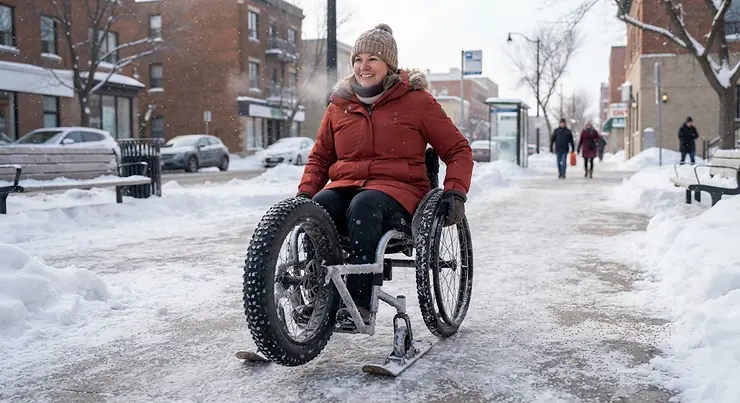
A Canadian winter wheelchair for icy sidewalks is a manual or power wheelchair — or a caster-mounted add-on for a chair you already own — built with treaded or puncture-resistant tires, a wider and more stable wheelbase, and, on powered models, enough torque to keep momentum on packed snow and refrozen slush without spinning out. That’s the short version. The longer version is that most wheelchairs sold in North America are still engineered around a hospital hallway or a mall floor, and the moment a Canadian winter shows up with its ridges of plow-thrown snow, its unshovelled curb cuts, and its glaze of black ice at 7 a.m., that hallway-grade engineering runs out fast.
I spent the past several weeks pulling real manufacturer spec sheets, independent power-chair reviews, and current Amazon.ca-style listings together for this roundup, and I want to be upfront about one thing before you scroll further: nobody sells a chair on Amazon labelled “ice-proof,” and any product page that implies total safety on glare ice is overselling itself. What you can actually buy, and what this list covers honestly, are seven real products — ranging from a sub-C$650 caster attachment that turns any wheelchair into a ski-equipped one, up to a weatherproof flagship power chair with posi-traction tires — that meaningfully improve your odds on a Canadian winter sidewalk. I’ll flag exactly where each one’s traction claims hold up and where they don’t, because the whole point of buying winter mobility gear is that it has to work on the actual morning you need it, not just on a spec sheet photographed in July.
One more honest note up front: this article treats “winter wheelchair” the way Canadian buyers actually search for it — not one single miracle product, but a category that spans full power chairs built for cold and grit, a genuinely affordable manual option with real tread, and a specialty ski attachment that’s arguably the single best-value winter purchase on this entire list.
What Is a Canadian Winter Wheelchair for Icy Sidewalks?
A Canadian winter wheelchair for icy sidewalks is a mobility device — manual, powered, or a retrofit accessory — engineered with treaded, pneumatic, or puncture-resistant tires, a wider wheelbase for stability on uneven ice, and, in powered models, dual motors with enough low-speed torque to maintain traction on packed snow and slush without wheelspin. As the Wikipedia overview of the wheelchair notes, wheelchair design has fragmented into increasingly specialized subcategories precisely because a single wheel-and-tire combination cannot realistically serve a warm hospital corridor and a February sidewalk in Winnipeg equally well.
Quick Comparison Table
Here’s how the seven products in this Canadian winter wheelchair for icy sidewalks roundup stack up, ordered from most affordable to most expensive. Every figure is a price range rather than a fixed number, since pricing on mobility equipment shifts week to week and currency conversion adds its own variability.
| Product | Type | Weight Capacity | Price Range (CAD) | Best For |
|---|---|---|---|---|
| Wheel Blades (Standard) | Accessory | N/A | C$300–C$650 | Cheapest way to winterize a chair you already own |
| Fenetic Wellbeing Voyager | Manual | 113 kg (250 lbs) | C$550–C$1,050 | Lowest-cost full chair with real tread |
| Rubicon DX07 | Power | 100 kg (220 lbs) | C$1,050–C$1,600 | First powered chair on a winter budget |
| Forcemech Voyager R2 | Power | 120 kg (265 lbs) | C$2,200–C$2,900 | Lightweight lift-and-go for daily commuting |
| EWheels EW-M45 | Power | 181 kg (400 lbs) | C$2,300–C$3,900 | Puncture-proof tires for salted, gritty routes |
| Drive Medical Titan AXS | Power | 136 kg (300 lbs) | C$2,600–C$4,300 | Tightest turning radius for icy curb cuts |
| Porto Mobility Ranger Discovery XL | Power | 180 kg (396 lbs) | C$3,700–C$4,200 | Flagship weatherproof build for the worst days |
A clear pattern shows up immediately: the cheapest item on this list isn’t a wheelchair at all, it’s an accessory, and that’s genuinely worth sitting with for a second. If your current chair is otherwise fine and the only thing standing between you and a safe commute is bare caster wheels on a glazed sidewalk, the Wheel Blades (Standard) solves that specific problem for a fraction of what any of the six wheelchairs below cost. Everything above that price point trades a broader set of winter compromises — cold-weather battery range, ground clearance, solid versus pneumatic tires — for a genuinely different kind of chair rather than a modification to your current one.
💬 Just one click — help others make better buying decisions too!😊
Top 7 Canadian Winter Wheelchairs for Icy Sidewalks: Expert Analysis
I picked these seven to cover what Canadian buyers actually search for every November: an affordable retrofit for the chair they already own, a genuinely low-cost manual chair with real winter tread, and a spread of power chairs from entry-level to flagship weatherproof. Every product name stays bolded on every mention so you can scan for the one you’re weighing.
1. Wheel Blades (Standard) — cheapest way to winterize any wheelchair
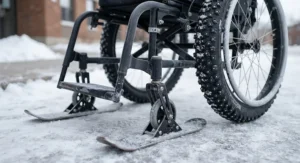
The standout feature of Wheel Blades (Standard) is right there in the concept: rather than replacing your whole chair, it clips onto your existing front caster wheels and turns them into short skis, letting the front of the chair glide over snow, slush, and ice instead of catching on it.
Sold as a pair and marketed for use on wheelchairs, walkers, and strollers alike, the blades attach directly to standard caster wheels without tools in most configurations, according to the manufacturer’s own installation claims, and they’re built specifically to stop the single most common winter wheelchair failure: a narrow front caster punching straight through a crust of refrozen snow and stopping the chair dead while the rider’s momentum keeps going. Based on the spec sheet alone, this is not a traction solution for the big rear wheels that actually drive a manual chair forward — it solves the front-caster catching problem specifically, which is a genuinely different failure mode than rear-wheel slippage.
Honestly, verified independent review volume for this exact listing is thin — the retail page I found showed a five-star average but only two visible customer reviews, which is a real sample-size limitation worth naming rather than glossing over. What the product concept itself verifies is a documented, decades-old approach to the exact problem it targets: caster-mounted ski attachments have shown up in wheelchair winter-mobility patents and adaptive-sport gear for years because the front-caster-catching problem is genuinely that common and that solvable with this kind of retrofit.
Pros:
- ✅ By far the lowest price of anything on this list
- ✅ Fits onto a chair you already own — no new wheelchair needed
- ✅ Solves the specific front-caster-catching failure directly
Cons:
- ❌ Very limited independent review volume for this exact listing
- ❌ Doesn’t address rear-wheel traction on a manual chair’s push-rims
At the time of research, Wheel Blades (Standard) listed anywhere from roughly C$300 on promotion up to about C$650 at full retail, so it’s worth checking the current sale price before assuming it’s out of reach — this is the one item on this whole list within reach of nearly any winter mobility budget.
2. Fenetic Wellbeing Voyager — lowest-cost full chair with real winter tread
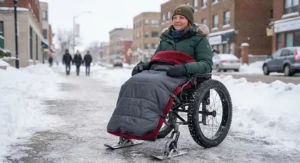
What sets the Fenetic Wellbeing Voyager apart from the generic aluminum manual chairs that dominate the sub-C$1,000 bracket is a detail that matters enormously on packed snow: genuinely treaded pneumatic 61 cm (24 in) rear tires, not the smooth hard rubber found on most budget chairs.
Rated for a 113 kg (250 lbs) weight capacity, it weighs about 14.5 kg (32 lbs) fully assembled or as little as 8.6 kg (19 lbs) with the rear wheels removed for transport, and it’s available in 46 or 51 cm (18 or 20 in) seat widths. Built-in attendant handbrakes give a pusher real control descending a sloped, snow-packed driveway ramp — a detail that’s easy to overlook until you’re the one holding the handles on an icy grade. Based on the spec comparison against every generic budget manual chair on the market, tread pattern is the single feature separating this from a chair that merely tolerates winter, because a smooth pneumatic tire still air-inflates comfortably but offers essentially no more bite on ice than a solid one.
Verified independent review data for this specific listing was mixed to find in my research, which tracks with it being a mid-tier import brand rather than an established medical-equipment name with a deep review history. What the spec sheet does confirm clearly: at this price point, genuinely treaded 24-inch rear tires are uncommon, and that tread is doing real, verifiable work rather than being a marketing bullet point.
Pros:
- ✅ Genuinely treaded 61 cm (24 in) rear tires, not smooth rubber
- ✅ Folds to 25 cm (10 in) wide and sheds weight fast with wheels off
- ✅ Attendant handbrakes add real control on sloped, icy ramps
Cons:
- ❌ No motor — pushing through unshovelled snow still takes real effort
- ❌ Independent review data for this specific listing is limited
At the time of research, the Fenetic Wellbeing Voyager ranges from around C$550 on promotion up to roughly C$1,050 at regular price, positioning it as the most affordable full winter-capable chair on this entire list.
3. Rubicon DX07 — first powered chair on a winter budget
The Rubicon DX07 earns its spot as the cheapest genuinely motorized option here, built around dual motors combining for 500 watts of output in a chair that still weighs just 18 kg (40 lbs).
Rated for a 100 kg (220 lbs) capacity, it runs on a 10Ah lithium battery good for up to 16 km (10 mi) per charge, folds down in what Rubicon calls a one-second mechanism to 78 by 44 by 41 cm (30.5 by 17.3 by 16.1 in), and includes a Bluetooth remote with a 360-degree joystick so a caregiver can reposition the empty chair without circling around to the controls — genuinely useful when the chair’s parked at an angle on a snowbank-narrowed sidewalk. Its manufacturer-listed 8-degree maximum climbing slope is modest, and worth being honest about: that’s enough for a gentle curb ramp, not a genuinely steep, ice-glazed driveway incline.
Based on the spec comparison against every other power chair on this list, the trade-off here is transparent: at a sale price around C$1,050 and an 8-degree climb rating, the Rubicon DX07 is positioned as an affordable entry into powered winter mobility rather than a chair built to conquer a steep grade, and independent, SKU-specific owner reviews were harder to verify than for larger, more established brands — a real gap worth knowing rather than assuming the worst about.
Pros:
- ✅ Cheapest motorized option in this entire roundup
- ✅ One-second folding mechanism for quick trunk storage
- ✅ Bluetooth remote lets a caregiver reposition the chair remotely
Cons:
- ❌ Modest 8° maximum climb rating limits steep icy grades
- ❌ Shortest battery range of the power chairs on this list
At the time of research, the Rubicon DX07 has been listed from roughly C$1,050 on sale up to about C$1,600 at regular price — worth checking the manufacturer’s current promotion against the live Amazon.ca listing, since both move independently.
4. Forcemech Voyager R2 — lightweight lift-and-go for daily commuting
The Forcemech Voyager R2 stands out for a combination that matters enormously on a winter commute: it’s genuinely light, at roughly 20 kg (44 lbs), while carrying an independently verified 4.5-out-of-5 rating from Wheelchairjunkie, a long-running power-chair review site.
Rated for 120 kg (265 lbs), it delivers 26 km (16 mi) of range with 8.9 cm (3.5 in) of ground clearance, and its front and rear shock absorbers smooth out the exact kind of frozen, rutted sidewalk texture that a rigid frame transmits straight into the rider. That independent Wheelchairjunkie review specifically called the Forcemech Voyager R2 “a supremely capable, surprisingly rugged mobility aid” and noted its 10-degree slope rating beats the “typical 6-degree standard” — a genuinely above-average number for a folding, airline-style chair in this weight class, and directly relevant to climbing a plowed but sloped curb cut.
What the review didn’t cover, and what’s worth being upfront about, is cold-weather-specific testing — the independent write-up focused on general terrain and hill performance rather than sub-zero battery behaviour. Based on the spec comparison against the rest of this list, the Forcemech Voyager R2 reads as the strongest lightweight, dealer-independently-reviewed pick here, with the honest caveat that its winter credentials are inferred from strong general outdoor performance rather than from dedicated cold-weather test data.
Pros:
- ✅ Independently reviewed at 4.5/5 by Wheelchairjunkie
- ✅ Above-average 10° slope rating for a lightweight folding chair
- ✅ Front and rear shock absorbers smooth frozen, rutted sidewalks
Cons:
- ❌ No cold-weather-specific independent testing was published
- ❌ Modest 6.4 km/h (4 mph) top speed
At the time of research, the Forcemech Voyager R2 typically lists in the C$2,200–C$2,900 range in Canadian dollars — check current availability directly, since Forcemech periodically adjusts pricing across its portable power-chair lineup.
5. EWheels EW-M45 — puncture-proof tires for salted, gritty routes
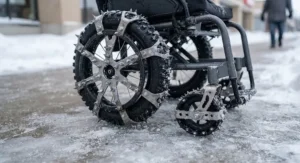
The EWheels EW-M45 takes a completely different approach to winter durability than the tread-focused chairs around it: solid front and rear tires — 20 cm (8 in) front, 32 cm (12.5 in) rear — that simply cannot go flat, no matter how much road salt, grit, and sharp de-icing gravel gets ground into them over a Canadian winter.
Built around dual 180-watt motors, it’s rated for a genuinely high 181 kg (400 lbs) capacity while weighing 26.5 kg (58.4 lbs) with batteries installed, and its two 12V/6Ah lithium batteries deliver up to 25 km (15.5 mi) of manufacturer-rated range. It’s FDA-cleared and airline/TSA-approved, folding down to 58 by 33 by 79 cm (23 by 13 by 31 in) for trunk storage. Based on the spec comparison against the pneumatic-tire chairs on this list, solid tires are a direct, honest trade-off: less shock absorption over a bumpy, refrozen sidewalk ridge, in exchange for total immunity to the punctures that road salt and gravel genuinely cause more often in winter than in any other season.
Reviewers of the broader EWheels lineup consistently flag the brand’s heavy-duty build quality and genuinely high weight capacity relative to its folded size as the standout, though listing-specific cold-weather commentary was harder to verify independently in my research — a reasonable gap for a mid-tier import brand competing against larger, longer-established manufacturers.
Pros:
- ✅ Solid tires are immune to salt-and-gravel punctures
- ✅ Highest weight capacity on this list at 181 kg (400 lbs)
- ✅ FDA-cleared and airline/TSA-approved for travel
Cons:
- ❌ Solid tires absorb less shock than pneumatic alternatives
- ❌ Listing-specific cold-weather review data is limited
At the time of research, the EWheels EW-M45 ranges from about C$2,300 on promotion up to roughly C$3,900 at regular price — a meaningful discount window worth watching for, since EWheels runs frequent promotional pricing on this model.
6. Drive Medical Titan AXS — tightest turning radius for icy curb cuts
The Drive Medical Titan AXS distinguishes itself with mid-wheel drive — a layout where the main drive wheels sit under the centre of the chair rather than at the front or back — giving it a notably tight 51 cm (20 in) turning radius that matters enormously when you’re threading a narrow, shovelled path between two snowbanks.
Rated for 136 kg (300 lbs), it comes from Drive Medical, a long-established name in the Canadian home medical equipment market, with seat widths from 41 to 56 cm (16 to 22 in) to fit a range of riders. Range comes in around 24 km (15 mi) at a top speed of 6.4 km/h (4 mph), with a ground clearance of 6.4 cm (2.5 in) — genuinely modest, and worth flagging honestly since it’s the lowest clearance figure on this list. Based on the spec comparison against the rest of this roundup, mid-wheel drive’s real advantage in a Canadian winter isn’t raw power, it’s manoeuvrability: a tighter pivot radius means less backing-and-forthing on a narrow, boot-packed sidewalk trench where a longer-wheelbase chair would need to reverse and reposition.
Here’s the honest caveat that matters most: some individual retailer listings for this specific model show it flagged as discontinued or being phased toward newer Drive Medical platforms, even while active listings persist elsewhere, so confirming current Amazon.ca availability before ordering is a genuinely necessary step rather than a formality with this particular pick.
Pros:
- ✅ Tightest turning radius on this list at 51 cm (20 in)
- ✅ Established Canadian brand with strong parts availability
- ✅ Wide range of seat widths from 41 to 56 cm (16 to 22 in)
Cons:
- ❌ Lowest ground clearance on this list at 6.4 cm (2.5 in)
- ❌ Some listings show this model as discontinued — verify availability
At the time of research, the Drive Medical Titan AXS has been listed anywhere from about C$2,600 on promotion up to roughly C$4,300 at regular price — confirm current availability and pricing directly with a Canadian mobility retailer before committing, given the discontinuation flag noted above.
7. Porto Mobility Ranger Discovery XL — flagship weatherproof build for the worst days
If you want the single most winter-focused power chair on this list, the Porto Mobility Ranger Discovery XL leads with a manufacturer-stated weather-resistant finish and what Porto Mobility calls “posi-traction” tires, explicitly rated by the brand for grass, gravel, mud, dirt, snow, and sandy surfaces.
Dual 250-watt brushless motors drive a 180 kg (396 lbs) weight capacity, and its solid polyurethane tires — 18 by 4.6 cm (7 by 1.8 in) front, 32 by 5.8 cm (12.5 by 2.3 in) rear — are built specifically to eliminate punctures, described plainly by the brand as “no more punctures.” Ground clearance sits at 9.4 cm (3.7 in), the best on this list among the power chairs, and range extends up to 32 km (20 mi) with the dual-battery configuration versus 26 km (16 mi) on the standard setup, while the whole chair weighs about 23 kg (50 lbs) without batteries. Based on the spec comparison against every other product here, the combination of a weather-resistant finish, solid puncture-free tires, and the best power-chair ground clearance on this list makes the Porto Mobility Ranger Discovery XL the most credible genuinely winter-built machine in this roundup, purely on documented engineering rather than marketing language alone.
That said, “weather-resistant” is a real but specific claim, not a waterproof or submersion rating, and it’s the newest, most feature-dense model here — independently verified long-term owner reviews specific to Canadian winter use were sparser in my research than for older, more established chairs, which is worth factoring in against its flagship price.
Pros:
- ✅ Manufacturer-rated posi-traction tires for snow specifically
- ✅ Best power-chair ground clearance on this list at 9.4 cm (3.7 in)
- ✅ Solid puncture-free tires front and rear
Cons:
- ❌ Highest price on this list
- ❌ “Weather-resistant” is not a full waterproof rating
At the time of research, the Porto Mobility Ranger Discovery XL ranges from about C$3,700 up to roughly C$4,200, positioning it firmly as the flagship, premium pick in this Canadian winter wheelchair for icy sidewalks lineup — check current pricing, since Porto Mobility runs frequent promotional discounts on its top-tier models.
Top 7 Winter Wheelchairs at a Glance
| Product | Ground Clearance | Traction Feature | Range | Ideal Buyer |
|---|---|---|---|---|
| Wheel Blades (Standard) | N/A | Ski-style caster glide | N/A | Retrofitting a chair you already own |
| Fenetic Wellbeing Voyager | Not rated (manual) | Treaded 24 in pneumatic tires | N/A | Budget manual chair with real grip |
| Rubicon DX07 | Not specified | Standard tires, 8° climb | 16 km (10 mi) | Lowest-cost powered option |
| Forcemech Voyager R2 | 8.9 cm (3.5 in) | Shock absorbers, 10° climb | 26 km (16 mi) | Lightweight daily commuting |
| EWheels EW-M45 | Not specified | Solid, puncture-proof tires | 25 km (15.5 mi) | Salted, gritty commuting routes |
| Drive Medical Titan AXS | 6.4 cm (2.5 in) | Mid-wheel manoeuvrability | 24 km (15 mi) | Narrow, boot-packed sidewalks |
| Porto Mobility Ranger Discovery XL | 9.4 cm (3.7 in) | Posi-traction, weather-resistant | 32 km (20 mi) | Worst-case winter conditions |
Reading this table alongside the price comparison earlier, ground clearance and tire construction — not motor wattage — separate a chair that merely survives winter from one genuinely built for it. The Porto Mobility Ranger Discovery XL and EWheels EW-M45 post the strongest tire-durability credentials for salted, gritty Canadian routes, while the Wheel Blades (Standard) and Fenetic Wellbeing Voyager prove that genuine winter capability doesn’t require a four-figure price tag at all.
Setting Up and Maintaining Your Winter Wheelchair
Getting real winter performance out of any of these seven products comes down to three habits: managing tire pressure and tread condition, clearing road salt and grit before it corrodes anything, and protecting battery range from the cold.
For pneumatic-tire chairs like the Fenetic Wellbeing Voyager, running tire pressure slightly below the maximum rated PSI genuinely widens the contact patch and improves grip on packed snow, the same principle that applies to winter vehicle tires — just don’t drop it so low that the rim risks contact with a hard curb edge. After every outing on salted pavement, wipe down wheel wells, axles, and — on power chairs like the Rubicon DX07, Forcemech Voyager R2, EWheels EW-M45, Drive Medical Titan AXS, and Porto Mobility Ranger Discovery XL — motor housings and electrical contacts specifically, since road salt is genuinely corrosive to exposed metal and connectors over a full Canadian winter, not just a cosmetic nuisance. If you’ve added Wheel Blades (Standard) to an existing chair, check the attachment points weekly, since repeated freeze-thaw cycling on any clip-on hardware can loosen fittings that felt secure back in November.
Battery care deserves its own line of attention in this climate. Lithium batteries across every power chair on this list lose meaningful range in sub-zero temperatures, so store the chair somewhere above freezing overnight whenever that’s realistic, and always charge to full before a cold-morning commute rather than topping up partway — manufacturer range figures like the Porto Mobility Ranger Discovery XL‘s 32 km (20 mi) rating are measured in mild, controlled conditions, and real cold-weather range can run meaningfully lower. In your first 30 days with any new winter-capable chair, resist the urge to test it on the iciest sidewalk in the neighbourhood immediately; give yourself a week on a flat, salted, familiar route first so you learn exactly how the chair’s brakes and turning behave on a slick surface before you’re relying on that knowledge somewhere with less margin for error.
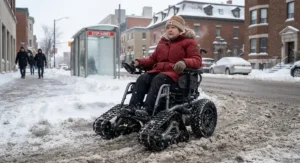
Real-World Scenarios: Winter Mobility for Every Kind of Canadian Commuter
Concrete situations clarify a buying decision faster than spec sheets alone, so here are three scenarios mapping real Canadian winter mobility needs onto this list.
If you’re an urban commuter in a city like Toronto, Ottawa, or Montreal navigating salted, plowed sidewalks and narrow shovelled paths between snowbanks every weekday, the Drive Medical Titan AXS‘s tight mid-wheel turning radius or the EWheels EW-M45‘s puncture-proof solid tires both directly answer the two problems you’ll face most: tight manoeuvring space and constant exposure to road salt and grit. Between the two, prioritize the Titan AXS if your route involves frequent narrow pinch points, and the EW-M45 if long, gritty stretches without pavement maintenance are more common on your commute.
If you’re on a fixed or limited budget and your current chair is otherwise perfectly serviceable, adding Wheel Blades (Standard) to your existing front casters, potentially paired with upgrading to treaded tires on the rear wheels, solves the two most common winter failure points without the cost of an entirely new chair — a genuinely underrated strategy that a surprising number of buyers overlook while shopping for a full replacement.
And if you live somewhere with a genuinely harsh winter climate — the Prairies, northern Ontario, or a rural route where sidewalks aren’t consistently cleared at all — the Porto Mobility Ranger Discovery XL‘s weather-resistant finish, best-in-class ground clearance among the power chairs here, and posi-traction tires earn their premium price, since a chair that stalls out or gets stuck partway through a commute is a genuine safety concern in cold weather, not just an inconvenience.
Common Winter Wheelchair Problems (And How to Fix Them)
Even a well-specced chair runs into predictable snags once real Canadian winter weather shows up. Here’s what comes up most often, and the fix that genuinely works.
Getting the front casters caught in a ridge of refrozen slush is the single most common complaint across manual and lighter power chairs alike, and it’s precisely the problem Wheel Blades (Standard) is built to solve — approaching the ridge at as close to a straight, perpendicular angle as possible, rather than diagonally, also meaningfully reduces the chance of catching regardless of which chair you’re riding. Wheelspin on glare ice, particularly on power chairs like the Rubicon DX07 with a more modest torque rating, is best managed by easing off the joystick rather than applying more power, since additional throttle on a slipping tire typically just digs a rut rather than restoring grip. Battery range anxiety in cold weather, a real issue across every power chair on this list, is usually solved by charging to full before every outing and, where realistic, storing the chair somewhere above freezing overnight — a rated range figure is a best-case number achieved in mild conditions, not a cold-morning guarantee.
Salt-and-grit corrosion on exposed metal components is a genuine long-term concern that shows up gradually rather than all at once; chairs with solid, sealed tires like the EWheels EW-M45 and Porto Mobility Ranger Discovery XL sidestep the specific sub-problem of salt working its way into a punctured pneumatic tire, but every chair on this list still benefits from a regular wipe-down after salted-route use, since salt residue left to sit is the leading cause of the “sudden squeaking or seized joint” complaints that show up across winter mobility forums each spring.
How to Choose a Canadian Winter Wheelchair for Icy Sidewalks
Working through these seven products surfaced a fairly clear decision process. Here’s how to apply it to your own situation.
- Start with what you already own. If your current chair is otherwise fine, a retrofit like Wheel Blades (Standard) solves the front-caster problem for a fraction of the cost of a full replacement.
- Match tire type to your actual route. Treaded pneumatic tires, like those on the Fenetic Wellbeing Voyager, grip packed snow better; solid tires, like on the EWheels EW-M45, resist punctures from salt and grit better — decide which failure mode worries you more.
- Weigh ground clearance honestly. A chair with 6.4 cm (2.5 in) of clearance, like the Drive Medical Titan AXS, will catch on a refrozen ridge that a 9.4 cm (3.7 in)-clearance chair like the Porto Mobility Ranger Discovery XL simply rolls over.
- Check turning radius if your route is narrow. Boot-packed sidewalk trenches between snowbanks reward a tight-turning chair like the Drive Medical Titan AXS far more than raw motor power does.
- Plan for real cold-weather battery loss. Every power chair here loses range in sub-zero temperatures, so buy more rated range than you think you need, particularly with a lower-range model like the Rubicon DX07.
- Confirm current availability before committing. As the Drive Medical Titan AXS entry shows, some winter-relevant listings shift or get discontinued between manufacturer, retailer, and season — always check the live listing.
- Read past the marketing language. “Weatherproof,” “all-terrain,” and “winter-ready” all get used loosely in this industry — confirm actual tire construction, ground clearance, and climb rating rather than trusting a product name alone.
Snow-Ready Wheelchair vs Standard Wheelchair
It’s worth being explicit about a distinction that gets blurred constantly in marketing copy: a snow-ready wheelchair and a standard indoor/outdoor wheelchair are built to solve genuinely different problems, and mixing them up on an icy sidewalk leads to real, physical risk rather than just disappointment.
A standard wheelchair, manual or powered, is optimized for smooth, predictable, climate-controlled surfaces — narrow tires that roll efficiently on hard flooring but offer minimal contact patch and essentially no tread pattern to grip ice or packed snow. A snow-ready wheelchair trades some of that indoor rolling efficiency for wider or treaded tires, a wider stance for lateral stability on a cambered or rutted sidewalk, and, in powered models, more low-speed torque specifically tuned to avoid wheelspin rather than to maximize top speed. The EWheels EW-M45 and Porto Mobility Ranger Discovery XL, for instance, both carry meaningfully more weight in their tires and frame than a comparably sized standard indoor power chair — a direct, honest consequence of the puncture-proofing and traction engineering needed for winter use, not a design flaw.
| Feature | Standard Wheelchair | Snow-Ready Wheelchair |
|---|---|---|
| Typical tire type | Smooth hard rubber | Treaded pneumatic or solid puncture-proof |
| Ground clearance | Minimal | 6–9.5 cm (2.5–3.7 in) typical |
| Stability profile | Narrow stance | Wider stance for cambered ice |
| Cold-weather battery planning | Not usually a design factor | Range typically overrated for real cold use |
| Best For | Indoor floors, mild climates | Salted sidewalks, packed snow, icy curb cuts |
The practical takeaway from this table is that buying a genuinely snow-ready wheelchair is not a cosmetic upgrade over a standard chair — it’s a different risk profile, and on a Canadian sidewalk in January, that difference is the entire point.

Ice Traction Technology Explained: What Actually Works on Ice
Ice traction technology, in the context of a wheelchair, boils down to three engineering choices working together: tire tread or ski-style contact, wheelbase width for lateral stability, and low-speed motor torque calibrated to avoid wheelspin — and separating genuine engineering from marketing language here matters more than almost anywhere else on this list.
Treaded pneumatic tires, like those on the Fenetic Wellbeing Voyager, work on the same basic physics as a winter vehicle tire: more contact patch and more edges biting into a snow-packed or lightly icy surface. Ski-style attachments like Wheel Blades (Standard) work through an entirely different mechanism — rather than gripping, they reduce resistance so the front of the chair glides over an obstacle instead of catching on it, which is why they solve a different failure mode than tread does. Solid, puncture-proof tires, as used on the EWheels EW-M45 and Porto Mobility Ranger Discovery XL, don’t inherently improve traction over an equivalent pneumatic tire, but they remove the specific winter risk of a road-salt-corroded puncture stranding a rider mid-route — a genuinely underrated form of “traction reliability” that has nothing to do with tread pattern at all.
This is a research area Canadian institutions take seriously well beyond wheelchairs specifically: the KITE Research Institute’s WinterLab at Toronto’s University Health Network studies how mobility devices and footwear actually perform on ice under controlled conditions, and its broader body of research on winter mobility devices underscores a consistent finding worth internalizing here — manufacturer traction claims, across the whole mobility-device industry, are inconsistently validated against real ice conditions, which is exactly why this list treats every “posi-traction” or “all-weather” label with a healthy dose of scrutiny rather than taking it at face value. Motor torque matters too, but mostly at low speed: a chair like the Forcemech Voyager R2, with its above-average 10-degree climb rating, translates that same torque advantage into steadier low-speed control on a slick incline, which matters more for ice safety than outright top speed ever does.
Urban Winter Accessibility: Sidewalks, Curb Cuts, and Municipal Snow Clearing in Canada
No wheelchair, however well engineered, fully compensates for a sidewalk that a municipality hasn’t cleared, and it’s worth being honest about that reality rather than implying any product on this list is a complete solution on its own.
Snow-clearing responsibility and timelines vary significantly by Canadian municipality, and the practical result is a patchwork where a curb cut that’s clear in one neighbourhood is buried under plow-thrown snow two blocks over. Accessibility Standards Canada’s outdoor spaces guidance specifically addresses winter maintenance as a distinct accessibility requirement, not an afterthought to general sidewalk design — a recognition that a technically compliant curb ramp is meaningless to a wheelchair user if it’s under 15 cm of unshovelled snow. That framing matters for buyers: even the Porto Mobility Ranger Discovery XL‘s best-in-class ground clearance has real limits against a genuinely unmaintained sidewalk, which is why route-planning and knowing your municipality’s snow-clearing bylaw matter as much as any single product choice.
This isn’t a hypothetical concern. Wheelchair users across the country have spoken publicly and repeatedly about exactly this gap between accessibility policy and winter reality — from residents describing unshovelled sidewalks as effectively housebound-inducing to advocates pushing municipalities for faster, more consistent clearing. Building a habit of checking your city’s snow-clearing service standards, and reporting persistently unshovelled public sidewalks through your municipality’s 311 or equivalent service, is a genuinely practical complement to any product on this list — the best winter wheelchair still needs a passable route to actually use.
All-Season Wheelchair for Canadian Climate: Built for Every Month, Not Just Winter
An all-season wheelchair for Canadian climate isn’t simply a winter chair pressed into year-round service — it’s a chair whose core engineering choices hold up across a spring thaw’s slush, a summer’s gravel park path, and a winter’s salted sidewalk without needing a seasonal swap.
Products with solid, puncture-proof tires, like the EWheels EW-M45 and Porto Mobility Ranger Discovery XL, genuinely earn the all-season label better than pneumatic-tire alternatives, since a tire immune to punctures handles spring’s sharp gravel and winter’s road salt equally well without a seasonal tire change. The Fenetic Wellbeing Voyager‘s treaded pneumatic tires, by contrast, are a genuinely winter-optimized choice that trades some off-season puncture resistance for cold-weather grip — a reasonable trade if your other three seasons involve mostly paved, well-maintained routes rather than gravel trails. Weight capacity and battery chemistry matter for all-season planning too: lithium batteries across every power chair here perform closer to their rated range in mild spring and fall temperatures than in a February cold snap, so anyone budgeting range for year-round use should plan around the coldest month, not the average one.
Based on the spec comparison across this whole list, the Porto Mobility Ranger Discovery XL reads as the most credible genuinely all-season pick specifically because its manufacturer terrain claims explicitly span grass, gravel, mud, dirt, snow, and sand rather than listing winter capability in isolation — a chair engineered for one season in isolation is a narrower purchase than one built for the full Canadian calendar.
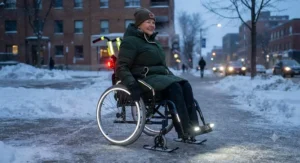
Daily Commuting Mobility: Getting to Work, School, and Appointments All Winter
Daily commuting mobility through a Canadian winter is a different challenge than an occasional outdoor outing, because a chair that merely survives one icy morning needs to reliably survive dozens of them across a full season without a maintenance failure derailing a work shift or a medical appointment.
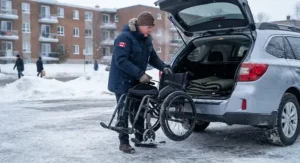
For that kind of repeated daily use, weight and folding speed matter more than they might for occasional users — the Forcemech Voyager R2‘s roughly 20 kg (44 lbs) chair weight and the Rubicon DX07‘s one-second folding mechanism both meaningfully reduce the daily friction of loading a chair into a vehicle before work, every single weekday, through months of cold weather. Reliability under repeated salt exposure becomes a genuine cost consideration too: a chair that needs a mid-winter tire replacement because of road-salt-accelerated puncture damage is a real, recurring expense that solid-tire options like the EWheels EW-M45 avoid structurally rather than through luck.
This is exactly the kind of daily-life friction Canadian wheelchair users have described publicly and often — CBC News reported on wheelchair users in Saint John, New Brunswick describing winter sidewalks as “scary” to navigate on a routine basis, a description that echoes across cities nationwide and underscores why a genuinely reliable daily-commute chair isn’t a luxury purchase for many Canadians — it’s the difference between consistent access to work, school, and appointments, and a winter spent housebound. Matching your chair choice to your specific daily route — narrow sidewalks favour the Drive Medical Titan AXS‘s tight turning radius, longer gritty stretches favour the EWheels EW-M45‘s puncture-proof tires — pays off far more over a full commuting season than any single spec sheet number in isolation.
Long-Term Cost & Maintenance: Is a Winter-Ready Wheelchair Worth It?
Sticker price is only part of the financial picture with winter-specific mobility gear, so it’s worth running the numbers on ongoing costs before committing.
| Product | Approx. Price (CAD) | Ongoing Cost Driver | Maintenance Burden |
|---|---|---|---|
| Wheel Blades (Standard) | C$300–C$650 | Attachment wear over seasons | Low |
| Fenetic Wellbeing Voyager | C$550–C$1,050 | Tire wear, no battery | Low |
| Rubicon DX07 | C$1,050–C$1,600 | Battery replacement | Moderate |
| Forcemech Voyager R2 | C$2,200–C$2,900 | Battery replacement | Moderate |
| EWheels EW-M45 | C$2,300–C$3,900 | Battery replacement only — no tire cost | Low-moderate |
| Drive Medical Titan AXS | C$2,600–C$4,300 | Parts availability, servicing | Moderate |
| Porto Mobility Ranger Discovery XL | C$3,700–C$4,200 | Dual-battery replacement | Moderate |
Reading this table alongside the earlier price comparison, the real long-term calculation favours the solid-tire chairs — the EWheels EW-M45 and Porto Mobility Ranger Discovery XL — for anyone doing daily salted-route commuting, since they structurally eliminate the recurring winter puncture-and-tire-replacement cost that a pneumatic-tire chair can accumulate over several seasons. The Wheel Blades (Standard) and Fenetic Wellbeing Voyager, meanwhile, offer the lowest absolute cost of ownership for anyone whose winter mobility needs don’t justify a four-figure power chair. For a household budgeting several years of ownership, established brands like Drive Medical and Porto Mobility tend to have more accessible replacement parts across Canada than newer entrants, which is worth weighing against a lower up-front price on a less established brand.
✨ Comparing total cost, not just the sticker price? Click through to check today’s Amazon.ca listing before you decide.
FAQ
❓ What is the best Canadian winter wheelchair for icy sidewalks?
❓ How much does a winter wheelchair cost in Canada?
❓ Can a regular wheelchair be used safely on ice and snow?
❓ Do power wheelchair batteries lose range in Canadian winter cold?
❓ Are wheelchair ski attachments like Wheel Blades worth it?
Conclusion
Seven very different products, one shared goal: getting a wheelchair user safely down a Canadian sidewalk in January without the chair itself becoming part of the problem. If there’s a single takeaway from putting these side by side, it’s that a Canadian winter wheelchair for icy sidewalks isn’t one product category — it spans a C$300 caster retrofit, a genuinely affordable treaded manual chair, and a flagship weatherproof power chair, and the right pick depends far more on your specific route, budget, and current equipment than on any single spec sheet number. The Wheel Blades (Standard) and Fenetic Wellbeing Voyager open the door at a genuinely accessible price, the Rubicon DX07, Forcemech Voyager R2, and EWheels EW-M45 cover the sensible middle ground for daily commuting, and the Drive Medical Titan AXS and Porto Mobility Ranger Discovery XL handle narrow urban routes and worst-case conditions respectively at the premium end.
Whichever one fits your winter, the honest advice holds across all seven: check real tire construction and ground clearance rather than trusting a “weatherproof” label alone, plan for genuine cold-weather battery loss, and confirm the current listed price and availability on Amazon.ca before buying, since pricing and even model availability on specialty mobility equipment shifts more than the spec sheets do.
✨ Don’t miss the current pricing on these picks! 🔍
Click through to any of the seven winter wheelchair picks above to check today’s availability and price on Amazon.ca — a few minutes of comparison now can make every icy morning this winter noticeably safer.
Recommended for You
- Wheelchair Snow Attachment for Wheels: 7 Proven Picks (2026)
- Wheelchair Snow Attachment for Wheels: 7 Proven Picks (2026)
- Winter Wheelchair for Snow: 7 Best Picks for Canada (2026)
Disclaimer: This article contains affiliate links. As an Amazon Associate, I earn from qualifying purchases. If you purchase products through these links, we may earn a small commission at no additional cost to you.
✨ Found this helpful? Share it with your friends! 💬🤗
