
In This Article
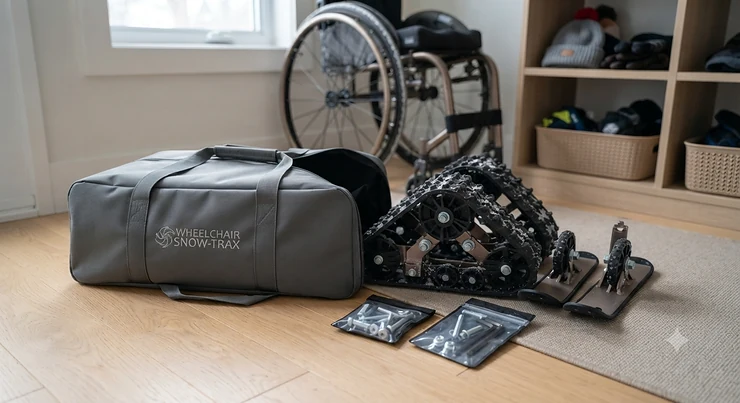
The first snowfall of the season looks pretty from a window. It looks a lot less charming from wheelchair height, where six centimetres of fresh powder can swallow a caster wheel whole and turn a five-minute trip to the mailbox into a stranded, frozen ordeal. If you’ve ever felt your front wheels bog down at the exact moment you needed momentum most, you already understand why a wheelchair snow attachment for wheels isn’t a luxury purchase — it’s a mobility lifeline for roughly six months of the Canadian calendar.
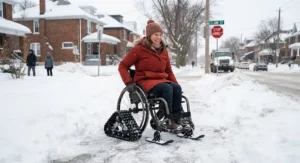
So, what is a wheelchair snow attachment for wheels? In plain terms, it’s any add-on device, tire swap, or traction accessory — from strap-on cleats to a full front caster-lift wheel — that improves grip, flotation, or rolling resistance for a manual or power wheelchair on snow, slush, or ice. Some clip on in seconds; others replace your existing tires outright.
This guide isn’t a rewritten spec sheet lifted from a listing page. We dug into real products sold by Canadian mobility retailers and cross-border sellers, pulled together what genuine users and dealers report about durability and grip, and laid out honest trade-offs — budget versus premium, DIY versus engineered — so you can pick gear that actually survives a Winnipeg February instead of gear that looks good in a promo photo. Every price below is shown as a range in Canadian dollars, because exact listed prices shift week to week and locking in a number here would be misleading the moment it’s published.
Quick Comparison Table
| Attachment | Type | Price Range (CAD) | Best For |
|---|---|---|---|
| FreeWheel Wheelchair Attachment | Front caster-lift wheel | around C$800–C$950 | Deep snow, daily active users |
| reTyre Traction Skins | Velcro-on tire skin | around C$280–C$350 | Slush, ice, quick swap-on/off |
| Kenda Nevegal Knobby Tire | Replacement knobby tire | around C$70–C$90 each | All-terrain, year-round grip |
| Primo V-Trak Knobby Tire | Replacement knobby tire | under C$45 each | Budget traction upgrade |
| FOLD & GO Snow Cleats | Strap-on metal cleats | around C$90–C$130 | Compatible Fold & Go chairs, deep snow |
| Wheel Blades-S | Clip-on caster skis | around C$150–C$220 | Packed snow, reducing caster drag |
| Cable-Tie DIY Traction Kit | Zip-tie tread wrap | under C$20 | Occasional light snow, tight budgets |
Looking at the spread above, there’s a clear split between attachments that solve the front-caster problem (the FreeWheel and Wheel Blades-S) and those that solve the drive-wheel grip problem (the reTyre Traction Skins, both knobby tires, and the FOLD & GO Snow Cleats). The Cable-Tie DIY Traction Kit sits in its own category entirely — it won’t out-grip a purpose-built product, but it costs less than a large pizza and can be assembled from a hardware-store aisle in twenty minutes. Your choice mostly comes down to how often you’re rolling through snow and how much of your winter budget you want tied up in wheels rather than, say, a proper coat.
💬 Just one click — help others make better buying decisions too!😊
Top 7 Wheelchair Snow Attachments: Expert Analysis
We picked these seven with an eye toward covering every budget tier and every failure mode winter throws at a wheelchair — deep unplowed snow, glassy ice, slushy crosswalks, and the in-between grey mush that’s honestly the worst of all of them. Below, each product gets the honest treatment: real specs, what they mean on pavement, and where they fall short.
1. FreeWheel Wheelchair Attachment — best for conquering deep, unplowed snow
The standout here isn’t traction in the traditional sense — it’s elevation. The FreeWheel Wheelchair Attachment clamps onto your footrest and lifts your small front casters entirely off the ground, replacing them with one large pneumatic wheel.
Specs that matter: the large-diameter front wheel (roughly the size of a bike wheel) has dramatically less rolling resistance than a 5-inch caster, and the aluminum frame keeps total added weight modest. In practice, this means the part of your chair most likely to auger into snow simply never touches it. Living Spinal and National Seating & Mobility both note the unit clamps on in seconds once the initial mount is installed, though the first-time setup — including a possible folding adaptor for non-rigid frames — takes closer to fifteen minutes.
Who should care: active daily users who cross unplowed sidewalks, gravel, or curb cuts regularly, not just three or four times a winter. If your neighbourhood’s snow-clearing schedule is inconsistent — and in a lot of Canadian cities, it is — this is the attachment that turns “stuck” into “still moving.”
Aggregated dealer and retailer feedback consistently describes the FreeWheel as a genuine independence upgrade rather than a novelty accessory, with most reported friction points centring on compatibility (flip-up footplates don’t work) rather than the wheel’s performance once installed.
Pros:
- ✅ Lifts casters completely clear of snow and slush
- ✅ Dramatically lower rolling resistance than stock casters
- ✅ Clamps on/off in seconds after initial setup
Cons:
- ❌ Incompatible with flip-up footplates
- ❌ Adds length to the chair, complicating car trunk storage
At around C$800–C$950 before any required folding adaptor, the FreeWheel is the priciest pick on this list, but for daily active users the value math works out over several winters of avoided stranding.
2. reTyre Traction Skins — best velcro-on traction skin for slush and ice
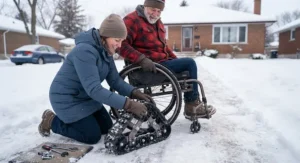
Instead of replacing your tire, the reTyre Traction Skins wrap around your existing drive-wheel tire like a fitted glove, using a Velcro closure system that a distributor pegs at roughly a 30-second install.
The natural rubber skins use a tread pattern engineered specifically for wheelchair propulsion and braking — not a repurposed bicycle or automotive pattern — which matters because most aftermarket traction gear is adapted from something never designed for a push-rim’s forward-and-brake motion. The skins fit 24-, 25-, and 26-inch drive wheels within a tight circumference tolerance, so measuring your existing wheel before ordering isn’t optional.
Who this suits: wheelchair users who want traction only when they need it, then want it gone the moment they’re back indoors — no permanently swapped tire tracking slush across hardwood floors. Because the skins work with your existing brake setup without adjustment, there’s no trip to a wheelchair technician required.
Independent review volume for this specific product is still thin in the Canadian market since it’s a relatively recent import, so we’ll say plainly: verified third-party ratings are limited. What does surface in dealer Q&A sections consistently praises the quick on/off cycle and the grip on wet slush; a smaller number of comments mention the rubber feeling noticeably firmer than a standard tire when rolling over smooth indoor ramps.
Pros:
- ✅ Purpose-built tread designed for wheelchair propulsion
- ✅ 30-second Velcro attachment, no brake adjustment needed
- ✅ Doubles as puncture protection and grass/gravel traction
Cons:
- ❌ Firmer ride feel on smooth indoor surfaces
- ❌ Narrow size range (24″–26″ wheels only)
Priced around C$280–C$350 for a set, this sits in the mid-to-premium tier — a fair trade if you want traction without committing to a full tire swap.
3. Kenda Nevegal Knobby Wheelchair Tire — best all-terrain knobby tire swap
Sometimes the smartest upgrade is the most boring one: swap the tire itself. The Kenda Nevegal Knobby Wheelchair Tire replaces your stock drive-wheel tire with a wider, deeper-tread all-terrain design built for sand, snow, dirt, and everything in between.
At 24 x 2.10 inches with a folding bead, the tread depth alone does most of the work here — more rubber contact edges means more surfaces for the tire to bite into rather than skate across. Unlike temporary traction devices, this is a permanent-ish upgrade: the tire stays on your wheel year-round, working double duty on gravel trails in summer and packed snow in winter.
Who it’s for: users who don’t want to be swapping accessories on and off every time the forecast changes and who spend a meaningful chunk of the year outdoors regardless of season. Retailer review threads describe it as among the most capable off-road traction available for a standard wheelchair wheel swap, which tracks with the wider footprint and aggressive tread pattern.
Pros:
- ✅ Wide, deep tread for year-round off-road grip
- ✅ Permanent upgrade — no on/off routine required
- ✅ Folding bead simplifies installation
Cons:
- ❌ Sold individually — budget for a pair
- ❌ Wider profile may not clear tight wheelchair frames
At roughly C$70–C$90 per tire (so around C$140–C$180 for the pair), this lands comfortably inside a winter wheelchair tires under $200 CAD budget while delivering meaningfully more traction than a stock tire.
4. Primo V-Trak Knobby Wheelchair Tire — best budget knobby tire upgrade
If the Kenda Nevegal is the mid-range knobby option, the Primo V-Trak Knobby Wheelchair Tire is its scrappier, cheaper cousin — and for a lot of casual winter users, that’s exactly the right call.
This tire uses a mountain-bike-style tread pattern rated for rough terrain, snow, and trails, running on a 65 PSI pneumatic setup that fits most 24-inch spoke and mag wheels across Quickie, TiLite, Ki Mobility, and Invacare chairs. The lighter-grey non-marking tread means it won’t leave streaks on indoor flooring, which matters if you’re rolling between a snowy driveway and a hospital or office lobby in the same trip.
Honest analytical take: this isn’t going to out-grip a dedicated cleat or the reTyre skins in genuine ice, but for light-to-moderate snow on cleared-but-not-perfectly-cleared sidewalks, it’s a substantial step up from a bald stock tire for a fraction of the cost. Retailer listings describe it as one of the most widely sold knobby tires in the category, which usually correlates with dependable, low-drama performance rather than any single standout feature.
Pros:
- ✅ Mountain-bike tread pattern for real snow and trail grip
- ✅ Fits most major wheelchair brands’ 24″ wheels
- ✅ Non-marking tread safe for indoor floors
Cons:
- ❌ Less aggressive tread than premium knobby alternatives
- ❌ Tube typically sold separately
Priced under C$45 per tire — around C$80–C$90 for a pair — this is the single cheapest genuine traction upgrade on this list that isn’t a DIY hack.
5. FOLD & GO Snow Cleats — best strap-on cleats for compatible chairs in deep snow
For owners of a FOLD & GO wheelchair specifically, the FOLD & GO Snow Cleats offer a reusable, strap-on solution built for exactly one job: chewing through snow deeper than 10–15 centimetres where tire tread alone gives up.
Each set includes four cleats — two per rear motorwheel tire — combining a waterproof silicone base for flexible fit with sturdy metal spikes for the actual grip. The manufacturer is refreshingly upfront about limitations here: these are for snow only, and using them on bare concrete or asphalt will flatten or break the metal spikes, with damage from that misuse excluded from warranty.
Who should care: this is a narrow-but-strong recommendation. If you own a compatible FOLD & GO chair and regularly face genuinely deep, unplowed snow — think rural driveways or a city that’s still catching up three days after a storm — this is purpose-engineered for that exact scenario. If your chair is a different make, this specific product won’t fit, and that’s worth knowing before you click “add to cart.”
Pros:
- ✅ Metal spikes provide serious bite in deep, loose snow
- ✅ Reusable and quick to strap on before heading out
- ✅ Comes with a padded storage bag for transport
Cons:
- ❌ Compatible only with FOLD & GO model wheelchairs
- ❌ Metal spikes damage on hard, bare pavement
At around C$90–C$130 for the full set, the value case is strong specifically for the deep-snow, compatible-chair scenario it was designed for — and considerably weaker outside it.
6. Wheel Blades-S — best caster-ski attachment for reducing front-wheel drag
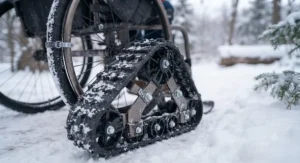
Where the FreeWheel solves the caster problem by removing casters from the equation entirely, the Wheel Blades-S takes a lighter-touch approach: small ski-like blades clip directly onto your existing front casters, letting them glide over packed snow and slush instead of digging in.
The mechanism is straightforward — rather than a round wheel meeting resistance head-on, the flattened ski profile distributes weight and slides across the surface. This matters most on packed or lightly fresh snow rather than deep powder, where a full elevation solution like the FreeWheel still has the edge.
Who this suits: users whose winter obstacle is mostly compacted, semi-cleared sidewalks rather than genuinely deep drifts, and who want a lighter, cheaper add-on than a full caster-lift wheel. It’s also a sensible pick for anyone whose chair configuration or footrest height rules out the FreeWheel entirely.
Independent, verifiable review data on this specific accessory is limited outside of mobility-blog roundups and dealer product pages, so we’ll flag that honestly rather than inventing a satisfaction score — what’s consistently described is a noticeable reduction in caster “catch” on packed snow, with less information available on longer-term durability of the clip mechanism.
Pros:
- ✅ Reduces caster drag on packed snow and slush
- ✅ Lighter and less bulky than a full caster-lift wheel
- ✅ Simple clip-on installation without tools
Cons:
- ❌ Less effective than the FreeWheel in deep, loose powder
- ❌ Long-term durability data is limited
Typically listed around C$150–C$220 per pair, it occupies a sensible middle ground between the cable-tie DIY route and a full FreeWheel setup.
7. Cable-Tie DIY Traction Kit — best rock-bottom budget traction fix
Not every solution on this list needs a model number and a manufacturer’s warranty card. The Cable-Tie DIY Traction Kit — built from nothing more exotic than sturdy plastic wire ties, a technique documented and endorsed by the United Spinal Association — simulates tire chains and studs using zip ties wrapped evenly around each drive wheel.
The method: 25 to 30 heavy-duty cable ties tied evenly around each tire, trimmed flush after cinching. It won’t summit anything resembling a mountain, as the original documentation candidly admits, but it noticeably improves grip in light snow or on paths that haven’t been plowed down to bare ground. Powered wheelchairs with smaller or enclosed wheel styles may only fit a reduced number of ties, so results vary by chair.
Who should care: budget-conscious users who need a stopgap for one or two snow events a winter rather than a season-long commitment, plus anyone who wants a genuinely free-or-near-free option to keep in a bag “just in case.” This is the definition of an aftermarket wheelchair accessory built from parts never intended for wheelchairs — and it works anyway.
Pros:
- ✅ Costs next to nothing — hardware-store cable ties
- ✅ Simulates chain-and-stud traction on light snow
- ✅ Quick to remove once conditions improve
Cons:
- ❌ Wears down fast with repeated use
- ❌ Not effective on deep snow or solid ice
At under C$20 for a full multi-pack of ties, it’s the cheapest genuine traction improvement on this entire list — you’re trading durability and polish for essentially zero financial risk.
✨ Don’t Miss These Exclusive Deals! 🔍
Take your winter mobility setup to the next level with these carefully selected products. Click on any highlighted item to check current pricing and availability on amazon.ca. These traction upgrades will help you keep rolling through the exact conditions that used to stop you cold!
Practical Usage Guide: Installing and Maintaining Your Winter Traction Setup
Buying the right wheelchair snow attachment for wheels is only half the job — installing and maintaining it properly is what determines whether it lasts one winter or five. Start with measurement, always. Whether you’re eyeing the Kenda Nevegal or the reTyre Traction Skins, confirm your exact wheel diameter and tire circumference before ordering; a half-inch mismatch is the single most common return reason dealers report.
For tire-based upgrades like the Kenda Nevegal or Primo V-Trak, plan for a proper installation session rather than a rushed five-minute swap — removing a pneumatic wheelchair tire cleanly usually benefits from a dedicated tire tool, the same kind bike shops use, and going in without one risks pinching a new tube on day one. Clip-on and strap-on products like Wheel Blades-S or the FOLD & GO Snow Cleats are faster, but resist the urge to skip the manufacturer’s fit-check step; a loose cleat at 15 km/h down a ramp is a genuine safety issue, not a minor inconvenience.
Maintenance schedule that actually matters: inspect Velcro closures on the reTyre Traction Skins every few uses for grit buildup, since packed salt and sand degrade hook-and-loop fasteners faster than plain wear. Metal-spiked products like the FOLD & GO Snow Cleats should be rinsed of road salt after each outing — salt corrosion is the number one killer of metal traction hardware, full stop. The most common first-30-days mistake we see referenced across dealer support pages: leaving traction gear installed on dry pavement, which needlessly wears knobby tread, dulls metal spikes, or simply looks (and sounds) odd rolling through an office lobby.
Real-World Scenarios: Matching the Right Traction Upgrade to Your Winter
Consider three genuinely different Canadian winter users, because “best wheelchair snow attachment” doesn’t have one universal answer.
Scenario one: a university student in Edmonton who commutes across an unplowed quad every morning before city crews get to secondary paths. For that person, the FreeWheel is the obvious call — daily, unpredictable deep-snow exposure justifies the higher upfront cost, and the caster-lift design solves the exact failure point (small front wheels sinking) that a tire swap alone can’t fix.
Scenario two: a retiree in suburban Ontario who mostly deals with slushy, salted crosswalks rather than genuine drifts, and who wants gear that comes off the moment they’re back in a warm house. The reTyre Traction Skins, with their 30-second Velcro cycle, fit that rhythm far better than a permanent tire swap — traction on demand, gone by the time the coffee’s poured.
Scenario three: a budget-conscious parent managing a child’s power wheelchair on a fixed income, facing maybe four or five real snow events a winter in a mild coastal city. Here, the Cable-Tie DIY Traction Kit or the Primo V-Trak tire genuinely makes more sense than a premium accessory that will spend ten months a year in a closet — the return on investment for premium gear only shows up with frequency of use, and this profile doesn’t have it.
Problem → Solution: Common Winter Wheelchair Traction Issues
Problem: front casters keep sinking in unplowed snow. Solution: a caster-lift attachment like the FreeWheel removes the small-wheel-in-deep-snow problem structurally rather than incrementally, or step down to Wheel Blades-S if a full lift wheel isn’t compatible with your chair.
Problem: drive wheels spin freely on packed ice at crosswalks. Solution: this is a rubber-tread problem, best solved by the Kenda Nevegal or reTyre Traction Skins, both of which are engineered specifically around forward-propulsion grip rather than automotive or bicycle traction patterns.
Problem: budget doesn’t stretch to a C$300+ accessory this season. Solution: the Primo V-Trak tire swap or the Cable-Tie DIY Traction Kit both deliver a real, measurable traction improvement well under C$100, even if neither matches premium performance in genuine ice.
Problem: traction gear works outside but tracks salt and grit indoors. Solution: prioritize removable systems — reTyre Traction Skins or Wheel Blades-S — over permanent tire swaps if you’re crossing the outdoor/indoor threshold multiple times a day.
Problem: metal cleats or spikes are damaging bare pavement patches. Solution: this is a compatibility mismatch, not a product flaw — cleated products like the FOLD & GO Snow Cleats are explicitly snow-only, and using them on cleared concrete will shorten their lifespan fast.
How to Choose a Wheelchair Snow Attachment for Wheels
- Identify your actual failure point first. Are your casters sinking, or are your drive wheels spinning? These are different problems with different fixes — a tire swap won’t help sinking casters, and a caster-lift wheel won’t help slipping drive wheels.
- Measure before you shop. Wheel diameter, tire circumference, and footrest height all determine compatibility, especially for fitted products like the reTyre Traction Skins or clamp-on units like the FreeWheel.
- Match frequency of use to price tier. Daily winter commuters justify premium gear; occasional users get better value from a knobby tire swap or the cable-tie method.
- Check chair-specific compatibility claims carefully. Products like the FOLD & GO Snow Cleats are explicitly built for one chair family — don’t assume universal fit from marketing photos alone.
- Weigh removable versus permanent setups. Removable systems suit users crossing indoor/outdoor thresholds often; permanent tire swaps suit users who are outdoors for extended stretches regardless of season.
- Budget for accessories, not just the headline product. Folding adaptors, replacement tubes, and tire tools add real cost that a sticker price alone won’t show.
- Read compatibility warnings, not just feature lists. The most consistent complaint across every product category here traces back to skipped compatibility checks, not product failure.
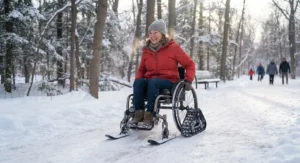
Wheelchair Traction Attachment for Snow vs Traditional Tires
Standard wheelchair tires are engineered around indoor manoeuvrability and low rolling resistance on flat, dry, predictable flooring — reasonable priorities for the other nine months of the year, and completely wrong priorities for a Canadian February. A dedicated wheelchair traction attachment for snow trades a bit of that indoor smoothness for tread depth, flexible rubber compounds, or mechanical elevation, all aimed at one job: keeping contact with a surface that’s actively trying to be slippery.
| Factor | Standard Wheelchair Tire | Dedicated Traction Attachment |
|---|---|---|
| Grip on packed snow | Poor to moderate | Good to excellent |
| Grip on ice | Poor | Moderate (varies by product) |
| Indoor floor performance | Excellent | Good to fair, depending on type |
| Typical cost | Included with chair | C$20–C$950 depending on type |
| Removability | N/A | Varies — permanent to instant |
This gap explains why Toronto disability advocates have specifically flagged uncleared sidewalks and snowbanks as human-made barriers that standard mobility equipment simply isn’t built to handle; as one advocate put it in a CBC News report on winter accessibility, accumulated snow at bus stops and curb cuts creates obstacles that able-bodied pedestrians barely register. The practical takeaway: if you’re relying on stock tires through a genuine Canadian winter, you’re not just accepting reduced comfort — you’re accepting reduced mobility on days when mobility matters most.
Common Mistakes When Buying Winter Wheelchair Tires Under $200 CAD
The first mistake is chasing the cheapest listing without checking tread depth specs — a “winter” tire with barely more tread than a stock indoor tire is marketing language, not engineering. Second, buyers frequently order a single tire when their chair needs a matched pair, only to end up with mismatched rolling resistance side to side, which can pull a manual chair off a straight line on slick surfaces. Third, and this one’s sneaky: not confirming whether the listing includes an inner tube, since many pneumatic wheelchair tires under $200 CAD are sold as “tire only,” with the tube priced as a separate add-on that pushes the real total past that budget line.
A fourth common misstep is ignoring PSI ratings — over-inflating a knobby tire reduces its contact patch and actually hurts snow traction, counterintuitively making a “grippier” tire perform worse than a properly inflated standard one. Finally, some buyers skip checking non-marking tread certification, which matters if you’re rolling between outdoor snow and indoor flooring in places like hospitals or apartment lobbies that explicitly prohibit marking tires.
Aftermarket Wheelchair Accessory Options for Every Budget
Not every winter mobility upgrade needs to be a single splurge purchase. Thinking of this as a layered aftermarket wheelchair accessory strategy — rather than one all-or-nothing decision — often produces better real-world results.
| Product | Traction Level | Price Range (CAD) | Removability |
|---|---|---|---|
| FreeWheel Wheelchair Attachment | Very high (caster problem) | C$800–C$950 | Quick-release |
| reTyre Traction Skins | High | C$280–C$350 | Velcro, ~30 sec |
| FOLD & GO Snow Cleats | Very high (deep snow) | C$90–C$130 | Strap-on |
| Wheel Blades-S | Moderate | C$150–C$220 | Clip-on |
| Kenda Nevegal Knobby Tire | Moderate-high | C$140–C$180/pair | Permanent |
| Primo V-Trak Knobby Tire | Moderate | C$80–C$90/pair | Permanent |
| Cable-Tie DIY Traction Kit | Light | under C$20 | Fully removable |
Reading this table left to right in terms of value, the Primo V-Trak tire delivers the best traction-per-dollar for users facing occasional, moderate snow, while the FreeWheel justifies its price tag only for genuinely frequent, deep-snow use. A smart layered approach some users adopt: budget knobby tires for the whole season, plus a removable option like Wheel Blades-S or the cable-tie method kept in a bag for the worst individual storm days.

Long-Term Cost & Maintenance of Retrofit Mobility Gear
Total cost of ownership tells a different story than sticker price alone. The FreeWheel, despite its high upfront cost, typically requires minimal ongoing spend beyond occasional tire pressure checks and tube replacement — a well-maintained unit can realistically serve five-plus winters, which works out to roughly C$160–C$190 per winter amortized, competitive with replacing a mid-range knobby tire annually.
Knobby tire swaps like the Kenda Nevegal or Primo V-Trak sit at the opposite end: lower upfront cost, but tread wears down with use across all seasons, not just winter, meaning a genuinely active user might replace them every one to two years rather than every five. The reTyre Traction Skins, since they’re only mounted during active snow conditions, tend to show less cumulative wear per calendar year despite their higher unit price — a case where usage pattern matters as much as sticker price for calculating real retrofit mobility gear ROI.
Metal-spiked products like the FOLD & GO Snow Cleats carry a maintenance wildcard: salt corrosion. Rinsing spikes after each outing meaningfully extends lifespan, while neglecting that single step can cut a product’s working life dramatically faster than the materials themselves would otherwise allow.
Safety, Regulations & Accessibility in Canada
Winter mobility gear doesn’t exist in a regulatory vacuum, even if most of these products are considered personal accessories rather than medical devices requiring certification. At the federal level, the Accessible Canada Act sets a goal of a barrier-free Canada by 2040, covering federally regulated transportation and public spaces — a useful backdrop for understanding why municipalities are under growing pressure to prioritize sidewalk and curb-cut snow clearing, not just road plowing.
Provincially, snow-clearing bylaws vary significantly: some cities offer free accessibility-priority sidewalk clearing for residents who submit proof of disability, while others still treat sidewalk clearing as a lower priority than road clearing entirely. That inconsistency is precisely why a personal wheelchair snow attachment for wheels matters — you can’t always count on the infrastructure around you to be cleared on your timeline, no matter what the bylaw says on paper.
From a personal-safety standpoint, a few practical rules apply across every product on this list: never exceed a manufacturer’s stated weight or footrest-height limits, inspect Velcro or clip mechanisms before every outing in freezing temperatures (cold makes plastic more brittle), and avoid metal-spiked cleats on any surface where you might unexpectedly hit bare concrete at speed, since sudden traction loss on an unexpectedly gripping spot can be just as destabilizing as no traction at all.
Features That Actually Matter (And Those That Don’t)
Tread depth, wheel diameter compatibility, and removability genuinely matter — these determine whether a product solves your specific failure point and whether it fits your chair at all. Salt-corrosion resistance on metal components matters more than most buyers initially weight it, since it’s the quiet killer of otherwise well-designed cleated products.
What matters less than marketing copy suggests: exact tread pattern branding (a “military-grade” or “extreme” tread name rarely correlates with measurable performance difference over a well-reviewed standard knobby pattern), and colour options, which affect exactly nothing about winter performance despite frequently being the first thing highlighted in product photos. Weight savings on tire-based products also matter less than advertised for most users — a few hundred grams difference between two knobby tire options is rarely the deciding factor compared to tread depth and compound quality.
FAQ
❓ Do wheelchair snow attachments work on ice, or just snow?
❓ Can I use a wheelchair snow attachment on a power wheelchair?
❓ How much does a wheelchair traction attachment for snow typically cost in Canada?
❓ Will a snow attachment damage my wheelchair or void the warranty?
❓ Is it worth buying winter wheelchair tires under $200 CAD instead of a full attachment?
Conclusion
Winter doesn’t ask wheelchair users for permission before it arrives, and stock tires simply weren’t built for the job Canadian sidewalks demand for half the year. Whether that means a full FreeWheel setup for daily deep-snow commuting, a pair of Kenda Nevegal knobby tires for balanced year-round grip, or a bag of cable ties tucked under the seat for the occasional surprise flurry, the right traction upgrade depends entirely on how often you’re out there and what specific failure point — sinking casters or spinning drive wheels — is actually costing you mobility.
The honest throughline across every product here: none of them are magic, and none of them replace properly cleared sidewalks or careful route planning on genuinely icy days. What they do offer is a meaningful, measurable edge on the days infrastructure lets you down, which — based on how many Canadian cities are still catching up on accessibility-first snow clearing — is more days than any of us would like. Pick the tier that matches your real winter, not your ideal one, and check current pricing before you commit, since availability and cost shift through the season.
Recommended for You
- Wheelchair Snow Attachment for Wheels: 7 Proven Picks (2026)
- Winter Wheelchair for Snow: 7 Best Picks for Canada (2026)
- Trail Wheelchair for Wheelchair Hikers: 7 Best Picks (2026)
Disclaimer: This article contains affiliate links. As an Amazon Associate, I earn from qualifying purchases. If you purchase products through these links, we may earn a small commission at no additional cost to you.
✨ Found this helpful? Share it with your friends! 💬🤗
