
In This Article
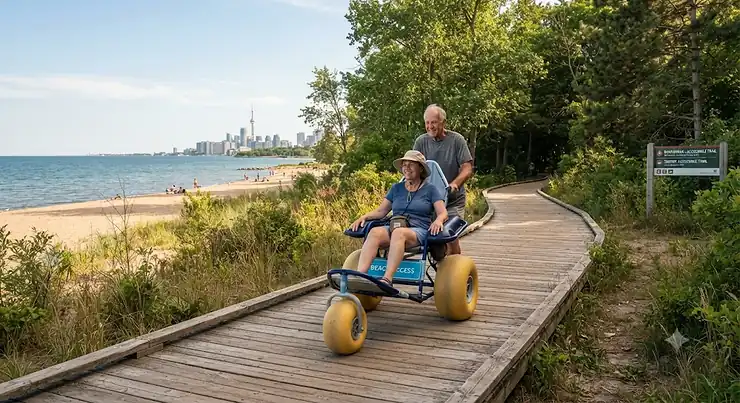
A beach wheelchair for sand and boardwalks is a wheelchair built around oversized, low-pressure tires — often called balloon or flotation tires — that spread a rider’s weight across soft or uneven ground instead of slicing into it, letting the chair roll over sand, warped boardwalk planks, and gravel that would stop a standard wheelchair cold within about two metres.
And that two-metre mark isn’t an exaggeration. Anyone who has tried to push a set of standard 61 cm (24 in) hard rubber wheels across dry beach sand knows the exact feeling: the chair sinks, the front casters bury themselves like tent stakes, and the whole outing stalls before the towels are even unpacked. It’s a mechanical problem, not a strength problem, and it’s one Statistics Canada’s 2022 Canadian Survey on Disability puts real numbers behind — mobility-related disabilities remain among the most commonly reported in the country, which is a big part of why so many provincial parks and municipal beaches have started stocking loaner beach wheelchairs in the first place.
This guide skips the vague “great for the beach!” marketing copy and goes straight to seven real, purchasable beach wheelchairs, spanning a sub-C$450 folding model up to a marine-grade unit built for daily saltwater exposure. Every spec below — tire size, weight capacity, frame material — comes from manufacturer documentation or retailer listings, not guesswork, and every price is shown as a range rather than a snapshot, because Amazon.ca pricing moves week to week. Along the way, we’ll get into why an off-road wheelchair and a beach wheelchair solve different problems, what wide flotation tires actually do to the physics of rolling on sand, and how to plan a vacation mobility aid strategy that doesn’t involve straining your car’s suspension with 27 kg (60 lb) of folded steel and PVC.
Quick Comparison Table
Here’s the seven-chair lineup at a glance before the deep dive. Weight capacities and frame materials come straight from each manufacturer’s published specifications; prices are ranges in Canadian dollars, since exact Amazon.ca figures shift too often to print responsibly.
| Beach Wheelchair | Tire/Wheel Size | Weight Capacity | Price Range (CAD) | Best For |
|---|---|---|---|---|
| FEIMIRE Light Beach Wheelchair | 30 cm/23 cm (12″/9″) balloon tires | 100 kg (220 lb) | under C$450 | Occasional day-trippers on a tight budget |
| Vhewq Beach Wheelchair | Front/rear balloon tires | 100 kg (220 lb) | under C$450 | Fastest breakdown for car-trunk trips |
| Fields Outdoor Supplies WC-1 | 30 cm (12″) balloon tires | 113 kg (250 lb) | C$1,300–C$1,500 | First “real” purpose-built beach chair |
| AccessRec TerraWheels | Rubber all-terrain wheels, 2 rear swivel casters | 136 kg (300 lb) | C$1,400–C$1,800 | Reclining comfort for long beach days |
| Fields Outdoor Supplies WC-16 | 41 cm (16″) balloon tires | 113 kg (250 lb) | C$1,800–C$2,000 | Widest flotation for dry, soft sand |
| Wheeleez Sandcruiser | 30 cm/49 cm (11.8″/19.3″) polyurethane balloon wheels | 120 kg (264 lb) | C$3,600–C$3,900 | Daily saltwater use, marine-grade build |
| GRIT Freedom Chair 3.0 | 23 cm (9″) front, 66 cm (26″) rear pneumatic wheels | 136 kg (300 lb) | C$3,900–C$4,200 | True off-road use: dunes, trails, gravel |
Reading across this table, the jump between the two budget models and the Fields Outdoor Supplies WC-1 is the single biggest gap on the list — nearly C$900 — and it isn’t padding. That gap is aluminum-and-fabric folding construction versus a healthcare-grade PVC frame engineered specifically to resist saltwater corrosion over hundreds of uses rather than a handful of vacation days. The GRIT Freedom Chair 3.0 sits at the top not because it floats over sand better than the Wheeleez Sandcruiser, but because it’s solving an entirely different problem — genuine self-propelled off-road travel — which the next section unpacks properly.
💬 Just one click — help others make better buying decisions too!😊
Top 7 Beach Wheelchairs for Sand and Boardwalks: Expert Analysis
These seven cover the real spread Canadian buyers run into: two accessible entry points for the family that needs a chair for one week at the cottage, two mid-tier purpose-built PVC chairs from a dedicated beach-mobility manufacturer, a reclining all-terrain option that doubles for park trails, and two premium picks built for people who need this equipment working reliably, day after day, for years. Every product name stays bolded on every mention so you can scan for the one you’re weighing.
1. FEIMIRE Light Beach Wheelchair — lightest wallet-friendly pick under C$450
The standout here is straightforward: it’s the lightest, cheapest way to get a rider from the boardwalk onto actual sand without renting anything.
The aluminum frame keeps assembled weight low enough for one person to lift into a hatchback, and the 30 cm and 23 cm (12″ and 9″) balloon tires — a larger rear pair paired with smaller front casters — are sized for short, flat rolls rather than dune-climbing. Manufacturer specifications list a 100 kg (220 lb) capacity, which comfortably covers most adult riders and virtually all children, matching how it’s marketed: as a family or multi-generational chair rather than a daily-use mobility device. Based on the spec comparison against the PVC-framed chairs further down this list, the trade-off is durability rather than function — aluminum tubing and fabric upholstery simply don’t shrug off repeated saltwater exposure the way healthcare-grade PVC does.
Aggregated feedback across general marketplace listings for this style of budget balloon-tire chair consistently flags the low weight and quick fold as the reasons buyers choose it, alongside occasional notes that the front casters need a firmer push to clear soft, dry sand compared to the larger-tired models later in this list.
Pros:
- ✅ Genuinely light enough for one person to load solo
- ✅ 100 kg (220 lb) capacity covers most adult and youth riders
- ✅ Folds down small enough for a sedan trunk
Cons:
- ❌ Smaller front casters struggle more in dry, loose sand
- ❌ Aluminum-and-fabric build won’t match PVC durability long-term
At the time of research, the FEIMIRE Light Beach Wheelchair sits under C$450, making it one of the most accessible entry points on this entire list — check current price, since budget beach chairs like this see frequent listing turnover.
2. Vhewq Beach Wheelchair — quickest wheel swap for car-trunk trips
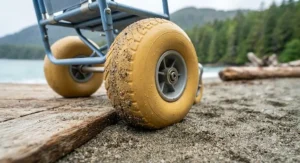
What sets the Vhewq Beach Wheelchair apart from the FEIMIRE model above is its quick-release wheel design, which lets the whole unit collapse to its smallest footprint in seconds rather than minutes.
Manufacturer listings confirm a 100 kg (220 lb) weight capacity and marketing that specifically calls out grass, gravel, and water-adjacent access alongside sand — a slightly broader terrain claim than most chairs in this price bracket make. Here’s what that practically means: the quick-release axles that make packing fast also make the wheels themselves easier to rinse and dry separately after a beach day, which matters more than it sounds once sand works its way into an axle bearing. What most buyers overlook about this category of chair is that the fold-flat frame, while convenient for transport, generally means less structural rigidity than a chair engineered around a fixed frame — a reasonable trade for a once-or-twice-a-summer vacation mobility aid, less so for someone who needs a chair working reliably every week.
Because this is a lower-volume, frequently-relisted SKU, individually verifiable long-term review data is harder to isolate — an honest limitation worth naming rather than glossing over with invented testimonials.
Pros:
- ✅ Quick-release wheels speed up packing and rinsing
- ✅ Rated for grass and gravel, not just dry sand
- ✅ Compact folded footprint for smaller vehicles
Cons:
- ❌ Fold-flat frame trades some rigidity for portability
- ❌ Long-term durability data is thin for this specific listing
The Vhewq Beach Wheelchair generally lists under C$450 in Canada, putting it neck-and-neck with the FEIMIRE on price — the deciding factor between the two usually comes down to whether quick-release wheels or slightly larger front casters matter more for your specific beach.
3. Fields Outdoor Supplies WC-1 — first real PVC-frame beach chair on this list
The Fields Outdoor Supplies WC-1 marks the point on this list where “beach-adjacent folding chair” becomes “purpose-built beach mobility equipment,” and the standout feature is its healthcare-grade PVC frame.
That frame detail matters more than a spec sheet makes it sound: PVC doesn’t rust, pit, or corrode the way painted steel eventually does under repeated saltwater and sun exposure, which is precisely why hospitals and pool-deck equipment favour it. Stainless steel and aluminum hardware round out the build, the 30 cm (12″) balloon tires handle firm-to-moderately-soft sand, and the 113 kg (250 lb) capacity gives noticeably more headroom than either budget option above. At 22 kg (48 lb) assembled and designed to disassemble tool-free for trunk transport, it splits the difference between the featherweight budget chairs and the heavier mid-tier options that follow.
Reviewers consistently note across retailer listings that the tool-free disassembly is the single most-mentioned feature, since it turns “how do I get this in my SUV” from a genuine logistics problem into a five-minute task. A recurring theme in aggregated feedback is that the mesh seat, while breathable, benefits from a towel or cushion on longer outings.
Pros:
- ✅ Healthcare-grade PVC frame resists saltwater corrosion
- ✅ 113 kg (250 lb) capacity with tool-free disassembly
- ✅ Backed by a 1-year manufacturer warranty
Cons:
- ❌ Meaningfully pricier than the two budget aluminum options
- ❌ Mesh seat is comfortable but thin on very long outings
At the time of research, the Fields Outdoor Supplies WC-1 lands in the C$1,300–C$1,500 range, and for buyers who plan to use it more than once or twice a year, the corrosion-resistant frame alone tends to justify the jump from the budget tier — check current price before your trip.
4. AccessRec TerraWheels — best reclining comfort for long beach days
The AccessRec TerraWheels distinguishes itself with three reclining seat positions, a feature none of the three chairs above it on this list offer at all.
Manufacturer specifications list an aluminum-and-stainless-steel frame with rubber all-terrain wheels, two rear swivel casters for tighter maneuvering, a front-wheel brake system for parking on a slope, and a genuinely high 136 kg (300 lb) weight capacity. What the spec sheet won’t tell you, but the reclining feature does, is that this chair is built for duration rather than a quick dip-and-back trip — someone planning to spend four or five hours on the sand benefits far more from adjustable recline than from a slightly larger tire. Based on the spec comparison with the PVC-framed WC-1 and WC-16, TerraWheels trades some outright sand flotation for versatility: the rubber all-terrain wheels and swivel rear casters make it a genuinely capable countryside wheelchair for uneven ground too, handling packed park trails and gravel paths as comfortably as a beach.
AccessRec markets this chair specifically for both beach and general outdoor accessibility use, and aggregated retailer feedback consistently highlights the reclining positions and included back storage pocket as the two most-cited reasons buyers chose it over a single-position alternative.
Pros:
- ✅ Three reclining positions for genuinely long outings
- ✅ 136 kg (300 lb) capacity, highest among the mid-tier options
- ✅ Doubles as a capable countryside wheelchair for uneven ground
Cons:
- ❌ Manufacturer doesn’t publish exact tire diameter or chair weight
- ❌ Rubber wheels float less on very soft, dry sand than balloon tires
The AccessRec TerraWheels doesn’t carry one fixed published price across every retailer, but expect a range broadly similar to comparable mid-tier beach wheelchairs, roughly C$1,400–C$1,800 — check current listings, since configuration and included accessories vary by seller.
5. Fields Outdoor Supplies WC-16 — widest flotation for dry, soft sand
The Fields Outdoor Supplies WC-16 is the sibling product to the WC-1 above, and its standout feature is right in the name: 41 cm (16″) balloon tires, the largest true flotation tires on this list outside the premium tier.
Larger tire diameter and volume translate directly into a bigger contact patch on soft sand, which is the entire physics behind flotation tires — spread the same rider weight across more surface area and the tire sinks less, full stop. The same healthcare-grade PVC frame, stainless and aluminum hardware, and 113 kg (250 lb) capacity carry over from the WC-1, but assembled weight climbs to 27 kg (60 lb) to support the larger wheels. Based on the spec comparison against the WC-1‘s 30 cm (12″) tires, the WC-16 is the more sensible choice specifically for beaches known for deep, dry, powdery sand rather than firmer packed shoreline — the extra 3 kg (12 lb) of chair weight is a fair trade for meaningfully less sinking.
Feedback aggregated across retailer listings consistently frames the larger tires as the deciding factor for buyers choosing between the WC-1 and WC-16, particularly among people who’d previously struggled with a smaller-tired chair at a specific dune-heavy beach.
Pros:
- ✅ 41 cm (16″) balloon tires float noticeably better on dry sand
- ✅ Same corrosion-resistant PVC frame as the WC-1
- ✅ Tool-free disassembly, reassembles in under 10 minutes
Cons:
- ❌ Heavier and bulkier to transport than the WC-1
- ❌ Costs roughly C$500 more than the smaller-tired sibling model
At the time of research, the Fields Outdoor Supplies WC-16 typically runs C$1,800–C$2,000, and for anyone whose local beach is genuinely soft, dry sand rather than firm packed shoreline, the wider tires are the single upgrade most worth paying for on this entire list.
6. Wheeleez Sandcruiser — marine-grade build for daily saltwater exposure
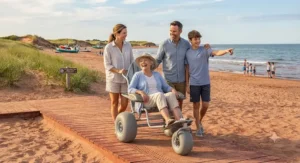
The Wheeleez Sandcruiser is built from 316 marine-grade stainless steel, the same alloy used in boat fittings, and it’s the standout reason this chair targets facilities and frequent users rather than a single family vacation.
Front wheels measure 30 cm by 18 cm (11.8″ by 7″) and rear wheels 49 cm by 23 cm (19.3″ by 9″) — genuinely the largest flotation tires on this list, made from Wheeleez’s own polyurethane compound rather than inflatable rubber, meaning no pumps, no punctures, and no pressure to monitor. Weight capacity sits at 120 kg (264 lb), assembled weight at 28 kg (62 lb), and the marine-grade canvas upholstery is explicitly rated for UV, mould, and saltwater exposure rather than merely tolerating it. What most buyers overlook about the price gap between this chair and the mid-tier PVC options is that 316 stainless steel simply doesn’t develop the pitting corrosion that even galvanized or powder-coated steel eventually shows after seasons of daily saltwater contact — this is equipment designed to outlast a rental fleet’s operating life, not a single household’s vacation calendar.
This profile — no-puncture wheels, marine-grade everything, a 3-year frame warranty — is why beach clubs, resorts, and municipal accessibility programs are the chair’s most common buyers rather than individual travellers, a genuinely different use case than the other six chairs here.
Pros:
- ✅ 316 marine-grade stainless steel resists years of saltwater exposure
- ✅ Puncture-proof polyurethane wheels need zero air maintenance
- ✅ Backed by a 3-year frame warranty, longest on this list
Cons:
- ❌ Highest sticker price among the seven chairs reviewed
- ❌ Overbuilt and pricier than most individual travellers need
The Wheeleez Sandcruiser generally sits in the C$3,600–C$3,900 range, and while that’s a serious investment for a single household, resorts and accessibility programs running the chair daily across an entire season tend to find the total cost per use genuinely competitive with replacing a cheaper chair every year or two.
7. GRIT Freedom Chair 3.0 — true off-road lever-drive for dunes and trails
The GRIT Freedom Chair 3.0 stands apart from every other chair on this list in one fundamental way: it isn’t a beach wheelchair at all, but a genuine off-road wheelchair, propelled by dual hand levers instead of pushrims, and it belongs here specifically because so many buyers confuse the two categories.
Its custom TIG-welded 1000-series steel frame carries a 66 cm (26″) pneumatic rear wheel pair borrowed straight from mountain bike components, paired with a single 23 cm (9″) pneumatic front mountainboard wheel — pneumatic, not balloon, meaning higher pressure and a narrower contact patch built for rolling resistance and climbing power over dunes, gravel, and singletrack trails rather than pure flotation. Weight capacity reaches 136 kg (300 lb), assembled weight is 21 kg (46 lb), and every wheel is a standard mountain-bike part serviceable at literally any bike shop in the country. Based on the spec comparison against the Wheeleez Sandcruiser‘s wide, low-pressure flotation tires, the GRIT trades pure sand-floating ability for genuine self-propelled range and climbing capability — this is the chair for someone who wants to cover kilometres of mixed terrain under their own power, not just get from the boardwalk to a beach towel.
Buyers and adaptive-recreation reviewers consistently frame the lever-drive system as a genuine mechanical-advantage upgrade over standard pushrims for climbing loose or inclined terrain, while also noting it takes a session or two to build the specific arm technique the levers reward.
Pros:
- ✅ Lever-drive propulsion adds real climbing power on loose terrain
- ✅ 136 kg (300 lb) capacity with standard, bike-shop-serviceable parts
- ✅ Disassembles for vehicle transport in under 5 minutes
Cons:
- ❌ Highest price on this list, at the true premium tier
- ❌ Narrower pneumatic tires float less than dedicated beach flotation tires
At the time of research, the GRIT Freedom Chair 3.0 runs roughly C$3,900–C$4,200, and it’s worth being direct about who it’s for: someone who wants an off-road wheelchair that happens to also reach the beach, not someone who only needs to cross 50 metres of sand and back.
How to Choose a Beach Wheelchair for Sand and Boardwalks
Working through the seven chairs above surfaces a fairly clear decision process. Here’s how to apply it to your own situation.
- Measure the actual terrain you’ll cross. A firm boardwalk-to-shoreline path needs far less tire volume than 30 metres of loose, dry dune sand — check the specific beach before assuming you need the biggest tires available.
- Confirm rider weight against the published capacity, with margin. Every capacity figure in this guide is a manufacturer maximum, not a comfortable working limit, so leave headroom rather than buying to the exact number.
- Decide between balloon, flotation, or pneumatic tires based on whether you’re prioritizing sand flotation or genuine off-road climbing — covered in detail in the section below.
- Weigh transport and storage realistically. A 27 kg (60 lb) PVC-framed chair that disassembles in minutes beats a lighter chair that doesn’t fold small enough for your actual vehicle.
- Check the frame material against how often you’ll actually use it. Aluminum and fabric suit a once-a-year vacation; PVC or marine-grade stainless make more sense for weekly or seasonal use.
- Look for tool-free assembly and quick-release wheels if you’re renting a cottage or travelling by air, since fumbling with hex keys on a windy beach is nobody’s idea of a good afternoon.
- Decide if you’re buying, renting, or borrowing. Many Canadian municipalities and provincial parks now loan beach wheelchairs for free or a small deposit — a genuinely relevant option covered in the vacation mobility aid section further down.
Off-Road Wheelchair vs Beach Wheelchair: What’s Actually Different
These two categories get lumped together constantly in casual conversation, but the GRIT Freedom Chair 3.0 sitting beside the Wheeleez Sandcruiser in the table above makes the actual difference obvious once you look at the wheels.
A beach wheelchair is engineered around flotation: wide, low-pressure balloon or polyurethane tires that spread weight across a large contact patch specifically to avoid sinking into sand, generally pushed by a companion rather than self-propelled by the rider. An off-road wheelchair, by contrast, is engineered around traction and climbing power — narrower, higher-pressure pneumatic tires, often paired with a lever-drive system like the GRIT‘s, built for a rider to self-propel across gravel, dirt, roots, and inclines under their own strength. The two solve genuinely different physical problems: flotation minimizes sinking on soft, flat ground, while traction and mechanical advantage handle firmer but uneven or sloped terrain.
| Category | Tire Design | Propulsion | Best Terrain | Example on This List |
|---|---|---|---|---|
| Beach Wheelchair | Wide, low-pressure balloon/flotation | Usually companion-pushed | Sand, soft shoreline | Fields Outdoor Supplies WC-16 |
| Off-Road Wheelchair | Narrower, high-pressure pneumatic | Often self-propelled (lever or pushrim) | Trails, gravel, dunes with slope | GRIT Freedom Chair 3.0 |
| Standard Manual Wheelchair | Hard rubber, narrow | Self-propelled pushrim | Pavement, indoor floors | Not recommended for either |
Looking at this table, the practical takeaway is that a standard manual wheelchair belongs nowhere near sand at all, while the choice between beach and off-road categories comes down to one honest question: do you need to get across a stretch of sand to a fixed spot, or do you need to cover real distance and elevation change under your own power? The former points toward a dedicated beach wheelchair for sand and boardwalks like the WC-16; the latter points toward something built like the GRIT.
✨ Not sure which category fits your beach? Compare the tire specs above against your own terrain, then click through to check today’s price on Amazon.ca!🔍
Countryside Wheelchair for Uneven Ground: When Beach Wheels Aren’t Enough
Sand isn’t the only surface that defeats a standard wheelchair, and this is where the distinction between a beach chair and a genuine countryside wheelchair for uneven ground starts to matter for Canadians who split time between a lakeside cottage, a gravel driveway, and an actual sandy shoreline.
Compacted dirt trails, root-crossed park paths, and loose gravel behave differently than sand — they’re firmer underfoot but far less predictable, with sudden dips, ruts, and camber changes that a chair built purely for flotation can struggle to track through smoothly. The AccessRec TerraWheels, with its rubber all-terrain wheels and rear swivel casters rather than pure balloon tires, sits closer to this countryside category than the PVC-framed sand specialists above it on this list, which is exactly why AccessRec markets it for general outdoor accessibility rather than beach use alone. If your actual use case is genuinely mixed — a lake dock one day, a gravel trail to a lookout the next, a sandy public beach on the weekend — a versatile chair like TerraWheels or, for serious trail distance, the lever-driven GRIT Freedom Chair, is a more honest fit than a chair optimized purely for dune sand.
The practical test is simple: if 90 percent of your trips involve dry, loose sand specifically, buy for flotation. If your terrain genuinely varies week to week, buy for versatility instead, even if it means slightly less flotation on the softest sand days.
Wide Flotation Tires Explained: The Feature That Actually Matters
Every beach wheelchair on this list works on the same basic physics principle, and understanding it makes every other spec on the sheet easier to evaluate honestly.
Ground pressure — how hard a tire pushes down on any given patch of sand — is simply rider-plus-chair weight divided by the tire’s total contact area. Wide flotation tires increase that contact area dramatically compared to a standard wheelchair’s narrow, hard tire, which is why the same rider who sinks immediately on 5 cm (2 in) wide rubber tires can roll relatively freely on the Wheeleez Sandcruiser‘s 23 cm (9 in) wide rear wheels. Lower internal pressure matters just as much as width: a softer, more deformable tire conforms to the sand surface rather than trying to punch straight through it, which is the entire reason these tires are commonly called balloon or flotation tires rather than just “big wheels.”
This is also why tire size alone doesn’t tell the full story — the Fields Outdoor Supplies WC-16‘s 41 cm (16″) tires and the GRIT‘s 66 cm (26″) rear wheels are both large, but the GRIT‘s wheels run at higher pneumatic pressure for climbing efficiency rather than flotation, which is precisely why it needs the countryside and off-road terrain covered above rather than pure soft sand. Reviewers and adaptive-recreation guides consistently frame tire width and pressure, not diameter alone, as the number one factor separating a chair that genuinely floats over sand from one that merely looks like it should.
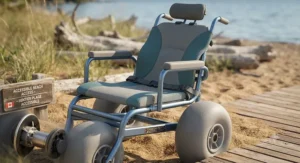
Beach Accessibility in Canada: What to Expect Before You Go
Beach accessibility has improved meaningfully across Canada over the past several years, and it’s worth checking what’s actually available before assuming you need to bring your own equipment at all.
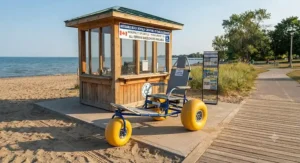
Prince Edward Island National Park was an early and well-documented example: CBC News reported on Parks Canada introducing floating beach wheelchairs and Mobi-Mat accessible pathways at several PEI beaches, a program that’s since been echoed at provincial and municipal beaches across the country, from Ontario Parks locations to city-run beaches in British Columbia. Many of these programs are genuinely free to use, often on a first-come or reservation basis through the park or municipal office, which means a family visiting a specific accessible beach for a single trip may not need to buy anything on this list at all. That said, availability is inconsistent — a single loaner chair at a popular beach on a busy long weekend is a real bottleneck, and not every beach, especially smaller or more remote ones, has any accessible infrastructure yet.
Parks Canada’s own accessible experiences page is worth checking location-by-location before a trip, since accessible beach access varies significantly between individual national parks and even between beaches within the same park. The honest planning advice: call ahead, confirm equipment availability for your specific dates, and treat owning a personal beach wheelchair for sand and boardwalks as the reliable backup plan rather than assuming a public program will always have what you need exactly when you need it.
Vacation Mobility Aid Playbook: Packing, Transporting, and Renting on the Road
Turning any of these seven chairs into a genuinely useful vacation mobility aid comes down to logistics as much as the chair itself, and a few practical habits make the difference between a smooth trip and a frustrating one.
For flying, check disassembled dimensions and weight against your airline’s mobility-equipment policy well before booking — most Canadian and international carriers transport wheelchairs free of charge and outside standard baggage limits, but confirming the folded footprint of something like the 27 kg (60 lb) Fields Outdoor Supplies WC-16 against the airline’s specific equipment door dimensions avoids a gate-side surprise. For road trips, the quick-release wheels on chairs like the Vhewq Beach Wheelchair genuinely earn their keep, since a chair that breaks down small enough for a hatchback trunk beats one that technically fits but eats your entire cargo space. Renting is a real option too: several Canadian mobility-equipment suppliers and beach-town outfitters rent beach wheelchairs by the day or week, which is often the more sensible vacation mobility aid choice for a single trip compared to buying a chair you’ll use once a year.
Whichever route you choose, pack a small rinse kit — fresh water, a soft brush, and a microfibre towel — specifically for wheels and axles, since sand and salt residue left in a folding hinge or quick-release mechanism is the single most common cause of a beach wheelchair seizing up between trips.
Getting Your Beach Wheelchair Beach-Ready: Setup, First 30 Days, and Maintenance
The first month of ownership sets the tone for how well any of these chairs holds up, and a short, consistent routine beats an occasional deep clean.
On first setup, assemble the chair once at home on a flat surface before its first real outing, confirming every quick-release pin and fold-lock engages fully — doing this in your driveway, not on sand with an impatient group waiting, catches a missing part or a stiff hinge while it’s still an easy fix. After every beach use, rinse tires, axles, and any exposed hardware with fresh water as soon as practical; saltwater left to dry on stainless or aluminum hardware accelerates corrosion far more than a quick rinse ever costs in time. Check tire pressure on any pneumatic model, including the GRIT‘s mountain-bike-style wheels, roughly monthly during regular use, since underinflated pneumatic tires lose both the rolling efficiency and the predictable handling they’re designed around.
Store the chair fully dry, ideally with the seat fabric loosely covered rather than left folded and damp in a hot trunk for days, since UV and trapped moisture are the two fastest ways to degrade upholstery on any of these chairs, marine-grade or not. A common first-30-days mistake is over-tightening quick-release levers “just to be safe” — most are hand-tight by design, and forcing them with tools risks stripping the exact mechanism that makes tool-free assembly possible in the first place.
Real-World Scenarios: Matching Riders to the Right Beach Wheelchair
Concrete situations tend to clarify a buying decision faster than specs alone, so here are three common Canadian scenarios mapped onto this list.
If you’re a family renting a cottage for one week each summer and need a chair for an aging parent or a child with limited mobility, the FEIMIRE Light Beach Wheelchair or Vhewq Beach Wheelchair covers the job honestly — light, cheap enough to justify buying outright for occasional use, and easy for one person to manage without a permanent storage plan taking up garage space the other 51 weeks of the year.
If you or a family member uses a beach wheelchair weekly through an entire summer season — a genuinely active retiree with a lakeside property, say, or someone managing a long-term mobility condition — the middle tier makes far more financial sense over time. The Fields Outdoor Supplies WC-1 or WC-16, or the reclining AccessRec TerraWheels if comfort over hours matters more than raw flotation, amortizes its higher upfront cost across dozens of uses per season rather than one or two.
And if your priority is genuine independence — self-propelling across kilometres of trail, dune, and gravel rather than being pushed a short distance to a beach towel — the GRIT Freedom Chair 3.0 is built specifically for that goal, while the Wheeleez Sandcruiser fits best for a resort, beach club, or municipal program outfitting a chair for years of daily public use rather than a single household’s occasional trip.
Common Mistakes When Buying a Beach Wheelchair for Sand and Boardwalks
The most common mistake by far is buying based on price alone without checking tire width and pressure type against the actual beach terrain — a chair that’s technically labelled a beach wheelchair can still struggle badly on a specific dune-heavy stretch of coast if its tires are narrower or higher-pressure than the sand demands.
A second frequent mistake is assuming any wheelchair with big tires is interchangeable with a genuine off-road wheelchair, or the reverse — as the earlier comparison section covers, flotation and climbing traction are different engineering goals, and buying a lever-driven trail chair for a simple boardwalk-to-towel walk is meaningfully overspending for capability you won’t use. A third mistake is ignoring published weight capacity margins; buying a chair rated right at a rider’s exact weight, rather than with genuine headroom, shortens the frame’s working life and can affect handling on soft terrain specifically. And a fourth, subtler mistake is skipping the rinse-and-dry routine covered above, then being surprised when a budget aluminum chair shows corrosion after a single salty season — that outcome isn’t a manufacturing defect, it’s the predictable result of skipping basic maintenance on a chair that was never marketed as marine-grade in the first place.
Long-Term Cost & Maintenance: What Beach Wheelchair Ownership Really Costs
Sticker price only tells part of the story with equipment this exposed to sun, sand, and saltwater, so it’s worth running the numbers on realistic service life before deciding where to spend.
| Model | Approx. Price (CAD) | Frame Durability | Typical Use Case |
|---|---|---|---|
| FEIMIRE Light Beach Wheelchair | under C$450 | Lower (aluminum/fabric) | 1–2 trips per year |
| Vhewq Beach Wheelchair | under C$450 | Lower (fold-flat frame) | 1–2 trips per year |
| Fields Outdoor Supplies WC-1 | C$1,300–C$1,500 | High (healthcare-grade PVC) | Weekly seasonal use |
| AccessRec TerraWheels | C$1,400–C$1,800 | High (aluminum/stainless) | Weekly, mixed terrain |
| Fields Outdoor Supplies WC-16 | C$1,800–C$2,000 | High (healthcare-grade PVC) | Weekly seasonal use |
| Wheeleez Sandcruiser | C$3,600–C$3,900 | Highest (316 marine stainless) | Daily, multi-year, public use |
| GRIT Freedom Chair 3.0 | C$3,900–C$4,200 | High (bike-shop-serviceable parts) | Regular self-propelled trail/beach use |
Reading this table honestly, the two budget chairs make the most financial sense specifically for infrequent use, since their lower material cost roughly matches their shorter realistic service life against saltwater exposure. The two Fields Outdoor Supplies models and the TerraWheels represent the genuine sweet spot for anyone using a beach wheelchair for sand and boardwalks weekly through a Canadian summer, spreading a meaningfully higher upfront cost across years rather than days. The Wheeleez Sandcruiser and GRIT Freedom Chair only pencil out financially for daily or near-daily use — a single-family buyer paying premium-tier pricing for a once-a-year vacation is very likely overspending relative to actual use.
It’s also worth knowing that accessibility equipment standards in Canada are actively evolving, not static. Accessibility Standards Canada and the CSA Group have been collaborating on new national accessibility standards covering the built environment and outdoor spaces, which over time tends to push manufacturers toward clearer, more consistent capacity and durability disclosures — exactly the kind of published spec this guide has leaned on throughout rather than marketing language alone.
💬 Weighing total cost against how often you’ll actually use it? Click through to check today’s Amazon.ca listing before you decide.😊
FAQ
❓ What is a beach wheelchair for sand and boardwalks?
❓ How much does a beach wheelchair cost in Canada?
❓ Can I rent a beach wheelchair instead of buying one?
❓ What's the difference between a beach wheelchair and an off-road wheelchair?
❓ Do beach wheelchairs work on boardwalks and paved paths too?
Conclusion
Seven chairs, three genuinely different jobs: getting a family member across sand for one week a year, getting a regular beach-goer through an entire Canadian summer without the equipment falling apart, or getting someone with real independence goals across kilometres of dune, trail, and gravel under their own power. The FEIMIRE Light Beach Wheelchair and Vhewq Beach Wheelchair cover that first job honestly and cheaply, the Fields Outdoor Supplies WC-1, WC-16, and AccessRec TerraWheels occupy the genuine sweet spot for regular seasonal use, and the Wheeleez Sandcruiser and GRIT Freedom Chair 3.0 earn their premium pricing for daily public use and true off-road independence respectively.
The single question worth answering honestly before buying any beach wheelchair for sand and boardwalks is how often it will actually leave the garage. Match that answer to the frame material and tire design covered throughout this guide, check whether your local beach already has a loaner program worth calling ahead about, and confirm the current listed price on Amazon.ca before ordering, since equipment pricing in this category shifts more than the spec sheets ever do.
✨ Don’t miss the current pricing on these picks!
🔍 Click through to any of the seven beach wheelchairs above to check today’s availability and price on Amazon.ca — a few minutes of comparison now can save a wasted trip to the sand later.
Recommended for You
- All-Terrain Wheelchair for Outdoor Use: 7 Best Picks (2026)
- Attendant Commode Wheelchair: 7 Top Picks for Canadian Homes (2026)
- Self-Propelled vs Attendant Commode Wheelchair: 7 Best Picks (2026)
Disclaimer: This article contains affiliate links. As an Amazon Associate, I earn from qualifying purchases. If you purchase products through these links, we may earn a small commission at no additional cost to you.
✨ Found this helpful? Share it with your friends! 💬🤗
