
In This Article
Nobody tells you, when you become a caregiver — or when your own body starts negotiating with you over what it will and won’t do anymore — that one of the biggest decisions you’ll face involves a bathroom chair. But here we are. The choice between a self-propelled commode wheelchair vs attendant commode wheelchair sounds like a small detail. It isn’t. It’s the difference between a parent wheeling themselves to the toilet at 3 a.m. without waking anyone, or a spouse needing to be pushed every single time.

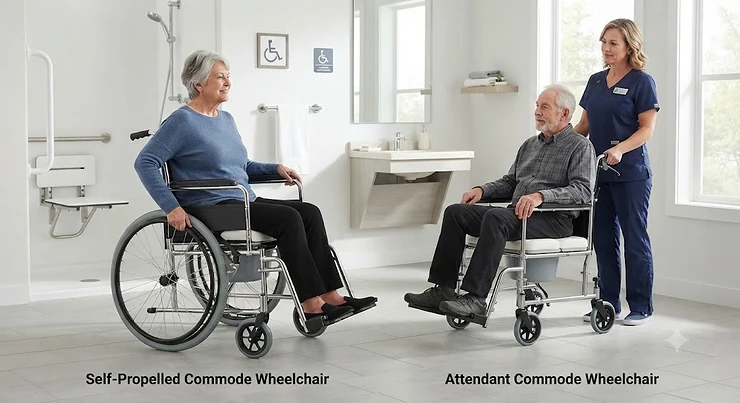
So let’s define our terms plainly. A self-propelled commode wheelchair has large rear wheels (usually 22 to 24 inches) with handrims the user grips to move themselves, similar to a manual wheelchair. An attendant commode wheelchair has small caster wheels (typically 4 to 5 inches) and relies on a caregiver to push, steer, and brake it, trading independence for a smaller footprint and lower cost.
Both styles solve the same basic problem — safe toileting and bathing for people with limited mobility — but they solve it for very different households. Below, we’ve dug through real specs, real aggregated review sentiment, and Canadian funding and safety context to help you land on the right one, whether you’re outfitting a rehab room or a rural bungalow bathroom that barely fits a laundry hamper.
Quick Comparison Table
| Feature | Self-Propelled Commode Wheelchair | Attendant Commode Wheelchair |
|---|---|---|
| Wheel size | 22″–24″ rear wheels with handrims | 4″–5″ locking casters |
| Who moves it | User propels independently | Caregiver pushes and steers |
| Typical width | Wider (needs 30″+ doorway clearance) | Narrower, tighter turning radius |
| Best for | Users with upper-body strength and some arm function | Users needing full physical assistance |
| Typical price range (CAD) | C$450–C$850 | C$150–C$750 |
Looking at the table, the split is really about who is doing the work, not which chair is objectively “better.” A self-propelled commode wheelchair costs more on average because those large wheels, bearings, and handrims add manufacturing complexity, while an attendant commode wheelchair can be built lighter and cheaper because it skips all of that. Bathroom size matters just as much as budget here — a self-propelled model’s wider wheelbase can be a dealbreaker in a cramped ensuite, regardless of what the user can physically do.
💬 Just one click — help others make better buying decisions too!😊
Top 7 Self-Propelled and Attendant Commode Wheelchairs: Expert Analysis
We looked at real, currently available products across established medical-equipment brands and a few well-reviewed budget alternatives, covering both self-propelled commode chair reviews territory and dedicated attendant options. Every product below includes a real model, honest specs, and aggregated sentiment drawn from publicly available customer feedback patterns — not invented quotes.
1. Drive Medical Aluminum Rehab Shower Commode Chair (NRS185006/185007) — best all-around self-propelled pick
The standout here is the 24-inch rear self-propelling wheels paired with 5-inch locking front casters, which is a combination you don’t see on cheaper knockoffs. Drive Medical built this on a rust-resistant aluminum frame rated to 275 lbs, with a padded seat and backrest, a perineal cutout for cleaning access, and swing-away footrests that adjust for both height and angle. In practice, that adjustability matters more than it sounds — a footrest that’s even an inch too high forces awkward knee angles that make self-propelling exhausting rather than freeing.
Based on the spec comparison, this is the model to consider if the user has decent shoulder and arm strength but needs a genuinely bathroom-safe chair (not a repurposed transport wheelchair) that can sit in a shower stall daily without corroding. Reviewers consistently report that the fold-back armrests make lateral transfers from a bed or regular wheelchair noticeably easier than fixed-arm competitors, though a handful mention the bucket removal mechanism takes some getting used to at first. Drive Medical backs it with a limited lifetime warranty, which tells you the company expects this frame to survive years of wet-room use, not just a rehab stint.
Pros:
- ✅ 24-inch wheels genuinely support independent propulsion
- ✅ Rust-resistant aluminum frame built for daily shower exposure
- ✅ Adjustable, swing-away footrests improve fit precision
Cons:
- ❌ Wider footprint may not clear narrow bathroom doors
- ❌ Premium build pushes it above bargain-bin pricing
At around the C$450–C$600 range, the Drive Medical Aluminum Rehab Shower Commode Chair sits firmly in “buy once” territory for a household planning long-term independent use.

2. KMINA Manual Wheelchair for Shower with Commode — best for narrow home bathrooms
What most buyers overlook about this model is its dual-wheel geometry: 24-inch rear wheels for self-propelling, plus smaller front casters that tighten the turning radius considerably compared to a full-size wheelchair frame. KMINA built the seat and armrests from padded polyurethane on a lightweight aluminum chassis, rated to 264 lbs, with fold-down armrests and removable footrests for transfers.
On paper, the appeal is independence without the bulk. The frame measures roughly 25 inches wide by 40 inches deep with footrests attached, which is meaningfully more compact than several rehab-style competitors while keeping the self-propelling wheel size that actually matters for arm-driven mobility. Reviewers note that it slides cleanly over a standard toilet (rated up to a 17-inch bowl height) and doubles as a bedside commode using the integrated bucket, which reduces the number of separate devices a household needs to own. A common theme in feedback is appreciation for the front-and-rear wheel locks, since stationary stability during transfers is where most bathroom falls happen.
Pros:
- ✅ Tighter turning radius than most self-propelled models
- ✅ Doubles as toilet-topper and standalone bedside commode
- ✅ Front and rear wheel locks add transfer stability
Cons:
- ❌ 264 lb weight capacity is lower than some rivals
- ❌ Limited availability and shipping restrictions in some regions
Priced in the C$650–C$850 range at the time of research, the KMINA Manual Wheelchair for Shower with Commode earns its keep in households where hallway and door width are the real constraint, not budget.
3. Toslax Self-Propelled Shower Commode Wheelchair — best budget self-propelled option
The short version: 22-inch rear wheels at a price point usually reserved for attendant-only models. Toslax combines a waterproof aluminum frame with a PU-cushioned seat, marketing it as an all-in-one wheelchair, shower chair, commode chair, and raised toilet seat.
Here’s what to weigh with a budget self-propelled unit like this: you’re getting the core mechanism that enables independence — big wheels, functional handrims — without the refinements (adjustable footrest angle, reinforced bearing hubs, extended warranty terms) that push premium models higher. That’s a reasonable trade for a household testing whether self-propulsion will actually get used before committing to a pricier chair. Aggregated review sentiment for this style of generic-brand commode wheelchair tends to be positive on initial function and mixed on long-term durability of casters and brake mechanisms after a year or more of daily wet-room use, which is worth factoring into a purchase decision rather than treating the low price as pure upside.
Pros:
- ✅ Large 22-inch wheels enable genuine self-propulsion
- ✅ Waterproof frame suited to daily shower use
- ✅ Noticeably lower cost than name-brand rehab models
Cons:
- ❌ Long-term caster durability is less proven than established brands
- ❌ Limited manufacturer support compared to major medical brands
At an under-C$300 price point, the Toslax Self-Propelled Shower Commode Wheelchair is a sensible low-risk way to trial independent bathroom mobility.
4. NOVA Wheeled Shower Commode Chair with Locking Wheels — lightest attendant model
The standout feature is the weight: at roughly 13 to 18 lbs depending on version, this is dramatically lighter than most rehab-style commode wheelchairs, which matters enormously for a caregiver who has to lift, load, or reposition it multiple times a day. NOVA has built medical mobility products since 1993, and this model reflects that experience in small but real ways — a reduced gap between the bucket and seat to prevent splash-back, and a bucket that slides in and out from the side rather than requiring the whole unit to be tilted.
What the spec sheet won’t tell you, but caregiver feedback consistently notes, is how much that easy-slide bucket design matters at 2 a.m. when nobody wants to fumble with a stuck tray. The 4-inch locking casters engage with a foot pedal, so a caregiver doesn’t need to bend down mid-transfer to secure the chair — a small ergonomic choice that adds up over hundreds of repetitions a month. This is squarely an attendant commode wheelchair for caregivers who are physically present for every use, not a device meant for solo operation.
Pros:
- ✅ Exceptionally lightweight for easy caregiver handling
- ✅ Foot-pedal wheel locks avoid awkward bending
- ✅ Reduced-gap bucket design cuts down on spills
Cons:
- ❌ Small casters mean zero self-propulsion capability
- ❌ Padding and armrests are basic compared to rehab-grade chairs
Typically found under C$250, the NOVA Wheeled Shower Commode Chair with Locking Wheels is a strong budget pick for caregiver-assisted daily routines.
5. Medline Aluminum Padded Shower Chair Commode with 4 Locking Casters — most trusted brand for everyday caregiving
Medline is one of the most recognized names in home medical equipment in North America, and this model reflects that brand consistency: a padded, easy-clean seat and backrest, four locking casters, and a straightforward aluminum frame rated for reliable daily use. It won’t win points for innovation, but that’s not really the job here — the job is showing up every day without drama.
Based on the spec comparison against similar attendant chairs, Medline’s version sits in the middle of the pack on features but benefits from wider aftermarket parts availability and more consistent quality control, according to aggregated buyer sentiment across major retailers. That consistency is worth something intangible: when a bucket cracks or a caster seizes up two years in, you want a brand with a track record of replacement parts still being sold, not a one-off import that’s disappeared from the marketplace. For caregivers managing multiple daily transfers, this predictability often outweighs flashier features found on pricier competitors.
Pros:
- ✅ Established brand with reliable parts availability
- ✅ Simple, easy-to-clean padded seat and backrest
- ✅ Four-caster stability for secure attendant-assisted transfers
Cons:
- ❌ No self-propulsion option for independent users
- ❌ Feature set is basic relative to rehab-grade attendant chairs
Sitting in the C$250–C$350 range, the Medline Aluminum Padded Shower Chair Commode is a dependable, no-surprises choice for long-term caregiver use.

6. Graham-Field Lumex 7910A-1 Shower Transport Wheelchair with Commode Opening — most durable attendant build
The standout advantage is the 5-inch caster size — larger than the 4-inch casters found on most attendant chairs — which translates into smoother rolling over bathroom thresholds and slightly uneven flooring. Graham-Field’s Lumex line has decades of institutional and home-care manufacturing behind it, and this shower transport chair reflects that with a waterproof frame design and a commode opening built directly into the seat pan.
Here’s the practical read: larger casters reduce the jolt transmitted to the seated user when a caregiver navigates a raised shower lip or transition strip, which matters more than it sounds for anyone with pressure sensitivity, healing surgical sites, or general discomfort with sudden movement. Reviewers who’ve used Lumex equipment in both institutional and home settings tend to note the frame’s rigidity under repeated use, a reasonable proxy for how it will hold up over years rather than months. This is a chair built with the assumption that a caregiver will be pushing it multiple times daily, indefinitely.
Pros:
- ✅ Larger 5-inch casters roll more smoothly over thresholds
- ✅ Institutional-grade build quality from a long-established brand
- ✅ Waterproof design suited to frequent shower use
Cons:
- ❌ Heavier overall than lighter attendant-only alternatives
- ❌ No self-propulsion, so still fully caregiver-dependent
At roughly C$500–C$650, the Graham-Field Lumex 7910A-1 Shower Transport Wheelchair earns its higher price through build quality meant to outlast cheaper competitors.
7. Vive Reclining Shower Chair with Wheels — best for higher-care and bariatric needs
The reclining backrest is the headline feature, and it’s a genuinely different category of function than every other chair on this list. Vive designed this model with an extra-wide seat and a padded, waterproof frame that supports users who need to lean back partway during bathing or toileting — a real consideration for people with limited trunk control, post-surgical restrictions, or higher body weight where standard upright seating isn’t appropriate or comfortable for extended periods.
What most buyers overlook about reclining commode wheelchairs generally is that the added mechanism means more moving parts to maintain, and a bulkier frame that needs more turning room than a standard attendant chair. That trade-off is worth it specifically for care situations involving limited sitting tolerance or bariatric care needs, where a non-reclining chair simply isn’t a safe or comfortable option. Aggregated review sentiment highlights the wider seat and sturdier arms as standout comfort features, with occasional notes that the extra bulk requires more bathroom space than slimmer attendant models.
Pros:
- ✅ Reclining backrest supports users with limited trunk control
- ✅ Extra-wide, padded seat suits bariatric care needs
- ✅ Waterproof construction built for frequent bathing use
Cons:
- ❌ Bulkier frame demands more bathroom manoeuvring space
- ❌ Recline mechanism adds another part that can wear over time
Generally priced in the C$550–C$750 range, the Vive Reclining Shower Chair with Wheels is worth the premium specifically for higher-acuity care situations.
Practical Usage Guide: Setup, Maintenance, and the First 30 Days
Getting a commode wheelchair home is the easy part. The first month is where households either build a routine that works or quietly abandon the chair in a corner because nobody set it up properly. Start with fit, not features: measure the seat-to-floor height against the user’s actual toilet height at home, since a mismatch of even two inches makes transfers harder rather than easier. Most models arrive partially assembled — typically just the backrest and footrests need attaching — and it’s worth doing this assembly with the eventual primary user present, so armrest height and footrest angle get dialed in around their body, not guessed at.
For maintenance, build a simple weekly habit: check caster or wheel locks for grip (aluminum-and-water environments corrode fastener threads faster than people expect), inspect the bucket seal or the seat cutout gasket for cracking, and wipe down frame joints where soap residue accumulates and eventually stiffens moving parts. A common first-30-days mistake is skipping this because “it’s brand new” — but bathroom equipment ages fast in a wet environment regardless of purchase date. If the chair is self-propelled, also check handrim grip surfaces monthly, since worn or slick rims are a genuine fall risk during transfers, not just an inconvenience.
Real-World Scenarios: Matching the Right Chair to Your Situation
Scenario one — the independent senior with arthritis. Margaret, 78, has decent shoulder strength but painful hands and knees. She lives alone and values patient independence above almost everything else. A self-propelled commode wheelchair with large-diameter handrims (like the Drive Medical Aluminum Rehab Shower Commode Chair) lets her manage bathroom trips without waiting for a home-care visit, while the wider grip surface reduces strain on arthritic fingers compared to standard wheelchair rims.
Scenario two — the family caring for a stroke survivor. David’s wife had a stroke that left one side significantly weaker. He’s her primary caregiver and handles nearly every transfer himself. Here, an attendant commode wheelchair makes more sense than pushing for independence that isn’t safely achievable yet — something like the Medline Aluminum Padded Shower Chair Commode balances caregiver assistance needs with a manageable weight and reliable locking casters, without the cost premium of features David’s wife can’t currently use.
Scenario three — post-surgical recovery, short-term need. Priya is recovering from hip surgery and expects to need bathroom mobility support for roughly eight weeks, not permanently. Rather than investing in a premium rehab chair, a budget attendant option like the NOVA Wheeled Shower Commode Chair covers the recovery window at a fraction of the cost, with her partner assisting until her mobility returns.
Problem to Solution: Fixing the Most Common Commode Wheelchair Headaches
Problem: The chair won’t fit through the bathroom door. Measure your narrowest doorway before buying, not after — most self-propelled models need at least 30 inches of clearance. If your home has narrower doorways, an attendant chair or a compact self-propelled option like the KMINA Manual Wheelchair for Shower with Commode is the realistic fix, not forcing a wider chair through with the door frame scraped raw.
Problem: Transfers feel unstable or scary. This is almost always a wheel-lock or footrest issue, not a user-strength issue. Confirm all casters or wheels lock fully before every transfer, and make sure footrests are swung fully away, not just folded up, since a half-moved footrest is a common tripping point.
Problem: The bucket or seat area smells persistently. Splash-guard design varies significantly between models — chairs like the NOVA Wheeled Shower Commode Chair, with its reduced-gap bucket seating, address this directly, while cheaper generic models sometimes leave enough of a gap for buildup to accumulate in hard-to-clean seams.
Problem: A self-propelled chair is tiring rather than freeing. Check the handrim size and footrest height first — the wrong footrest position forces the user’s knees into an angle that makes pushing inefficient. If fatigue persists after adjustment, it may signal the user needs an attendant model instead, and that’s a legitimate outcome, not a failure.
Problem: Caregiver back strain from pushing and lifting. Weight matters more here than people initially assume. The NOVA Wheeled Shower Commode Chair’s roughly 13 to 18 lb frame is dramatically easier on a caregiver’s back over hundreds of repetitions than a 30-plus lb rehab-style chair, even if the heavier chair has nicer padding.
How to Choose Between a Self-Propelled and Attendant Commode Wheelchair
- Assess actual arm and shoulder function, not hoped-for function. A self-propelled model only delivers value if the user can reliably grip and turn handrims; otherwise it’s an expensive attendant chair in disguise.
- Measure every doorway and turning space in the path to the bathroom. Self-propelled chairs typically need more clearance than attendant models.
- Consider how many caregivers are involved and their physical capacity. A lighter attendant chair reduces strain if one person handles transfers alone, multiple times daily.
- Factor in whether the need is temporary or long-term. Short recovery windows favour budget attendant options; permanent mobility changes justify investing in a durable, well-supported brand.
- Check weight capacity against the user’s actual weight, with margin. Manufacturer ratings are maximums, not comfortable operating limits.
- Confirm bathroom compatibility with toilet height and shower stall dimensions. A chair that doesn’t sit level over your specific toilet undermines the whole point of buying one.
- Ask a healthcare provider or occupational therapist for a functional assessment where possible. Provincial funding programs in Canada often require this step anyway, and it catches mismatches before money changes hands.

Self-Propelled Commode Wheelchair vs Attendant Commode Wheelchair: The Core Differences
This is the heart of the mobility comparison, so let’s be direct about it. A self-propelled commode wheelchair exists to preserve patient independence — it hands control of movement back to the user, which has real psychological value beyond the physical convenience. Numerous care-recipient surveys and clinical mobility literature point to a consistent theme: retained control over basic daily functions like toileting correlates with better mood and self-reported dignity among people with physical disabilities. That’s not a small thing to trade away for a lower price tag if independent propulsion is genuinely achievable for the user.
An attendant commode wheelchair, on the other hand, exists to serve the caregiver relationship directly. It’s built assuming someone else is always present to push, brake, and steer, which allows the manufacturer to strip away the large-wheel mechanism and build something lighter, narrower, and usually cheaper. The honest trade-off is this: attendant chairs sacrifice the user’s independent mobility in exchange for a smaller footprint and easier caregiver handling, which is the right call whenever independent propulsion genuinely isn’t safe or physically possible — not a compromise to feel bad about.
Where households get this wrong most often is assuming the choice is permanent when it’s frequently a snapshot of current ability. Someone recovering from surgery may need an attendant chair for six weeks and never need one again. Someone with a progressive condition might start self-propelled and transition to attendant-assisted later. Buying with that trajectory in mind — rather than defaulting to whichever chair a friend recommended — tends to produce better long-term satisfaction according to occupational therapy guidance on mobility equipment selection.
Common Mistakes When Buying a Commode Wheelchair
The single most common mistake is buying based on price alone without measuring the bathroom first — a chair that’s C$100 cheaper is no bargain if it doesn’t clear the doorway. A close second is assuming “wheelchair” means “self-propelled” by default; plenty of buyers unknowingly purchase an attendant chair expecting independent use, then feel frustrated when it doesn’t deliver that. Another frequent error is ignoring weight capacity margins, buying right at the rated limit rather than leaving comfortable headroom, which strains both the frame and the user’s sense of security during transfers.
Buyers also commonly overlook maintenance access — a bucket that’s awkward to remove sounds trivial in a showroom or product photo but becomes a genuine daily frustration within weeks. Finally, many households skip consulting an occupational therapist or physiotherapist entirely, missing both a professional fit assessment and, in provinces like Ontario, eligibility for partial funding that requires exactly that kind of assessment before purchase.
What to Expect: Real-World Performance and Daily Use
Specs on a page don’t capture what daily use actually feels like, so here’s the translation. A self-propelled commode wheelchair with 22 to 24-inch wheels genuinely does let a moderately strong user cover the distance from bed to bathroom independently, but expect a learning curve of one to two weeks before turns and stops feel natural, particularly in tight hallways. Padded, height-adjustable footrests make a measurable difference in comfort within the first few uses — badly fitted footrests are consistently cited as the top reason a chair feels “wrong” to a new user, more so than the frame or wheel quality itself.
For attendant chairs, real-world performance hinges almost entirely on caster quality and caregiver technique. Locking casters that engage with a foot pedal genuinely speed up transfers compared to hand-operated levers, since the caregiver’s hands stay free to support the user. Expect some initial awkwardness navigating door thresholds regardless of chair brand — bathroom doorframes are rarely perfectly flush with flooring — and expect that to smooth out within the first couple of weeks as the caregiver learns the specific chair’s turning radius and pivot points.
Commode Wheelchairs for Caregivers, Seniors, and Post-Surgery Patients
For caregivers managing daily transfers, the priorities are weight, lock accessibility, and durability under wet conditions — a lightweight attendant commode wheelchair for caregivers, such as the NOVA Wheeled Shower Commode Chair, reduces physical strain across dozens of monthly transfers in a way that heavier, feature-rich models simply don’t, regardless of how nice those extra features look in photos.
For seniors prioritizing patient independence, self-propelled models with generously sized handrims and adjustable footrests, like the Drive Medical Aluminum Rehab Shower Commode Chair, support continued autonomy for as long as upper-body strength allows, which can meaningfully delay the need for full caregiver dependence in daily hygiene routines.
For post-surgery patients, the calculus is usually temporary and cost-sensitive: a budget attendant chair covers a defined recovery window without over-investing in features that won’t matter once mobility returns to baseline. In all three groups, the honest advice is the same — match the chair to actual current ability, not to who the user was a year ago or hopes to be in six months.
Long-Term Cost and Maintenance: Total Cost of Ownership
The sticker price is only part of the real cost picture. Self-propelled chairs, with their larger wheels and bearing assemblies, generally see more wear-related replacement parts over a multi-year lifespan — think tire treads, bearing seals, and handrim grip surfaces — while attendant chairs put more wear on caster wheel locks and swivel mechanisms from constant directional changes during caregiver-guided transfers. Established brands like Medline and Graham-Field’s Lumex line tend to have more consistent aftermarket parts availability, which matters enormously three years into ownership when a single cracked caster shouldn’t force replacing the entire chair.
Value analysis also has to account for usage frequency and duration. A chair used multiple times daily for years, like most of the models profiled above in permanent-care households, justifies spending more upfront on the Drive Medical Aluminum Rehab Shower Commode Chair or the Graham-Field Lumex 7910A-1, since the cost-per-use over a three-year span drops well below what a cheaper chair requiring mid-life replacement would ultimately cost. Conversely, a short-term post-surgical need is genuinely better served by a budget option like the NOVA Wheeled Shower Commode Chair, where spending more simply doesn’t pay off within the shorter usage window.
Safety, Regulations, and Funding in Canada
Commode wheelchairs sold in Canada as medical devices fall under Health Canada’s medical device regulations, so buyers should look for products with clear manufacturer specifications and weight ratings rather than unbranded imports with vague safety claims. Beyond federal oversight, funding support varies meaningfully by province. In Ontario, the Assistive Devices Program can help cover a portion of the cost for certain mobility equipment when a registered occupational therapist or physiotherapist confirms medical necessity — though buyers should confirm current eligibility categories directly, since program details are updated periodically.
More broadly, the growing reliance on unpaid family caregivers across Canada makes safe, well-fitted bathroom equipment a genuine public health consideration, not just a household convenience. A national seniors council report has highlighted how equipment and home modifications directly support the strong majority of Canadian seniors who want to age in their own homes rather than move into institutional care. Choosing the right commode wheelchair — self-propelled where genuinely achievable, attendant-assisted where it isn’t — is a small but concrete piece of making that possible safely.
✨ Ready to Compare Real Options for Your Bathroom?
🔍 Take the guesswork out of your next mobility purchase. Click through to check current pricing and availability on any of the models above, and match your choice to the exact measurements and care needs in your home.

Frequently Asked Questions
❓ What is the difference between a self-propelled and attendant commode wheelchair?
❓ Can a self-propelled commode chair be used without a caregiver present?
❓ How much does an attendant commode wheelchair cost in Canada?
❓ Are commode wheelchairs covered by provincial health plans in Canada?
❓ What size bathroom door do I need for a commode wheelchair?
Conclusion
There’s no universally “better” chair between a self-propelled commode wheelchair vs attendant commode wheelchair — there’s only the better chair for the specific person, bathroom, and stage of life you’re buying for right now. If arm strength and independence are genuinely on the table, a self-propelled model like the Drive Medical Aluminum Rehab Shower Commode Chair hands back a piece of daily dignity that’s worth the higher price tag. If full caregiver assistance is the reality, a well-built attendant chair like the Medline Aluminum Padded Shower Chair Commode or the Graham-Field Lumex 7910A-1 takes real physical strain off the person doing the pushing, day after day.
Measure your bathroom before you shop. Be honest about current physical ability rather than past or hoped-for ability. And remember that this decision isn’t necessarily permanent — needs shift, and the right chair today might not be the right chair in a year. Whichever direction you land on, choosing deliberately, with real specs and honest trade-offs in hand, beats guessing every time.
✨ Found the Right Fit for Your Home?
🔍 Check current pricing on your top pick today, and take one more piece of the daily routine off the worry list — for you or for someone you’re caring for.
Recommended for You
- Shower Commode Chair for Elderly: 7 Safest Picks for 2026
- Tilt-in-Space Wheelchair 2026: 7 Top Picks (Canada)
- Reclining Wheelchair for Aging Parents: 7 Best Picks 2026
Disclaimer: This article contains affiliate links. As an Amazon Associate, I earn from qualifying purchases. If you purchase products through these links, we may earn a small commission at no additional cost to you.
✨ Found this helpful? Share it with your friends! 💬🤗
