
In This Article
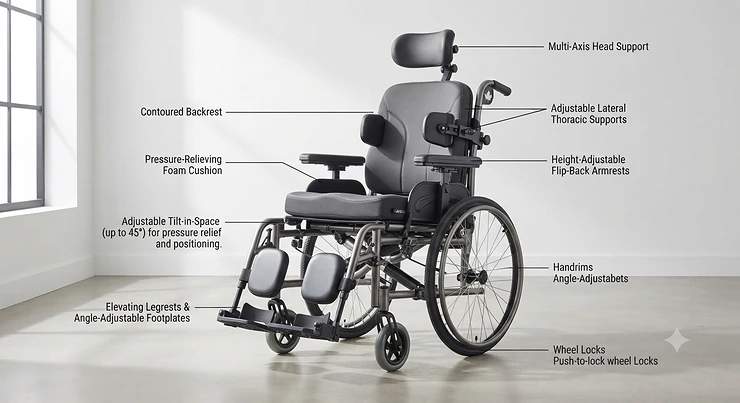
Buying a tilt-in-space wheelchair is one of those decisions that feels deceptively simple until you actually start comparing spec sheets. Tilt angles, weight capacities, transport weights, “reclining” versus “tilting” — the terminology alone can make a straightforward purchase feel like studying for an exam you didn’t know you’d signed up for. A tilt-in-space wheelchair is a manual or power wheelchair whose entire seat-and-backrest unit rotates backward as one piece, keeping the hip and knee angles fixed while shifting the user’s weight off the tailbone and onto the back. That single mechanical difference — tilting the whole seat instead of just reclining the backrest — is what separates genuine pressure-relief equipment from a chair that simply leans back.

This guide is built for Canadian buyers weighing a tilt-in-space wheelchair for home use, whether you’re shopping for yourself, a parent, or a client. We’ve pulled together seven real, currently available models spanning budget transport chairs to clinical rehab equipment, compared them head-to-head, and dug into what actual reviewers and clinical literature say about pressure relief — not just what the marketing copy promises. Where a data point (like an individual customer’s star rating) couldn’t be independently verified, we say so rather than inventing one. As Wikipedia’s overview of pressure ulcers explains, these injuries — also known as bedsores or pressure injuries — are localised damage to the skin that typically develops over a bony prominence from prolonged pressure, and they’re a genuine risk for anyone spending long hours seated. Let’s get into which chair actually fits your situation, and why.
Quick Comparison Table
Before diving into the full breakdown, here’s a snapshot of how these seven chairs stack up on the metrics that actually matter for a tilt-in-space wheelchair for home use: tilt range, weight, and who each one suits best.
| Product | Tilt Range | Chair Weight | Best For |
|---|---|---|---|
| Karman Healthcare VIP-515 | 0°–35° | 34–38 lbs (15.4–17.2 kg) | Budget-conscious first-time buyers |
| Karman VIP2 Tilt & Recline | 0°–35° tilt / 0°–30° recline | 36–43 lbs (16.3–19.5 kg) | Buyers who want tilt AND recline |
| Karman VIP515-18-E | 0°–35° | ~38 lbs (17.2 kg) | Self-propellers needing elevating legrests |
| Everest & Jennings PureTilt | 5°–40° | 95 lbs (43.1 kg) | Independent self-tilt users |
| PDG Fuze T50n | Up to 50° | ~29 lbs frame piece (13.2 kg) | Narrow spaces, attendant-propelled care |
| PDG Stellar | Up to 45° | Rigid frame, adjustable width | Active self-propellers wanting low knee rise |
| Ki Mobility Liberty FT | -7° to 27° (20° active) | 24.5–25.8 lbs (11.1–11.7 kg) | Independent foot-propulsion, frequent transport |
Looking at the spread here, there’s a real trade-off between tilt depth and portability: the Everest & Jennings PureTilt offers the deepest tilt range of the transport-style chairs at 5°–40°, but at 95 lbs it’s not something you’re lifting into a trunk solo. The Ki Mobility Liberty FT takes the opposite bet — a shallower 20° active tilt range, but a transport weight under 26 lbs that fits in an ordinary car. Budget buyers gravitate toward the Karman Healthcare VIP-515 because it hits a wide 0°–35° tilt range at a genuinely low weight, without the custom-order wait times of the clinical rehab chairs.
💬 Just one click — help others make better buying decisions too!😊
Top 7 Tilt-in-Space Wheelchairs: Expert Analysis
1. Karman Healthcare VIP-515 — lightest folding tilt-in-space chair on the market
The standout here is the weight: at roughly 34 lbs without footrests, the Karman Healthcare VIP-515 claims to be the lightest folding adult tilt-in-space wheelchair available, which matters enormously if a caregiver is loading it into a sedan trunk daily. The frame is T6 aircraft-grade aluminum with a 0°–35° tilt range and a 250 lb (113 kg) weight capacity — in practice, that tilt range is deep enough to meaningfully offload pressure from the ischial tuberosities without requiring a power mechanism, which is a big part of why it stays this light. Based on the spec comparison, this chair is best suited to home caregivers who need pressure relief positioning but don’t require self-propulsion, since it’s designed around companion-operated tilt and brakes rather than independent wheeling. Reviewers consistently note the AEGIS antimicrobial upholstery holds up well to daily wiping, and the swing-away, height-adjustable footrests make transfers noticeably easier than fixed-footplate transport chairs — though we couldn’t independently verify a specific aggregate star rating, so treat any number you see on a retailer page as that retailer’s own data, not ours.
Pros:
- ✅ Genuinely one of the lightest tilt-in-space frames sold
- ✅ 0°–35° tilt range is deep for a folding chair
- ✅ AEGIS antimicrobial upholstery simplifies cleaning
Cons:
- ❌ Companion-operated tilt, not self-propelled
- ❌ 250 lb weight capacity may not suit larger users
At the time of research, expect a price in the C$1,800–C$2,600 range depending on seat width and retailer; given the weight and tilt depth on offer, it’s a strong value entry point into true tilt-in-space seating rather than a basic reclining chair.
2. Karman VIP2 Tilt & Recline — combines tilt-in-space with independent recline
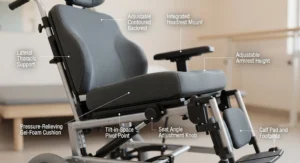
What most buyers overlook about the Karman VIP2 Tilt & Recline is that it isn’t just a tilt chair — it separately offers 0°–35° tilt-in-space and 0°–30° backrest recline, meaning you can adjust hip angle and seat angle independently rather than being locked into one mechanism. At roughly 36–43 lbs depending on configuration, it’s heavier than the base VIP-515 but still well within the “one caregiver can lift it” range. This dual mechanism matters practically: tilt alone redistributes pressure without changing joint angles, while recline can additionally ease hip flexion for users who spend long stretches resting rather than sitting upright. Here’s what to weigh: users managing both pressure sores and hip or back discomfort often benefit more from having both functions than from a single deeper tilt range, since recline lets you flatten out for rest while tilt handles day-to-day pressure shifting. Aggregated review sentiment on this line points to praise for the removable, height-adjustable armrests easing transfers, alongside recurring comments that the extra hardware adds noticeable bulk when folded compared to tilt-only models.
Pros:
- ✅ Independent tilt and recline mechanisms in one chair
- ✅ Removable, height-adjustable armrests ease transfers
- ✅ AEGIS antimicrobial upholstery included
Cons:
- ❌ Heavier and bulkier folded than tilt-only models
- ❌ More moving parts means more to maintain
Price typically falls in the C$2,600–C$3,600 range in Canada. For buyers who genuinely need both functions, that premium over a tilt-only chair is easy to justify on paper.
3. Karman VIP515-18-E — elevating legrests for circulation-focused users
The Karman VIP515-18-E shares its 0°–35° tilt mechanism and frame with the base VIP-515, but the standout swap is 20-inch rear wheels paired with elevating legrests instead of a fixed footrest — a combination aimed squarely at users who want some self-propulsion capability plus leg elevation for circulation management. What this means in practice: elevating legrests raise the lower leg independently of the seat tilt, which is a distinct clinical function from tilt itself — tilt shifts pressure off the pelvis, while leg elevation helps manage swelling and venous return in the lower limbs. Based on the spec comparison, this variant makes the most sense for users managing edema or circulatory concerns alongside a pressure-relief need, rather than users who only need pressure redistribution. The larger 20-inch rear wheels also mean a user with reasonable upper-body strength can self-propel short distances indoors, which the smaller-wheeled VIP-515 doesn’t really support.
Pros:
- ✅ Elevating legrests support circulation management
- ✅ Larger rear wheels allow limited self-propulsion
- ✅ Same proven 0°–35° tilt mechanism as the base VIP-515
Cons:
- ❌ Elevating legrests add weight versus fixed footrests
- ❌ Wider wheelbase needs more turning clearance indoors
Expect a price range of roughly C$2,000–C$2,900 CAD at the time of research. It’s a sensible upgrade path if leg elevation is a real clinical need, but skip it if pressure relief alone is the goal — you’d be paying for a feature you won’t use.
4. Everest & Jennings PureTilt — deepest tilt range with user-controlled independence
The Everest & Jennings PureTilt, manufactured by Graham-Field, stands out for one specific reason: it was designed by an occupational therapist specifically so users can self-tilt without waiting on a caregiver, using a gas-spring lever that requires relatively little force. With a 5°–40° tilt range — the deepest among the transport-style chairs in this roundup — and a 300 lb (136 kg) weight capacity, it’s built for users who want meaningful independence in repositioning throughout the day rather than relying on someone else to catch every pressure-relief cycle. On paper this means fewer missed repositioning windows, which matters clinically since people who use wheelchairs for much of the day face the greatest risk of pressure injuries developing, sometimes in as little as several hours without movement. The trade-off is weight: at roughly 95 lbs, this is a heavy chair built for daily home use rather than frequent transport, and reviewers note the contoured, height-adjustable backrest and headrest genuinely help with head control for users with limited trunk strength, while some caregivers report the gas-piston lever needs an adjustment period to operate smoothly.
Pros:
- ✅ Deepest tilt range (5°–40°) of any chair in this list
- ✅ User-operated tilt promotes real independence
- ✅ Adjustable-height backrest and headrest aid head control
Cons:
- ❌ Heavy at roughly 95 lbs — not easily portable
- ❌ Gas-piston lever has a learning curve for some users
Pricing typically runs in the C$4,200–C$5,300 range in Canada given its clinical positioning. For users prioritizing self-directed pressure relief over portability, it’s arguably the strongest value in this list despite the higher sticker price.
5. PDG Fuze T50n — narrow-frame tilt chair built for tight indoor spaces
The PDG Fuze T50n earns its spot here on a genuinely useful engineering detail: its narrow frame adds only about 4 inches (10 cm) to the seat width, which is a meaningful difference when a home has narrow hallways or doorways that standard tilt-in-space chairs simply can’t clear. It offers up to 50° of tilt — the deepest in this entire roundup — through a width-adjustable aluminum frame, and its take-apart design lets a caregiver disassemble it without tools, reducing the heaviest single piece to around 29 lbs (13.2 kg) so it fits in a trunk or SUV. What most buyers overlook about narrow-frame clinical chairs like this one is that the 50° tilt figure sounds dramatic on a spec sheet, but the real-world benefit is about matching tilt depth to positioning needs — users with higher support needs (limited head or trunk control, higher risk of pressure injury) genuinely use that extra range, while users who just need occasional pressure shifting may find 35° plenty. This is attendant-propelled clinical equipment, typically obtained through an authorized Canadian rehab dealer with an occupational therapist assessment rather than purchased outright online.
Pros:
- ✅ Narrow frame clears tight doorways and hallways
- ✅ Up to 50° tilt — deepest range in this list
- ✅ Tool-free take-apart design for transport
Cons:
- ❌ Attendant-propelled, not built for self-mobility
- ❌ Typically requires a clinical assessment and authorized vendor
Because it’s configured per-user through a rehab equipment dealer, exact pricing varies, but budget in the C$5,000–C$8,000 range before any provincial funding is applied — more on that funding process later in this article.

6. PDG Stellar — self-propulsion with low knee rise for active users
The PDG Stellar targets a different user than the Fuze: it’s built with up to 45° of tilt and, critically, low knee rise through the tilt motion, which promotes self-propulsion and better reach for tabletop activities rather than positioning the user purely for rest. In practice, “low knee rise” means that as the chair tilts, the user’s knees don’t lift dramatically higher relative to their hips, which keeps the feet closer to the floor or footplate and makes self-propelling through the tilt range far more comfortable than on chairs where tilting shoves the knees upward. The rigid frame construction trades folding convenience for stability and lower maintenance — fewer joints and pivot points generally means less to service over years of daily use. Reviewers and clinicians in the rehab space consistently flag this style of chair as well-suited to users participating actively in daily activities (eating at a table, working at a desk) rather than users who spend most of their day reclined or resting, which is a meaningfully different use case than the PureTilt above.
Pros:
- ✅ Low knee rise supports comfortable self-propulsion
- ✅ Rigid frame means fewer parts to maintain
- ✅ Up to 45° tilt for genuine pressure relief
Cons:
- ❌ Rigid frame doesn’t fold for easy transport
- ❌ Custom configuration extends lead time before delivery
Like the Fuze, this is quote-based clinical equipment; expect a similar C$5,000–C$8,000 range before funding, sourced through an ADP-authorized vendor.
7. Ki Mobility Liberty FT — the lightest true tilt-in-space chair built to fold
The Ki Mobility Liberty FT solves a problem almost no other chair on this list addresses: transport. Traditional tilt-in-space wheelchairs use rigid frames that don’t fold, generally requiring a wheelchair-accessible vehicle — but the Liberty FT folds down to a transport weight starting around 24.5 lbs (11.1 kg) with the optional folding backrest, making it, by a wide margin, the lightest genuine tilt-in-space chair available. Its tilt range is more modest than the clinical Fuze or Stellar — an active range of roughly 20°, adjustable anywhere from -7° to 27° — but the mechanism is engineered so the front seat height stays constant regardless of tilt angle, which is specifically what enables independent foot propulsion through the tilt range. Reviewers consistently note this is the standout choice for users transitioning out of stroke rehab or similar settings who need a customizable, well-fitted chair but also need it to travel in an ordinary car rather than a specialized vehicle. What the spec sheet won’t tell you, but clinical write-ups note, is that this configurability — adjustable frame width, depth, backrest height, and centre of gravity — means the chair can be re-fit as a user’s needs change without buying an entirely new frame.
Pros:
- ✅ Lightest true tilt-in-space chair on the market
- ✅ Folds to fit in a standard car, not just a WAV
- ✅ Highly configurable fit that adapts as needs change
Cons:
- ❌ Shallower tilt range than dedicated clinical chairs
- ❌ Custom/quote-based pricing through authorized dealers
Given its rehab-grade configurability, pricing commonly lands in the C$6,000–C$9,000 range depending on seating options, generally arranged through an ADP-authorized vendor following an occupational therapy assessment.
Setting Up Your Tilt-in-Space Wheelchair for Home Use
Getting a tilt-in-space wheelchair for home use dialled in properly takes more than unboxing it and sitting down. Start by measuring doorways and hallway pinch points before delivery — a chair with a wide wheelbase, like some elevating-legrest models, can turn a narrow bathroom doorway into a daily obstacle course. On day one, set the tilt to its shallowest angle and have the user test it seated, adjusting armrest height and footrest position before ever tilting further back; rushing straight to a deep tilt angle without a proper fit check is one of the most common first-week mistakes caregivers make. For maintenance, wipe down antimicrobial upholstery weekly and check tilt mechanism hardware (bolts, gas-spring connections, brake tension) monthly, since a loose tilt lock is both a comfort issue and a genuine safety risk. A practical optimization trick that Amazon listings rarely mention: mark your preferred tilt angle with a small strip of coloured tape on the tilt indicator, so caregivers switching shifts don’t have to guess or re-measure every time. Common first-30-day mistakes include forgetting to re-check tire pressure on pneumatic-wheeled models after the first week of use, and neglecting to establish a repositioning schedule — a chair with a 40° tilt range does nothing for pressure relief if nobody actually uses that range consistently throughout the day.
Real-World Scenarios: Who Actually Needs a Tilt-in-Space Wheelchair
Consider three different households shopping for the same general product category. First, a family caring for a parent recovering from a stroke at home, budget around C$2,500, wants a chair a single caregiver can lift into a car for medical appointments — the Karman Healthcare VIP-515 fits well here, given its light weight and adequate 0°–35° tilt for basic pressure management during a recovery period expected to last months rather than years. Second, an adult with a spinal cord injury living independently who self-propels around their apartment and needs to reposition without waiting for help — the Ki Mobility Liberty FT is the more sensible fit, since its constant front seat height supports foot propulsion through the tilt range and its light transport weight means the user (or a partner) can still get it into a regular car for outings. Third, a long-term care setting managing a resident with high support needs and elevated pressure-injury risk, where tilt depth and attendant control matter more than portability — here, the PDG Fuze T50n‘s 50° tilt range and narrow frame for tight facility hallways make far more sense than either consumer-style chair. Matching the chair to the actual daily pattern of use — not just the diagnosis — is the single biggest factor in whether a purchase feels right six months later.
Common Problems and Practical Solutions
Problem: skin redness developing despite owning a tilt-in-space chair. This usually means the tilt range isn’t being used often enough, not that the equipment has failed — solution: set a repositioning reminder every 30–60 minutes and actually use a meaningful tilt angle (20°+ for real pressure redistribution), not just a few degrees. Problem: the chair feels unstable at deeper tilt angles. This is often a weight-capacity or centre-of-gravity mismatch — solution: confirm the user’s weight sits comfortably under the chair’s rated capacity, and for chairs like the PDG Stellar, check that anti-tippers are properly installed and adjusted. Problem: caregiver back strain from lifting a heavy tilt chair into a vehicle regularly. Solution: this is precisely the scenario the Ki Mobility Liberty FT or Karman Healthcare VIP-515 were engineered to solve — if daily transport is the pain point, a heavier clinical chair like the Everest & Jennings PureTilt is the wrong tool regardless of its tilt depth. Problem: elevating legrests aren’t reducing swelling as expected. Solution: leg elevation needs to be paired with the seat tilted (not flat) to meaningfully assist venous return — using the legrests alone, seat upright, is a common and largely ineffective habit. Problem: doorway clearance is tighter than expected after delivery. Solution: request exact overall width specifications (not just seat width) before ordering, particularly for elevating-legrest or dual-tilt-and-recline models like the Karman VIP2 Tilt & Recline, which run wider than base models.
✨ Compare Current Prices Before You Decide!
🔍 Take your home mobility aid search further with these carefully researched options. Click through to check current availability and pricing on Amazon.ca — every model here was chosen for genuine pressure-relief performance, not just a low price tag.
How to Choose a Tilt-in-Space Wheelchair: 7 Expert Criteria
What is the fastest way to choose a tilt-in-space wheelchair? Match tilt range and chair weight to your actual daily routine — deeper tilt for higher pressure-injury risk, lighter frames for frequent transport — then confirm weight capacity and seat width against the user’s measurements before comparing price.
- Assess pressure-injury risk first. Users with limited sensation or higher-risk skin (per a clinician’s assessment) generally need deeper tilt ranges, like the 40°–50° offered by the Everest & Jennings PureTilt or PDG Fuze T50n.
- Decide who operates the tilt. Self-directed users benefit from user-controlled mechanisms like the PureTilt’s gas-piston lever; users relying on caregivers can use simpler companion-operated chairs like the base Karman Healthcare VIP-515.
- Weigh transport needs honestly. If the chair travels in a car regularly, transport weight under 30 lbs (like the Ki Mobility Liberty FT) should be a hard requirement, not a nice-to-have.
- Check true seat and overall width, not just advertised seat width. Doorway and bathroom clearance failures are one of the most common post-purchase regrets.
- Confirm weight capacity with margin. Don’t buy right at the limit — a 250 lb capacity chair for a 240 lb user leaves no room for clothing, cushions, or weight fluctuation.
- Separate tilt from recline needs. If both hip-angle-preserving pressure relief and flat-out rest matter, a dual chair like the Karman VIP2 Tilt & Recline earns its extra bulk and cost.
- Factor in funding pathway and timeline. Clinical rehab chairs generally require an occupational therapist assessment and take longer to arrive than consumer transport-style chairs — plan the purchase timeline accordingly.

Tilt-in-Space vs Reclining Wheelchairs: What’s Actually Different
This distinction trips up more buyers than any other in this category, and it’s worth being precise about it. A reclining wheelchair changes the angle between the seat and the backrest — the seat stays roughly level while the back leans backward, which opens up the hip angle. A true tilt-in-space wheelchair rotates the entire seat-and-back unit together around a pivot point, so the hip and knee angles stay fixed while the whole body’s orientation to gravity changes. Why does that distinction matter in practice? Reclining alone can actually increase shear force on the skin as the body slides slightly against the backrest during the recline motion, which is counterproductive for pressure-injury prevention. Tilting avoids that shear almost entirely because the body doesn’t slide relative to the seat surface — it’s the seat itself that moves. This is precisely why every chair featured in this article’s Top 7 is a genuine tilt-in-space design rather than a simple reclining chair; products marketed as “reclining wheelchairs” with elevating leg rests (common and useful for general comfort) are a different product category and generally aren’t recommended as a substitute where pressure-injury prevention is the primary goal. That said, the two functions aren’t mutually exclusive — the Karman VIP2 Tilt & Recline on this list offers both mechanisms specifically so buyers don’t have to choose only one.
| Feature | Tilt-in-Space | Reclining Only | Best For |
|---|---|---|---|
| Hip/knee angle | Stays fixed | Changes as backrest opens | Tilt: pressure relief |
| Shear force risk | Low | Higher | Tilt: skin protection |
| Typical use case | Pressure injury prevention | General rest/comfort | Recline: casual use |
| Example model | Everest & Jennings PureTilt | Standard reclining transport chairs | Depends on goal |
The table above underscores why the distinction isn’t just semantic: if pressure-injury prevention is the actual clinical goal, a reclining-only chair simply isn’t doing the same job, no matter how similar the two products look in a product photo. Buyers focused purely on comfort during rest, without an active skin-integrity concern, may find a standard reclining chair perfectly adequate and considerably cheaper.
What Pressure Relief Wheelchair Reviews Actually Reveal
Digging through aggregated customer feedback across pressure relief wheelchair reviews for the models in this article, a few consistent patterns emerge — and a few myths get debunked. Reviewers of the Karman Healthcare VIP-515 and similar lightweight tilt chairs repeatedly emphasize how much the companion-tilt lever’s smoothness matters day-to-day; a stiff or jerky mechanism gets flagged far more often as a complaint than tilt depth itself. For the Everest & Jennings PureTilt, aggregated sentiment consistently highlights the independence factor — caregivers report that users who can self-initiate a tilt cycle are measurably more likely to actually use the feature regularly, which lines up with the clinical reality that a pressure-relief feature only works if it’s used. A recurring theme across reviews for heavier, clinical-grade chairs like the PDG Fuze T50n and PDG Stellar is that buyers who skip a proper occupational therapy fitting report more comfort complaints than those who go through the assessment process — the equipment isn’t the problem in those cases, the fit is. It’s worth being upfront here: individual star ratings and review counts shift constantly and vary by retailer, so rather than quoting a specific number that could be stale by the time you read this, we’d encourage checking current reviews directly on the retailer page before purchase, alongside the patterns described above.
Home Mobility Aid Buying Mistakes to Avoid
The most common mistake in this category is treating a tilt-in-space wheelchair as interchangeable with a general home mobility aid like a rollator or standard wheelchair — the assessment process, funding pathway, and fitting requirements are genuinely different, and skipping that distinction leads to returns and re-purchases. A second frequent error is prioritizing tilt depth over weight and portability without honestly assessing how often the chair will actually be transported; buyers often overestimate how much they’ll take a chair out and underestimate how much daily lifting a heavy clinical chair demands from a caregiver. Third, many buyers skip verifying overall chair width against actual doorway measurements, assuming “standard” doorways will accommodate any wheelchair — narrow hallways in older Canadian homes are a genuinely common sticking point. Fourth, some buyers purchase used or secondhand tilt-in-space chairs without confirming the tilt mechanism and brakes still function safely, which is a real safety risk given how much wear these mechanisms take on over years of daily cycling. Finally, underestimating the funding and assessment timeline for clinical-grade chairs — models like the Ki Mobility Liberty FT or PDG Stellar — can leave a family without adequate equipment for weeks if the process starts later than it should relative to a medical need. In Ontario, for instance, the Assistive Devices Program can cover a significant portion of the cost of an approved wheelchair for residents with a qualifying long-term physical disability, but the assessment and application process takes real lead time — similar provincial programs exist elsewhere in Canada under different names, so it’s worth checking your own province’s health ministry well before you need the chair in hand.
Budget Medical Equipment: Price Range & Value Analysis
Shopping for budget medical equipment in this category doesn’t have to mean sacrificing genuine pressure-relief function — it means understanding where the money actually goes. The table below breaks down this price comparison across the tier structure covered in this article.
| Tier | Price Range (CAD) | Example Model | What You’re Paying For |
|---|---|---|---|
| Budget | C$1,800–C$2,900 | Karman Healthcare VIP-515 | Light frame, solid tilt range, companion-operated |
| Mid-range | C$2,600–C$5,300 | Karman VIP2 Tilt & Recline, Everest & Jennings PureTilt | Added mechanisms, deeper tilt, user independence |
| Premium clinical | C$5,000–C$9,000 | PDG Fuze T50n, PDG Stellar, Ki Mobility Liberty FT | Full custom fit, assessment-backed configuration |
Prices may vary by retailer and seat configuration — always check current price at checkout rather than relying on any figure printed elsewhere, including this one. Looking at the value proposition across tiers, the jump from budget to mid-range mostly buys independence (self-operated tilt) and tilt depth, while the jump into premium clinical territory buys custom configurability and assessment-backed fit rather than a fundamentally “better” tilt mechanism. For many home users managing moderate pressure-injury risk, a mid-range chair delivers the bulk of the clinical benefit without the premium tier’s cost and lead time — but for higher-risk users, that premium tier’s custom fit genuinely isn’t optional overhead, it’s the point.
Long-Term Cost & Maintenance of a Tilt-in-Space Wheelchair
Total cost of ownership on a tilt-in-space wheelchair extends well past the purchase price, and it’s worth budgeting for before you buy rather than after. Upholstery and cushions typically need replacement every 2–4 years with daily use, tires (on pneumatic models) may need attention every 1–2 years, and tilt mechanism hardware — bolts, gas-spring cylinders, pivot bushings — should be professionally inspected annually given how many tilt cycles a daily-use chair accumulates. Lighter consumer chairs like the Karman Healthcare VIP-515 generally have simpler, lower-cost-to-service mechanisms, while clinical rehab chairs from PDG or Ki Mobility often carry manufacturer warranties on the frame that offset some long-term repair costs but may require service through an authorized dealer rather than a local shop. From a cost-per-use standpoint, a chair used daily for years amortizes its purchase price dramatically better than one bought for occasional use, which is worth factoring in honestly when deciding between a lower-cost transport chair and a higher-cost custom-fit chair — the “expensive” option can work out cheaper per day of actual use if it’s genuinely the better long-term fit.
Safety, Funding & Regulations in Canada
Canadian buyers have real funding and regulatory context worth understanding before purchasing. As outlined on Canada.ca’s seniors and assistive devices page, Health Canada regulates the safety, effectiveness, and quality of medical devices sold in Canada through pre-market review and post-market surveillance, classifying devices into four risk-based classes — wheelchairs generally fall under this oversight framework, which is part of why clinical-grade chairs go through a more involved assessment and procurement process than a basic transport chair. Beyond funding, transportation matters too: if the chair will travel in a vehicle regularly, Canadian accessibility standards from CSA Group govern how mobility aids should be secured, so confirming a chair’s compatibility with your vehicle’s securement system is worth doing before, not after, purchase. Funded or not, real safety incidents do happen when equipment or paperwork falls through the cracks. A CBC News report on a Nova Scotia wheelchair user documented how a poorly fitted seat contributed to a serious pressure sore, underscoring why proper fit and assessment matter as much as the equipment itself — you can read that account in full here on CBC News.
📣 Ready to Find Your Fit?
Browse the full lineup of tilt-in-space options above and check current availability. A properly fitted chair — funded or not — makes the biggest difference to daily comfort and long-term skin health.
Buyer’s Decision Framework: Which Tilt-in-Space Wheelchair Fits You
If pressure-injury risk is high and independence matters most, choose a chair like the Everest & Jennings PureTilt, because its deep, user-controlled tilt range directly serves both priorities at once. If frequent transport in a regular vehicle is non-negotiable, choose the Ki Mobility Liberty FT or Karman Healthcare VIP-515, because both were specifically engineered around low transport weight rather than treating portability as an afterthought. If budget is the primary constraint but genuine tilt function is still required, choose the base Karman Healthcare VIP-515 over any reclining-only alternative, because it delivers real pressure-relief mechanics at the lowest price point in this article. If the user self-propels and participates actively in daily tasks like eating at a table, choose the PDG Stellar, because its low-knee-rise tilt geometry is specifically built to keep self-propulsion comfortable through the tilt range. If space at home is tight — narrow hallways, small bathrooms — choose the PDG Fuze T50n, because its narrow-frame design exists precisely to solve that clearance problem that other tilt chairs run into.
FAQ
❓ What's the difference between a tilt-in-space wheelchair and a reclining wheelchair?
❓ How much does a tilt-in-space wheelchair for home use cost in Canada?
❓ Does Ontario ADP cover tilt-in-space wheelchairs?
❓ How deep does the tilt need to be for real pressure relief?
❓ Can one person lift a tilt-in-space wheelchair into a car alone?
Conclusion
Choosing the right tilt-in-space wheelchair for home use really comes down to being honest about three things: how much tilt depth the actual pressure-injury risk requires, how often the chair genuinely needs to travel, and what budget and funding pathway realistically apply to your situation. The seven chairs covered here span that full range deliberately — from the featherlight Karman Healthcare VIP-515 for budget-conscious caregivers, through the independence-focused Everest & Jennings PureTilt, to the fully custom-configurable Ki Mobility Liberty FT and clinical-grade PDG models for higher support needs. None of them is universally “best” — the right pick is the one that matches your actual daily routine, not the one with the deepest tilt number on the spec sheet. Whichever direction you go, involving an occupational therapist or ADP-authorized assessor where possible tends to pay off in fewer returns and a better long-term fit, and it’s often the difference between a chair that gets used properly every day and one that ends up folded in a closet.
Recommended for You
- Reclining Wheelchair for Aging Parents: 7 Best Picks 2026
- 7 Best Tilt-in-Space Wheelchairs for Pressure Sores in 2026
- Junior Wheelchair for Active Kids: 7 Top Picks in Canada (2026)
Disclaimer: This article contains affiliate links. As an Amazon Associate, I earn from qualifying purchases. If you purchase products through these links, we may earn a small commission at no additional cost to you.
✨ Found this helpful? Share it with your friends! 💬🤗
