

In This Article
A folding transit wheelchair for elderly parents or spouses is, in plain terms, a compact four-wheeled mobility chair designed to be pushed by a caregiver, folded flat in seconds, and lifted into a car trunk without a second pair of hands. It trades self-propulsion for portability — which sounds like a small trade-off until you’re the one hauling it up three porch steps in the rain. My father-in-law went through two of these chairs before we figured out what actually mattered, and it wasn’t the brand name stitched on the upholstery.
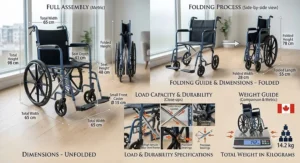
Here’s the thing nobody tells you at the medical supply store: most folding transit wheelchairs look nearly identical in photos, but a five-pound difference in frame weight is the line between “I can do this alone” and “I need to call my brother.” Add in Canadian realities — compact sedan trunks, icy sidewalks, and provincial funding rules that don’t cover every model — and the decision gets more complicated than a quick scroll through Amazon.ca reviews.
Below, we’ve pulled together seven real, currently available folding transit wheelchairs spanning budget, mid-range, and premium tiers, with honest analysis grounded in published specifications and aggregated review sentiment rather than invented testimonials. We’ll walk through comparison tables, a practical usage guide, real caregiver scenarios, and the regulatory context that matters if you’re applying for provincial funding. By the end, you should know exactly which folding transit wheelchair for elderly use fits your car, your budget, and your back.
Quick Comparison Table
| Chair | Approx. Weight | Fold Type | Price Range (CAD) | Best For |
|---|---|---|---|---|
| Medline Ultralight Transport Wheelchair | ~15 lb | Two-hand, compact | Under C$250 | Solo caregivers lifting alone |
| Carex Transport Wheelchair | ~21 lb | Two-hand | C$220-C$300 | Everyday caregiver pushing |
| Vive Lightweight Transport Wheelchair | ~23 lb | Two-hand | C$250-C$350 | Extra seat width for comfort |
| Drive Medical Silver Sport 1 | ~34 lb | Two-hand, steel frame | C$200-C$320 range | Daily durability on a budget |
| Invacare Compact Folding Manual Wheelchair | ~27 lb | Two-hand | C$350-C$500 range | Users who want some self-propulsion |
| Featherweight Wheelchair | ~13.5 lb | Near one-hand, quick-release wheels | C$550-C$750 range | Lightest possible one-person lift |
| WHILL Model F | ~53 lb | True one-hand button fold, powered | C$4,500-C$6,500 range | Caregivers who can’t lift heavy chairs |
Looking at the spread above, weight and price move almost in lockstep until you hit the WHILL Model F, which breaks the pattern entirely by trading lifting effort for battery power. For most families, the sweet spot sits between the Medline Ultralight Transport Wheelchair and the Vive Lightweight Transport Wheelchair, where you get genuine portability without paying a premium for materials science. If your loved one needs any degree of independent movement, though, the Invacare Compact Folding Manual Wheelchair is the only entry here that realistically allows self-propulsion.
💬 Already have a favourite? Check current pricing and availability before you decide — stock and options shift often.
Top 7 Folding Transit Wheelchairs for Elderly: Expert Analysis
1. Medline Ultralight Transport Wheelchair — lightest overall for one-caregiver lifting
At roughly 15 lb before accessories, the Medline Ultralight Transport Wheelchair is built almost entirely around one design goal: letting a single caregiver lift it without a second person spotting them. The aluminum frame keeps weight down while an 8-inch rear wheel setup and swing-away footrests preserve manoeuvrability indoors. Weight capacity sits around 250-300 lb depending on the trim, which covers most users comfortably.
Based on the spec comparison across this category, this chair earns its “ultralight” label honestly — it’s genuinely one of the lightest transport chairs sold under a major brand name rather than a boutique label. It suits caregivers with limited upper-body strength, apartment dwellers without elevators, and anyone who transfers the chair in and out of a vehicle multiple times a day. Reviewers consistently report that the trade-off for the low weight is a narrower, less cushioned seat than heavier competitors, so longer outings can feel less comfortable than a 20-minute doctor’s appointment.
Pros:
- ✅ Among the lightest mainstream transport chairs available
- ✅ Compact folded footprint fits small trunks easily
- ✅ Simple two-hand fold with no tools required
Cons:
- ❌ Thinner padding than heavier mid-range models
- ❌ Lower weight capacity than steel-frame alternatives
At around C$250 or under at the time of research, the Medline Ultralight Transport Wheelchair delivers strong value for anyone prioritizing lift weight over plush comfort — check current price before buying, since availability shifts seasonally.
2. Carex Transport Wheelchair — best caregiver hand-grip comfort
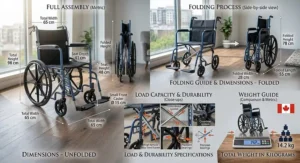
The Carex Transport Wheelchair ships with a 19-inch seat and caregiver-oriented push handles that are noticeably wider and better padded than the budget competition. Its footrests are removable rather than merely swinging away, which matters more than it sounds when transferring someone from a bed or car seat.
What most buyers overlook about this model is that the grip ergonomics — not the weight — are what caregivers end up praising most in aggregated reviews. Pushing a chair for fifteen minutes through a shopping mall is a different experience with contoured handles than with the bare tubing found on cheaper models. This chair fits a caregiver who does the pushing daily rather than occasionally, where hand and wrist comfort compounds over weeks.
Pros:
- ✅ Padded, ergonomic push handles reduce caregiver strain
- ✅ Removable (not just folding) footrests ease transfers
- ✅ Sturdy frame at a moderate, non-premium price
Cons:
- ❌ Heavier than the ultralight tier by several pounds
- ❌ Fewer colour and size options than larger brands
Priced in the C$220-C$300 range, the Carex Transport Wheelchair is the pick for caregivers who value their own hands and shoulders as much as the user’s comfort.
3. Vive Lightweight Transport Wheelchair — widest seat in this class
The Vive Lightweight Transport Wheelchair weighs about 23 lb but adds nearly two extra inches of seat width compared to most transport chairs in the same weight bracket. It arrives fully assembled, with padded armrests and adjustable folding footrests rather than a fixed footplate.
On paper this means a wider comfort margin for users who don’t fit comfortably into a standard 18-inch seat, which is a common complaint with narrower budget chairs. Reviewers consistently note that the extra width doesn’t come with a matching jump in folded bulk, so it still fits most sedan trunks without requiring an SUV. This model suits larger-framed seniors, or anyone who winces at the idea of a narrow, hard-edged seat pan for outings longer than a quick errand.
Pros:
- ✅ Roughly two inches wider seat than category norm
- ✅ Arrives fully assembled out of the box
- ✅ Steel frame rated to 300 lb capacity
Cons:
- ❌ Slightly heavier than the true ultralight tier
- ❌ Armrests are fixed rather than flip-back for transfers
At C$250-C$350 at the time of research, the Vive Lightweight Transport Wheelchair earns its keep by solving the comfort gap that lighter chairs often ignore.
4. Drive Medical Silver Sport 1 Folding Transport Wheelchair — best all-rounder for daily use
The Drive Medical Silver Sport 1 Folding Transport Wheelchair uses a durable steel frame rather than aluminum, which pushes its weight up to roughly 34 lb but buys noticeably better long-term durability. Full-length desk arms and swing-away, removable footrests round out a design that’s changed little in years — for good reason.
Here’s what to weigh with this one: steel costs you portability but earns back reliability. Drive Medical is one of the most established names in the transport-chair category, and aggregated review sentiment across retailers consistently points to frame longevity as the standout strength, especially for chairs used daily rather than occasionally. This is the chair for a household using it every single day for years, not just for the occasional hospital run.
Pros:
- ✅ Steel frame built for years of daily wear
- ✅ Full-length desk arms support easier transfers
- ✅ Widely available with established parts support
Cons:
- ❌ Noticeably heavier to lift than aluminum models
- ❌ Bulkier folded profile than ultralight competitors
Sitting around C$200-C$320 depending on configuration, the Drive Medical Silver Sport 1 Folding Transport Wheelchair rewards buyers who plan to use their folding chair daily use after daily use for the long haul.
5. Invacare Compact Folding Manual Wheelchair — best for self-propulsion option
Unlike the other transport-only chairs on this list, the Invacare Compact Folding Manual Wheelchair includes larger rear wheels with push rims, meaning the user can propel themselves when strength allows, while still folding compactly for caregiver storage and transport. Flip-back, removable desk-length arms and a fold-down backrest add flexibility for transfers and tight storage spaces.
Based on the spec comparison, this is less a pure transport chair and more a hybrid — and that hybrid nature is exactly what most buyers overlook when they assume “transport chair” and “self-propelled wheelchair” are interchangeable terms. For elderly users whose mobility fluctuates day to day, having the option to self-propel on a good day while still relying on a caregiver on a harder day adds real dignity that a pure transport chair can’t offer.
Pros:
- ✅ Push rims allow optional self-propulsion
- ✅ Flip-back arms simplify sideways transfers
- ✅ Fold-down backrest shrinks storage footprint further
Cons:
- ❌ Larger rear wheels add bulk versus transport-only chairs
- ❌ Heavier overall than dedicated ultralight transport models
At roughly C$350-C$500 at the time of research, the Invacare Compact Folding Manual Wheelchair is worth the premium for households wanting flexibility rather than a single-purpose chair.
6. Featherweight Wheelchair — best one-hand quick-fold design
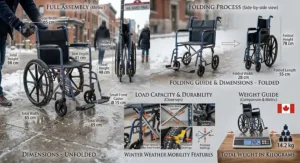
The Featherweight Wheelchair is built around a genuinely different engineering philosophy: at roughly 13.5 lb, it’s marketed among the lightest wheelchairs available anywhere, with one-button quick-release rear wheels that let a caregiver strip weight further before lifting. Full-length fixed armrests and push-to-lock brakes round out a frame designed specifically for solo caregiver handling.
What the spec sheet won’t tell you, but caregiver forums consistently mention, is how much the quick-release wheel system changes the actual lifting experience — removing the wheels first, then folding the frame, effectively splits one heavy lift into two light ones. That’s a meaningfully different physical task than wrestling an intact 25-lb chair into a trunk, and it’s the closest thing on this list to a true one-hand fold wheelchair experience without stepping up to a powered model.
Pros:
- ✅ Among the lightest wheelchairs sold anywhere
- ✅ Quick-release wheels split the lift into two stages
- ✅ Push-to-lock brakes simplify caregiver control
Cons:
- ❌ Premium price relative to other manual transport chairs
- ❌ Smaller dealer network than major mass-market brands
Expect a price range around C$550-C$750 at the time of research, positioning the Featherweight Wheelchair as the specialist’s choice for caregivers who value lift weight above nearly everything else.
7. WHILL Model F — best power-assisted one-motion fold
The WHILL Model F is the outlier on this list: a powered folding wheelchair that collapses in one continuous motion at the push of a single button, weighing under 53 lb despite carrying its own lithium-ion battery. WHILL states the battery is airline-approved, the chair can climb inclines up to roughly 10 degrees, and it manages a driving range near 12.4 miles per charge.
Here’s what to weigh with a power chair like this: 53 lb sounds heavy next to a 15-lb manual transport chair, but the comparison is misleading, because the WHILL Model F removes the caregiver’s pushing effort entirely — the user drives, the caregiver only lifts the folded unit into the trunk occasionally rather than pushing it block after block. Reviewers consistently frame this as transformative for caregivers dealing with their own back or joint issues, though the price tag puts it well outside the “budget transport chair” category. In Canada, Health Canada’s medical device framework governs power mobility devices, so confirm current licensing status with the seller before purchasing.
Pros:
- ✅ True single-motion, one-hand fold mechanism
- ✅ Eliminates caregiver pushing effort entirely
- ✅ Airline-approved battery for travel flexibility
Cons:
- ❌ Substantially more expensive than manual chairs
- ❌ Heavier lift than any manual chair on this list
At a price range around C$4,500-C$6,500 at the time of research, the WHILL Model F belongs in the conversation only once manual pushing has become the real limiting factor, not the price.
Practical Usage Guide: Getting the Most From Your Chair
Unboxing day matters more than most buyers expect. Before the first outing, practice the fold and unfold sequence indoors, on carpet, without anyone in the chair — most folding wheelchair easy to collapse designs need one confident motion rather than a hesitant half-fold, and fumbling with an unfamiliar mechanism at a curbside pickup is worse than doing it at home first.
For maintenance, check tire pressure and caster wheels monthly if the chair uses pneumatic tires, and wipe down the frame after wet-weather outings since road salt in Canadian winters accelerates corrosion on lower-quality steel joints. Brake tension loosens gradually with cable-actuated hand brakes, so test stopping power on a slight slope every few weeks rather than assuming it still matches day one. A folding chair daily use routine also benefits from a simple habit: fold it the same way, in the same order, every single time — consistency prevents the pinched fingers and jammed hinges that account for a surprising share of first-month complaints in aggregated reviews.
The most common first-30-days mistake is lifting from the seat frame rather than the designated carry points, which stresses the folding hinges unnecessarily. A close second is skipping the seatbelt because “it’s just a short trip” — Canadian sidewalks with uneven curb cuts make that seatbelt matter on even a two-minute walk to the mailbox.
Real-World Scenarios: Matching the Chair to the Caregiver
Consider Marguerite, 78, in Halifax, whose daughter visits twice weekly and drives a compact sedan. She needs a chair light enough to lift solo after a short flight from Ontario, so something like the Medline Ultralight Transport Wheelchair or the Featherweight Wheelchair makes more sense than a heavier steel frame she’d struggle to hoist alone.
Now picture Robert, 84, in suburban Calgary, who uses his transport chair every single day for a full lap around the neighbourhood with his spouse. Daily wear matters more than occasional portability here, and the Drive Medical Silver Sport 1 Folding Transport Wheelchair‘s steel durability starts to look like the smarter long-term investment despite the extra weight.
Finally, think about Anh, 71, in Vancouver, recovering from hip surgery with a caregiver who has chronic shoulder pain from years of lifting. For that household, the pushing effort itself is the problem, not just the folding — which points squarely toward the WHILL Model F, where the battery does the work a strained shoulder no longer can.
Problem → Solution Guide
Problem: The chair won’t fit the trunk. Measure your trunk opening height and depth before ordering, then compare against the manufacturer’s folded dimensions rather than trusting a generic “fits most trunks” claim — this single step prevents the majority of returns in this category.
Problem: Caregiver back pain from lifting. Consider a two-stage lift chair like the Featherweight Wheelchair with quick-release wheels, or step up to a powered fold like the WHILL Model F if lifting itself has become unsustainable.
Problem: Chair tips backward on ramps. Confirm anti-tip wheels or bars are installed and adjusted correctly; most transport chairs include them, but they’re occasionally shipped unattached and forgotten during setup.
Problem: Brakes feel weak after a few months. Cable-actuated hand brakes stretch slightly with use; a quick cable-tension adjustment, often doable with a small wrench, restores most of the original stopping power.
Problem: User feels every bump on sidewalks. Larger rear wheels, like those on the Carex Transport Wheelchair or Vive Lightweight Transport Wheelchair, absorb pavement irregularities noticeably better than smaller caster-style wheels.
How to Choose a Folding Transit Wheelchair for Elderly Users
- Confirm the lifter’s real strength. Be honest about who lifts the chair daily, and choose weight accordingly — a chair that’s “manageable” once is not manageable every day.
- Measure the vehicle before the chair. Trunk depth and liftover height eliminate more options than any spec sheet feature.
- Match seat width to the user’s actual build. A too-narrow seat causes pressure discomfort within weeks, not months.
- Decide between self-propulsion and pure transport. Fluctuating mobility favours hybrids like the Invacare Compact Folding Manual Wheelchair.
- Weigh frequency of use against frame material. Daily users benefit from steel durability; occasional travellers benefit from aluminum lightness.
- Check provincial funding eligibility first. Some programs only reimburse specific device categories, which can change which model makes financial sense.
- Verify the fold mechanism in person or via video. A “quick fold” claim means little until you’ve watched someone actually do it.
One-Hand Fold Explained: Transit Chair Fold One Hand vs Two-Hand Mechanisms
Most transport wheelchairs, including budget aluminum models, technically require two hands and two distinct motions to collapse — one hand releasing a latch, the other guiding the frame closed. A genuine transit chair fold one hand design, by contrast, uses a single continuous motion or button press, which matters enormously for caregivers managing a walker, a cane, or an armful of groceries at the same time.
The WHILL Model F is the clearest true one-hand fold wheelchair on this list, using a single button to trigger the entire collapse sequence. The Featherweight Wheelchair gets closer than most manual chairs by splitting the process into a quick-release wheel step and a light frame fold, effectively reducing — though not fully eliminating — the two-handed requirement. Reviewers consistently note that marketing language around “one-hand” folding varies wildly between brands, so it’s worth watching an actual demonstration video rather than trusting the phrase on a product listing alone.
Lightweight Folding Caregiver Wheelchair vs Standard Hospital Wheelchair
| Feature | Lightweight Folding Caregiver Wheelchair | Standard Hospital-Style Wheelchair |
|---|---|---|
| Typical weight | 13-25 lb | 35-45 lb |
| Fold time | Seconds | Often requires tools or none at all |
| Trunk fit | Usually yes, compact sedans included | Frequently requires an SUV or van |
| Self-propulsion | Rare, transport-only in most models | Common, with large push-rim wheels |
| Best setting | Outings, appointments, travel | Long-term facility or home use |
The comparison above makes the trade-off obvious: a lightweight folding caregiver wheelchair sacrifices self-propulsion and some seat cushioning in exchange for portability that a standard hospital-style chair simply can’t match. For a household managing occasional outings rather than round-the-clock indoor mobility, that trade almost always favours the lighter option. Where a standard wheelchair still wins is long-duration comfort and independent movement, which matters more in a care facility setting than during a two-hour outing.
Does It Fit? Wheelchair Fits Sedan Trunk Considerations
What is the biggest reason a transport chair fails to fit a sedan trunk? It’s almost always liftover height, not folded width — a chair that folds thin but tall can still refuse to clear a shallow trunk opening, even when the manufacturer lists a compact footprint.
Before buying, measure your trunk’s opening height with a tape measure and compare it against the manufacturer’s stated folded height, adding an inch of margin for wheel protrusion. Chairs like the Medline Ultralight Transport Wheelchair and Featherweight Wheelchair were both designed with compact sedan trunks specifically in mind, while steel-framed models like the Drive Medical Silver Sport 1 Folding Transport Wheelchair occasionally need the rear seats folded down for a clean fit.
Common Mistakes When Buying a Folding Transit Wheelchair for Elderly Users
The most frequent error is prioritizing price over the lifter’s actual physical capacity — a C$150 savings means little if the chair spends most of its life unused because it’s too heavy to load solo. A close second is skipping the seat width measurement, assuming “one size fits most” applies universally, when a poor fit causes real discomfort within a few outings. Buyers also commonly forget to check the weight capacity rating against the user’s actual weight, including winter coats and blankets, which can push a borderline case over the limit. Finally, many purchases happen without confirming provincial funding eligibility first, leaving families to discover after the fact that a specific model doesn’t qualify for reimbursement under programs like Ontario’s Assistive Devices Program.
Features That Actually Matter (And Those That Don’t)
Hand brakes that lock reliably, swing-away or removable footrests, and an honest folded-dimension listing matter enormously — they affect daily use directly. Seat width and frame weight matter just as much, since both determine whether the chair actually gets used regularly or gathers dust in a closet. What matters far less than marketing suggests: flashy colour options, oversized cup holder attachments, and vague “ergonomic” claims without published measurements. Reviewers consistently rank genuine lift weight and fold simplicity above nearly every cosmetic feature combined.
Long-Term Cost & Maintenance
| Cost Factor | Manual Transport Chairs | WHILL Model F (Power) |
|---|---|---|
| Upfront price range | C$200-C$750 | C$4,500-C$6,500 |
| Annual maintenance | Low — tires, brake cables | Moderate — battery, electronics |
| Expected lifespan | 3-7 years with care | 3-5 years, battery-dependent |
| Ongoing costs | Minimal | Charging, occasional battery replacement |
The math above shows manual chairs winning decisively on total cost of ownership for most households, but the calculation changes when caregiver injury risk enters the picture — a strained back or a missed shift at work carries real financial cost too, even if it never shows up on a receipt. Value isn’t only about the sticker price; it’s about what the chair prevents down the line, whether that’s a fall, a lifting injury, or simply a caregiver too exhausted to keep helping.
Safety, Regulations & Compliance in Canada
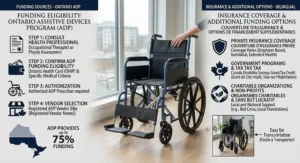
Health Canada classifies most manual folding wheelchairs as lower-risk Class I medical devices, meaning they aren’t subject to individual pre-market licensing the way powered mobility devices are, though post-market surveillance still applies across categories, according to Health Canada’s guidance on assistive devices for seniors. Several provinces, including Ontario’s Assistive Devices Program, cover a portion of approved mobility equipment costs for residents with long-term physical disabilities, though transport-only chairs aren’t always eligible in the same way power wheelchairs are — confirm category eligibility with your provincial program before assuming reimbursement.
Fall prevention is worth taking seriously here too: falls remain the leading cause of injury-related hospitalization for Canadian seniors, and occupational therapists interviewed by CBC Radio’s White Coat, Black Art stress using mobility aids correctly and keeping them well-maintained as a practical, low-cost way to reduce risk. A properly fitted, well-maintained folding transit wheelchair for elderly users isn’t just a convenience item — it’s part of a broader fall-prevention strategy.
✨ Don’t Miss These Exclusive Deals!
🔍 Take your search for the right mobility chair further with these carefully compared options. Click through to check current pricing and availability on Amazon.ca before stock changes. The right chair can make outings easier for everyone involved! 🚗
FAQ
❓ What is the lightest folding transit wheelchair for elderly users?
❓ Can a folding transit wheelchair fit in a small sedan trunk?
❓ Is a transport wheelchair the same as a regular wheelchair?
❓ Does Ontario's Assistive Devices Program cover transport wheelchairs?
❓ How much does a folding transit wheelchair cost in Canada?
Conclusion
Choosing a folding transit wheelchair for elderly use ultimately comes down to an honest inventory of three things: who’s lifting it, what car it needs to fit, and how often it’ll actually get used. The Medline Ultralight Transport Wheelchair and Featherweight Wheelchair solve the solo-lifter problem beautifully, the Carex Transport Wheelchair and Vive Lightweight Transport Wheelchair balance comfort with portability, the Drive Medical Silver Sport 1 Folding Transport Wheelchair rewards households using their chair daily use after daily use, the Invacare Compact Folding Manual Wheelchair adds welcome flexibility for fluctuating mobility, and the WHILL Model F removes the pushing burden entirely for caregivers who need that relief most.
None of these chairs is universally “best” — the right one depends entirely on your specific car, your specific caregiver, and your specific budget. What matters is measuring honestly before you buy, rather than guessing and hoping the trunk cooperates on delivery day.
✨ Ready to Choose the Right Chair?
🔍 Compare current prices and availability on Amazon.ca today, and give your family’s outings one less thing to worry about. 🦽💙
Recommended for You
- Folding Transit Wheelchair: 7 Best Picks for Canadians in 2026
- Lightweight Transit Wheelchair for Caregivers: 7 Best Picks 2026
- Lightweight Transit Wheelchair: 7 Best Picks for Canada (2026)
Disclaimer: This article contains affiliate links. As an Amazon Associate, I earn from qualifying purchases. If you purchase products through these links, we may earn a small commission at no additional cost to you.
✨ Found this helpful? Share it with your friends! 💬🤗
