

In This Article
Picture this: you’ve spent weeks researching wheelchairs, finally ordered one online, and two months later you’re wrestling it into your Honda CRV every single day — or worse, you’ve bought a sleek rigid frame only to discover your Toronto apartment hallway barely fits it. Sound familiar? If you’re navigating the folding vs rigid wheelchair comparison for the first time, you’re not alone. It’s one of the most consequential mobility decisions a Canadian can make, and yet most buyers still base it on a quick Google search and a spec table.
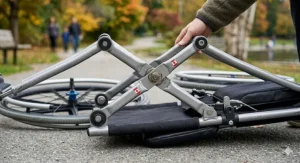
Here’s what the spec tables don’t tell you: the “right” wheelchair has nothing to do with which one looks lighter or costs less. It’s about your daily routine, your living space, your climate, and — let’s be honest — whether someone else is loading it into a vehicle for you. In Canada, those factors are shaped by brutal winters, long commutes, condo-sized apartments, and provincial funding programs that can cover a significant portion of your costs.
In a folding vs rigid wheelchair comparison, the core difference is structural. A folding wheelchair uses a cross-brace “X” frame that collapses sideways for easy transport and storage. A rigid frame — often favoured by active users and athletes — does not fold side-to-side; instead, the rear wheels typically quick-release and the back folds down. That design difference ripples into weight, rolling efficiency, durability, and how the chair behaves on Canadian terrain year-round.
This guide breaks it all down: a clear comparison table, seven real products available on Amazon.ca with Canadian price ranges in CAD, practical usage guides, Canadian funding information, and an honest take on which type of user genuinely benefits from each frame style. Whether you’re in suburban Mississauga, downtown Montréal, or a smaller community in northern BC, there’s a right answer here — and we’ll help you find it.
Quick Comparison: Folding vs Rigid Wheelchair at a Glance
| Feature | Folding Wheelchair | Rigid Wheelchair |
|---|---|---|
| Frame design | X-brace cross frame, folds side-to-side | Fixed frame, rear wheels quick-release |
| Primary benefit | Portability & caregiver convenience | Rolling efficiency & lightweight performance |
| Weight | Typically heavier (14–22 kg / 31–48 lbs) | Typically lighter (8–13 kg / 18–29 lbs) |
| Propulsion energy | More effort — frame flex absorbs energy | Less effort — solid frame transfers energy directly |
| Seating system options | Wider variety, easier to fit complex seating | More limited; custom-fit standard |
| Ideal for | Travel, caregivers, occasional use | Active self-propelling users, daily community use |
| Durability | More joints = more potential wear | Fewer moving parts = fewer failure points |
| Folded size | Narrow (25–30 cm / 10–12″) | Compact once wheels removed |
| Price range (CAD) | $200–$1,500+ | $800–$4,000+ |
| Best for Canadian winters | ✅ Easier to store and dry indoors | ⚠️ Better performance on hard-packed snow |
Analysis: This table reveals the central trade-off of the folding vs rigid wheelchair comparison: folding chairs optimise for portability and caregiver convenience, while rigid frames optimise for the active user’s energy and efficiency. For Canadians, the cold-weather variable tips the balance in interesting ways — rigid chairs roll more smoothly over icy sidewalks because their frames don’t flex and absorb propulsion energy, but folding chairs can be collapsed and left to thaw and dry indoors more quickly after wet-snow exposure. Your lifestyle, not just your diagnosis, should drive this decision.
💬 Just one click — help others make better buying decisions too! 😊
✨ Don’t Miss These Exclusive Deals!
🔍 Take your mobility to the next level with these carefully selected products. Click on any highlighted item to check current pricing and availability on Amazon.ca. These tools will help you get the independence and comfort you deserve!
Top 7 Wheelchairs for Canadians: Expert Analysis
Products verified available on Amazon.ca. Prices quoted as CAD ranges — always check current pricing on Amazon.ca as prices fluctuate.
1. Drive Medical Blue Streak Wheelchair (18″ Seat)
The Drive Medical Blue Streak is a folding workhorse that has quietly become one of the most recommended standard wheelchairs across Canadian rehabilitation centres — and for good reason. It features a lightweight steel frame with flip-back desk-length arms and swing-away footrests, weighing approximately 16 kg (35 lbs) in its standard 18-inch seat configuration. The triple rear axle positions deserve special mention: they allow you to adjust seat-to-floor height between standard and hemi positions without tools, which matters enormously if you’re a foot-propeller or transitioning from a hospital chair with a different height.
What most Canadian buyers overlook about the Blue Streak is how well the desk-arm design interacts with kitchen tables and workspaces in the compact condos common in cities like Toronto and Vancouver. You can roll up flush to a surface without an armrest blocking you — a daily-life quality-of-life win that specs tables won’t highlight. The precision sealed wheel bearings are another quiet standout; in Canadian spring conditions with road-salt residue everywhere, sealed bearings last significantly longer than loose-ball alternatives on cheaper chairs.
Customer feedback from Canadian buyers consistently praises the easy foldability for loading into compact crossovers and SUVs — popular vehicles in Canada. However, some longer-term users note that the steel frame, while durable, does add weight compared to aluminium alternatives, which can be a fatigue factor on longer transfer sessions.
✅ Easy-to-find replacement parts across Canada
✅ Desk arms ideal for table-height use
✅ Triple axle positions for height customisation
❌ Steel frame heavier than aluminium alternatives
❌ Not ideal for vigorous self-propulsion long-term
Price range: $250–$380 CAD. Solid entry-level value for caregivers and occasional-use buyers.
2. Medline Strong and Sturdy Wheelchair (K1166N22S, 16″ Seat)
The Medline Strong and Sturdy (model K1166N22S) is a folding wheelchair that earns its name. Built around a durable steel frame with desk-length arms and swing-away legrest riggings, it targets the caregiver-managed user who needs reliable, uncomplicated performance. At approximately 17 kg (37.5 lbs), it’s not the lightest chair on this list, but its 136 kg (300 lb) weight capacity makes it a suitable option for a wider range of users than many budget-tier folding chairs.
The spec sheet won’t tell you this, but the swing-away footrests on this Medline model are particularly easy to remove and reattach — a small thing until you’re doing it twelve times a day at doorways, then it becomes significant. For Canadian families caring for an elderly parent across a multi-level home or transitioning in and out of accessible vehicles, that operational simplicity is genuine value. The 16-inch seat width suits smaller-framed users; if you need wider sizing, Medline offers the same frame in 20″ (K1166N20S).
Canadian reviewers on Amazon.ca report reliable durability over the first two to three years of daily use. Some flag that the steel frame shows surface rust after prolonged exposure to Canadian road salt — a practical reminder that wiping down your chair after wet-weather outings is non-negotiable maintenance in provinces like Ontario and Quebec where winter road treatments are heavy.
✅ Generous 136 kg weight capacity
✅ Easy footrest removal/reinstallation
✅ Widely available for Prime shipping in Canada
❌ Surface corrosion risk in salt-heavy provinces without proper maintenance
❌ Heavier than aluminium alternatives for self-propelling users
Price range: $280–$400 CAD. Best for family caregivers who prioritise reliability over weight savings.
3. Drive Medical Cruiser III Lightweight Folding Wheelchair (K320DFA-ELR)
Step up to the Cruiser III and you immediately feel the difference: an aluminium frame that brings the overall weight down to approximately 14 kg (31 lbs), making it genuinely manageable for solo caregivers loading into vehicle trunks. The K320DFA-ELR variant includes flip-back detachable full arms and elevating legrests — a configuration that’s notably helpful for users with circulation concerns or post-surgical lower-limb restrictions.
The aluminium frame on the Cruiser III isn’t just about weight. In Canadian winter conditions, aluminium doesn’t rust the way steel does, which is a practical long-term advantage that justifies the modest price premium over steel-framed alternatives. If you’re in a city like Calgary or Edmonton where freeze-thaw cycles are aggressive and road brine is heavily applied from October through April, an aluminium frame will look and function far better after year three than its steel counterparts.
What stands out from Canadian buyer reviews is the Cruiser III’s stability despite its lighter frame — a balance Drive Medical achieves through a dual over-centre cross-frame design that adds rigidity without adding the extra thickness (and weight) of heavier-walled steel. The elevating legrests are particularly noted by caregivers of post-stroke users who need variable leg positioning throughout the day.
✅ Aluminium frame resists Canadian winter road salt corrosion
✅ Elevating legrests for post-surgical/circulation needs
✅ Noticeably lighter than comparable steel folding chairs
❌ Aluminium frames can be pricier to repair than steel
❌ Elevating legrests add bulk when not needed
Price range: $350–$500 CAD. The best upgrade from entry-level steel folding chairs for year-round Canadian use.
4. VEVOR Aluminum Alloy Ultra-Lightweight Transport Chair (Foldable, 15.75″ Seat)
The VEVOR folding transport chair sits at an interesting niche in the folding vs rigid wheelchair comparison — it’s technically a transport/transit chair (smaller 30 cm / 12″ rear wheels, meant for caregiver-pushed use only) but merits inclusion here because it’s among the top-selling chairs on Amazon.ca and frequently purchased by Canadians navigating airports, shopping centres, and medical appointments. Weighing approximately 10 kg (22 lbs), it’s one of the lighter options available at its price point.
The self-locking brake system is the standout feature here. Unlike many budget transport chairs that rely solely on hand-operated brakes on the push handles, the VEVOR’s design adds an element of safety when parking on inclines — relevant if you’re navigating the ramp-heavy entrances of older Canadian buildings or parking structures. The flip-back desk-length arms allow flush table access, and the aluminium alloy construction keeps weight down and corrosion risk low.
Be clear about what this chair is not, though: without the large rear wheels of a self-propelling wheelchair, the user cannot independently manoeuvre themselves. This is a caregiver-dependent chair. Canadian buyers who need any degree of independent mobility should step up to a full manual wheelchair with 60 cm (24″) rear wheels. For families who need a lightweight, foldable option strictly for caregiver-pushed scenarios — medical trips, mall shopping, travel — this chair delivers at a compelling CAD price point.
✅ Among the lightest options on Amazon.ca at this price
✅ Self-locking brakes add safety on inclines
✅ Clean aluminium build for Canadian weather durability
❌ User cannot self-propel — caregiver-dependent only
❌ 15.75″ seat width suits smaller frames only
Price range: $150–$250 CAD. Excellent value for caregiver-managed transport scenarios.
5. Drive Medical Silver Sport 1 Folding Transport Chair (Full Arms, 18″ Seat)
The Drive Medical Silver Sport 1 is one of the most-reviewed transport wheelchairs on Amazon.ca, and it earns that attention through a combination of practical design choices and genuine affordability. Full arms (rather than desk-length) provide better lateral support for users who may have reduced trunk stability — an important consideration for post-stroke users and elderly Canadians recovering from hip or spinal procedures. The removable swing-away footrest keeps transfers clean and obstacle-free.
What distinguishes the Silver Sport 1 in the Canadian market is the combination of caregiver-friendly handle height (ergonomically positioned for average Canadian adult stature) and the chair’s relatively compact folded profile. It folds to approximately 28 cm (11″) wide, which fits in the trunk of most Canadian sedans and compact crossovers. The silver powder-coat finish is aesthetically neutral and holds up reasonably well against light moisture exposure, though — like all powder-coated steel chairs — it benefits from a periodic wipe-down after wet outings.
Canadian long-term care facilities have been known to keep several Silver Sport 1 chairs on hand for guest/visitor use precisely because of their unfussy, one-fold design and easy-to-sanitise hard surfaces. If you’re purchasing for a loved one in a retirement residence or assisted living facility in provinces like Nova Scotia or Alberta, this model’s durability under heavy-rotation use is a genuine asset.
✅ Full arms for better lateral trunk support
✅ Compact folded width for smaller vehicle trunks
✅ Suitable for institutional/high-rotation use
❌ Heavier than aluminium transport chairs
❌ User cannot self-propel
Price range: $180–$280 CAD. A dependable, no-fuss choice for family caregivers and long-term care settings.
6. Portable Aluminum Transport Wheelchair with Handbrakes (18″ Seat, 12″ Rear Wheels)
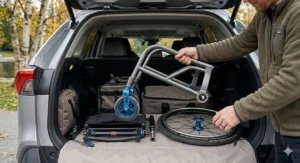
This category of lightweight aluminium transport wheelchairs — available from several sellers on Amazon.ca under variations of the “Portable Aluminum Transport Chair” listing — represents a significant upgrade in build material over the steel transport chairs above, at a price point still accessible to most Canadian families. At approximately 11–12 kg (24–26 lbs), they’re noticeably easier to lift into vehicle trunks than their heavier steel counterparts.
The 30 cm (12″) rear wheels on this type of chair are slightly larger than many compact transport chairs, which makes a real-world difference when rolling over Canadian sidewalk gaps, frost-heaved pavement, or the transition strips between different floor surfaces in medical facilities. The included hand brakes on the push handles are a safety feature worth prioritising — particularly for caregivers managing inclined surfaces. In cities like Vancouver and Halifax where terrain is rarely flat, attendant-operated hand brakes are a practical safety layer, not a luxury.
The included travel bag is a genuinely useful addition for Canadians who travel by air or need to protect the chair during off-season storage. These chairs are generally Prime-eligible on Amazon.ca, which means most Canadian urban areas receive them quickly. Remote northern communities may face longer shipping windows — worth factoring in if you’re in a rural area of Ontario, Manitoba, or BC and have a time-sensitive need.
✅ Aluminium frame: lightweight and corrosion-resistant
✅ 12″ rear wheels handle uneven Canadian sidewalks better
✅ Attendant hand brakes for sloped terrain safety
❌ User cannot self-propel
❌ Weight capacity typically lower (~100 kg / 220 lbs) than steel alternatives
Price range: $120–$220 CAD. Best lightweight caregiver-pushed option for active travellers and families on a budget.
7. Super Lightweight Portable Transit Travel Wheelchair (24 lbs / ~11 kg)
This compact, ultralight folding transport wheelchair — listed by multiple sellers on Amazon.ca and marketed specifically around its ~11 kg (24 lb) weight — represents the lightest end of the folding wheelchair spectrum that Canadian buyers can reasonably access through Amazon.ca. The telescopic push handles allow caregiver height adjustment, which is a thoughtful design detail for families with caregivers of varying heights. The travel bag is included.
At this weight, the chair becomes genuinely one-handed-liftable for most adults — a meaningful threshold if the caregiver is a smaller-framed individual, an older spouse, or someone managing their own physical limitations while assisting another person. This is the kind of practical spec interpretation the product listing won’t tell you: 11 kg isn’t just a number, it’s the difference between independently managing a vehicle transfer versus needing a second person every single time.
Be aware that ultralight transit chairs at this price point often achieve their weight reduction through narrower seat widths, lower weight capacities (~100 kg / 220 lbs), and simplified frame construction. They’re not substitutes for full self-propelling manual wheelchairs. But for Canadians who need a secondary “travel chair” for airport navigation, cruise ship boarding, or medical appointments — while their primary chair stays home — these ultralight options fill that gap very well. Amazon.ca Prime eligibility makes fast delivery to most Canadian addresses straightforward.
✅ Among the lightest folding options on Amazon.ca
✅ Telescopic handles accommodate different caregiver heights
✅ Excellent secondary/travel chair for active Canadian lifestyles
❌ Lower weight capacity limits user profile
❌ Not suitable as a full-time primary chair for most users
Price range: $130–$220 CAD. Outstanding value as a dedicated travel or secondary chair.
How to Choose a Wheelchair in Canada: A Practical Decision Framework
This is where most buyer’s guides fall short: they tell you what the chairs do, but not which one matches your actual daily life. Let’s fix that with a structured decision framework built around Canadian realities.
If you self-propel independently and use your chair for daily community participation, lean toward a rigid or semi-rigid lightweight frame. Rigid frames don’t flex when you push, which means your energy actually moves you forward rather than being absorbed by the X-brace. Over a full day of propulsion — whether navigating a Toronto office building or a Montréal campus — that energy efficiency difference becomes very real. Consider upgrading beyond the Amazon.ca options listed here toward dedicated rehabilitation suppliers like Motion or National Seating & Mobility once your needs are assessed.
If a caregiver manages most transfers and transportation logistics, a folding X-frame wheelchair is almost certainly the right choice. The folding mechanism exists primarily for caregiver benefit — easy loading into vehicles, compact storage, simple management in tight spaces. A rigid frame offers the user advantages, but if the user isn’t self-propelling, those advantages largely disappear.
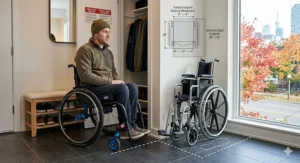
If you live in a compact urban condo or apartment (very common in Vancouver, Toronto, Calgary, or Montréal), folded width matters as much as seated width. A chair that folds to 28 cm (11″) fits through storage closets and past furniture far more easily than one folding to 33 cm (13″). Measure your hallways before you buy.
If winter outdoor use is part of your routine, prioritise sealed wheel bearings (to resist road salt and slush) and an aluminium or titanium frame over steel. Every Canadian winter exposes your wheelchair to brine, freeze-thaw stress, and moisture. The modest extra investment in an aluminium frame pays back over three to five years of reduced maintenance and preserved structural integrity.
If provincial funding is part of your plan — and it should be — confirm what your province covers before selecting a model. Ontario’s Assistive Devices Program (ADP) covers up to 75% of approved wheelchair costs, while BC’s Health Equipment Loan Program may provide full funding for approved equipment. A chair purchased through Amazon.ca without a clinical assessment may not qualify for ADP funding, so speak with a certified authorised prescriber (an occupational therapist or physiotherapist) before committing.
Real-World Scenarios: Which Wheelchair Fits Which Canadian User?
The best way to understand the folding vs rigid wheelchair comparison isn’t to read spec tables — it’s to put yourself in concrete Canadian situations.
Scenario 1: Maria, 72, recovering from hip replacement in Oakville, Ontario. Maria’s daughter drives her to physiotherapy twice a week and manages all transfers. Maria does not self-propel. What she and her daughter need is a lightweight folding chair that fits in the back of a Honda Civic, has swing-away footrests for easy transfers, and ideally resists the winter salt spray on post-surgical outings. The Drive Medical Cruiser III or VEVOR Aluminum Transport Chair fit this profile well: aluminium build, compact fold, manageable weight for a daughter loading the car solo. Ontario ADP may provide partial funding if Maria’s hip replacement requires a longer-term mobility aid, so an occupational therapist assessment is worth scheduling early.
Scenario 2: James, 34, incomplete spinal cord injury, living in a two-bedroom apartment in downtown Vancouver. James self-propels most of the day, takes transit, and participates actively in his community. He needs a chair that minimises propulsion effort (rigid or near-rigid frame), fits through a 32-inch (81 cm) doorway, and handles Vancouver’s damp autumn and winter pavement without corroding. The chairs on this Amazon.ca list, while practical, are entry points — James’s occupational therapist would likely refer him to a specialist supplier for a custom-fit rigid or folding-rigid hybrid (like a Quickie or TiLite) through BC’s health equipment program. That said, the Drive Medical Blue Streak or Cruiser III can serve as a temporary chair during the funding and assessment process.
Scenario 3: The Tremblay family in Laval, Québec, caregiving for an elderly parent. They need a chair that can be stored in a hallway closet between uses, is easy for two different family members (both of average height) to push, and won’t break the family budget. The Silver Sport 1 or Medline K1166N22S fit perfectly: durable, simple to fold and store, modest CAD price, and available through Amazon.ca with Prime shipping. French-language documentation is legally required on products sold in Québec — both Drive Medical and Medline provide bilingual (English/French) product documentation, which is worth verifying before purchase.

Folding Wheelchair Advantages vs Rigid: What the Numbers Actually Mean
The folding wheelchair advantages that most manufacturers highlight — portability, easy storage, versatile seating options — are genuine. But understanding why they matter in practice requires looking past the bullet points.
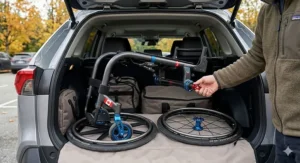
Portability in the Canadian context isn’t abstract. It means loading and unloading from the trunk of a Toyota RAV4 on a -15°C February morning when the driveway is icy and you’ve got two minutes before the physiotherapy appointment. Folding chairs, when done well, reduce a 60-second folding-and-loading task to a 20-second one. Over a year of twice-weekly medical appointments, that accumulated ease matters.
Complex seating compatibility is a folding wheelchair advantage that rarely gets mentioned in consumer guides. Because the X-frame design has been around for decades, the market for compatible seating systems, cushions, laterals, and adaptive accessories is enormous. If your loved one requires specific pressure-relief cushioning (particularly relevant for users at risk of pressure injuries), trunk laterals, or custom headrests, folding X-frame wheelchairs offer far more off-the-shelf compatibility than most rigid frames.
Rigid frame advantages, on the other hand, come down to physics: a frame that doesn’t flex is a frame that transfers your push energy into forward motion. Research from rehabilitation medicine has consistently shown that rigid frames reduce the propulsion force required per stroke — meaning less shoulder and wrist strain over time. For self-propelling users who average hours of daily use, that translates to a measurable reduction in upper limb overuse injuries over years of use, which is a serious quality-of-life concern.
Weight is the most cited comparison point, but it requires nuance. Yes, many rigid frames are lighter than folding alternatives. But a well-engineered aluminium folding chair at 11–12 kg is lighter than a poorly designed rigid steel frame at 14 kg. The material and quality of manufacturing matter as much as the frame design.
Common Mistakes When Buying a Wheelchair in Canada
These are the errors I see repeated constantly — and they’re almost always avoidable with a bit of prior knowledge.
Mistake 1: Buying the seat width you have, not the seat width you need. A wheelchair seat should leave 2–3 cm (about an inch) of clearance on each side of the user’s hips. Too narrow causes pressure and discomfort; too wide increases the chair’s overall width, making standard Canadian doorways (81–86 cm / 32–34 inches) into tighter navigations than necessary. Measure in a seated position before ordering.
Mistake 2: Ignoring provincial funding eligibility. This is a costly error. Ontario’s Assistive Devices Program, BC’s HELP Program, and equivalent programs in other provinces can cover a significant portion of your wheelchair costs. These programs typically require a prescription from a regulated health professional and an assessment by an authorised prescriber. Buying off Amazon.ca without this assessment doesn’t automatically disqualify you from future funding, but it does mean you may be paying out of pocket for a chair that could have been substantially subsidised.
Mistake 3: Assuming a folding chair is automatically easier to store. The folded width of a wheelchair (typically 25–30 cm / 10–12″) is narrower, but the height and length remain similar. In a cramped Toronto condo storage closet, that profile may actually be harder to fit vertically than you’d expect. Measure your storage space in all three dimensions.
Mistake 4: Choosing a transport chair for a user who actually needs a self-propelling wheelchair. Transport chairs (with small 12″ rear wheels) are designed exclusively for caregiver-pushed use. They offer no independent mobility. If there’s any possibility the user may benefit from even occasional self-propulsion, invest in a full manual wheelchair with 60 cm (24″) rear wheels.
Mistake 5: Neglecting Canadian winter maintenance. Steel-framed folding wheelchairs exposed to road brine, slush, and freeze-thaw cycles will corrode at joints and cross-frame pivots if not maintained. A quick wipe-down with a damp cloth after wet-weather outings, followed by light machine oil on pivot points at the start and end of winter, extends chair life dramatically. Aluminium frames are inherently more resistant but not immune to surface oxidation.
Canadian Regulations, Funding Programs & Provincial Context
The wheelchair type comparison in Canada isn’t complete without understanding the funding and regulatory landscape — because for many Canadians, the question isn’t just “which wheelchair is best” but “which wheelchair can I access with funding support.”
Ontario Assistive Devices Program (ADP): Ontario’s ADP covers 75% of approved wheelchair costs for residents with long-term physical disabilities. Coverage includes manual wheelchairs, power wheelchairs, scooters, and positioning devices. The program is income-independent — eligibility is based on medical need, not financial means. An occupational therapist or physiotherapist must complete the assessment and authorisation paperwork. For full details, visit ontario.ca/page/mobility-aids.
British Columbia Health Equipment Loan Program: BC’s HELP program, administered through the BC Ministry of Health, provides full funding for approved equipment — but with more restrictive criteria than Ontario’s ADP. Applications require physician or occupational therapist involvement.
Other Provinces: Society for Manitobans with Disabilities (SMD) offers long-term wheelchair loans. New Brunswick’s Social Development program assists with rehabilitation equipment. Quebec’s RAMQ covers wheelchair costs for eligible residents. PEI, Newfoundland & Labrador, and Nova Scotia each have provincial programs — the Canadian Red Cross Health Equipment Loan Program (HELP) also operates nationally as a supplementary resource.
Bilingual Labelling: In Canada, federal law under the Consumer Packaging and Labelling Act requires that product labels include both official languages (English and French). This is particularly relevant for wheelchair buyers in Québec, New Brunswick, and other bilingual regions. Both Medline and Drive Medical — the major brands featured in this guide — comply with Canadian bilingual labelling requirements. Verify this when purchasing through third-party Amazon.ca sellers, particularly for lesser-known brands.
Amazon.ca vs Cross-Border Shopping: While some wheelchair models available on Amazon.com (US) are not listed on Amazon.ca, cross-border purchasing of medical equipment introduces complications: different warranty terms, potential import duties, and customer service challenges if something needs repair. For a piece of equipment you use every day, buying from Amazon.ca (or Canadian retailers) is strongly advisable. Amazon.ca Prime membership ($99.99 CAD/year) provides free shipping on eligible items and is worth considering for anyone regularly purchasing mobility-related supplies.
Long-Term Cost & Maintenance in Canada: The Real Total Cost of Ownership
The purchase price on Amazon.ca is only part of the story. Let’s walk through the real total cost of owning a wheelchair in Canada over a three-to-five-year horizon.
Entry-level steel folding wheelchairs ($200–$350 CAD): These chairs are accessible and functional, but the steel frame is vulnerable to corrosion in Canadian conditions. Over three years of regular use, expect to replace or lubricate cross-frame pivot points annually, monitor tyre wear (solid tires are low-maintenance; pneumatic tires may need occasional inflation or replacement at $20–$40 CAD per tire), and potentially replace the vinyl seat and back upholstery if heavily used ($30–$80 CAD for aftermarket parts). Total three-year cost: $300–$500 CAD all-in for moderate maintenance.
Mid-range aluminium folding wheelchairs ($350–$600 CAD): Lower corrosion risk means lower maintenance costs over time. The aluminium frame commands a higher initial investment but typically needs less intervention over a three-to-five-year lifecycle. Sealed bearings (like those on the Drive Medical Blue Streak) are particularly valuable here — they don’t require re-greasing and resist salt infiltration better than loose-ball alternatives. Total three-year cost: $400–$600 CAD all-in.
Provincial funding impact: If you qualify for Ontario ADP at 75% coverage on an approved $1,200 CAD manual wheelchair, your out-of-pocket cost is $300 CAD. That dramatically changes the value calculation — a more expensive, better-suited chair may actually cost you less out-of-pocket than an off-the-shelf Amazon.ca purchase if it qualifies for funding. This is why the clinical assessment step is financially as well as clinically important.
Canadian repair network: Drive Medical and Medline both have established Canadian repair and parts networks. Replacement parts (armrests, footrests, anti-tip bars, tires) are available through Canadian medical suppliers and sometimes through Amazon.ca itself. For less-common brands — particularly newer Chinese-manufactured chairs on Amazon.ca — parts availability in Canada can be limited, which drives up long-term replacement costs.
FAQ: Folding vs Rigid Wheelchair Comparison in Canada
❓ Is a folding wheelchair covered by provincial health insurance in Canada?
❓ What are the main folding wheelchair advantages over rigid frames for Canadian users?
❓ How do rigid wheelchairs perform in Canadian winter conditions?
❓ Can I use a transport wheelchair as my primary mobility device in Canada?
❓ Does Amazon.ca have free shipping on wheelchairs to all Canadian provinces?
Conclusion: Making the Right Wheelchair Choice for Your Canadian Life
The folding vs rigid wheelchair comparison, at its heart, comes down to a simple question: who is this chair serving, and how? If the answer is a caregiver who manages transport and transfers for a loved one with limited self-propulsion ability, a quality folding X-frame wheelchair — preferably aluminium for Canadian weather durability — is almost always the right choice. If the answer is an active self-propelling user who navigates community life daily, a rigid or semi-rigid lightweight frame is worth the additional investment and the clinical assessment process required to access provincial funding.
For most Canadians purchasing through Amazon.ca, the Drive Medical Blue Streak and Cruiser III represent the best balance of practicality, availability, and value in the folding category. The VEVOR and portable aluminium transport chairs fill the lightweight caregiver-push niche at accessible CAD price points.
Don’t skip the provincial funding research. Whether you’re in Ontario, BC, Manitoba, or Atlantic Canada, there is likely a program that can offset a significant portion of your wheelchair cost — but it requires a clinical assessment. Book that occupational therapy appointment before you finalise your purchase.
For more guidance on Canadian wheelchair accessibility, Health Canada’s website at canada.gc.ca and Wheelchair Canada (powerplusmobility.com) are authoritative starting points.
✨ Don’t Miss These Exclusive Deals!
🔍 Ready to find the right wheelchair for your Canadian lifestyle? Click on any highlighted product above to check current pricing and availability on Amazon.ca. The right mobility solution is one click away!
Recommended for You
- 7 Best Quick Fold Wheelchairs in Canada 2026
- Best Most Portable Wheelchair in Canada 2026: Top 7 Picks
- Best Compact Folding Wheelchair in Canada 2026: Top 7 Picks
Disclaimer: This article contains affiliate links. As an Amazon Associate, I earn from qualifying purchases. If you purchase products through these links, we may earn a small commission at no additional cost to you.
✨ Found this helpful? Share it with your friends! 💬🤗
