
In This Article
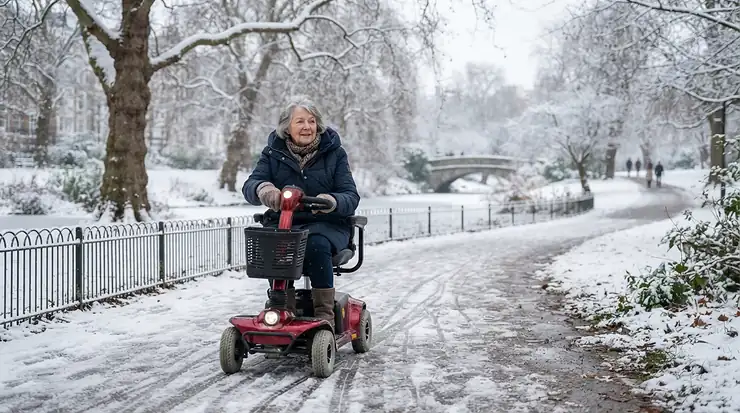
Your driveway is gravel. The path behind the cottage is root-ribbed and generous in calling itself a trail. The park your family loves is half pavement, half spring-soaked lawn. An indoor power chair treats all of that like a personal insult. Picking an all-terrain power wheelchair for uneven ground comes down to one question: which machine keeps rolling when the surface stops cooperating?
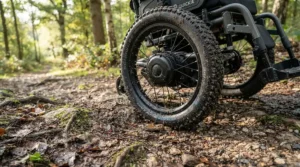
One honest note before we start. I haven’t driven any of these chairs, and I won’t pretend otherwise. This guide rests on spec-by-spec analysis, aggregated owner and reviewer reports from published roundups (several are affiliate sites, so I treat their enthusiasm with a raised eyebrow), and Canadian context such as winter, national parks and air travel. Where the evidence is thin, I say so.
What Is an All-Terrain Power Wheelchair for Uneven Ground?
An all-terrain power wheelchair for uneven ground is a motorized wheelchair built with larger tires, stronger dual motors, suspension and extra ground clearance. That combination lets it cross grass, gravel, packed dirt and gentle trails. It belongs to the wider motorized wheelchair family, whose first production model came from a National Research Council of Canada engineer.
Everything below is priced in Canadian dollars as ranges only, because prices on amazon.ca move constantly. Model availability can also differ from the US listings that most reviews cover, so confirm your exact model before you commit.
Quick Comparison Table: Best All-Terrain Power Wheelchairs at a Glance
Here is the lineup in one view. Motor and range figures are manufacturer listings, which, as you’ll see, deserve a haircut once real grass and gravel enter the picture.
| Product | Motors (listed) | Range (listed) | Best For |
|---|---|---|---|
| Culver Artemis | Dual 150W | ~19 km (12 mi) | First-time buyers on firm, moderately rough ground |
| Serianie Heavy-Duty 400LB | Dual 500W (disputed) | ~24 km (15 mi) | Lighter riders on a tight budget |
| WEYRAL 30+ Mile | Dual 350W | 48+ km (30+ mi) | Value hunters wanting accessories included |
| Porto Mobility Ranger Discovery | Dual 250W | ~32 km (20 mi) | One chair for car trips and weekend trails |
| Mujocooker 440 lb | 700W (listed) | 48+ km (30+ mi) | Soft grass and loose surfaces |
| Porto Mobility Ranger Magnum Ultra | Dual 350W | 48+ km (30+ mi) | Bariatric riders and wet climates |
| Porto Mobility Ranger The Beast | Dual 400W | 48+ km (30+ mi) | Serious trails, long days, cold weather |
Notice how the motor wattage barely tracks capability. The Porto Mobility Ranger Discovery has the smallest motors in the premium-ish group yet earns praise for hills, because torque delivery and traction matter more than the headline number. Buyers with heavier loads or steeper terrain should look at Porto Mobility Ranger The Beast or Porto Mobility Ranger Magnum Ultra. Budget buyers should treat the Serianie Heavy-Duty 400LB wattage claim with caution, for reasons covered below.
💬 Just one click — help others make better buying decisions too!😊
Top 7 All-Terrain Power Wheelchairs for Uneven Ground: Expert Analysis
Products run from budget to premium. Pros and cons come from real specs and recurring review themes, not invented testing.
1. Culver Artemis — lowest entry price, honest basics
The Culver Artemis is the cheapest way into genuine all-terrain territory that reviewers keep recommending. Its dual 150W motors sound modest, but they’re geared for grass, gravel and brick rather than speed. Top speed sits near 6.4 km/h (4 mph), which is a feature if you’ve never driven a power chair. At roughly 43 kg (95 lb) it folds in about three seconds, and the electromagnetic brake holds when you let go of the joystick, a real comfort on damp slopes.
Based on the spec comparison, the roughly 19 km (12 mi) range suits errands and park loops, not all-day expeditions. Reviewers repeatedly flag footrest weld quality on some units, a short power cable and an occasional right-turn pull that wheel alignment usually fixes. Think of it as a smart first chair for firm-to-moderately-rough ground, not a trail machine.
Pros:
- ✅ Lowest-priced all-terrain option in this roundup
- ✅ Three-second fold for car trunks
- ✅ Electromagnetic brake adds confidence on slopes
Cons:
- ❌ Shorter range than every other pick here
- ❌ Footrest quality complaints appear in reviews
Price range: budget tier, roughly under C$2,000 (check current price). Value verdict: strong for light duty, risky if you expect rough-trail punishment.
2. Serianie Heavy-Duty 400LB — big capacity claims, read the fine print
The Serianie Heavy-Duty 400LB looks like a bargain on paper: dual 500W motors, a 181 kg (400 lb) rating and a wide seat. Reviewers who dug deeper report a gap between listing and reality. The advertised 20-inch seat measured closer to 16–17 inches (about 41–43 cm), the motors felt weaker than 500W under load, and owners suggest the realistic capacity is nearer 120 kg (264 lb). Actual weight lands between 33 and 45 kg (73–100 lb) depending on configuration.
What the spec sheet won’t tell you is that listed numbers alone shouldn’t decide this purchase. The joystick is right-hand only, which matters for left-handed riders. Large rear wheels and a reversing warning horn are genuine pluses. Mixed-terrain range reportedly lands near 19 km (12 mi) against the 24 km (15 mi) claim. Customer service experiences are mixed.
Pros:
- ✅ Large rear wheels smooth out uneven ground
- ✅ Folds compactly for transport
- ✅ Reversing warning horn adds safety
Cons:
- ❌ Seat width and motor power reportedly overstated
- ❌ Right-hand-only joystick limits some users
Price range: budget tier, roughly under C$2,000 (check current price). Value verdict: fair for lighter riders, but not the chair for anyone near the listed limit.
3. WEYRAL 30+ Mile — range and extras for the money
The WEYRAL 30+ Mile bundles what other brands sell separately. You get an LED light, a storage backpack, two 12Ah lithium batteries and a 53 cm (21 in) wide seat. Dual 350W motors (700W combined) and six shock absorbers give it a respectable rough-ground resume, and the listed 150 kg (330 lb) capacity suits most riders.
Here’s the thing about that 48 km (30 mi) claim. Every reviewer who measured range found real-world figures lower on grass and gravel, and general buying guidance suggests surfaces like these can cut range by 30–50 percent. Plan on roughly half the headline number in rough terrain and you’ll never be stranded. One roundup cites about 4.7 stars across only 28 reviews, a small pool, so treat the praise as promising rather than proven.
Pros:
- ✅ Light and backpack included in the box
- ✅ Wide 53 cm seat with shock absorption
- ✅ Responsive customer service reported
Cons:
- ❌ Not waterproof rated, so avoid rain
- ❌ Needs two people or a ramp to load
Price range: mid tier, roughly C$2,000–C$3,500 (check current price). Value verdict: good for dry-weather riders who value extras.
4. Porto Mobility Ranger Discovery — folds small, climbs well
The Porto Mobility Ranger Discovery is the chair reviewers recommend most often for people who want one machine for home, car trips and weekend trails. Dual 250W brushless motors with Posi-Traction power delivery handle grass and gravel, and reviewers describe confident climbs on steep driveways. The listed 23 kg (50 lb) frame weighs closer to 26 kg (58 lb) with batteries, and it folds in about three seconds. A 81 cm (32 in) turning radius keeps it usable indoors.
Dual slide-out lithium batteries are reportedly airline approved, though carriers set their own rules. Roundups report around 29 km (18 mi) of real mixed-terrain range against a 32 km (20 mi) claim, plus roughly 10-degree hill capability. Loose sand stops it. Replacement batteries are a notable long-term cost. A wide-seat Porto Mobility Ranger Discovery XL variant exists for larger riders, with about 533 reviews across the Discovery line.
Pros:
- ✅ Lightweight yet rated to 200 kg (440 lb)
- ✅ Real-world range close to the claim
- ✅ Strong customer service reputation
Cons:
- ❌ Still a two-person lift for some riders
- ❌ Joystick feels twitchy at first
Price range: mid tier, roughly C$2,000–C$3,500 (check current price). Value verdict: the most balanced pick in the group.
5. Mujocooker 440 lb — front-wheel drive for soft ground
The Mujocooker 440 lb stands out for front-wheel drive, which reviewers say pulls through soft grass and mud where rear-drive chairs stall. A listed 700W motor, 56 cm (22 in) seat and six spring shock absorbers round out the package. One reviewer reports about 43 km (27 mi) on flat pavement but only about 32 km (20 mi) across mixed grass, gravel and hills, a useful reality check against the 30+ mile headline.
At roughly 41 kg (90 lb), it needs a vehicle lift or a strong helper, and the cushion must come off before folding. The most important caveat for this guide: reviewers note lower ground clearance than purpose-built trail chairs like Porto Mobility Ranger The Beast. That makes it better on lawns and soft fields than on rocky, rutted paths. The manual also warns against rain.
Pros:
- ✅ Front-wheel drive excels on soft surfaces
- ✅ Extra-wide seat with spring suspension
- ✅ Dual lithium batteries slide out for indoor charging
Cons:
- ❌ Lower clearance than true off-road chairs
- ❌ Heavy and not suited to rain
Price range: mid tier, roughly C$2,000–C$3,500 (check current price). Value verdict: excellent for grass-heavy yards and fields.
6. Porto Mobility Ranger Magnum Ultra — 660 lb rating and weatherproofing
The Porto Mobility Ranger Magnum Ultra is the bariatric champion, with a 299 kg (660 lb) rating that leads this guide by a wide margin. Dual 350W brushless motors, a reinforced aluminum frame and an IP4X rating (protection against splashing water from any direction) make it the most weather-ready chair here. One reviewer reported climbing a 12-degree incline with a 100 kg (220 lb) passenger. Reviewers also describe suspension that handles ruts and PU solid puncture-free tires, which trade a little ride comfort for zero flats.
Costs of that toughness: about 48 kg (105 lb) of weight, no airline approval, long charge times and 5 cm (2 in) curbs that need momentum. Another reviewer measured about 42 km (26 mi) on mixed terrain against a 30+ mile claim. IP4X means splash-resistant, not submersible, so don’t treat a stream crossing as a challenge.
Pros:
- ✅ Highest weight rating in this roundup
- ✅ IP4X splash resistance suits damp climates
- ✅ Memory-foam cushion included
Cons:
- ❌ Not airline approved and very heavy
- ❌ Long charge times
Price range: premium tier, roughly C$4,000+ (check current price). Value verdict: worth it if capacity and weather protection are non-negotiable.
7. Porto Mobility Ranger The Beast — tri-battery range and six-point suspension
Porto Mobility Ranger The Beast earns its name. Dual 400W brushless motors, a 227 kg (500 lb) rating, a tri-battery system and a six-point suspension on a 6061 aluminum frame add up to the most trail-ready chair in this guide. Reviewers describe sandy tracks, rocky trails and hill climbs it handled while lighter chairs struggled. One roundup reports it retained about 85 percent of summer range around −4°C (25°F), good news for Canadians, though that’s a single reviewer’s claim.
It is not portable; plan on a van ramp or lift. The 99 cm (39 in) turning radius makes tight indoor corners awkward, the joystick is very responsive, and charging a three-battery system takes time. What most buyers overlook is that this chair wants a dedicated outdoor role, not double duty as your apartment chair.
Pros:
- ✅ Six-point suspension absorbs rough impacts
- ✅ Tri-battery range suits full-day outings
- ✅ Cold-weather range reportedly holds up
Cons:
- ❌ Too large for tight indoor spaces
- ❌ Highest price tier and long charge times
Price range: premium tier, roughly C$4,000+ (check current price). Value verdict: the pick for riders who tackle rugged terrain weekly.
How to Choose an All-Terrain Power Wheelchair for Uneven Ground
Follow these seven steps in order, because each one narrows the field.
- Map your worst surface. Gravel driveway, root-laced trail or soft lawn? Soft ground favours front-wheel drive; rocks and ruts favour clearance and suspension.
- Demand ground clearance in writing. Few listings publish it, so ask the seller before you buy.
- Match tires to terrain. Air-filled tires ride softest, while solid ones eliminate flats.
- Choose capacity with margin. Pick a rating at least 23 kg (50 lb) above your weight plus gear.
- Discount the range. Grass and gravel can cut range 30–50 percent, so buy for your worst day.
- Plan transport honestly. These chairs range from about 23 kg to 48 kg (50–105 lb).
- Try before you buy. Some national park sites lend all-terrain or large-tire wheelchairs. Parks Canada’s accessible trails page describes several, and borrowing one tells you what your terrain demands.
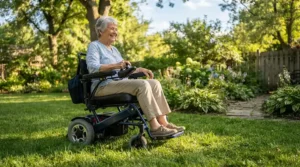
All-Terrain Power Wheelchair Ground Clearance: The Numbers Nobody Prints
Ground clearance is the distance between level ground and the lowest rigid part of the chair, usually the battery box, footplate or frame. General buying guidance puts about 7.6 cm (3 in) as the minimum for small rocks and curbs, and true off-road chairs at 10–15 cm (4–6 in). Anything under 7.6 cm tends to high-centre on uneven ground.
Here’s the catch: all-terrain power wheelchair ground clearance is rarely listed with a measurement method. Ground clearance specs on manufacturer pages may reflect an unloaded chair on stiff suspension, while a seated rider compresses springs and shaves centimetres. The Mujocooker 440 lb shows why this matters, since reviewers flag its clearance as lower than trail-focused chairs despite a rugged reputation.
Do this before buying: ask for the lowest-point clearance with a 90 kg (200 lb) load, and check where anti-tip wheels and footplates sit. Those are the parts that scrape first, and a chair advertised for rough ground that grounds out on a gravel crown isn’t doing its job.
Large Pneumatic Tires vs Solid Tires: What Actually Survives Gravel and Roots
The debate over large pneumatic tires vs solid tires is really a trade between comfort and convenience. Air-filled tires absorb bumps and grip loose surfaces best, but they can puncture. Foam-filled tires mimic the feel of air without flats, with a slightly harsher ride. Solid tires are puncture-proof but pass every bump straight to the rider, which is why buying guides call them pavement-friendly rather than trail-friendly.
| Tire Type | Grip on Grass/Gravel | Ride Comfort | Flat Risk | Best For |
|---|---|---|---|---|
| Pneumatic (air-filled) | Excellent | Best | Yes, carry a patch kit | Trails and soft ground |
| Foam-filled | Very good | Moderate | None | Thorny or remote areas |
| Solid (PU) | Good on packed surfaces | Harshest | None | Mixed paths, low maintenance |
Looking at the table, knobby pneumatic tires win for pure traction, but the maintenance burden is real, especially in Canadian winters when air pressure drops with temperature. Interesting wrinkle: Porto Mobility Ranger Magnum Ultra reportedly uses PU solid tires yet still earns off-road praise, because suspension compensates for the harsher ride. For cottage-country gravel and brush, foam-filled is often the quiet sweet spot.
Stability on Slopes and Inclines: What Degrees Really Mean
Reviewer claims about hills are easy to misread, so convert them. A 10-degree slope is about a 17.6 percent grade, 12 degrees is about 21 percent, and 15 degrees is about 27 percent. Compare that with typical accessible-design guidance such as Canada’s CSA B651 standard, which generally caps ramps at about a 1:12 slope (roughly 8.3 percent, or 4.8 degrees). Even Parks Canada’s Forillon accessibility guide describes trail grades of 6–10 percent on compacted stone dust.
So when a reviewer says a chair climbed a 15-degree test hill, as one did with the ABAKAN, that’s extreme by accessibility standards. The real stability on slopes and inclines question isn’t climbing power but what happens on descents and side slopes.
Look for these features:
- An electromagnetic brake that engages when the joystick is released.
- Regenerative braking on descents.
- Anti-tip wheels.
- A low battery position, which keeps the centre of gravity down.
Rear-wheel drive reportedly gives better slope stability, while front-wheel drive grips soft ground better. Cross-slopes, where one wheel sits uphill, are the quiet hazard, so slow down and wear the seat belt.
Power Wheelchair for Gravel and Grass Canada: A Seasonal Reality Check
A power wheelchair for gravel and grass Canada riders can trust has to survive more than dry-summer test days. Spring means saturated lawns where weight sinks and tires spin. Autumn brings wet leaf cover over rutted trails. Winter swaps gravel for snow and ice, where most of these chairs simply aren’t designed to go.
Dry-condition tests dominate published reviews, so Canadian buyers should add margin. Expect shorter range in the cold, and verify weather ratings. Of the seven chairs here, only Porto Mobility Ranger Magnum Ultra lists an IP4X splash rating, while WEYRAL 30+ Mile and Mujocooker 440 lb both warn against rain.
For soft lawns, front-wheel drive on the Mujocooker 440 lb is a smart match. For packed gravel driveways and rural roads, the Porto Mobility Ranger Discovery is plenty. For anything involving frost heave, mud and roots, step up to Porto Mobility Ranger The Beast. Finally, keep a towel in the vehicle, because gravel dust and road salt are not kind to electronics.
✨ Don’t Miss These Exclusive Deals!
🔍 Take your outdoor independence to the next level with these carefully selected chairs. Click on any highlighted product name to check current pricing and availability on amazon.ca. The right all-terrain power wheelchair for uneven ground could turn “I can’t get there” into “see you at the lookout”! 🌲
Off-Road Capable Electric Wheelchair vs Mobility Scooter vs Manual Trail Chair
Not everyone needs a heavy-duty off-road capable electric wheelchair. Here’s how the alternatives compare.
| Option | Terrain Ability | Effort Required | Portability | Best For |
|---|---|---|---|---|
| All-terrain power wheelchair | Grass, gravel, trails | Joystick only | 23–48 kg, folds | Mixed outdoor use |
| Mobility scooter | Pavement, light outdoor | Tiller steering | Disassembles in pieces | Sidewalks and malls |
| Manual trail chair | Varies, often with large tires | Arm strength or attendant | Light | Short trails with a helper |
| Standard indoor power chair | Smooth floors only | Joystick only | Varies | Indoor use |
The takeaway: a mobility scooter such as the Vive 4 Wheel Mobility Scooter is reportedly fine on pavement but struggles on tall grass, loose gravel and slopes over about 8 degrees. A manual chair demands upper-body strength that many riders lack. An all-terrain power wheelchair costs more and weighs more, yet it’s the only option here that covers lawn, gravel and a gentle trail without asking you to push.
Practical Guide: Your First 30 Days on Uneven Ground
Buying the chair is the easy part. These habits protect it.
Week one: Practise on pavement and short grass at the lowest speed setting. Reviewers across several chairs mention twitchy joysticks, and most controllers let you adjust sensitivity, so use it. Learn where the brake release is before you need it.
Week two: Graduate to packed gravel. Approach slopes straight on, not diagonally. Check tire pressure weekly if you have pneumatic tires.
Week three: Try a gentle trail with a companion. Note battery drop; if it falls faster than expected, your real range is shorter than the listing. Wipe mud and grit off frame joints.
Week four: Inspect everything: footrest welds (flagged on the Culver Artemis), bolts, cable connections and the joystick boot. Charge batteries fully before storage.
Common first-month mistakes: ignoring the manual’s rain warnings, charging in a cold garage, skipping tire checks and loading gear that pushes you past the weight rating.
Real-World Scenarios: Three Canadian Riders, Three Different Picks
The suburban senior with a gravel driveway. Daily trips run 2–3 km to the mailbox, a community garden and a short park loop. Budget is tight and the chair goes in a sedan trunk. The Porto Mobility Ranger Discovery matches the portability and hill needs, while the Culver Artemis works if funds are tighter and distances shorter.
The cottage owner with a bush trail. Weekend use, 5–8 km on roots, ruts and mud, often in damp weather. Ground clearance and suspension decide this one, so Porto Mobility Ranger The Beast fits, with Porto Mobility Ranger Magnum Ultra as the weatherproof alternative if weight capacity matters most.
The rural rider on soft pastureland. Daily farm-path travel over wet grass and fields. Mujocooker 440 lb front-wheel drive is a natural fit, provided the rider accepts its lower clearance and keeps it out of the rain.
Common Mistakes When Buying an All-Terrain Power Wheelchair
Trusting wattage alone. Motor wattage tells you little without gearing and traction. The 250W Porto Mobility Ranger Discovery gets better hill feedback than some chairs listing double the power.
Believing capacity claims blindly. The Serianie Heavy-Duty 400LB shows how listed and actual specs can diverge.
Ignoring transport weight. A 48 kg chair is useless if you can’t get it into the vehicle.
Skipping the ground clearance specs. If the listing doesn’t state clearance, ask.
Assuming Canadian approval means off-road tested. Health Canada treats wheelchairs as low-risk Class I medical devices, so being sold here doesn’t prove performance on trails. Ask for test documentation, such as the ISO 7176 wheelchair standards.
Forgetting the funding rules. Many provincial assistive-device programs are built around daily-living needs, so an off-road chair for recreation may fall outside coverage. Ask your program and occupational therapist first.
Long-Term Cost & Maintenance for an All-Terrain Power Wheelchair
The sticker price is only chapter one. Lithium batteries are the main long-term expense, and reviewers note replacement packs for the Porto Mobility Ranger Discovery are pricey. Tires, brake adjustments and joystick repairs add up too, especially after rough seasons.
| Tier | Products | Approx. Price Band | Value Verdict | Best For |
|---|---|---|---|---|
| Budget | Culver Artemis, Serianie Heavy-Duty 400LB | Under about C$2,000 | Good for light duty | Short, firm-ground trips |
| Mid-range | WEYRAL 30+ Mile, Porto Mobility Ranger Discovery, Mujocooker 440 lb | About C$2,000–C$3,500 | Best balance | Mixed everyday terrain |
| Premium | Porto Mobility Ranger Magnum Ultra, Porto Mobility Ranger The Beast | About C$4,000+ | Highest durability | Heavy loads, rough trails |
These bands are approximations drawn from published category ranges converted to CAD, so check current prices. Cost per year of use favours the mid-range if you ride often but not on extreme terrain. The premium tier only pays for itself when your terrain or weight genuinely demands it. A wise budget includes a spare battery, a tire repair kit and a waterproof cover, and Canadians may also find the medical expense tax credit applicable with proper documentation, so confirm with the CRA or a tax professional.
Safety, Regulations and Travel in Canada
Before you head out, keep a few Canadian realities in mind. Park rules vary: some Parks Canada sites offer loaner trail wheelchairs and mobility mats on beaches, and the PEI National Park accessibility page is a good example of what’s offered. Always check each park’s mobility device policy first.
Air travel needs planning. Canadian carriers apply Canadian Transportation Agency battery requirements, and at least one carrier states that US FAA approvals alone aren’t enough. Canadian Transportation Agency rulings show how carriers must handle electric wheelchairs and their batteries. The lithium-battery Porto Mobility Ranger Discovery is reportedly travel-friendly, while the Porto Mobility Ranger Magnum Ultra is not airline approved. Confirm directly with your airline well in advance.
On the trail, wear the seat belt, carry a charged phone and tell someone your route. Winter riding should be limited to cleared, treated surfaces unless your manufacturer approves otherwise.
FAQ
❓ What is the best power wheelchair for gravel and grass in Canada?
❓ How far will an off-road capable electric wheelchair go on one charge?
❓ Can I fly with an all-terrain power wheelchair in Canada?
❓ Will provincial programs or insurance cover an all-terrain power wheelchair?
❓ Can I try an all-terrain wheelchair before I buy one?
Conclusion
The best all-terrain power wheelchair for uneven ground isn’t the one with the biggest numbers. It’s the one whose strengths match your worst surface. The Porto Mobility Ranger Discovery is the balanced all-rounder. The Culver Artemis is the budget entry. The Mujocooker 440 lb shines on soft grass, the Porto Mobility Ranger Magnum Ultra rules for capacity and weather resistance, and Porto Mobility Ranger The Beast is the trail specialist. Meanwhile the WEYRAL 30+ Mile adds value through extras, and the Serianie Heavy-Duty 400LB demands a careful read of its fine print.
Before you click anything, remember the basics: demand ground clearance specs in writing, discount the range, check the tires and slope features, and try a loaner if you can.
✨ Ready to roll beyond the pavement?
🌲 Check current pricing and availability on amazon.ca for the chair that fits your terrain, and give yourself the freedom to go where the path gets interesting.
Recommended for You
- All-Terrain Power Wheelchairs: 7 Proven Picks For Canada 2026
- Heavy Duty Power Wheelchair: 7 Tough Picks For Canada 2026
- Small Turning Radius Power Wheelchair For Home Use: 7 Best (2026)
Disclaimer: This article contains affiliate links. As an Amazon Associate, I earn from qualifying purchases. If you purchase products through these links, we may earn a small commission at no additional cost to you.
✨ Found this helpful? Share it with your friends! 💬🤗
