
In This Article
Top 7 Outdoor Mobility Picks: Expert Analysis
A quick honesty note before the line-up. Prices below are ranges in Canadian dollars. Check current price and availability on Amazon.ca, because some full-size scooters sell mainly through Canadian mobility dealers. Manufacturer specs also vary by market, so confirm the Canadian model before buying.
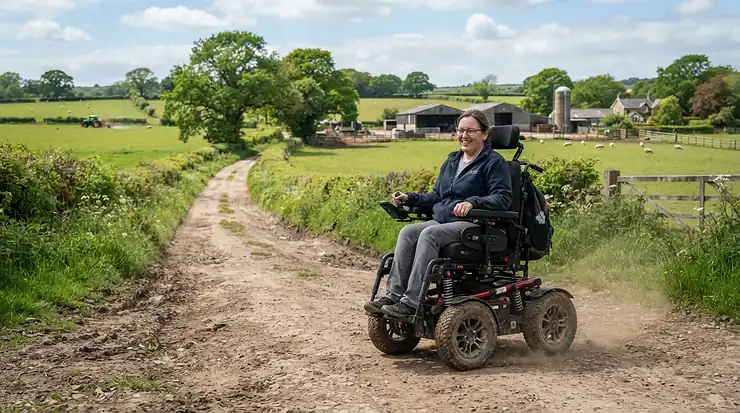
1. Pride Baja Raptor 2 4-Wheel — fastest, plushest scooter on this list
Full four-coil suspension on 16-inch tubeless pneumatic tires is what separates this from a mall scooter wearing hiking boots. It’s rated for 181 kg (400 lb), tops out around 21 km/h, and runs on two 75 Ah deep-cycle batteries.
Range is up to about 34 km at a 91 kg (200 lb) rider weight, falling to about 24 km at full capacity. Ground clearance is 15.5 cm at the side deck but only 8.9 cm at the centre of the frame. That centre number matters more than tire size on rutted trails. Pride labels it a non-medical device, which matters for funding.
Based on the spec comparison, this is a path-and-pavement machine, not a boulder crawler. That 235 cm turning radius means you plan U-turns like a ferry captain. I couldn’t verify a large pool of independent Canadian owner reviews, so check recent Amazon.ca and dealer feedback before buying.
Pros:
- ✅ Full suspension smooths gravel and cracked pavement
- ✅ 181 kg capacity with long claimed range
- ✅ Full LED lighting for dusk rides
Cons:
- ❌ Doesn’t disassemble; needs a ramp or lift
- ❌ Very wide turning circle
Price: roughly C$5,000–C$6,000 at Canadian dealers. It’s premium money, justified only if you ride outdoors most days.
2. Pride Pathrider 130XL — balanced mid-size scooter with real tires and suspension
The headline here is large 33 cm (13 in) pneumatic tires paired with front and rear suspension plus seat-post suspension. Together they take the sting out of rough sidewalks.
Capacity is about 159 kg (350 lb). Ground clearance sits around 10–11 cm depending on the spec sheet. Turning radius is roughly 170 cm, and top speed is about 10–12 km/h. Manufacturer range runs up to about 35 km, but that figure comes from European test conditions, so expect less in real life. A common rule of thumb says real-world range lands at roughly 60–70% of the claim.
On paper, it’s the sensible pick for suburban paths, campground roads and market days. It’s not the fastest, but a lower top speed is a feature on shared multi-use trails. Tie-down points make van transport safer, though the 73 kg base (without batteries) means you’ll still want a ramp. Verified Canadian review data was thin in my research, so lean on dealer test rides.
Pros:
- ✅ Triple suspension for a calmer ride
- ✅ Tighter footprint than the Raptor 2
- ✅ Built-in tie-down points for van transport
Cons:
- ❌ Modest 10–11 cm clearance
- ❌ Heavy for solo loading
Price: around the mid-C$4,000s to mid-C$5,000s, with dealer pricing varying. Solid value for mixed pavement-and-gravel life.
3. Shoprider Rocky 4 — budget-minded battery heavyweight
Its calling card is capacity and battery size at a lower entry cost than the premium scooters. Published specs from the Australian market list a 2 hp motor, 330 mm (13 in) wheels, front and rear adjustable suspension, and a 225 kg load rating. Weight is about 146 kg with batteries.
Claimed range tops out at up to 50 km. Safe climbing is listed at 9°, with a 12° maximum. Turning radius is about 180 cm. Speed is limited to 10 km/h on the low setting, which suits shared paths.
What the spec sheet won’t tell you: 9° is a moderate slope, so steep driveways deserve a test drive first. A 225 kg rating is a real option for bariatric riders who rarely see it on mainstream scooters. I couldn’t verify Canadian review data, and Canadian models may differ from these Australian figures, so confirm specs with a local dealer.
Pros:
- ✅ Very high 225 kg load rating
- ✅ Large battery for long outings
- ✅ Hi/Lo speed switch for shared paths
Cons:
- ❌ Heavy at about 146 kg
- ❌ Specs vary by market; verify before buying
Price: roughly C$3,500–C$5,000. Value depends on Canadian dealer availability and support.
4. Pride Baja Bandit 4-Wheel — outdoor scooter that actually comes apart
The standout is a lithium-ion pack that’s removable and the fact that the frame breaks down. Total weight is about 72 kg, battery weight is about 6.6 kg, and the heaviest single piece is about 32 kg.
Capacity is 181 kg (400 lb). The upgradable dual-lithium setup is listed at up to about 47 km. The standard 20 Ah pack is listed at up to about 23 km at 100 kg rider weight. That’s a gap worth noticing: the long-range figure needs the upgrade.
The expert take: this is the scooter for people who want outdoor capability but can’t leave a 150 kg machine in the driveway all winter. Being able to bring the battery indoors also dodges the cold-garage problem. Review data was limited in my research, so check recent owner feedback.
Pros:
- ✅ Disassembles into pieces around 32 kg or less
- ✅ Removable lithium battery for indoor charging
- ✅ 181 kg capacity
Cons:
- ❌ Base 23 km range is modest
- ❌ Premium price for the upgrade path
Price: about C$5,000–C$6,000. Worthwhile if portability is the deciding factor.
5. Porto Mobility Ranger Discovery — folding chair with a 200 kg capacity
A weatherproof folding chair rated for 200 kg (440 lb) while weighing about 23 kg is the party trick here. Dual brushless motors, dual lithium batteries and a listed range of about 32 km round out the specs. One retailer listing gives a turning radius of about 81 cm.
Reviewer roundups praise the build quality and responsive customer service. One roundup cites a three-year frame warranty and a one-year warranty on motors, controller and batteries. The common complaint is weight: a purchaser at the upper capacity end said they and their elderly mother could only lift it together, and not far. Another reviewer notes the front pivot wheels can drag on thick carpet.
My analysis: this is the spec sheet that finally makes the chair side of the debate competitive outdoors, if your car can swallow a 23 kg lift. For solo travellers with weak backs, the lift is the real specification.
Pros:
- ✅ 200 kg capacity in a folding frame
- ✅ Tight turning for indoor-outdoor life
- ✅ Weatherproof build with dual batteries
Cons:
- ❌ 23 kg is heavy for solo lifting
- ❌ Casters can struggle on thick carpet
Price: roughly C$2,800–C$3,800. Good value for a chair that does both worlds.
6. Porto Mobility Ranger Quattro XL — longest range in a folding frame
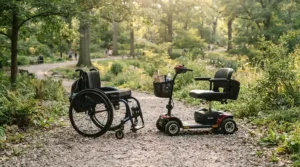
The headline is a 600W motor setup with a listed range of about 48 km. It’s rated for 181 kg (400 lb) and described as weatherproof.
Real weight runs about 34–36 kg according to one review roundup, which is a lot more than the 23 kg Discovery. That’s the cost of range and torque. The power-to-weight maths suits hilly neighbourhoods and long park loops.
Here’s what to weigh: the extra 11–13 kg over the Discovery is the difference between a one-person car load and a two-person one for many people. If your trips are under 10 km, the Discovery covers you. If you ride to a cottage lane and back, the Quattro XL earns its mass. I couldn’t verify a large body of independent reviews, so treat this as a spec-led recommendation.
Pros:
- ✅ Roughly 48 km claimed range
- ✅ 600W power for slopes and gravel
- ✅ 181 kg capacity in a folding frame
Cons:
- ❌ Noticeably heavier than the Discovery
- ❌ Costs more than basic folding chairs
Price: roughly C$3,500–C$4,500. A strong pick for hills and distance.
7. Aotedor 500W All Terrain — light, airline-friendly budget entry
What stands out is a 22 kg (48.5 lb) frame without the battery and a 500W dual-motor setup. Capacity is 159 kg (350 lb), and the removable lithium battery gives up to about 24 km. The listing claims airline approval, and you should confirm battery rules with your carrier.
Reviewers like the motor and battery life. One review mentions a battery-retaining screw that was too short. An editorial review notes it’s more all-terrain than off-road, which is the right expectation. Think packed gravel, grass and uneven pavement, not mud pits.
The spec sheet shows a chair that handles errands and park paths well and travels easily. At this price you give up the fine-tuned ride and the larger battery of the premium chairs. For many people, that’s a fair deal.
Pros:
- ✅ Light at about 22 kg without battery
- ✅ Removable lithium battery for indoor charging
- ✅ 500W dual motors for slopes and grass
Cons:
- ❌ Not a true off-road machine
- ❌ Shorter claimed range than premium chairs
Price: roughly C$1,000–C$1,800. The best entry point on this list.
| Model | Type | Capacity | Claimed range | Approx. weight | Price range (CAD) | Best For |
|---|---|---|---|---|---|---|
| Pride Baja Raptor 2 4-Wheel | Scooter | 181 kg | 24–34 km | 156 kg with batteries | C$5,000–C$6,000 | Daily outdoor riders with a ramp or lift |
| Pride Pathrider 130XL | Scooter | 159 kg | Up to about 35 km | About 73 kg without batteries | Mid-C$4,000s–mid-C$5,000s | Mixed pavement and gravel |
| Shoprider Rocky 4 | Scooter | 225 kg | Up to about 50 km | About 146 kg | C$3,500–C$5,000 | Heavier riders on a budget |
| Pride Baja Bandit 4-Wheel | Scooter | 181 kg | About 23–47 km | About 72 kg | C$5,000–C$6,000 | Riders who need it to come apart |
| Porto Mobility Ranger Discovery | Power chair | 200 kg | About 32 km | About 23 kg | C$2,800–C$3,800 | Trunk-friendly outdoor chair |
| Porto Mobility Ranger Quattro XL | Power chair | 181 kg | About 48 km | About 34–36 kg | C$3,500–C$4,500 | Hills and long loops |
| Aotedor 500W All Terrain | Power chair | 159 kg | About 24 km | About 22 kg | C$1,000–C$1,800 | Budget and air travel |
The pattern is clear: scooters buy you size and distance, chairs buy you portability. The Aotedor 500W All Terrain and Porto Mobility Ranger Discovery give the most capability per kilogram of lifting. The Pride Baja Raptor 2 4-Wheel and Pride Baja Bandit 4-Wheel deliver the plushest outdoor ride, at premium prices.
Power Wheelchair vs Scooter Pros and Cons: The Honest Ledger
Power wheelchair vs scooter pros and cons really boil down to who you are on the worst day of the week. A power chair wins on tight turning, joystick control for weaker hands, and upgradeable seating. A scooter wins on long-haul comfort, an easier get-on-and-go posture, and often a lower purchase price.
The downsides are the mirror image. Chairs have smaller drive wheels, so they can feel busier over rough ground unless the suspension is good. Scooters demand grip strength, trunk stability and the ability to transfer unaided. A tiller can be tiring if your shoulders aren’t happy.
| Option | Strength | Weakness | Best For |
|---|---|---|---|
| Manual wheelchair | Light, no battery | Taxing on slopes | Short, flat trips |
| Rollator or walker | Low cost, builds stamina | Limited outdoor distance | People who walk but tire fast |
| All-terrain power wheelchair (e.g., Aotedor 500W All Terrain) | Tight turning, folds | Smaller drive wheels | Indoor-outdoor life |
| Outdoor scooter (e.g., Pride Pathrider 130XL) | Distance and comfort | Wide turning circle | Upright riders on paths |
The table shows why neither device is universally better. If you can still walk indoors but tire outdoors, the scooter is usually the better answer. If you spend most of your day seated and need to get through doorways, the chair is. Be honest about which describes your week.
Mobility Scooter vs Electric Wheelchair Canada: Rules, Funding and Climate
Mobility scooter vs electric wheelchair Canada comes down to provincial and municipal rules, not one national rulebook. Where you can ride, how fast, and whether insurance matters are set locally. Check your municipality’s bylaws before you spend money.
Funding is where Ontario residents have a real edge. The Ontario Assistive Devices Program helps fund mobility devices, including power wheelchairs and scooters, after an assessment by an authorized professional. The ADP application form asks the assessor to confirm that scooter users can operate the device independently with the standard seat and tiller. Power wheelchairs with tilt or recline go through the Central Equipment Pool.
Here’s the catch: funding is tied to approved equipment. A consumer-priced import like the Aotedor 500W All Terrain may not qualify, and Pride lists the Pride Baja Raptor 2 4-Wheel as a non-medical device. Ask your authorizer before you buy, not after. Other provinces run their own programs, so check yours.
Climate matters too. Snow and slush are tough on batteries and electronics, and cold reduces battery capacity. A removable battery, like the Pride Baja Bandit 4-Wheel or the Aotedor 500W All Terrain has, lets you charge indoors. Weatherproof ratings on chairs like the Porto Mobility Ranger Discovery help in rain, but don’t treat them as winter-driving licences.
Seating and Postural Support Differences
Seating and postural support differences are the least glamorous and most important gap between these two device types. Power chairs usually offer chair-style seating, and many models can add positioning options. Pride’s own comparison notes padded, captain’s-style seating as standard on its electric wheelchairs.
Scooters typically use vinyl seating that adjusts and may swivel. The Pride Baja Raptor 2 4-Wheel‘s seat is a 20 in × 18 in limited-recline memory-foam unit. The Pride Pathrider 130XL lists an 18 in × 18 in seat. Those are comfortable for a couple of hours but aren’t built for pressure relief or complex posture.
If you need lateral support, head support, tilt or recline, a power chair is the safer choice. Specialty tilt and recline chairs are generally funded and supplied through dedicated programs. Remember that a scooter’s tiller demands upright posture and trunk control. If you tire in your core after an hour, that’s a clue about which device fits.
Also think about transfers. A swivelling scooter seat helps you get on from the side. A chair with flip-up armrests and a stable base makes transfers easier from a bed or car seat.
Storage and Transport Differences
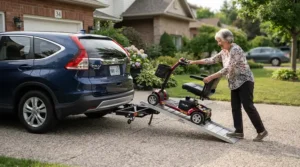
Storage and transport differences decide more purchases than any motor spec. A folding chair like the Porto Mobility Ranger Discovery (about 23 kg) fits a hatchback. The Aotedor 500W All Terrain weighs about 22 kg before you remove its battery. Full-size scooters are another world: the Pride Baja Raptor 2 4-Wheel is a one-piece frame of about 156 kg with batteries, so it needs a ramp or lift and a covered storage spot.
The Pride Baja Bandit 4-Wheel splits into pieces of about 32 kg or less. The Pride Pathrider 130XL has tie-down points for transporting the unoccupied scooter in a van.
Air travel adds another layer. CBC reported on a B.C. traveller who said airline and security staff pressured him to remove the lithium battery from his portable scooter before flying. Airline rules vary, and some airlines need advance notice before you travel with a powered mobility aid. Porter notes that your battery must meet Canadian Transportation Agency requirements. Air Canada asks for at least 48 hours’ notice. Call before booking, not at the check-in counter.
Plan your parking spot too. A scooter stored in an unheated garage still needs its batteries kept charged and above freezing.
Typical User Needs by Product Type
Typical user needs by product type are easier to see through three profiles.
The weekend wanderer. A retiree in suburban Ontario who still walks indoors but can’t manage the 2 km to the lake. A scooter such as the Pride Pathrider 130XL fits: upright posture, long range, comfortable on paths. Budget is moderate and storage is a garage.
The full-time chair user who travels. A condo-dwelling rider who needs tight turning indoors and wants to hit gravel paths on holiday. The Porto Mobility Ranger Discovery suits that mix. It folds into a car, handles outdoor surfaces, and still fits through doorways. Weight is the trade-off.
The heavier rider on a budget. Someone who needs a high capacity without premium pricing. The Shoprider Rocky 4 (225 kg rating) or the Porto Mobility Ranger Quattro XL (181 kg, 48 km range) cover that, depending on whether trunk-friendliness matters.
Each profile starts with the body and the home, then picks the machine. Frequency of use matters too. A weekly outing is a different purchase from a daily commute.
✨ Don’t Miss These Exclusive Deals!
🔍 Take your outdoor mobility to the next level with these carefully selected products. Click on any highlighted item to check current pricing and availability. These machines will help you create genuine independence your family will love!
Choosing Between a Scooter and a Power Chair: 6 Steps
Choosing between a scooter and a power chair is easier with a checklist. Work through these steps in order:
- Measure your doorways and turning space. If your home has tight halls, a chair’s smaller turning footprint is worth more than range.
- Check your core and arm strength. A tiller needs upright posture and hand control. A joystick needs much less.
- Define your outdoor terrain. Packed gravel and sidewalks suit most models. Grass, snow and ruts need larger tires, suspension and ground clearance.
- Plan transport. If you lift it yourself, weight is the spec. If you use a ramp or van, weight matters less.
- Confirm funding. In Ontario, ask an ADP authorizer first. In other provinces, ask your health authority or occupational therapist.
- Test-drive both. Real use beats any comparison table.
A simple decision tree helps: if you tire outdoors but walk well indoors, choose a scooter. If you sit most of the day or need posture support, choose a chair. If you need both, a folding chair like the Aotedor 500W All Terrain or Porto Mobility Ranger Discovery is the compromise.
Features That Actually Matter (And Those That Don’t)
Ground clearance, tire type and suspension are what make an outdoor machine. Pneumatic tires cushion the ride and grip better than solid ones. The Pride Baja Raptor 2 4-Wheel‘s 8.9 cm centre clearance is a more honest number than its 16-inch tire size.
Motor wattage tells less than you’d think. A 500W dual-motor chair and a 600W model differ less in daily use than their weights and batteries do. What matters is torque on slopes and how the controller behaves at low speed.
Marketing extras like USB ports and cup holders are nice but never the reason to pick one. Skip the “off-road” label unless the ground clearance and tires back it up. Remember that “all-terrain” in this price range usually means grass, gravel and cracked pavement, not mud and boulders.

Common Mistakes When Buying Outdoor Mobility Devices
The most common mistake is buying for the best day instead of the average one. A rider who tests on a dealer’s smooth floor may not notice that a 235 cm turning radius is a problem in a narrow condo elevator lobby.
A second mistake is trusting claimed range. Manufacturers measure range under ideal conditions, and rider weight, hills and cold all reduce it. Plan for around 60–70% of the claim.
Third, ignoring transport. A 156 kg scooter with no ramp is a lawn ornament. Fourth, skipping a funding conversation. In Ontario, an ADP assessment can change what you buy. Finally, assuming weatherproof means winter-proof. Water resistance doesn’t protect cold batteries.
What to Expect: Real-World Performance
On paper, a 34 km range sounds enormous. In practice, steady wind, hills and cold cut it down. Plan a round trip at half the claimed range for safety, and you’ll rarely get stranded.
Expect vibration on cracked pavement with any model. The scooters with full suspension, like the Pride Baja Raptor 2 4-Wheel, smooth it out noticeably more than a folding chair on smaller wheels. Chairs are more nimble, scooters are calmer.
Speed is a distraction. A 21 km/h top speed sounds fun, but on shared paths you’ll likely use the low setting. The Shoprider Rocky 4 includes a Hi/Lo switch for exactly this reason. And be ready for the slow, careful approach to curb cuts and ramps. They decide your route more than horsepower does.
Practical Usage Guide: Your First 30 Days
A few habits protect your investment. In week one, practise in an empty parking lot: starts, stops, turns and reversing. Learn the speed settings before you hit a shared path.
Charge fully before first use, and follow the manual’s battery guidance. Charge after each ride, and don’t let lead-acid batteries sit empty. Lithium batteries like those on the Pride Baja Bandit 4-Wheel and Aotedor 500W All Terrain can be removed and charged indoors during winter.
Weekly, check tire pressure on pneumatic tires, test brakes, and wipe down electronics. Monthly, inspect cables and connectors for wear. Keep a simple log of range so you notice when the battery starts to fade. Travelling by air? Read the Canadian Transportation Agency’s summary of its mobility aids and air travel recommendations and call your airline early.
Problem → Solution Guide
Problem: the device won’t fit in my car. Solution: choose a folding chair like the Porto Mobility Ranger Discovery or Aotedor 500W All Terrain, or a disassembling scooter like the Pride Baja Bandit 4-Wheel.
Problem: I’m worried about range. Solution: take half the claimed range as your round-trip plan. For longer outings, consider the Porto Mobility Ranger Quattro XL or the Shoprider Rocky 4.
Problem: my hands tire on a tiller. Solution: a joystick chair reduces grip demands. Ask an occupational therapist to assess.
Problem: snow and cold. Solution: store batteries indoors, keep tires inflated, and treat weatherproofing as rain protection, not a winter licence.
Problem: flying with my device. Solution: contact the airline weeks ahead, confirm battery type and watt-hours, and carry the manufacturer’s documentation.
Long-Term Cost & Maintenance
Purchase price is only part of the cost. Batteries are the big recurring expense, and lead-acid packs typically need replacing sooner than lithium. Tires need checking, and electronics may need servicing.
| Cost area | Power wheelchair | Scooter |
|---|---|---|
| Purchase | Wide range; Aotedor 500W All Terrain at the low end | Often higher for full-size outdoor models |
| Batteries | Smaller packs, simpler swaps | Larger packs, higher replacement cost |
| Servicing | Joystick and controller issues | Tiller, brakes and tires |
| Best For | Budget-conscious or travelling users | Daily outdoor riders |
The table shows that a cheaper chair doesn’t mean cheaper to own forever. A warranty matters: one roundup lists three years on the Porto Mobility Ranger Discovery frame and one year on motor, controller and batteries. Budget for a battery replacement within a few years, whichever device you choose.
FAQ
❓ Can an all-terrain power wheelchair handle snow?
❓ Do I need a licence or insurance for a mobility scooter in Canada?
❓ How much of the claimed range will I actually get?
❓ Is a scooter or a chair better for hills?
❓ Can I fly with a lithium-battery mobility device in Canada?
Conclusion
The all-terrain power wheelchair vs mobility scooter for outdoor use choice is less about which is “better” and more about which fits your body, home and terrain. Scooters like the Pride Baja Raptor 2 4-Wheel and Pride Pathrider 130XL deliver comfortable distance for upright riders with room to store them. Chairs like the Porto Mobility Ranger Discovery, Porto Mobility Ranger Quattro XL and Aotedor 500W All Terrain win on tight turning, seating options and portability.
Be honest about your daily life, not your best day. Check funding first if you live in Ontario, confirm local rules, and test-drive if you can. Treat every range and slope number as a ceiling, not a promise.
✨ Ready to compare current options?
🔍 Click any highlighted product above to check current pricing and availability on Amazon.ca, and take the first step toward confident outdoor independence! 🌲
Recommended for You
- All-Terrain Power Wheelchair For Uneven Ground: 7 Proven Picks 2026
- All-Terrain Power Wheelchairs: 7 Proven Picks For Canada 2026
- Heavy Duty Power Wheelchair: 7 Tough Picks For Canada 2026
Disclaimer: This article contains affiliate links. As an Amazon Associate, I earn from qualifying purchases. If you purchase products through these links, we may earn a small commission at no additional cost to you.
✨ Found this helpful? Share it with your friends! 💬🤗
