

In This Article
A mid-wheel drive power wheelchair places its two drive wheels directly beneath the rider, near the centre of the base, with casters at both ends. That layout lets the chair spin almost on the spot. It is why the mid-wheel drive power wheelchair has become a go-to design for tight hallways, condo elevators, and older Canadian homes whose doorways were never designed with mobility in mind.
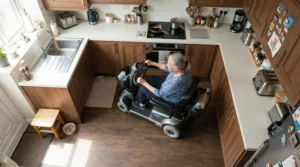
The idea has deep Canadian roots. Wikipedia’s overview of motorized wheelchairs credits George Klein, who worked for the National Research Council of Canada, with the first electric wheelchair put into production, built to help injured veterans after the Second World War. Eight decades later, the engineering question hasn’t changed: how do you get a person through a world full of corners?
This guide answers it with seven real models, plain-language spec analysis, and a few honest caveats. Everything here comes from manufacturer sheets and Canadian dealer listings gathered in 2026. I haven’t driven any of these chairs, and I won’t pretend otherwise. Where reviews are thin, I’ll say so. Where two spec sheets disagree, you’ll see both numbers.
Availability on amazon.ca shifts quickly, and several of these chairs are sold mainly through mobility dealers, so check the live listing. Prices are ranges in Canadian dollars, never exact figures.
Along the way we’ll cover the best mid-wheel power wheelchair Canada shoppers can realistically compare, turning radius by drive type, indoor maneuverability ratings, and a frank look at centre of gravity and tipping risk.
Quick Comparison: Seven Mid-Wheel Drive Power Wheelchair Options at a Glance
| Model | Published turning radius | Weight rating | Price range (CAD) | Best For |
|---|---|---|---|---|
| Pride Jazzy 600 ES | 52 cm (20.5 in) | 136 kg (300 lb) | Around C$4,500–C$5,500 | All-round daily use |
| Quantum Q6 Edge 3 | 52 cm (20.5 in) | 136 kg (300 lb) | Quote-based, configured | Complex seating, funded builds |
| Invacare Pronto M51 with SureStep | About 50–57 cm (19.5–22.5 in; sources differ) | Verify per listing | Around C$4,800–C$5,800 | Thresholds and transitions |
| Golden Compass Sport GP605 | 50–61 cm (19.5–24 in; sheets differ) | 136 kg (300 lb) | Around C$5,000 | Value-minded outdoor use |
| Drive Titan AXS | 51 cm (20 in) | 136 kg (300 lb) | About C$2,800–C$3,500 if stock is found | Tight budgets, indoor use |
| Quantum Q6 Edge 3 Stretto | 53 cm (21 in) | 136 kg (300 lb) | Quote-based, configured | Narrow spaces, smaller riders |
| Invacare Pronto M94 | About 49 cm (19.3 in) | Up to 227 kg (500 lb) | Quote-based; check current price | Heavy-duty capacity |
Looking at the table, the turning radii cluster tightly between roughly 49 and 53 cm, so radius alone won’t pick a winner. The real separators are weight rating, drive-wheel size and how each chair is sold. The Drive Titan AXS undercuts the field on price, but its stock situation (covered below) matters more than the sticker. The Invacare Pronto M94 is the outlier on capacity. The two Quantum chairs trade price simplicity for deep customization.
💬 Just one click — help others make better buying decisions too!😊
Best Mid-Wheel Power Wheelchair Canada Buyers Can Compare: Top 7 Expert Analysis
These seven span budget, mid-range and premium tiers. Each entry translates specs into daily life and flags where the evidence runs thin.
1. Pride Jazzy 600 ES — best all-rounder for mixed indoor and outdoor days
Pride positions this chair as having one of the tightest turning radii in its Jazzy line, and the numbers support a balanced personality.
The 52 cm (20.5 in) turning radius suits hallways, while the 36 cm (14 in) foam-filled drive wheels roll over cracks and thresholds more calmly than the 25 cm (10 in) wheels on budget chairs. The 6 in omni-casters at both ends are designed to avoid hang-ups, a quiet but real benefit on door tracks. Ground clearance is only 7 cm (2.75 in), so steep ramp lips need respect.
Pride’s range claim is up to about 40 km (24.8 mi) at 300 lb and about 47 km (29.5 mi) at 200 lb. Pride notes these come from theoretical calculations, and one retailer lists just 17 mi (27 km), so plan on the conservative figure. The base’s heaviest piece weighs 56 kg (124 lb), which matters if you will be lifting it into a vehicle.
This is the chair for someone who wants one machine for the apartment, the mall and the sidewalk. At the time of research, a major U.S. retailer listing carried no customer reviews, so I can’t report verified sentiment.
Pros:
- ✅ 52 cm turning radius handles tight hallways
- ✅ Large 14 in flat-free drive tires smooth out cracks
- ✅ Up to about 40 km rated range
Cons:
- ❌ Low 7 cm ground clearance limits rough ramps
- ❌ Heaviest base piece is 56 kg
Expect around C$4,500–C$5,500 (check current price). The value verdict is strong for a full-size, mid-range chair.
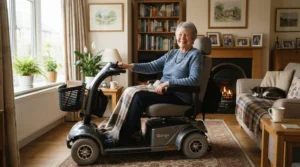
2. Quantum Q6 Edge 3 — best for seating that changes as needs change
The Edge 3 is a platform more than a product: you configure it to a prescription, then reconfigure as your body or needs evolve.
It pairs a 52 cm (20.5 in) turning radius with a 62 cm (24.4 in) base and 36 cm (14 in) solid drive wheels. Quantum’s Canadian sheet cites speeds up to 10 km/h (the U.S. sheet says up to 7 mph, about 11 km/h). The optional iLevel seat elevation lifts you up to 30 cm (12 in), but speed drops to roughly 7 km/h while elevated. That slowdown is a stability trade-off, and we’ll return to it. The base is also heavy at 63 kg (138.6 lb).
A Canadian dealer describes this as an ADP-eligible category device. That matters for Ontario buyers, though eligibility always runs through an authorized assessment. Standard LED fender lights and a USB port are small touches that earn their keep on dark winter evenings.
I couldn’t verify a meaningful pool of independent consumer reviews, which is typical for clinician-prescribed chairs. Judge it on the spec sheet and your therapist’s input.
Pros:
- ✅ Seat elevation and tilt options as needs change
- ✅ Smooth Ride Suspension with LED fender lights
- ✅ Funding-friendly category in some provinces
Cons:
- ❌ Quote-based pricing and a prescription-style process
- ❌ Heavy base and a non-folding design
Pricing is quote-based. One private resale listing cited an original price above C$11,000 for a heavily configured unit, so expect a wide range. It is good value only if you need what it offers.
3. Invacare Pronto M51 with SureStep — smoothest over thresholds up to 5 cm
SureStep is the headline: Invacare says it lets the chair cross thresholds and transitions up to 5 cm (2 in) without a jarring lurch.
That matters in Canadian homes, where patio-door tracks and entry thresholds are daily obstacles. The chair is described as true centre-wheel drive with 6 × 2 in casters front and rear. Published turning radii range from 19.5 in on one listing to 22.5 in on a roundup, so the maths is uncertain. Even the loosest figure is workable indoors.
Spec disagreement is this chair’s quirk. Weight-rating and range claims vary by retailer, so confirm the rating for your exact configuration before buying. Replacement 12 V batteries in the 32–35 Ah range are widely stocked, a small but practical bonus for long-term ownership.
One retail roundup rates it for balance across manoeuvrability, range and comfort. It is an aggregator, so treat that as soft evidence rather than verified owner feedback.
Pros:
- ✅ SureStep eases transitions up to 5 cm
- ✅ Compact footprint suits tight homes
- ✅ Common replacement battery sizes
Cons:
- ❌ Published specs differ between sources
- ❌ Small casters can still catch on rough ground
Expect around C$4,800–C$5,800 (check current price). It is a solid value if thresholds are your daily headache.
4. Golden Compass Sport GP605 — best value with a chassis built to keep wheels down
Golden’s springless articulating chassis is designed to keep all six wheels in contact with the ground, which is the core promise of mid-wheel stability.
The listed specs include a 136 kg (300 lb) rating, 6.4 km/h (4 mph) top speed, 25 cm (10 in) flat-free nylon drive wheels and 8.3 cm (3.25 in) ground clearance, the most generous in this group. Maximum incline is 6°. For context, a common 1:12 ramp ratio is about 4.8°, so ramps built to that ratio fall inside the rating. Standard range is listed near 39 km (24 mi), and optional 50 Ah batteries stretch that to about 55 km (34 mi).
Spec sheets disagree on turning radius: U.S. and some Canadian listings say 19.5 in, while Golden’s own Canadian sheet says 24 in (61 cm). When a manufacturer’s regional sheet contradicts a retailer, I’d plan around the larger number. The Dynamic LiNX controller supports Bluetooth programming from a phone or tablet, per a Canadian dealer listing.
The only review I found was a single five-star rating at one retailer, which is too small to mean much.
Pros:
- ✅ Highest ground clearance here at 8.3 cm
- ✅ Optional 50 Ah batteries reach about 55 km
- ✅ Phone-based controller programming
Cons:
- ❌ Turning radius figures conflict across sources
- ❌ Smaller 25 cm drive wheels than the 36 cm competitors
Expect around C$5,000 (check current price). It is fair value for mixed-terrain use.
5. Drive Titan AXS — lowest entry cost, with a stock caveat
On paper this is the budget benchmark. But a Canadian dealer notes Drive’s current Canadian and U.S. catalogues no longer list it as a factory-order model, and another lists it as discontinued. Confirm stock and warranty before you get attached.
The numbers: a 51 cm (20 in) turning radius, 136 kg (300 lb) rating, 6.4 km/h (4 mph) and about 31 km (19 mi) of range. The total weight of 77.5 kg (171 lb) splits into an 39.5 kg base, a 20 kg battery pair and an 18 kg seat, so no single piece is a lifting nightmare. The captain’s seat comes in 16–22 in widths, swivels in 45° increments and reclines, and the Bluetooth controller aids troubleshooting.
The catch is the 25 cm (10 in) drive wheels. They are fine on smooth floors but less forgiving on thresholds and broken pavement, so this is an indoor-leaning chair. The warranty reportedly runs lifetime on the frame, 24 months on electronics and 12 months on batteries, but verify for your seller.
I found no verifiable review pool.
Pros:
- ✅ Lowest entry cost in this group
- ✅ Seat swivels in 45° increments
- ✅ Bluetooth controller aids troubleshooting
Cons:
- ❌ Reportedly discontinued, so stock and parts are uncertain
- ❌ Small 25 cm drive wheels struggle outdoors
Expect about C$2,800–C$3,500 if you find new stock (check current price). The value is good only with a confirmed warranty.
6. Quantum Q6 Edge 3 Stretto — narrowest base for tight spaces and smaller riders
Stretto is Quantum’s slimmed-down answer for narrow homes, children, teens and smaller adults.
The base is 55 cm (21.75 in) wide with 14 in wheels, or 52 cm (20.47 in) with 12.5 in wheels. The 53 cm (21 in) turning radius is slightly larger than the full-size Edge 3’s, but the narrower swept footprint is the point: it fits where wider chairs can’t. Top speed is up to 10 km/h (6.25 mph), dropping to about 5.6 km/h (3.5 mph) with iLevel raised. Ground clearance is 2.9 in (7.4 cm), and the casters are 5 in front and 6 in rear, both flat-free.
Seats top out at 20 in wide, so it is not for everyone. Like its sibling, it is configured to a prescription and sold through dealers, so there is no meaningful consumer review pool to cite.
Pros:
- ✅ Base width as narrow as 52 cm
- ✅ Choice of 12.5 in or 14 in drive wheels
- ✅ Same 136 kg rating as the full-size Edge 3
Cons:
- ❌ Seat width tops out at 20 in
- ❌ Quote-based pricing and clinical setup
Pricing is quote-based. Value depends on whether a narrow footprint solves a real access problem for you.
7. Invacare Pronto M94 — heavy-duty capacity up to 227 kg (500 lb)
Most mid-wheel chairs top out at 136 kg (300 lb). The M94 is among the few full-size options rated to 227 kg (500 lb).
Despite that capacity, the listed turning radius is just 19.3 in (49 cm), among the tightest here. It rides on 14 in mid wheels with 6 in casters front and rear and includes SureStep for thresholds up to 5 cm. If you’re a larger rider, a tight radius with real transition handling is exactly what you want indoors.
Expect a bigger footprint and heavier transport weight than standard chairs. I couldn’t verify base width or weight from the sources I reviewed, so confirm both with a dealer before assuming it will clear your doors. One retailer shows four stars from two reviews, far too few to draw conclusions.
Pros:
- ✅ Rated up to 227 kg (500 lb)
- ✅ Tight 49 cm turning radius for its class
- ✅ SureStep eases thresholds up to 5 cm
Cons:
- ❌ Expect a larger, heavier build
- ❌ Tiny review pool makes feedback hard to verify
Pricing is quote-based, so check current price. It is good value when capacity is non-negotiable.
Your First 30 Days: A Practical Setup and Care Guide
Buying the chair is the easy part. These steps turn spec-sheet promises into reliable daily use.
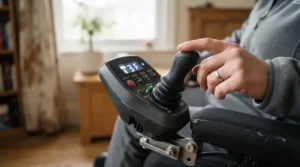
Week one: practise where it’s boring. Drive the empty hallway, a doorway and your bathroom before anywhere that matters. Mid-wheel chairs rotate around the rider, so your instinct to steer “from the front” takes a few days to unlearn. Start at the lowest speed profile. Chairs with Bluetooth or phone-programmable controllers, like the Drive Titan AXS and Golden Compass Sport GP605, let a dealer or therapist tune acceleration without a service visit.
Do a doorway dry run. Cut a cardboard rectangle to your chair’s base width (about 62 cm for the Pride Jazzy 600 ES) and walk it through your tightest door, then try the swept circle for turning.
Build a charging habit. Plug in nightly and avoid running the batteries to empty. Learn freewheel mode before you need it, and never use it on a slope.
Winter care matters in Canada. Wipe road salt from the base and casters, store the chair indoors, and expect shorter range in the cold. Don’t treat any of these chairs as snow-capable: ground clearance of 7–8 cm won’t clear slush ruts.
Log the oddities. A wobbling caster or odd noise in week two is a cheap fix, but ignoring it is not.
Real-World Scenarios: Matching Chairs to Real Lives
These are hypothetical profiles, built from published specs, to show how the reasoning works.
Scenario one: the condo dweller. Imagine someone in a 55-square-metre condo with a narrow hallway, an elevator and daily short errands. A chair around the C$5,000 mark with a tight radius suits them. The Invacare Pronto M51 with SureStep handles the elevator-door gap and the balcony threshold, while the Pride Jazzy 600 ES adds larger wheels for the sidewalk.
Scenario two: the bungalow retiree. Picture a retiree with a ramped front entrance, a gravel driveway and weekly outings. The Golden Compass Sport GP605 with the 50 Ah battery option offers the clearance and range to cover that, provided the ramp stays below its 6° rating.
Scenario three: the growing teenager. A teen needing tilt, narrow-hallway access and seating that adjusts with growth fits the Quantum Q6 Edge 3 Stretto, assessed and prescribed by a therapist.
Scenario four: the larger rider. If capacity beyond 136 kg is required, the Invacare Pronto M94 is the obvious shortlist entry, with a dealer confirming widths.
How to Choose a Mid-Wheel Drive Power Wheelchair
Choosing well comes down to seven steps, in this order:
- Measure your tightest spaces first. Doorways, hallways and bathrooms set your maximum base width. A chair that can’t fit is worthless however good its radius.
- Check the weight rating with margin. Choose a rating above your body weight plus items you carry, since range figures are quoted at stated loads.
- Decide your funding route early. If a program applies, devices often must be prescribed by an authorized professional and bought from an approved vendor.
- Match wheel size to terrain. Bigger drive wheels (36 cm) handle thresholds and cracks better than 25 cm wheels.
- Plan seating for the next five years. If your needs may change, a modular platform like the Quantum Q6 Edge 3 is worth the premium.
- Check transport and service. Heaviest-piece weight and local dealer support decide whether the chair is livable.
- Test drive before you commit. A mid-wheel drive power wheelchair feels different from anything else, and ten minutes beats ten spec sheets.
Mid-Wheel Drive Electric Wheelchair Features That Actually Matter (And Those That Don’t)
Marketing sheets list dozens of mid-wheel drive electric wheelchair features. Only a handful change daily life.
Features that earn their keep:
- Suspension design. Whether branded Active-Trac, Smooth Ride Suspension or a springless articulating chassis, it governs how often wheels lose contact with the ground.
- Drive-wheel diameter. It decides how gracefully the chair climbs a threshold.
- Controller programmability. Bluetooth tuning, as on the Drive Titan AXS and Golden Compass Sport GP605, lets a clinician fix a twitchy chair in minutes.
- Seat elevation (where needed). Elevation like the Quantum Q6 Edge 3‘s iLevel, which lifts up to 30 cm, helps reach counters and eye-level conversation.
- Flat-free tires. They remove pressure checks and punctures from your life.
Features that matter less:
- Colour-changing shrouds. Nice, but cosmetic.
- Headline top speed. At 6.4 km/h, most users never need more indoors.
- Quoted range at maximum weight. It is a theoretical figure, so subtract a third mentally.
Turning Radius by Drive Type: What the Numbers Actually Mean
Rear-wheel, front-wheel and mid-wheel designs each turn differently. A clinical summary on Permobil’s blog reports that mid-wheel chairs needed the least space for a 360-degree turn in place and performed about equal to front-wheel chairs on other turning tasks. It also concludes front- and mid-wheel designs outperform rear-wheel designs in confined spaces.
| Drive type | Where the pivot sits | Strength | Trade-off | Best For |
|---|---|---|---|---|
| Rear-wheel drive | Behind the rider | Straight tracking at speed, high ground clearance | Largest turning radius | Higher-speed outdoor use |
| Front-wheel drive | Ahead of the rider | Climbs obstacles, handles soft terrain | Rear swing on tight turns | Uneven ground |
| Mid-wheel drive | Under the rider | Smallest space for spin-in-place turns | Can pitch without good suspension | Indoor and mixed use |
The table shows why indoor users gravitate to mid-wheel. Turning in place is a different skill from a tight arc, and in a small bathroom, pivoting beats a wide sweep. The trade-off is outdoor finesse, where front-wheel designs may climb obstacles more easily.
One practical warning: manufacturers report turning radius differently, and one dealer notes some sheets quote radius while others quote diameter. Compare like with like, and treat a conflict, like the Golden Compass Sport GP605‘s 19.5 in versus 24 in, as a reason to ask the dealer.
Indoor Maneuverability Ratings: How the Seven Chairs Stack Up
These indoor maneuverability ratings are my analytical read of published specs, not lab results. Think of them as tiers.
Tightest on paper: the Invacare Pronto M94 (49 cm) and Invacare Pronto M51 with SureStep (about 50 cm on most listings), followed by the Drive Titan AXS (51 cm). Remarkable for the M94 given its capacity.
Middle tier: the Pride Jazzy 600 ES and Quantum Q6 Edge 3 at 52 cm. They give up nothing meaningful and add larger wheels.
Narrowest rather than tightest: the Quantum Q6 Edge 3 Stretto. Its 53 cm radius is slightly larger, but its 52–55 cm base fits spaces nothing else here can.
Check before buying: the Golden Compass Sport GP605, because its sheets disagree, ranging from 50 cm to 61 cm.
A 52 cm radius implies a swept circle roughly 105 cm across, if the radius is measured as stated. That is before footrests, feet and a carried bag. Mark that circle on your floor with painter’s tape and see what it hits.
Mid-Wheel Power Chair Stability Review: How Six Wheels Hold Up
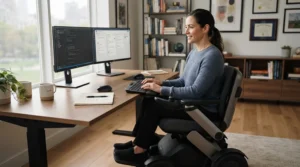
This mid-wheel power chair stability review rests on design logic, not crash tests. Mid-wheel chairs aim to keep six wheels on the ground. An older design patent notes the common weakness: a “teeter-totter” rocking motion as the chair pitches over its drive wheels. Modern suspensions exist largely to tame it.
Each brand tackles this differently. The Pride Jazzy 600 ES uses Active-Trac suspension with Mid-Wheel 6 technology. The Quantum Q6 Edge 3 and Stretto use Smooth Ride Suspension. The Golden Compass Sport GP605 relies on a springless articulating chassis. The Drive Titan AXS uses a frame designed to keep all six wheels down, with rear anti-tip wheels listed by one UK seller.
What spec sheets can’t tell you is how a given chair behaves under hard braking or on a cambered sidewalk. That is why a test drive on a ramp and a threshold matters more than any label. Stability on paper is a hypothesis, and your own house is the experiment.
Centre of Gravity and Tipping Risk: What Every Rider and Caregiver Should Know
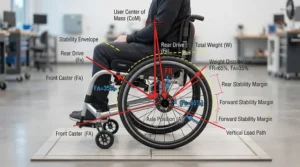
Mid-wheel placement puts your mass over the drive axle, which is stabilizing in most daily conditions. But centre of gravity and tipping risk don’t disappear. They shift.
Raising the seat lifts the centre of gravity, which is why the Quantum Q6 Edge 3 drops to about 7 km/h with iLevel elevated and the Stretto to about 5.6 km/h. Carrying a heavy backpack, driving across a slope, or braking hard on a descent all change the balance. RESNA conference research on stability testing shows how engineers measure static tipping angles for rear, mid and front drive positions. The lesson for buyers is that stability is measured, not assumed.
Practical habits help. Use the positioning belt, lower the seat before driving on slopes, never exceed the chair’s rated incline (6° on the Golden Compass Sport GP605), and avoid turning on a ramp. If you or a caregiver have concerns, talk to an occupational therapist. This article is general information, not medical advice.
Funding, Licensing and Canadian Rules You Should Know
Funding is where Canadian buying gets complicated. Ontario’s Assistive Devices Program helps eligible residents with wheelchairs and mobility aids. Per listings of the program, you need a valid Ontario health card and a disability lasting six months or longer. A health care professional must authorize the device, you must complete an authorization form before buying, and the equipment must come from an ADP-authorized vendor.
That last point is crucial. If you want program funding, buying from a general online marketplace may not qualify, so confirm with your authorizer before ordering anything. Other provinces run different programs with different rules, so check yours.
More broadly, wheelchairs are regulated as medical devices in Canada. Ask any dealer to confirm the chair they’re selling is properly licensed for sale here, and keep your warranty paperwork. Imported, discontinued or second-hand chairs may lack parts and service support.
Long-Term Cost and Maintenance: What the Sticker Price Hides
A C$5,000 chair used for seven years works out to roughly C$700 a year before batteries and service. Batteries are the recurring cost, and chairs like the Pride Jazzy 600 ES use two NF-22 units at about 17 kg each.
| Model | Entry price range (CAD) | Value verdict |
|---|---|---|
| Pride Jazzy 600 ES | Around C$4,500–C$5,500 | Strong all-rounder |
| Quantum Q6 Edge 3 | Quote-based | Worth it for modularity |
| Invacare Pronto M51 with SureStep | Around C$4,800–C$5,800 | Good for thresholds |
| Golden Compass Sport GP605 | Around C$5,000 | Fair, with range upside |
| Drive Titan AXS | About C$2,800–C$3,500 | Cheap, but confirm stock |
| Quantum Q6 Edge 3 Stretto | Quote-based | Value if narrowness matters |
| Invacare Pronto M94 | Quote-based | Value for capacity needs |
The cheapest chair isn’t necessarily the lowest-cost chair: a discounted Drive Titan AXS with unavailable parts can cost more over time than a Pride Jazzy 600 ES with proper support. Budget for batteries, a service plan and, if needed, transport. Prices change constantly, so check current listings.
FAQ
❓ How much does a mid-wheel drive power wheelchair cost in Canada?
❓ Are mid-wheel drive power wheelchairs good for outdoor use?
❓ Are mid-wheel drive power wheelchairs more likely to tip?
❓ How long do mid-wheel power chair batteries last?
❓ Can I get funding for a mid-wheel drive power wheelchair in Canada?
Conclusion
A mid-wheel drive power wheelchair is the strongest answer to a simple problem: small spaces. Across the seven chairs here, turning radii cluster around 49–53 cm, so the real decision lies elsewhere. Pick the Pride Jazzy 600 ES for balance, the Invacare Pronto M51 with SureStep for thresholds, the Golden Compass Sport GP605 for ground clearance and range, the Invacare Pronto M94 for capacity, and the Quantum Q6 Edge 3 or Stretto when seating and narrowness drive the decision. Treat the Drive Titan AXS as a budget option only if you can confirm stock and warranty.
Above all, measure your spaces, check how funding works in your province, and test drive before you buy. Specs predict; your own doorway decides. This article is general information, not medical advice, so involve a therapist or other qualified professional in the final choice.
✨ Ready to find your fit?
🔍 Click any highlighted chair to check current pricing and availability, then bring your measurements to a dealer for a test drive. Your best mid-wheel drive power wheelchair is the one that fits your home and your life! ♿
Recommended for You
- Lightweight Foldable Power Wheelchair For Indoor Transport 2026
- Indoor Power Wheelchair For Narrow Hallways: 7 Best Picks (2026)
- Compact Power Wheelchair vs Manual Wheelchair: 7 Smart Picks 2026
Disclaimer: This article contains affiliate links. As an Amazon Associate, I earn from qualifying purchases. If you purchase products through these links, we may earn a small commission at no additional cost to you.
✨ Found this helpful? Share it with your friends! 💬🤗
