
In This Article
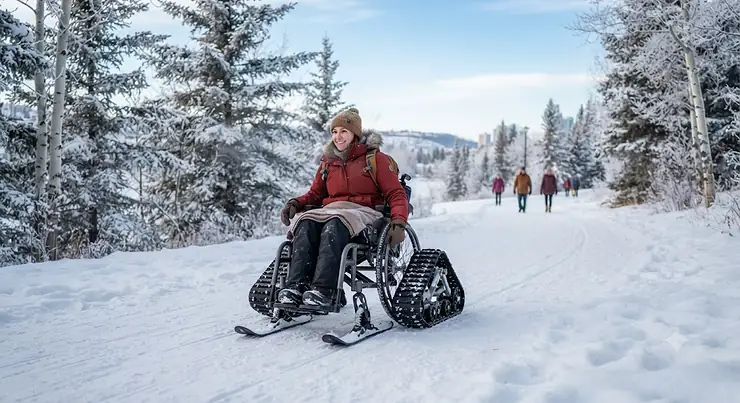
A winter wheelchair for snow is any mobility chair or add-on system engineered — through wider wheels, tracks, skis, or traction accessories — to keep a user moving across snow and ice instead of sinking, spinning out, or getting stranded at the curb. That’s the textbook version. The lived version is messier: it’s the difference between watching the first snowfall from your window with dread versus grabbing your coat because you know your setup can handle it.
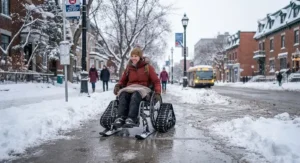
Canadian winters don’t ask nicely. Disability advocates in Toronto have pointed out that snowbanks and unplowed curb cuts function as human-made barriers that most walking pedestrians never notice and most wheelchair users can’t avoid — a bus ramp simply can’t lower onto a snow pile, and a standard wheelchair caster sinks into six centimetres of fresh powder about as easily as a stiletto heel does. That’s not a design flaw in the person’s chair; it’s a mismatch between everyday mobility equipment and a five-month season. This guide exists to close that gap.
We’ll walk through seven real, currently available products spanning inexpensive traction add-ons to premium tracked power chairs, break down what actually changes when snow enters the picture (hint: it’s rarely just “bigger tires”), and hand you a practical framework for matching equipment to your terrain, budget, and daily routine. Every price below is shown as a range in Canadian dollars, because exact listed prices shift constantly and honest advice shouldn’t pretend otherwise. Whether you’re dealing with a suburban driveway or acreage outside Saskatoon, there’s a workable answer here — and by the end, you’ll know which one fits your winter, not someone else’s.
Quick Comparison Table
Before diving into individual products, it helps to see the three broad categories a winter wheelchair for snow typically falls into, because the right category matters more than the specific brand within it.
| Category | Price Range (CAD) | Snow Depth Handled | Best For |
|---|---|---|---|
| Traction accessories (cleats, ski attachments) | C$100 – C$900 | Up to ~10-15 cm | Upgrading a chair you already own |
| Manual all-terrain wheelchairs | C$4,500 – C$14,000 | Up to ~20-30 cm packed | Active, independent users, year-round use |
| Powered track chairs | C$16,000+ | 30 cm+ deep/loose | Acreage, hunting, cottage access, rural properties |
The jump in capability between tiers is real, but so is the jump in cost and storage/transport complexity — a set of cleats fits in a closet, while a track chair usually needs a trailer or lift-equipped vehicle. Reading this table honestly, most people don’t need the top tier; they need the middle tier’s traction paired with the bottom tier’s price, which is exactly why several of the seven picks below blend categories. Use this table as your starting filter, then let the detailed breakdowns narrow things further.
Just one click — help others make better buying decisions too!😊
Top 7 Winter Wheelchairs for Snow: Expert Analysis
We researched real products across budget, mid-range, and premium tiers, verified current availability, and gathered aggregated review sentiment wherever it genuinely exists. Prices are shown as ranges only, and every specification below comes with an explanation of what it actually means once you’re rolling through slush.
1. FOLD & GO Snow Cleats — cheapest way to add grip to an existing chair
These reusable silicone-and-metal cleats strap directly onto the rear motor wheels of a compatible all-terrain power wheelchair, and the concept is refreshingly simple: four cleats (two per tire) turn a smooth tread into something closer to a snowmobile track’s edge. The manufacturer is explicit that this is a snow-only accessory — the metal spikes will flatten or crack against bare concrete, so this isn’t a year-round tire swap, it’s a storm-day tool you put on and take off. Practically, that means once snow builds past roughly 10-15 cm, the cleats bite into it rather than letting the tire spin uselessly on top, which is the exact failure point most standard power wheelchair tires hit first.
This is squarely a budget-conscious pick for someone who already owns a compatible FOLD & GO wheelchair and just needs occasional extra bite during specific storms, not a full winter wheelchair for snow on its own. Because this is a niche, brand-specific accessory, independently verified customer review data is thin; what’s consistent across retailer listings is the repeated warning about pavement damage, which suggests the traction claims hold up but the “snow only” limitation is real and worth respecting rather than testing.
Pros:
- ✅ Very low cost compared to any full chair
- ✅ Reusable across multiple winters
- ✅ Compact, comes with its own storage bag
Cons:
- ❌ Only fits FOLD & GO wheelchair models
- ❌ Damages quickly if used on cleared pavement
Priced around C$100-C$150, this is the cheapest entry point on this whole list — a smart add-on if you already own the base chair, and a poor standalone purchase if you don’t.
2. Wheelblades Wheelchair Skis — swap front casters for skis in seconds
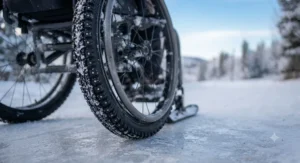
Wheelblades replace the small front caster wheels on almost any standard manual wheelchair with a pair of compact skis, clamped on without tools in a matter of seconds and adjustable to caster widths from about 1.8 to 6 cm. The engineering logic here is worth spelling out: small caster wheels concentrate a rider’s weight onto a tiny contact patch, which is precisely why they auger down into snow that a person walking beside them barely notices. Skis spread that same weight over a much wider surface, and two tracking channels underneath keep the blades running straight instead of skittering sideways on packed snow.
Because Wheelblades attach to the front casters rather than replacing the whole chair, this is the most universally compatible option here — it works whether you’re already in a lightweight everyday manual chair or a sportier rigid-frame model. The trade-off is that your rear wheels still need their own traction; on deep, unpacked powder, skis up front paired with narrow rear tires can still bog down, so this shines brightest on compacted or lightly fresh snow rather than a foot of fresh powder. Aggregated feedback across several adaptive-equipment retailers consistently highlights how quickly the blades click on and off, and one recurring theme in buyer comments is that helpers find it noticeably easier to push a wheelchair through snow once the front skis are on — though, as with most specialty mobility gear, a large independent review base simply doesn’t exist yet, so treat that sentiment as directionally useful rather than exhaustively verified.
Pros:
- ✅ Fits most standard manual wheelchairs, not one brand
- ✅ Tool-free installation in seconds
- ✅ Lightweight and easy to travel with
Cons:
- ❌ Doesn’t help rear-wheel traction on its own
- ❌ Less effective in deep, unpacked powder
Expect a price in the C$450-C$900 range depending on the model and retailer, making Wheelblades Wheelchair Skis one of the better value-for-money upgrades if your winters bring moderate, packed snow rather than backcountry drifts.
3. GRIT Freedom Chair 3.0 — lever-drive traction for backcountry snow
The GRIT Freedom Chair 3.0 swaps standard push-rim wheels for 26-inch mountain-bike-style rear wheels and adds an MIT-designed lever-drive propulsion system, all built onto a frame that disassembles into car-trunk-sized pieces in under five minutes. Those larger wheels matter more in snow than almost any other spec on this list — the same float-over-versus-sink-into physics that makes fat-tire bikes work on snow applies directly here, and mountain-bike tread adds grip that a smooth indoor caster simply can’t match. The lever-drive system, meanwhile, delivers noticeably more torque per stroke than push-rims, which becomes the difference between clearing a slushy driveway incline and getting stuck halfway up it.
Based on the spec comparison with the rest of this list, the Freedom Chair 3.0 sits in an appealing middle position: it’s a genuine everyday manual wheelchair with all-terrain capability built in, rather than either a cheap accessory or a five-figure power chair. That makes it the pick for an active, independent user who wants one chair for sidewalks, trails, and snow rather than swapping equipment by season. Rehab-equipment retailers describe it as one of the most popular all-terrain wheelchairs on the market, and recurring themes in user community discussion point to the lever mechanism reducing shoulder strain compared with conventional push-rims — alongside an honestly-reported learning curve in the first few outings before the lever motion feels natural.
Pros:
- ✅ Large mountain bike wheels resist sinking in snow
- ✅ Lever drive reduces shoulder and wrist strain
- ✅ Disassembles to fit in almost any vehicle
Cons:
- ❌ Lever technique takes practice to master
- ❌ Heavier overall than a standard everyday wheelchair
Priced around C$4,500-C$6,000 for the base 3.0 build, this is where “everyday chair that happens to handle snow” transitions into genuine all-terrain territory.
4. Hippocampe All-Terrain Wheelchair with Front Ski Kit — beach chair that converts to a snow sled
Originally designed by French manufacturer Vipamat as a beach-access wheelchair, the Hippocampe uses a single central front wheel rather than the usual two-caster layout, and it’s genuinely lightweight at roughly 17 kg. The optional front ski kit clips onto that central wheel, converting the tricycle-style front end into a ski that glides rather than digs in — a straightforward swap that keeps snow from packing against the wheel the way it does on a standard caster.
What most buyers overlook about the central-wheel design is that it changes how the chair handles uneven terrain compared with a four-wheel layout: a Hippocampe rocks less over ruts and ridges because there’s one contact point up front instead of two independently sinking casters. This chair is also usually attendant-pushed rather than self-propelled, similar to an all-terrain jogging stroller, which makes it a strong option for someone with limited upper-body strength who still wants regular outdoor time with a caregiver or family member. Vipamat markets the Hippocampe as equipping more than 200 beaches worldwide, which speaks to outdoor durability in general, but independently verified Canadian consumer reviews specifically covering snow performance are limited — so the ski kit’s winter claims should be treated as a reasonable extension of proven summer engineering rather than a separately tested feature.
Pros:
- ✅ Central-wheel design resists tipping on uneven snow
- ✅ Very lightweight and easy to fold
- ✅ Quick-dry foam seat handles wet, slushy conditions
Cons:
- ❌ Best suited to packed snow, not deep powder
- ❌ Mostly designed for attendant-assisted use
With the ski kit included, budget around C$5,500-C$7,000, positioning the Hippocampe All-Terrain Wheelchair with Front Ski Kit as a strong mid-tier option for caregiver-assisted outings.
5. Mountain Trike — hydraulic disc brakes for icy hills
The Mountain Trike is a three-wheeled manual all-terrain wheelchair with an independent shock absorber on each wheel and, critically for Canadian winters, hydraulic disc brakes rather than the rim brakes found on many mobility products. Steering happens through the single rear wheel using the same lever-drive concept as other chairs on this list, which keeps a rider’s hands clean and dry in slush instead of gripping wet push-rims.
Here’s what the spec sheet won’t spell out on its own: disc brakes matter enormously on an icy sloped driveway, because rim-style brakes lose stopping power fast once moisture and grit build up on the braking surface, while a sealed hydraulic disc keeps working consistently in wet, freezing conditions. Combined with three independently sprung wheels instead of a rigid four-wheel frame, the Trike stays planted across the lumpy, refrozen ridges that plowed snowbanks tend to leave behind, rather than rocking awkwardly like a flatter-framed chair might. This is the pick for someone facing genuinely variable terrain within the same week — packed trail one day, slushy sidewalk the next — who wants a purpose-built off-road frame rather than a converted beach or accessory setup. Mountain Trike has operated since 2011 and is frequently referenced by rehabilitation clinics and disability publications as a benchmark all-terrain wheelchair, though because Canadian distribution is newer than the UK market, locally sourced customer testimonials remain less plentiful than reviews from British users.
Pros:
- ✅ Hydraulic disc brakes hold on icy inclines
- ✅ Independent suspension on all three wheels
- ✅ Three-year warranty included with purchase
Cons:
- ❌ Premium price compared to standard manual chairs
- ❌ Limited Canadian dealer network so far
Expect to pay in the C$7,500-C$9,500 range for the manual Mountain Trike, a fair ask given the suspension and braking engineering packed into the frame.
6. Mountain Trike eTrike — throttle assist when snow gets heavy
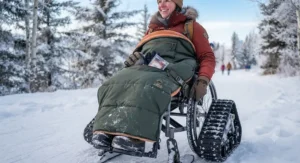
The eTrike takes the same rugged three-wheel frame and suspension as the manual Mountain Trike and adds electric assist through a twist or thumb throttle, with a realistic estimated range of roughly 13 to 32 km (8-20 miles) per charge depending on terrain, speed, and rider weight. That range estimate matters more in winter than it sounds, because pushing through slush or packed snow burns dramatically more energy per metre than rolling across dry pavement — the same reason walking through snow tires you out faster than walking the same distance on a cleared sidewalk.
Here’s the honest trade-off: electric assist means a rider isn’t stranded mid-route if arm strength gives out partway through a snowy errand run, which is a genuine independence upgrade for people managing fatigue, limited grip strength, or simply longer winter routes than the manual Trike comfortably covers. On the other hand, cold weather is well documented to reduce battery range across virtually all lithium-based systems, so the “8-20 mile” estimate should be treated as an optimistic ceiling rather than a guaranteed number once temperatures drop well below freezing — a detail worth confirming directly with a Canadian dealer before committing. Review data leans heavily on rental and demo feedback from UK-based off-road mobility providers rather than a broad public review base, with cold-weather range variability the most consistently repeated caveat.
Pros:
- ✅ Throttle assist removes the arm-fatigue ceiling
- ✅ Same rugged suspension and brakes as the manual Trike
- ✅ Can switch between manual and powered modes
Cons:
- ❌ Real-world range drops noticeably in cold weather
- ❌ Higher price and heavier than the manual version
Budget C$11,000-C$14,000 for the eTrike, and factor in a slightly conservative range estimate for genuinely cold days.
7. Action Trackchair — tank-style tracks for deep snow
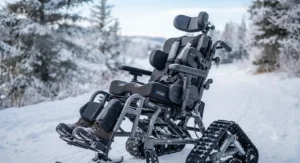
The Action Trackchair replaces wheels entirely with dual rubber tracks, available in two tread patterns, and adds features like an electric tilt mechanism, swing-up arms for easier transfers, and PMDC drive motors rated at several combined horsepower depending on the model. Tracks are the ceiling of this category for a simple physics reason: they spread a rider’s entire body weight across a long rubber footprint instead of four small contact points, which is the same principle that keeps a snowshoe on top of powder instead of sinking through it.
The two track options genuinely change performance rather than just looks — Type I tracks have raised knobs that grip aggressively in wet snow and mud but can pack with snow inside their own grooves, while Type II tracks ride smoothly on cleared pavement but offer less bite in sticky conditions, so the “right” choice depends on whether most of your terrain is loose snow or plowed concrete. This is the category ceiling for a reason: it’s the appropriate choice for someone who needs genuine rural or acreage access — a hunting property, a farm, or cottage country — rather than daily downtown sidewalk use, and it typically requires a trailer or lift-equipped vehicle given the added weight. Independent retailer and rehabilitation-equipment sources consistently describe the Trackchair as the most established name in tracked mobility, in continuous production since 2009 with an established North American dealer network; comparative hands-on reviews show up more often in hunting and outdoor-recreation publications than in general consumer channels, which makes an in-person dealer demo especially worthwhile before committing this level of budget.
Pros:
- ✅ Tracks distribute weight for deep-snow flotation
- ✅ Electric tilt and swing-up arms ease transfers
- ✅ Established dealer network across North America
Cons:
- ❌ Highest price point on this entire list
- ❌ Requires a trailer or lift-equipped vehicle to transport
Pricing typically starts around C$16,000 and can climb to C$24,000 or more depending on model, track type, and accessories — a serious investment, but one aimed squarely at year-round rural access rather than casual winter errands.
Practical Usage Guide: Winterizing and Maintaining Your Snow Wheelchair
Getting a winter wheelchair for snow home is only step one; the first month of real use is where most avoidable problems show up. Start with a pre-season inspection before the first real snowfall hits, not after: check tire pressure (or track tension, on a Trackchair), tighten any quick-release axles, and confirm brakes engage firmly, since cold rubber and metal both behave differently than they do in summer. If you’re adding an accessory like Wheelblades or snow cleats, do a dry run in your driveway before you actually need it for a doctor’s appointment — clamp mechanisms and strap tension are far easier to troubleshoot at home than at the curb.
A common first-month mistake is treating winter gear like summer gear: leaving metal snow cleats on after the storm clears will flatten them against pavement within days, and letting slush freeze onto brake calipers overnight can seize them by morning. Wipe down any exposed metal components after wet outings, and store accessory attachments somewhere dry rather than in a cold garage where moisture lingers. For powered chairs and eTrikes, bring batteries indoors to a room-temperature space between uses whenever practical, since cold storage is the single biggest factor in reduced winter range. Finally, build a simple biweekly check into your routine — bolts, brake pads, and battery terminals all loosen or corrode faster in salted, wet Canadian winters than most manufacturer manuals, written for milder climates, actually account for.
Real-World Scenarios: Which Winter Wheelchair Fits Your Life
Scenario one — the urban commuter. Priya lives in a Toronto apartment and needs to reach a bus stop eight blocks away most weekdays, through streets where sidewalks get plowed inconsistently. For her, Wheelblades Wheelchair Skis on her existing manual chair, paired with realistic expectations about days when the snow is simply too deep to attempt alone, makes more sense than a five-figure investment she’d rarely use to its full capability.
Scenario two — the rural property owner. Dale lives on ten acres outside Red Deer and needs to reach a mailbox, a workshop, and a hunting blind across ungroomed terrain all winter. The Action Trackchair is the only option on this list actually built for that job, and its higher price reflects genuinely different engineering, not just brand markup.
Scenario three — the active all-season user. Meredith wants one chair that handles hiking trails in October and snowy park paths in January without swapping equipment. The GRIT Freedom Chair 3.0 or the manual Mountain Trike both fit that “one chair, every season” brief far better than a snow-specific accessory ever could.
How to Choose a Winter Wheelchair for Snow
- Start with your typical snow depth, not the worst storm of the year. Most Canadian winters involve repeated 5-15 cm accumulations punctuated by the occasional major dump — buy for the common case, and treat the rare deep-snow day as a “stay home” day rather than a spec requirement.
- Match propulsion to your upper-body reality, honestly. A lever-drive or electric-assist system genuinely reduces shoulder strain versus push-rims, which matters more with each additional centimetre of resistance snow adds.
- Weigh transport before you weigh performance. A Trackchair that can’t fit your vehicle or a lift you don’t own isn’t actually more capable for you than a chair you can reliably get out of the garage.
- Check brake type for icy inclines. Hydraulic disc brakes, like those on the Mountain Trike, hold consistently on ice; standard rim brakes can lose bite once wet and gritty.
- Ask about cold-weather range if going electric. Battery-powered assist systems lose range in freezing temperatures — get a realistic winter estimate from the dealer, not just the marketing number.
- Decide between a dedicated snow chair and an accessory upgrade. If snow is a seasonal add-on to an otherwise fine daily chair, accessories like ski attachments or cleats solve the problem cheaper than a full replacement.
- Confirm local dealer support before buying premium equipment. Track chairs and imported all-terrain frames benefit enormously from an accessible service network for winter-specific maintenance.
Common Mistakes When Buying a Winter Wheelchair for Snow
The most frequent misstep is buying for the single worst storm of the year instead of the season’s actual average — that logic leads people toward an expensive Trackchair when a GRIT Freedom Chair 3.0 or a set of Wheelblades Wheelchair Skis would cover 90 percent of real winter days for a fraction of the cost. A close second is ignoring transport logistics entirely; a chair that requires a trailer hitch you don’t own becomes a chair that sits in a shed from December to March.
Another recurring error is assuming any accessory fits any wheelchair. Snow cleats and ski attachments are often brand- or size-specific, and buying based on a product photo rather than confirming caster width or wheel compatibility is a common, avoidable disappointment. Finally, many buyers underweight brake type, focusing entirely on wheel size or motor power while overlooking that a chair with weak cold-weather braking is a safety issue on any icy incline, regardless of how well its tires grip going forward.
Ice and Snow Wheelchair vs Traditional Manual Wheelchair for Canadian Winters
| Feature | Standard Manual Wheelchair | Ice and Snow Wheelchair Setup |
|---|---|---|
| Front wheel behaviour in snow | Small casters sink past ~5 cm | Skis or larger wheels resist sinking |
| Braking on ice | Rim brakes lose bite when wet | Disc brakes (Mountain Trike) hold consistently |
| Rear traction | Smooth or lightly treaded tires | Knobby mountain-bike tread or tracks |
| Typical price impact | Baseline cost | C$100 (accessories) to C$24,000+ (track chairs) |
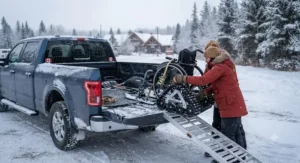
Reading this table plainly: the core difference isn’t one single feature but a combination of contact-patch size, tread pattern, and braking reliability, each of which fails independently in snow even if the others hold up. A standard all-terrain wheelchair upgrade addresses the front-wheel sinking problem specifically, which is why front-only accessories like Wheelblades solve a real but partial slice of the winter mobility puzzle rather than the whole thing. For someone facing genuinely icy inclines rather than flat, plowed paths, brake type arguably matters more than wheel size — a detail the marketing for most snow-specific products understandably underplays since it isn’t as visually dramatic as bigger tires.
What to Expect: Real-World Performance on Snow and Ice
Specs read differently on paper than they feel in practice. A 26-inch mountain bike wheel, for instance, doesn’t just “look” more capable than a standard wheelchair wheel — it changes how often you get stuck at all, because the larger diameter rolls over compressed ridges (like the edge of a snowbank) that a smaller wheel simply rams into. Lever-drive systems similarly translate to a very specific everyday experience: less immediate strain reaching a driveway’s top, but noticeably more deliberate motion at low speed compared with the instinctive push-rim technique most manual wheelchair users already know.
On the powered end, expect a real difference between a chair’s rated range and its winter range — cold temperatures slow chemical reactions inside lithium batteries, which is why a Mountain Trike eTrike’s 20-mile ceiling should be read as a summer number. Track chairs, meanwhile, genuinely do float over fresh snow the way marketing suggests, but they trade that flotation for a much wider turning radius and a noticeably bumpier ride on cleared pavement — a legitimate compromise, not a flaw, given what they’re built to solve.
Cold-Weather Accessibility for Different Users
Cold-weather accessibility needs shift significantly depending on who’s using the chair and how. Independent, active users — the kind of rider who self-propels daily and values speed — tend to get the most out of lever-drive systems like the GRIT Freedom Chair 3.0 or manual Mountain Trike, since these designs reward upper-body engagement with real efficiency gains. Attendant-assisted users, by contrast, often benefit more from a chair like the Hippocampe, where a caregiver’s pushing effort is the primary propulsion and the equipment’s job is simply to stay stable and glide rather than dig in.
Users managing fatigue, reduced grip strength, or variable energy levels day to day are usually better served by electric assist, whether that’s the Mountain Trike eTrike for moderate distances or an Action Trackchair for someone who needs to cover real rural ground without exhausting themselves before they arrive. And for anyone whose winter mobility need is occasional rather than constant — a person who mostly stays indoors during storms but still wants the option to get out on lighter snow days — a budget accessory addition to an existing everyday chair, rather than a dedicated second chair, is usually the more accessible choice both financially and logistically.
Snow Traction 101: What Actually Grips in Deep Snow
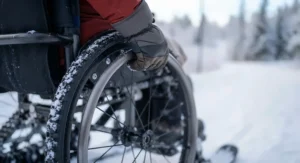
Snow traction comes down to two physical principles working together: contact-patch size and surface texture. A wider tire or ski distributes weight over more surface area, which is why fat mountain-bike tires and Wheelblades’ ski attachments both outperform narrow standard wheels despite using completely different mechanisms. Surface texture then determines how well that spread-out weight actually grips once it’s on the snow — knobby tread, metal cleats, or track lugs all bite into snow’s granular structure the way a hiking boot’s sole bites into gravel, while a smooth caster wheel simply glides uselessly on top until it eventually punches through.
This is also why traction solutions aren’t universally interchangeable: metal cleats provide excellent bite in soft snow but are actively harmful on bare pavement, while ski-style attachments glide well on packed snow but contribute nothing to grip on an icy incline where a disc brake matters far more than tread pattern. Understanding which traction principle a product relies on — flotation, bite, or braking — is genuinely more useful when comparison-shopping than any single spec number, because it tells you exactly which winter condition that product is solving for.
Seasonal Mobility Equipment: Storage, Swaps, and Off-Season Care
Treating winter gear as seasonal mobility equipment rather than a permanent chair configuration saves both money and wear. Accessories like snow cleats or ski attachments should come off entirely once the ground clears, both because they perform poorly on bare pavement and because storing them properly extends their working life for the next winter. A dry, temperature-stable spot — a hall closet rather than an unheated garage — prevents rubber and silicone components from cracking prematurely between seasons.
For dual-purpose all-terrain chairs like the GRIT Freedom Chair or Mountain Trike, seasonal swapping usually means changing wheel sets or tire pressure rather than storing the whole chair, since these are designed as year-round equipment. Powered chairs and eTrikes deserve extra off-season attention to battery storage specifically — keeping batteries at a moderate charge level (rather than fully depleted or fully charged) in a temperature-stable indoor space over long gaps between use meaningfully extends their working lifespan, a detail that matters more in a Canadian climate with genuine seasonal extremes than it does in milder regions where most product manuals were originally written.
Long-Term Cost & Maintenance
Sticker price only tells part of the ownership story. A FOLD & GO Snow Cleats purchase at roughly C$100-C$150 has essentially no ongoing cost beyond eventual replacement every few winters, while a Mountain Trike eTrike or Action Trackchair carries real recurring costs: battery replacement every few years, track or tire wear from abrasive salted surfaces, and potential shipping costs for parts sourced from overseas manufacturers.
Cost-per-use is a more honest lens than sticker price alone. If a C$16,000 Trackchair genuinely replaces a vehicle trip or hired assistance for daily rural access over a decade of ownership, its effective cost-per-outing can undercut a cheaper chair used rarely because it doesn’t fit the terrain. Conversely, spending C$8,000 on a Mountain Trike that sits unused because a simpler C$600 ski attachment would have solved 90 percent of the actual need is poor value regardless of build quality. Budget for consumables too — brake pads, tire replacements, and battery packs are the recurring costs manufacturers rarely headline but owners consistently mention.
Safety, Regulations & Compliance Guide
Canada’s approach to winter accessibility is increasingly formalized rather than left to individual goodwill. Accessibility Standards Canada has developed a dedicated standard for outdoor spaces, CAN-ASC-2.1, which requires publicly available maintenance plans with clear timelines for clearing snow and ice from outdoor surfaces under federal jurisdiction. That’s a meaningful shift from informal expectations toward measurable, published commitments, though it currently applies to federally regulated spaces rather than every municipal sidewalk.
On the personal-equipment side, look for CSA-certified components where they exist (particularly for powered mobility devices and their charging systems), and confirm any electric-assist chair’s battery meets standard transport and airline safety guidelines before travelling with it. At a broader policy level, the Accessible Canada Act establishes the federal framework aiming for a barrier-free Canada by 2040, which increasingly shapes how public infrastructure — and by extension, private mobility equipment expectations — gets designed around winter conditions rather than around them. Practically speaking, reflective lighting on your chair, a charged phone, and telling someone your route before heading out in serious cold remain the simplest, most effective safety habits regardless of which equipment tier you choose.
Frequently Asked Questions
❓ How much does a winter wheelchair for snow cost in Canada?
❓ Can a regular wheelchair be used in snow?
❓ What is the best all-terrain wheelchair for snow and ice?
❓ Do snow wheelchair attachments work on any wheelchair?
❓ Are winter wheelchairs covered by insurance or funding programs in Canada?
Conclusion
Winter doesn’t have to mean four months of watching the weather from a window. Across the seven products covered here, there’s a genuine range of entry points: FOLD & GO Snow Cleats and Wheelblades Wheelchair Skis solve the traction problem for a few hundred dollars on equipment you already own, the GRIT Freedom Chair 3.0, Hippocampe All-Terrain Wheelchair, and Mountain Trike occupy a genuinely capable mid-tier for active, all-season use, and the Mountain Trike eTrike and Action Trackchair exist for people whose winter routes demand real power and flotation.
The honest takeaway is that more expensive doesn’t automatically mean more suitable — matching the equipment to your actual terrain, your typical snow depth, and how you’re transporting and storing it matters more than chasing the most capable spec sheet on this list. Start with the Quick Comparison Table above, work through the “How to Choose” checklist, and be realistic about the storms you’ll actually face most winters rather than the one big blizzard that happens twice a decade. Whichever tier fits, the goal is the same: getting out the door in January with the same confidence you’d have in July.
✨ Ready to compare current prices and availability? Check today’s listings before the next storm rolls in!
Recommended for You
- Trail Wheelchair for Wheelchair Hikers: 7 Best Picks (2026)
- Beach Wheelchair for Sand and Boardwalks: 7 Best Picks
- All-Terrain Wheelchair for Outdoor Use: 7 Best Picks (2026)
Disclaimer: This article contains affiliate links. As an Amazon Associate, I earn from qualifying purchases. If you purchase products through these links, we may earn a small commission at no additional cost to you.
✨ Found this helpful? Share it with your friends! 💬🤗
