
In This Article
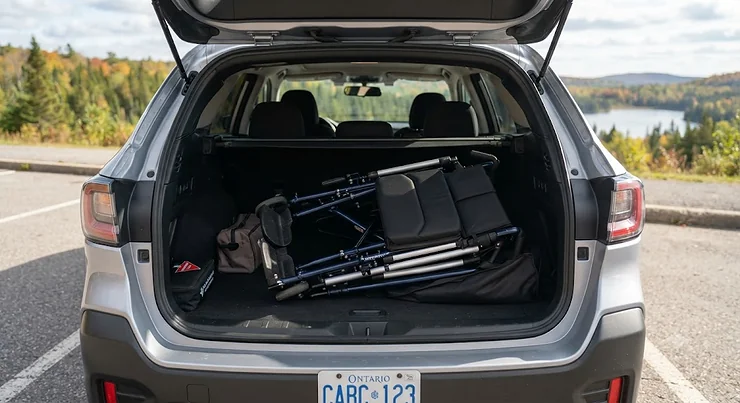
Airports are cruel to hesitation. You’ve got a boarding pass in one hand, a coffee sweating through its sleeve in the other, and somewhere behind you a gate agent is eyeing the clock like it owes them money. If mobility is part of your daily reality — yours or someone you’re travelling with — the difference between a smooth trip and a stressful one often comes down to a single piece of equipment: the chair. A portable wheelchair for travel isn’t just a smaller version of a hospital-hallway wheelchair. It’s a purpose-built tool, engineered around weight, fold size, and the specific chaos of trains, taxis, and jet bridges. The best ones fold in seconds, weigh less than a case of sparkling water, and tuck into a sedan trunk without a fight.

This guide breaks down seven real, currently available models — from no-frills attendant-propelled transport chairs under C$250 to a folding power chair for travellers who need motorized assistance. We’ll walk through genuine spec interpretation (not marketing copy), aggregated review sentiment, and the practical stuff Amazon listings never mention: how these chairs actually behave at a Pearson security line, in a rental-car trunk, or on a cobblestone street in Quebec City. Whether you’re shopping for yourself, a parent, or a client as a caregiver, you’ll leave with a shortlist and a clear framework for choosing between them.
Quick Comparison Table
| Product | Weight | Best For | Price Range (CAD) |
|---|---|---|---|
| Medline Ultra Lightweight Transport Wheelchair | ~18-19 lbs | Best all-around budget pick | C$180-C$240 |
| Carex Transport Wheelchair | ~25 lbs | Best for caregivers, everyday errands | C$190-C$260 |
| Vive Health Lightweight Folding Transport Wheelchair | ~19 lbs | Best no-assembly, arrives ready | C$210-C$280 |
| Vive Ultra-Lightweight Transport Wheelchair | ~23 lbs | Best compact fit for smaller users | C$230-C$300 |
| Karman Healthcare LT-980 | ~24 lbs | Best self-propelling ultralight | C$500-C$650 |
| Drive Medical Blue Streak | ~41 lbs | Best value with elevating leg rests | C$210-C$280 |
| Pride Mobility Jazzy Ultra Light Folding Travel Power Chair | ~48 lbs w/ battery | Best premium power option | C$2,600-C$3,400 |
At a glance, this lineup splits cleanly into three lanes: sub-25-lb attendant-propelled transport chairs for travellers who’ll have a companion pushing, one true self-propelling ultralight for people who want independence on their own wheels, and a single power chair for those whose arms simply can’t do the propelling. Notice that price doesn’t track neatly with weight here — the Karman Healthcare LT-980 costs more than several lighter transport chairs because self-propel wheels, axle hardware, and a stronger frame add real manufacturing cost. If your main criterion is “lightest possible chair regardless of who pushes it,” start with the transport chairs; if independence matters more than raw weight, the Karman and the Jazzy deserve a longer look.
💬 Just one click — help others make better buying decisions too!😊
Top 7 Portable Wheelchairs for Travel: Expert Analysis
1. Medline Ultra Lightweight Transport Wheelchair — best all-around budget pick
The Medline Ultra Lightweight Transport Wheelchair earns its reputation the boring way: it does the basics extremely well and doesn’t try to be anything fancier. Built around an aluminum frame with a 19-inch seat, it’s designed purely for attendant-propelled transport rather than self-propulsion — there are no large push-rims here, just compact rear wheels meant for someone else to steer. That’s a meaningful trade-off, not a flaw: dropping the big self-propel wheels is exactly what keeps the weight down and the fold this tight. Reviewers consistently note that the frame feels sturdy for its weight class, and a common theme in aggregated feedback is praise for how quickly it collapses for car trunks, alongside occasional comments that the padding is thin for all-day use. Based on the spec comparison with heavier steel-frame transport chairs, this is the model to reach for when the trip involves multiple transfers — car to curb, curb to gate, gate to taxi — and every pound of lift matters more than plush cushioning.
Who should buy this: someone travelling with a companion who’ll do the pushing, prioritizing minimum bulk over adjustability. Families doing occasional trips to visit relatives, rather than daily home use, tend to be the sweet spot here.
Pros:
- ✅ Genuinely light for car trunks and stairs
- ✅ Compact folded footprint, easy to store
- ✅ Simple design with few parts to break
Cons:
- ❌ Thin padding for extended sitting
- ❌ Not self-propelling, needs an attendant
Price range: around C$180-C$240 (check current price, as promotions shift often). For travellers prioritizing weight above all else, this is hard to beat on value.
2. Carex Transport Wheelchair — best for caregivers on everyday outings
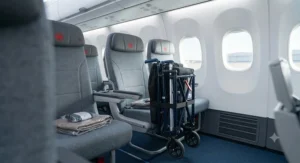
Carex has built its whole brand around home healthcare basics, and the Carex Transport Wheelchair reflects that focus. The 19-inch seat sits on a steel frame with 8-inch rear wheels — larger than many rivals in this weight class, which in practice means a noticeably smoother ride over sidewalk cracks and threshold bumps than the smaller-wheeled competitors. What most buyers overlook about this model is that the bigger wheels add a few pounds versus the ultra-minimalist options, but that weight buys stability that caregivers pushing on uneven terrain will actually feel. Aggregated review sentiment repeatedly highlights the swing-away footrests as a genuine convenience during transfers, with some reviewers flagging the armrests as narrower than expected for larger users.
This chair is squarely built for the caregiver use case rather than solo travel: picture bringing a parent home from a hospital stay, or pushing a spouse through a shopping mall. The steel frame trades a little portability for durability, which matters if the chair will see regular, not occasional, use.
Pros:
- ✅ Larger 8-inch wheels smooth out bumps
- ✅ Swing-away footrests speed up transfers
- ✅ Trusted home-healthcare brand, easy parts sourcing
Cons:
- ❌ Heavier than the ultralight transport options
- ❌ Armrests run narrow for bigger frames
Price range: around C$190-C$260. Reviewers consistently frame it as good value for households needing a dependable everyday transport wheelchair for frequent travelers, not just occasional flyers.
3. Vive Health Lightweight Folding Transport Wheelchair — best no-assembly option
Vive Health has quietly become a go-to name in home mobility gear, and their Vive Health Lightweight Folding Transport Wheelchair leans into one specific selling point: it arrives pre-assembled, with footrests that click on tool-free. That sounds minor until you’re the person standing in a driveway with an Allen key and an instruction sheet in the wrong language. The aluminum frame keeps total weight close to 19 lbs, and the backrest and handles fold down independently from the seat fold, which — based on the spec comparison — gives it a flatter storage profile than chairs that only fold side-to-side. Reviewers consistently mention the quick-release seat belt and breathable backrest fabric as small details that add up over a long travel day; a recurring complaint is that the padded armrests are fixed rather than flip-back, which limits how close it can pull up to a table.
This is a strong pick for travellers who want a chair to be functional the moment the box opens — no tools, no guesswork — which matters if the chair is being ordered right before a trip rather than tested at home first.
Pros:
- ✅ Arrives ready, no tools needed
- ✅ Independent backrest fold for flatter storage
- ✅ Locking hand brakes for extra security
Cons:
- ❌ Fixed armrests limit desk/table access
- ❌ Backrest padding feels thin on long rides
Price range: around C$210-C$280. A solid travel-ready wheelchair for someone who wants zero setup friction.
4. Vive Ultra-Lightweight Transport Wheelchair — best compact fit for smaller frames
Most transport chairs are sized for an average adult and hope everyone else adapts. The Vive Ultra-Lightweight Transport Wheelchair flips that script, purpose-built for users roughly 4’10” to 5’7″ tall, with a narrower overall frame that’s genuinely easier to steer through airport jet bridges and hotel bathroom doorways than the standard-width alternatives. At roughly 23 lbs, it isn’t the single lightest chair in this roundup, but the narrower build means less lateral bulk to wrestle around corners — a distinction spec sheets rarely explain but frequent flyers notice immediately. Reviewers consistently praise the fit for petite adults who felt swallowed by standard 19-inch-seat chairs, while a fair number note that larger users should skip this model entirely; it’s simply not built for them.
Who it’s for: smaller-framed adults and seniors who’ve found standard transport chairs too wide, plus caregivers managing a petite family member through tight indoor spaces like cruise-ship corridors.
Pros:
- ✅ Narrower frame clears tight doorways easily
- ✅ Genuinely lightweight at roughly 23 lbs
- ✅ No-assembly setup out of the box
Cons:
- ❌ Not suited to larger or taller users
- ❌ Smaller seat limits long-haul comfort
Price range: around C$230-C$300. If you’ve been searching for a compact travel wheelchair Amazon.ca shoppers actually rate well for narrow-frame fit, this is the one to shortlist.
5. Karman Healthcare LT-980 — best self-propelling ultralight
Every chair above this point in the list is attendant-propelled — someone else does the pushing. The Karman Healthcare LT-980 changes that equation entirely. At roughly 24 lbs (the frame itself is closer to 13 lbs, with large 22-inch push-rim wheels adding the rest), it’s built for the user to propel themselves, which is a fundamentally different value proposition than a transport chair. The spec sheet won’t tell you this, but user reports suggest the tower-style frame construction distributes weight in a way that keeps the chair tracking straight even when self-propelled one-handed — a common complaint with cheaper self-propel frames is that they drift. Reviewers consistently flag the folding backrest as a genuine space-saver for car trunks, with some noting the padding is basic compared to rehab-grade chairs costing three times as much.
This is the pick for someone who values independence over minimal weight — a traveller who wants to wheel themselves through an airport rather than rely on a pusher, without paying rehab-clinic prices for a custom ultralight frame.
Pros:
- ✅ True self-propulsion, not attendant-only
- ✅ Folding backrest saves extra trunk space
- ✅ Frame weight competitive with rehab-tier chairs
Cons:
- ❌ Costs noticeably more than transport chairs
- ❌ Basic upholstery versus premium rehab models
Price range: around C$500-C$650, reflecting the added engineering in self-propel wheels and axle hardware. For anyone typing packable mobility aid into a search bar because they specifically want to travel independently, this is the strongest match in the lineup.
6. Drive Medical Blue Streak — best value with elevating leg rests
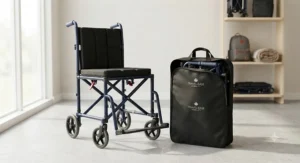
Drive Medical is one of the oldest names in home mobility equipment, and the Drive Medical Blue Streak shows what that institutional experience buys you: a steel-framed, self-propelling wheelchair with flip-back desk arms, swing-away footrests, and an elevating leg rest option — features usually reserved for pricier chairs. At around 41 lbs, this is the heaviest chair in our lineup, and it’s worth being honest about that upfront: it’s less a grab-and-go travel chair and more a durable everyday wheelchair that happens to fold down for car trunks and occasional trips. Based on the spec comparison, the trade-off is straightforward — you’re giving up several pounds of portability in exchange for large 24-inch rear wheels that self-propel more naturally than the smaller-wheeled ultralights, plus armrests that flip back for closer table access. Aggregated reviews consistently describe it as “a lot of chair for the price,” with a recurring complaint that the extra weight is noticeable when lifting it into a trunk solo.
Best suited to travellers who need a wheelchair for the whole trip — hotel room, restaurant, sightseeing — not just gate-to-gate transport, and who have help lifting it when the car is involved.
Pros:
- ✅ Elevating leg rests aid circulation on trips
- ✅ Flip-back arms allow closer table access
- ✅ Large wheels self-propel more smoothly
Cons:
- ❌ Noticeably heavier to lift into a trunk
- ❌ Bulkier folded size than ultralights
Price range: around C$210-C$280. A strong pick when comfort and self-propulsion matter more than minimizing every last pound.
7. Pride Mobility Jazzy Ultra Light Folding Travel Power Chair — best premium power option
For travellers who can’t self-propel a manual chair — whether due to arm strength, endurance, or a progressive condition — the calculus changes completely, and that’s where the Pride Mobility Jazzy Ultra Light Folding Travel Power Chair comes in. Pride Mobility is a long-established name in power mobility, and this model is specifically engineered around airline travel: it uses a 10Ah lithium battery sized to meet the FAA’s watt-hour limits for carry-on batteries, which matters because most standard power wheelchair batteries are far too large to fly with. What most buyers overlook about power travel chairs generally is that “foldable” and “airline-approved” are two separate claims — a chair can fold compactly and still carry a battery too large to bring on a plane. This model addresses both. With a stated 300-lb weight capacity and a top speed around 3.69 mph, it’s built for moderate distances — think airport terminals and hotel hallways, not cross-country trail use. Reviewers consistently highlight how much less physically taxing travel becomes once pushing is no longer required, while a recurring theme in feedback is that the folded chair, while lighter than most power chairs, is still noticeably heavier than any manual option here.
Who should buy this: travellers with limited arm strength or stamina who need genuine motorized mobility, and specifically need a battery that clears airline security screening without special arrangements.
Pros:
- ✅ Airline-approved lithium battery included
- ✅ Genuine motorized mobility, not attendant-dependent
- ✅ Folds far more compactly than typical power chairs
Cons:
- ❌ Significant price jump over manual options
- ❌ Heavier than any manual chair in this list
Price range: around C$2,600-C$3,400 at the time of research — always confirm current pricing and any available financing before buying, since power mobility equipment pricing shifts with component costs. For a genuinely capable on-the-go transport chair that removes the physical strain of self-propulsion, this is the category leader.
Top 7 Products: Full Comparison
| Product | Frame Type | Propulsion | Fold Style | Best For |
|---|---|---|---|---|
| Medline Ultra Lightweight Transport Wheelchair | Aluminum | Attendant | Compact side-fold | Minimum-weight travel |
| Carex Transport Wheelchair | Steel | Attendant | Standard side-fold | Caregiver everyday use |
| Vive Health Lightweight Folding Transport Wheelchair | Aluminum | Attendant | Independent backrest fold | No-assembly travel |
| Vive Ultra-Lightweight Transport Wheelchair | Aluminum | Attendant | Compact side-fold | Smaller/narrower users |
| Karman Healthcare LT-980 | Aluminum | Self-propel | Folding backrest + frame | Independent wheeling |
| Drive Medical Blue Streak | Steel | Self-propel | Standard side-fold | Full-day comfort use |
| Pride Mobility Jazzy Ultra Light Folding Travel Power Chair | Aluminum | Motorized | Compact power-chair fold | Motorized independence |
Looking at the table above, the split between attendant-propelled and self-propelling chairs is really the first decision point, and it matters more than any individual spec. If you or the traveller can physically wheel yourself, the Karman Healthcare LT-980 delivers that independence at a fraction of the Pride Mobility Jazzy‘s cost, but if arm strength or stamina rules out self-propulsion, the extra spend on a power chair buys back genuine freedom of movement. Budget-focused buyers should note that the four attendant-propelled transport chairs cluster tightly in both weight and price, so the deciding factor there usually comes down to seat width and assembly convenience rather than raw capability.
✨ Don’t Miss These Exclusive Deals!
🔍 Take your travel prep to the next level with these carefully selected mobility aids. Click on any highlighted item to check current pricing and availability. These picks will help you create genuinely smoother, more independent trips for you or someone you love!
Benefits vs. Traditional Full-Size Wheelchairs
| Factor | Portable/Transport Wheelchairs | Traditional Full-Size Wheelchairs |
|---|---|---|
| Typical weight | 18-25 lbs (manual models) | 35-55+ lbs |
| Car trunk fit | Fits most sedans easily | Often needs an SUV or van |
| Self-propulsion | Limited (some models only) | Standard on most models |
| Daily-use durability | Moderate | High |
| Air travel handling | Easier to check/gate-check | Bulkier, more handling risk |
| Best for | Trips, appointments, occasional use | Full-time daily mobility |
The core trade-off here is durability versus portability, and neither option is objectively “better” — it depends entirely on how often the chair leaves the house. Reviewers who’ve owned both types consistently note that a transport chair used as a daily driver tends to show wear (frame flex, worn upholstery) much faster than a full-size wheelchair built for constant use. On the other hand, hauling a 45-lb full-size wheelchair through airport security for a once-a-year trip is its own kind of misery that a sub-25-lb transport chair simply eliminates.
Practical Usage Guide: Getting Your Travel Wheelchair Trip-Ready
The first 30 days with a new travel wheelchair set the tone for every trip after. Start by practising the fold and unfold motion at home, ideally five or six times, before the actual travel day — airport gate agents move fast, and fumbling with an unfamiliar latch under time pressure is avoidable stress. Check the tire pressure or wheel condition (for pneumatic models) a few days before departure, since underinflated wheels drag noticeably on carpet and increase the effort needed to push. If the chair has a seat belt or lap strap, test the buckle mechanism with the actual traveller seated, not just on an empty chair — some belts feel different under load.
A common first-30-days mistake is skipping the manufacturer’s weight-capacity fine print. That capacity typically includes the occupant only, not bags balanced on the lap or hung from the handles, and exceeding it stresses the frame welds in ways that aren’t visible until something fails. For maintenance, wipe down the frame after any trip involving salt (winter roads, ocean air) since corrosion on hinges and folding joints is the single most common cause of a packable mobility aid becoming stiff to fold within a year. Finally, keep the original box or a padded travel bag if flying — checked wheelchairs handled by baggage crews fare far better with even minimal protective padding around the wheels and folding hinges.
Real-World Scenario: Which Traveller Are You?
The weekend visitor: Sarah flies twice a year to see her father, who uses a wheelchair only for the terminal-to-gate walk and the occasional shopping trip during her visit. For this profile — infrequent use, someone else pushing, minimum storage space at home between trips — a sub-20-lb attendant-propelled chair like the Medline Ultra Lightweight Transport Wheelchair is close to ideal. It’s light enough that Sarah can lift it into an overhead bin herself if needed, and it doesn’t demand a dedicated storage closet.
The daily caregiver: Marcus pushes his wife to physiotherapy three times a week and takes her on regular outings around the city, in addition to occasional travel. Durability matters more here than absolute minimum weight, which points toward something like the Carex Transport Wheelchair or the Drive Medical Blue Streak — both built to handle repeated daily folding and unfolding without the hinges loosening prematurely.
The independent flyer: Priya has full upper-body strength and wants to wheel herself through the airport without relying on anyone else. For her, the attendant-propelled chairs are the wrong category entirely, regardless of weight — she needs the self-propel wheels on the Karman Healthcare LT-980, or if stamina is a limiting factor over long distances, the motorized independence of the Pride Mobility Jazzy Ultra Light.
Problem → Solution Guide
Problem: The chair won’t fit in my trunk. Measure the folded dimensions before buying, not after — most listings include folded width and length, and a compact sedan trunk (roughly 13-15 inches wide at the opening) rules out bulkier steel-frame chairs like the Drive Medical Blue Streak unless the trunk is unusually deep.
Problem: My arms get tired pushing myself long distances. This is a strong signal to consider the Pride Mobility Jazzy Ultra Light Folding Travel Power Chair rather than pushing through discomfort on a manual self-propel chair — fatigue-driven overexertion is a common but avoidable issue.
Problem: The chair feels unstable on uneven sidewalks. Larger rear wheels (8 inches or more, as on the Carex Transport Wheelchair) absorb bumps far better than the smaller 5- to 6-inch wheels found on some ultralight models — this is a direct trade-off between minimum weight and ride comfort.
Problem: Assembly instructions are confusing or missing parts. Choose a pre-assembled model specifically, like the Vive Health Lightweight Folding Transport Wheelchair, which arrives ready to use with tool-free footrest attachment.
Problem: The battery on a power chair got flagged at airport security. Always carry the battery’s watt-hour rating documentation; airline-approved lithium batteries under the FAA/IATA limit, like the one included with the Pride Mobility Jazzy Ultra Light, generally clear screening without issue when the paperwork is on hand.
How to Choose a Portable Wheelchair for Travel
What is a portable wheelchair for travel? It’s a folding manual or power wheelchair engineered specifically for light weight, compact storage, and quick setup — typically under 25 lbs for manual models — built to move easily through airports, cars, and hotels rather than serve as an all-day, everyday mobility device.
- Confirm who’s propelling it. Attendant-pushed and self-propelling chairs are built differently; this decision should come before you compare a single spec.
- Weigh the folded dimensions against your actual trunk or closet space. A chair that’s technically light but folds bulky can still be a hassle.
- Check the seat width against the traveller’s body, not the average adult. Narrower frames like the Vive Ultra-Lightweight Transport Wheelchair exist precisely because standard sizing doesn’t fit everyone.
- Factor in trip frequency. Occasional trips favour minimum weight; frequent or daily use favours the added durability of a steel frame.
- Verify battery rules early if considering a power chair. Airline lithium battery limits can eliminate options before you’ve even compared features.
- Read aggregated review themes, not star ratings alone. A 4.5-star average can still hide a recurring complaint (thin padding, narrow armrests) that matters specifically to your use case.
- Price the whole trip, not just the chair. Some airlines and provinces offer accessibility support that changes the real cost comparison between manual and power options.
Common Mistakes When Buying a Travel Wheelchair
The single most common mistake is buying based on weight alone. A chair that’s two pounds lighter but has a stiffer, harder-to-operate fold mechanism often ends up being more frustrating in real use than a slightly heavier chair with a smooth one-motion fold. Another frequent misstep is skipping the seat width check — a 19-inch seat feels roomy for some travellers and genuinely uncomfortable for others, and returns due to fit issues are common in aggregated review data. Buyers also regularly underestimate how much armrest style matters: fixed armrests block table and desk access in a way that’s easy to overlook when scanning specs but becomes a daily annoyance. Finally, many people wait until the week before a trip to test the fold mechanism, discovering assembly issues under time pressure rather than at home with no deadline looming.
Portable Wheelchair vs. Mobility Scooter for Travel
A folding portable wheelchair and a travel mobility scooter solve overlapping but distinct problems. Scooters generally offer longer range and higher top speeds, making them better suited to covering large outdoor distances — a theme park, a large mall, a cruise ship deck. Portable wheelchairs, by contrast, tend to be better in tight indoor spaces: narrower turning radius, easier to navigate through standard doorways, and typically easier to fold flat for a car trunk without disassembling a tiller column. Scooters also usually require the rider to transfer from a standing or seated position onto a saddle-style seat, which isn’t practical for everyone, while a wheelchair supports direct transfer from another seated position. For most air travel specifically, wheelchairs — whether manual or the compact power style like the Pride Mobility Jazzy Ultra Light — tend to clear airline size and battery rules more predictably than three- or four-wheel scooters, which are often bulkier to break down for cargo hold storage.
What to Expect: Real-World Performance on Trips
Specs on a page rarely capture what a chair actually feels like at 6 a.m. in a crowded terminal. In practice, the lighter attendant-propelled chairs in this lineup — the Medline Ultra Lightweight Transport Wheelchair and the Vive Ultra-Lightweight Transport Wheelchair — genuinely do feel dramatically easier to lift and manoeuvre than anything approaching 40 lbs, but that same lightness means less cushioning against jolts on rough pavement or cobblestone streets. The Drive Medical Blue Streak‘s larger wheels roll noticeably smoother over uneven ground, a difference riders feel immediately even if they couldn’t have predicted it from the spec sheet alone. For the Karman Healthcare LT-980, self-propelling users report that the learning curve for one-handed steering (common when one arm is managing a bag) is real but manageable within the first day or two of use. And for power chair users, the Pride Mobility Jazzy Ultra Light‘s modest top speed of roughly 3.69 mph is genuinely well-matched to indoor pedestrian traffic — it won’t outrun anyone, but it also won’t feel jarringly fast in a crowded hallway.
Features That Actually Matter (And Those That Don’t)
Marketing copy loves to highlight seat colour options and cosmetic details that have zero bearing on how a chair performs on a trip. What actually matters: folded width (does it clear your trunk or a standard doorway), wheel size (bigger wheels roll smoother over rough terrain), armrest style (flip-back versus fixed changes table and transfer access), and — for power chairs specifically — documented battery watt-hours for airline compliance. What matters far less than marketing suggests: frame colour, cosmetic trim, and headline weight figures measured without the seat cushion or footrests attached, since real-world “ready to use” weight is often a few pounds heavier than the number on the box.
Safety, Airline Rules & Regulations Guide for Canada
Travelling with a mobility aid in Canada comes with specific protections worth knowing before you book. Under Canadian Transportation Agency rules, large airlines operating in Canada generally must transport a passenger’s mobility aid as long as the airline receives advance notice, and airlines are expected to make reasonable efforts to store manual folding wheelchairs in the cabin when space allows, rather than automatically routing them to cargo. If your mobility aid does need to be transported in the cargo hold, be ready to share its weight, folded dimensions, and — for power chairs — battery details in advance, since crews may need disassembly instructions for larger equipment. These aren’t hypothetical protections: in 2025, the CTA fined Air Canada $97,500 after a passenger using a wheelchair was left without proper boarding assistance, underscoring that these rules carry real enforcement weight. For battery-powered chairs like the Pride Mobility Jazzy Ultra Light, always confirm your airline’s advance-notice window, typically 48 hours, and carry printed battery specifications, since lithium battery documentation is one of the most common friction points at check-in.
Portable Wheelchairs for Caregivers and Frequent Flyers
Mobility device ownership in Canada is more common than many people realize — a national survey found an estimated 197,950 Canadians use a manual wheelchair, alongside tens of thousands using power wheelchairs, and demand for a reliable portable wheelchair caregiver travel solution only grows as that population ages. For caregivers managing transport on a near-daily basis — medical appointments, errands, family outings — durability and ease of loading into a vehicle matter more than shaving off the last pound or two, which is exactly where the Carex Transport Wheelchair and Drive Medical Blue Streak earn their keep. For frequent flyers who travel for work or regularly visit family across the country, minimizing checked-baggage handling risk becomes the priority; a chair that folds fast and travels light, like the Medline Ultra Lightweight Transport Wheelchair or the Vive Health Lightweight Folding Transport Wheelchair, reduces both physical strain and the odds of damage during transit. Both groups benefit from keeping a laminated card with the chair’s folded dimensions and weight in the storage bag — a small habit that speeds up check-in conversations considerably.
Long-Term Cost & Maintenance
A C$220 transport chair and a C$3,000 power chair aren’t really competing products, but it’s worth running the actual math on total cost of ownership rather than sticker price alone. Manual transport chairs have almost no ongoing costs beyond the occasional wheel or tire replacement, typically under C$30 a part, and a well-maintained aluminum frame can last five-plus years of occasional use. Power chairs carry real ongoing costs: replacement lithium batteries for travel-rated power chairs often run several hundred dollars every few years as capacity degrades, plus the higher upfront investment. Where the math shifts in the power chair’s favour is physical cost — reduced strain injuries, fewer missed activities due to fatigue — which doesn’t show up on a receipt but matters just as much for someone weighing daily quality of life against a five-year budget.
Buyer’s Decision Framework
If you travel once or twice a year and someone else will push, choose a sub-20-lb attendant-propelled transport chair because minimum weight and simple storage matter most. If you’re a caregiver managing daily or weekly outings, choose a steel-frame transport chair with larger wheels because durability outlasts the marginal weight savings. If you have full upper-body strength and want independence, choose a self-propelling ultralight because attendant-only chairs will frustrate you within the first outing. If arm strength or stamina limits self-propulsion, choose a compact, airline-approved power chair because pushing through fatigue isn’t a sustainable long-term solution. If you or the traveller are notably smaller-framed, prioritize a narrow-seat model over a standard 19-inch chair, since fit issues are one of the most common sources of buyer’s remorse in this category.

Frequently Asked Questions
❓ What is the lightest portable wheelchair for travel?
❓ Can I bring a folding wheelchair on a plane for free in Canada?
❓ Do power wheelchairs need special batteries to fly?
❓ What's the difference between a transport wheelchair and a self-propelling wheelchair?
❓ How much does a good travel wheelchair cost in Canada?
Conclusion
There’s no single “best” portable wheelchair for travel — there’s only the best match for who’s doing the pushing, how often the chair leaves the house, and how much bulk your trunk or closet can realistically absorb. For most occasional travellers, a sub-20-lb attendant-propelled chair like the Medline Ultra Lightweight Transport Wheelchair covers the basics without overcomplicating the decision. Caregivers managing regular outings will get more mileage — literally and figuratively — from the added durability of the Carex Transport Wheelchair or Drive Medical Blue Streak. Independent self-propellers should look straight past the transport chairs to the Karman Healthcare LT-980, and travellers who need motorized assistance have a genuinely capable, airline-compliant option in the Pride Mobility Jazzy Ultra Light Folding Travel Power Chair. Whichever direction you land on, the framework matters more than any single spec: confirm who’s propelling it, measure your actual storage space, and read the aggregated review themes — not just the star rating — before you buy.
Recommended for You
- Lightest Transport Wheelchair: 7 Best Sub-15lb Picks (2026)
- How to Fly With a Wheelchair: 7 Smart Picks for 2026
- Airline Approved Wheelchair: 7 Best Picks for Flying in 2026
Disclaimer: This article contains affiliate links. As an Amazon Associate, I earn from qualifying purchases. If you purchase products through these links, we may earn a small commission at no additional cost to you.
✨ Found this helpful? Share it with your friends! 💬🤗
