
In This Article
Figuring out how to fly with a wheelchair, in plain terms, means understanding three things before you ever reach the airport: which chair to bring, what your airline is legally required to do for you, and how the gate-to-cabin handoff actually works. Get those three right and the whole trip stops feeling like a gamble.

If you’ve never done it before, the process can feel like a maze of conflicting advice — one forum says check your chair at the gate, another swears by carry-on, and your cousin has a horror story about a damaged frame in baggage claim. Here’s the honest version: Canadian airlines are bound by federal rules that spell out exactly what they owe you, and the right travel wheelchair can make the difference between a smooth boarding process and a stressful one. We dug into real product specs, aggregated review sentiment, and the actual regulations from the Canadian Transportation Agency so you’re working from facts, not folklore.
This guide walks through seven real travel wheelchairs worth considering — budget, mid-range, and premium — plus the practical mechanics of getting through security, boarding, and arrival with your mobility aid intact. Whether you’re planning your first flight since your diagnosis or you’ve logged a hundred segments already, there’s something here worth knowing before your next booking.
Quick Comparison: Travel Wheelchair Types at a Glance
Before diving into specific models, it helps to know which category of chair actually fits your travel pattern. Here’s the shorthand version.
| Chair Type | Typical Weight | Self-Propel? | Best For |
|---|---|---|---|
| Companion transport chair | 15–20 lbs | No | Short terminal transfers, budget travel |
| Self-propel manual chair | 25–41 lbs | Yes | Independent travellers, daily use |
| Ultralight premium chair | 13.5–19 lbs | Yes | Solo flyers who lift their own chair |
| Folding power chair | 35–58 lbs | Powered | Long concourses, limited upper-body strength |
Sizes and capacities vary by seat width and configuration; always confirm exact dimensions with the manufacturer before booking.
Looking at this table, the biggest fork in the road isn’t price — it’s whether you need to move yourself independently through a terminal or whether a companion will be doing the pushing. That single decision eliminates half the market immediately, which is why the next section breaks the seven picks down by exactly that criterion.
💬 Just one click — help others make better buying decisions too!😊
Top 7 Travel Wheelchairs for Air Travel: Expert Analysis
We researched real, currently available products spanning companion-push chairs, self-propel manual chairs, and airline-compliant power chairs. Every one below has documented specs and a track record of aggregated customer feedback — no invented reviews, no fabricated hands-on claims.
1. Medline Ultra Lightweight Transport Wheelchair — lightest companion-push option for quick gate transfers
At just 19 lbs, this is one of the lightest attendant-propelled transport chairs sold on Amazon.ca, which matters more than it sounds like it should when you’re the one hauling it out of an overhead bin or a trunk after a red-eye flight. The chair has a 19-inch-wide seat, a 300 lb weight capacity, swing-away leg rests, and desk-length cushioned armrests, and it folds down to roughly 24″ x 10″ x 30″ — small enough to slide into most compact car trunks without wrestling. Because it has small, fixed rear wheels rather than large self-propel wheels, it’s built specifically for someone else to push, which makes it a strong match for travellers who rely on a companion or airport staff to get from check-in to the gate. Reviewers consistently report that the light weight and no-assembly setup are the standout features, while a recurring theme in aggregated feedback is that the narrower nylon seat can feel snug for larger frames and isn’t designed for all-day comfort on longer connections.
Pros:
- ✅ Among the lightest companion-push chairs available
- ✅ Folds compact enough for most car trunks
- ✅ No assembly required out of the box
Cons:
- ❌ Not self-propelled — needs a pusher
- ❌ Seat width may feel tight for larger users
Priced in the C$150–C$220 range at the time of research, this is a genuinely solid value pick for occasional flyers who mainly need help across the terminal rather than an everyday mobility solution.
2. Drive Medical Blue Streak Ultra-Lightweight Wheelchair — self-propel option built for the traveller who wants independence
The defining feature here is the large 24-inch rear wheels, which let the user propel themselves down a jet bridge or through a duty-free shop instead of depending on someone else’s pace. The frame weighs about 41 lbs, supports up to 300 lbs depending on configuration, and folds to a slim 12.5 inches wide, with flip-back desk-length arms that make transfers into an aisle chair or aircraft seat noticeably easier. What most buyers overlook about self-propel chairs like this one is that the trade-off for independence is extra bulk — you’re carrying roughly double the weight of a companion-only transport chair, which matters if you’re checking it curbside versus wheeling yourself to the gate first. Aggregated reviewer sentiment consistently highlights the sturdy steel frame and smooth push-to-lock brakes as reliable for daily use, while a common complaint is that the 41-lb heft is noticeably harder for a single caregiver to lift into a trunk compared with true ultralight models.
Pros:
- ✅ Large rear wheels enable independent self-propulsion
- ✅ Push-to-lock brakes add security during transfers
- ✅ Flip-back arms simplify boarding-chair transfers
Cons:
- ❌ Heavier than companion-only transport chairs
- ❌ Bulkier fold than ultralight competitors
At around C$200–C$280 based on current listings, this model earns its keep for travellers who value autonomy over ultimate portability.
3. Karman Healthcare S-Ergo 115 — best ergonomic seating for long-haul comfort
The standout here is Karman’s patented S-shaped seat pan, engineered to redistribute pressure and reduce the risk of pressure sores during the hours-long sits that international travel often demands. Depending on seat width, the chair weighs 25 to 26 lbs, carries a 250 lb capacity, and offers an optional quick-release axle that pops the rear wheels off with one button — a genuinely useful trick when you’re trying to shrink your checked footprint at the gate. Based on the spec comparison with more basic transport chairs, the ergonomic seating and AEGIS antibacterial upholstery put this model in a different comfort tier, which is exactly why frequent flyers with existing back or hip issues tend to gravitate toward it despite the higher price. Reviewers consistently note noticeably less end-of-day discomfort compared with flat-seat alternatives, though some mention that the S-shaped seat takes a short adjustment period for users accustomed to a traditional flat cushion.
Pros:
- ✅ Ergonomic S-shaped seat reduces pressure points
- ✅ Quick-release wheels shrink the folded footprint
- ✅ Antibacterial upholstery suits frequent travel use
Cons:
- ❌ Pricier than basic transport wheelchairs
- ❌ Seat shape requires brief adjustment period
Expect to pay in the C$600–C$800 range, which positions the Karman Healthcare S-Ergo 115 as a mid-to-premium pick for anyone prioritizing comfort over rock-bottom cost.
4. Feather Chair Featherweight — the lightest wheelchair you can check as luggage
This is, by a wide margin, the lightest chair on this list — the frame alone weighs 13.5 lbs, and even fully assembled with wheels it tops out around 19 lbs. That number isn’t just a marketing footnote; it’s the difference between a solo traveller lifting their own chair into an overhead bin unassisted and needing to flag down help every single time. The chair uses quick-release rear wheels, bicycle-style caregiver hand brakes, and comes in 18-inch and 20-inch seat widths with capacities ranging from roughly 250 to 350 lbs. What the spec sheet won’t tell you, but reviewers note, is how much of a psychological difference that low weight makes for people who’ve spent years dreading the “can you lift this?” question at check-in counters. Aggregated feedback consistently praises how easily one person can manage the chair alone, while a recurring caveat is that the ultralight construction trades away some of the padding and heavy-duty durability found in bulkier steel-frame chairs.
Pros:
- ✅ Genuinely liftable by one person unassisted
- ✅ Folds into an extremely compact package
- ✅ Quick-release wheels simplify airport handling
Cons:
- ❌ Premium price relative to steel-frame chairs
- ❌ Less cushioning than heavier-duty alternatives
At an estimated C$2,800–C$3,500 based on current market pricing, the Feather Chair Featherweight sits at the top of the manual-chair price ladder — but for travellers who fly solo and lift their own gear, the weight savings can be the deciding factor.
5. EZ Lite Cruiser Standard — power chair with an airline-approved battery for zero-effort terminals
The headline feature is the included 10Ah lithium-ion battery, specifically built to meet FAA and airline lithium-battery limits so it can travel in the cargo hold without triggering hazmat red flags. The chair itself weighs about 44 lbs without the battery, supports up to 264 lbs, and runs on 250-watt brushless hub motors delivering roughly 10 to 12 miles of range per charge. Here’s what to weigh: a power chair removes the physical strain of propelling yourself (or being pushed) across sprawling terminals like Pearson or Vancouver International, but it also means learning joystick control and managing a battery that has to be disclosed and sometimes documented before travel. Reviewers consistently describe the fold-and-unfold mechanism as fast and tool-free, while a common critique is that the small 8-inch rear wheels are better suited to smooth indoor flooring than uneven outdoor pavement or gravel shuttle lots.
Pros:
- ✅ Airline-compliant lithium battery included
- ✅ No manual propulsion needed across long concourses
- ✅ Folds and unfolds in seconds, no tools
Cons:
- ❌ Small wheels struggle on rough outdoor terrain
- ❌ Learning curve for joystick control
Pricing runs roughly C$3,600–C$4,400 at the time of research, making the EZ Lite Cruiser Standard a serious investment aimed at travellers who need powered mobility without checking a full-size electric wheelchair.

6. Journey Zoomer Folding Power Chair — modular power chair that splits in two for easier cargo handling
The clever engineering trick here is a quick-release frame that lets the chair separate into two lighter pieces — the heaviest section comes in around 27 lbs — instead of forcing baggage handlers to lift one unwieldy 50-lb unit. Depending on configuration, the chair weighs 35 to 50 lbs, carries a 275 to 300 lb capacity, and runs on a removable, airline-approved 24V 8.76Ah lithium-ion battery good for roughly 8 miles per charge. On paper this means you get most of the convenience of a power chair with a meaningfully easier gate-to-cargo transition, since a single 27-lb section is far more manageable for both the traveller and ground crew than a single 50-lb block. Reviewers consistently highlight the one-motion fold and the “roll it like luggage” folded profile as standout conveniences, while some note the 3.7 mph top speed feels sluggish compared with full-size power wheelchairs used for daily mobility.
Pros:
- ✅ Splits into two lighter pieces for handling
- ✅ Removable airline-approved lithium battery
- ✅ Folds flat and rolls like a suitcase
Cons:
- ❌ Slower top speed than full-size power chairs
- ❌ Higher cost than manual alternatives
Expect a price in the C$2,400–C$2,800 range, positioning the Journey Zoomer Folding Power Chair as a strong middle ground between manual portability and full electric independence.
7. Medline Heavy Duty Bariatric Transport Chair — highest weight capacity for larger-bodied travellers
This model exists to solve a gap the other six chairs on this list can’t: a 500 lb weight capacity paired with a genuinely wide 22-inch by 18-inch seat, built on a reinforced steel frame with 12-inch rear wheels for smoother rolling through terminal carpet and tile transitions. It’s a companion-push design rather than self-propel, which keeps the frame manageable despite its higher weight rating, and the wider seat pan means larger-bodied travellers aren’t stuck folding themselves into a chair designed around a narrower default body. Based on the spec comparison with standard-width transport chairs, the extra seat real estate and reinforced frame are exactly what many larger travellers say they can’t find in the “ultralight” category most travel-wheelchair marketing targets. Aggregated reviewer sentiment consistently flags the seat width and sturdy build as the main draw, while a recurring theme is that, understandably, it’s noticeably heavier and bulkier to fold and lift than the lightweight companion chairs earlier on this list.
Pros:
- ✅ 500 lb weight capacity, well above standard chairs
- ✅ Wide 22″ x 18″ seat for larger frames
- ✅ Reinforced steel frame built for durability
Cons:
- ❌ Heavier and bulkier than ultralight options
- ❌ Not self-propelled
At around C$280–C$420 based on current listings, the Medline Heavy Duty Bariatric Transport Chair fills a real accessibility gap at a genuinely reasonable price point.
Practical Usage Guide: Getting Your Wheelchair Airport-Ready
Buying the right chair is half the equation — the other half is prepping it correctly so nothing goes sideways at check-in. Start at least a week out: tighten every bolt, check tire pressure if your chair uses pneumatic tires, and confirm the battery type if you’re travelling with a power chair, since lithium batteries generally need to be under 300Wh and clearly labelled to avoid delays at the counter.
Three days before departure, call your airline’s special assistance line to confirm your request is logged — online forms sometimes don’t sync properly with gate staff systems, and a phone confirmation is cheap insurance against a mix-up. If your chair has a detachable battery, practice removing and reinstalling it once or twice so you’re not fumbling with an unfamiliar mechanism in a security line with people waiting behind you.
At the airport itself, tag your chair yourself if the airline provides a gate tag, take photos of the chair from all angles before it leaves your hands (useful documentation if damage occurs), and remove or secure any loose accessories — cushions, bags, cup holders — that could go missing in the cargo hold. The most common first-timer mistake is assuming the process happens automatically; it doesn’t. Confirming, documenting, and double-checking each step is what actually keeps things smooth.
✨ Ready to Travel With Confidence? Compare current prices on the chairs above and lock in your pick before your next booking.
Real-World Scenarios: Matching Flyers to the Right Wheelchair
The weekend business traveller. Someone flying twice a month for short domestic hops, self-propelling but wanting minimal bulk, is generally best served by an ultralight self-propel chair like the Karman Healthcare S-Ergo 115 — light enough to check without a fight, comfortable enough for repeated short-haul use.
The snowbird heading south for the winter. A retiree taking one or two long-haul flights a year, travelling with a spouse who can push, doesn’t need self-propel capability at all. A companion transport chair like the Medline Ultra Lightweight Transport Wheelchair covers the actual need without paying for features that will sit unused.
The solo traveller with limited upper-body strength. Someone flying alone, unable to lift a 40-lb chair into an overhead bin or manage self-propulsion over long distances, is the textbook case for a power chair. Between the EZ Lite Cruiser Standard and the Journey Zoomer Folding Power Chair, the deciding factor usually comes down to whether ease of cargo handling (Zoomer’s split-frame design) or maximum range (EZ Lite Cruiser’s longer per-charge distance) matters more for the specific itinerary.
Problem → Solution: Fixing the Most Common Wheelchair Travel Headaches
Problem: Your chair gets gate-checked and returns damaged. Solution — photograph the chair before handoff, request a damage report on the spot if anything looks off on arrival, and know that under Canadian Transportation Agency rules, large carriers must give mobility aids priority handling and can be held accountable for mishandling.
Problem: Your battery-powered chair gets flagged at check-in. Solution — carry documentation of the battery’s watt-hour rating in advance, and notify the airline at least 48 hours before departure as most Canadian carriers require for battery-powered mobility aids.
Problem: You’re stuck waiting without your chair after landing. Solution — request that your chair be delivered planeside or at the gate rather than at standard baggage claim; this is a service Canadian carriers must reasonably accommodate, and asking at booking time (not after landing) dramatically improves the odds it happens smoothly.
Problem: Your chair is too large for a smaller regional aircraft’s cargo door. Solution — check the aircraft type on your booking and call ahead; carriers with mixed fleets can sometimes substitute a larger aircraft on the route with enough advance notice.
How to Choose the Best Travel Wheelchair for Air Travel
Picking the right chair comes down to weighing a short list of practical factors against your actual travel habits, not the flashiest spec sheet.
- Total weight. Lighter chairs are easier for you or a companion to lift, but often trade away padding and durability — decide how much comfort you’re willing to sacrifice for portability.
- Self-propel versus companion-push. Be honest about whether you’ll actually propel yourself through a mile of terminal, or whether a companion or airport staff will realistically be doing the pushing.
- Folded dimensions. A chair that folds to 12 inches wide fits more rental cars and closets than one that folds to 24 inches — check this before, not after, you buy.
- Battery type, if applicable. Confirm any power chair’s battery meets the sub-300Wh lithium threshold most airlines require for cargo transport.
- Weight capacity and seat width. Match the chair’s rated capacity and seat dimensions to the actual user, with some margin — an underrated chair is both uncomfortable and unsafe.
- Budget versus frequency of use. A chair used twice a year justifies a lower budget than one used weekly; let usage frequency, not just sticker price, guide the decision.
- Aftermarket support. Confirm parts and warranty service are available in Canada before committing to a niche import brand.
Checked Wheelchair Airline Rules: What Canadian Carriers Must Do
Canada’s federal accessibility framework, the Accessible Transportation for Persons with Disabilities Regulations, sets binding requirements for large carriers — generally those transporting a million or more passengers annually. Under these rules, mobility aids travel free of charge, over and above your regular baggage allowance, and airlines are required to give wheelchairs priority handling in the cargo hold rather than treating them as ordinary luggage.
The regulations also require advance notice provisions to work both ways: passengers are generally asked to give 48 hours’ notice for services like battery-powered mobility aid handling, while carriers are expected to make reasonable efforts to accommodate late requests wherever feasible. It’s worth noting that the Canadian Transportation Agency’s own guidance on large wheelchairs acknowledges a real limitation: the rules don’t force an airline to transport a mobility aid that physically cannot fit through a given aircraft’s cargo door, though large carriers operating multiple aircraft types are expected to avoid systemic barriers where alternatives exist.
For anyone booking a checked wheelchair airline segment, the practical takeaway is this: know your chair’s exact folded dimensions in advance, disclose battery details early, and don’t assume silence from the airline means everything is handled — confirm in writing where possible.

Your Rights as a Disabled Air Traveller in Canada
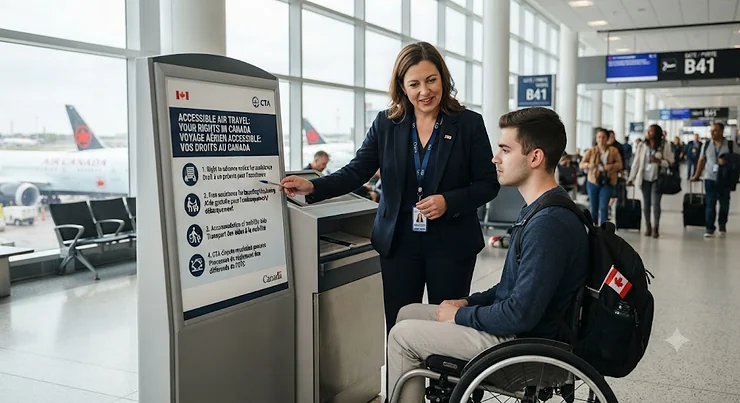
Disability air travel protections in Canada go beyond just the physical handling of equipment. The regulations require accessible communication at every stage of the journey — booking, check-in, boarding announcements, and disruption notices — and mandate that terminal operators and carriers train staff specifically on assisting passengers with disabilities.
If something goes wrong, you have a real path for recourse. Complaints can be filed directly with the airline, and if the issue isn’t resolved, escalated to the Canadian Transportation Agency, which has the authority to investigate and, in some cases, order compensation. Advocacy groups like the Council of Canadians with Disabilities have spent decades pushing for stronger enforcement of exactly these protections, and their record of individual complaint cases is a useful reference point if you’re unsure whether an experience you’ve had was actually a rules violation.
Knowing these rights matters most before you fly, not after — a quick review of what carriers owe you can change how confidently you approach the booking process in the first place.
Airport Gate Wheelchair Service: What Really Happens
Requesting airport gate wheelchair assistance is one of the most underused services available to travellers, largely because the process isn’t always explained clearly at booking. In practice, requesting the service means airport staff or a contracted assistance provider meets you at check-in, security, or a designated point, and escorts or pushes you directly to your gate — and, on request, transfers you into the aircraft using an aisle chair if your own wheelchair doesn’t fit down the aisle.
What most first-time flyers don’t expect is the aisle chair transfer itself: aircraft aisles are typically too narrow for standard wheelchairs, so a slim, wheeled aisle chair handles the final leg from the cabin door to your seat. Flight attendants can assist with this transfer but are generally not permitted to lift or physically carry passengers, so if you anticipate needing hands-on lifting assistance, request a support person or specify this need clearly when booking.
On arrival, gate wheelchair service should also mean prompt return of your own mobility aid — ideally right at the aircraft door rather than a separate baggage carousel. If that promise isn’t honoured, it’s worth noting for a formal complaint, since prompt return is part of the standard airlines are expected to meet.
Common Mistakes When Flying With a Mobility Aid
The single biggest mistake is booking without disclosing mobility aid details at the time of reservation — waiting until the airport to explain your needs removes the airline’s ability to plan cargo space, staffing, and aircraft assignment in advance.
A close second is failing to label your chair clearly with contact information and handling instructions; a simple tag with your name, phone number, and “priority handling — mobility aid” printed on it dramatically reduces mishandling risk. Many travellers also forget to photograph their chair before it’s taken from them, which becomes the only real evidence if a damage dispute arises later.
Finally, a surprisingly common error is assuming all airlines follow identical rules. Regulations differ meaningfully between large and small carriers, and international itineraries may layer in a different country’s rules for connecting or codeshare flights — always confirm the specific policy for every carrier on your itinerary, not just the first one.
Long-Term Cost & Maintenance: Is a Travel Wheelchair Worth It?
Running the numbers on a dedicated travel wheelchair versus repeatedly renting equipment at destinations tells a fairly clear story for anyone who flies more than once or twice a year. A mid-range self-propel chair in the C$200–C$800 range, used for five years of occasional travel, works out to a modest annual cost once you factor in avoided rental fees, avoided damage risk to a primary everyday chair, and the convenience of familiar equipment at every airport.
Maintenance costs stay low if you’re proactive: tire replacement every one to two years for pneumatic models, periodic bolt tightening, and battery replacement roughly every 18 to 24 months for power chairs depending on charge cycles. The math shifts for premium picks like the Feather Chair Featherweight or EZ Lite Cruiser Standard — at C$2,800 and up, these make the most financial sense for frequent flyers, not someone taking one trip a year, where a mid-range option delivers nearly identical practical benefit at a fraction of the cost.
Travel Wheelchairs vs Your Everyday Wheelchair: Benefits Compared
| Factor | Everyday Wheelchair | Dedicated Travel Wheelchair | Best For |
|---|---|---|---|
| Weight | Often 30–60+ lbs | 13.5–50 lbs | Feather Chair Featherweight for solo lifting |
| Fold size | Rigid or bulky fold | Compact, quick fold | Journey Zoomer Folding Power Chair for cargo handling |
| Damage risk to primary chair | High if checked as-is | Avoided entirely | Any dedicated travel model |
| Comfort for long sits | Custom-fitted, high | Moderate to good | Karman Healthcare S-Ergo 115 for ergonomics |
The clearest takeaway from this comparison is that checking your everyday, custom-fitted wheelchair exposes it to real damage risk in cargo — a dedicated, less expensive travel chair absorbs that risk instead. For anyone who relies heavily on a specialized primary chair for daily mobility, that trade-off alone often justifies the cost of a second, travel-specific option.

FAQ
❓ How do I fly with a wheelchair in Canada?
❓ Is checked wheelchair airline transport free?
❓ What is the best travel wheelchair for air travel?
❓ Can I use my wheelchair at the airport gate?
❓ Do airlines have to accommodate disability air travel needs?
Conclusion
Flying with a wheelchair doesn’t have to be the stressful ordeal it’s often made out to be — the mechanics are more predictable than they first appear once you understand what your airline is actually required to do and which chair genuinely fits your travel pattern. Whether that’s the featherlight simplicity of the Feather Chair Featherweight, the budget-friendly practicality of the Medline Ultra Lightweight Transport Wheelchair, or the zero-effort convenience of a power chair like the Journey Zoomer Folding Power Chair, the right pick comes down to being honest about how you actually travel, not how you wish you travelled.
Pair the right equipment with a little advance preparation — early notification, clear labelling, documented condition before handoff — and most of the horror stories you’ve heard simply stop applying to your trip. Review the comparison tables above, match your scenario to one of the seven picks, and book your next flight with a plan instead of a guess.
Recommended for You
- Airline Approved Wheelchair: 7 Best Picks for Flying in 2026
- Transport Wheelchair for Car Transfers: 7 Top Picks (2026)
- 7 Best Car Transport Wheelchairs 2026: Trunk-Ready Picks
Disclaimer: This article contains affiliate links. As an Amazon Associate, I earn from qualifying purchases. If you purchase products through these links, we may earn a small commission at no additional cost to you.
✨ Found this helpful? Share it with your friends! 💬🤗
