
In This Article
An airline approved wheelchair is a manual or foldable transport wheelchair built to meet the weight, folding-dimension, and battery rules that airlines and security agencies enforce for cabin and cargo transport. If you’ve ever stood at a check-in counter watching a gate agent measure your mobility aid with a tape measure, you already know why that definition matters. Flying with a wheelchair shouldn’t feel like a science exam, but for a lot of Canadians it does — one wrong fold dimension, one battery type nobody warned you about, and suddenly you’re rebooking a connection.
Here’s the thing nobody tells you at the store: “airline approved” isn’t a stamp any manufacturer slaps on a box. It’s a set of practical characteristics — weight under roughly 20 kg (44 lb), a fold-flat frame that clears cargo-hold doors, and (for powered chairs) a battery within the limits set out by Transport Canada and the Canadian Transportation Agency. This guide walks through seven real, currently sold transport wheelchairs that check those boxes, plus the regulations, mistakes, and packing tricks that actually make a difference at the gate. We researched real specs, real owner feedback themes, and Canada’s accessible-transportation rules so you’re not left guessing between security and boarding.
Whether you’re shopping for an aging parent who needs a chair for a Florida trip, a spinal cord injury survivor tired of airline damage stories, or a caregiver booking a first flight with a folding transport chair, this article breaks down what actually matters — not just what’s printed on the box.
Quick Comparison Table: Airline Approved Wheelchairs at a Glance
| Wheelchair | Weight | Best For | Price Range (CAD) |
|---|---|---|---|
| Vive Mobility Ultra Lightweight Wheelchair | 28 lb | Best all-around pick | C$300–C$400 |
| FeatherMobility Lightweight Folding Wheelchair | 13.5 lb | Lightest overall | C$350–C$450 |
| Karman Healthcare S-2512 Ergo Flight | 18 lb | Premium ultralight | C$700–C$900 |
| Vive Ultra-Lightweight Transport Wheelchair (Small Adults) | 23 lb | Petite/narrow frame | C$300–C$380 |
| Medline Durable Folding Steel Transport Wheelchair | ~36 lb | Best budget option | C$180–C$260 |
Even at a glance, the spread here tells a story: weight and price move together almost every time. Dropping from a 36-pound steel frame to an 18-pound carbon-and-aluminum build roughly triples the cost, which is the trade-off every buyer eventually has to make peace with. If your flying is occasional and mostly airport-to-curb, the heavier budget option is genuinely fine — it’s frequent flyers and solo travellers doing their own transfers who feel the weight difference most acutely.
💬 Just one click — help others make better buying decisions too!😊
Top 7 Airline Approved Wheelchairs: Expert Analysis
We shortlisted these seven after looking at real product specs, current Amazon.ca listings, and recurring themes in verified owner feedback — not marketing copy. Each one is a genuine, purchasable model, not a fictional stand-in, and every price is given as a range because Amazon pricing shifts too often for a fixed number to stay accurate for long.
1. Vive Mobility Ultra Lightweight Wheelchair — best all-rounder for mixed travel
The Vive Mobility Ultra Lightweight Wheelchair earns its spot at the top by refusing to specialize — it’s not the lightest, not the cheapest, but it’s the one that fits the most travel scenarios without compromise. At 28 lb with an 18-inch seat and a 300 lb weight capacity, it splits the difference between a flimsy ultralight and a boat-anchor steel frame.
The adjustable leg rest and footrest matter more than they sound: for a passenger with swelling or limited knee flexion after a long flight, being able to raise the footrest mid-journey is a genuinely practical feature, not a spec-sheet checkbox. Based on the build quality relative to its price bracket, this is the chair we’d point a first-time buyer toward — it’s forgiving of rough handling, which matters given how airline cargo crews treat mobility aids.
Reviewers consistently report that it arrives pre-assembled and folds down small enough for a sedan trunk, with the swing-away footrests cited repeatedly as the detail that makes wheelchair-to-car transfers less of a wrestling match. A recurring complaint centres on the armrest padding wearing thin after a year of near-daily use — worth knowing if you’re buying for everyday mobility, not just the occasional flight.
Pros:
- ✅ Balanced 28 lb weight for most airline cargo holds
- ✅ Arrives pre-assembled, no tools required
- ✅ Adjustable footrest suits swelling or limited mobility
Cons:
- ❌ Armrest padding shows wear within a year
- ❌ Not the lightest option for solo self-transfers
At around C$300–C$400, this sits squarely in the mid-range — not the cheapest chair on this list, but arguably the best value once you weigh durability against price.

2. FeatherMobility Lightweight Folding Wheelchair — lightest in its class
If shaving every possible pound off your carry-on wheelchair airline approved setup is the priority, the FeatherMobility Lightweight Folding Wheelchair is hard to beat at 13.5 lb — genuinely one of the lightest folding manual chairs currently sold, with an 18-inch seat width and a 300 lb capacity that belies how little it weighs.
What most buyers overlook about ultralight frames like this one is that weight savings usually come from thinner-gauge aluminum, which can mean a slightly less rigid ride over rough pavement. Here, the quick-release wheels and swing-away legrests offset that trade-off nicely — you get a chair that a smaller-framed caregiver can genuinely lift into a car trunk solo, which for a lot of families is the single biggest quality-of-life factor in wheelchair ownership.
Aggregated owner sentiment leans heavily positive on the ease of one-person handling and the anti-tipper bars for outdoor curbs and ramps. Some reviewers note the seat upholstery runs narrow for larger frames, so it’s worth double-checking the 18-inch width against the user’s hip measurement before buying — this isn’t a chair built for bariatric-range users.
Pros:
- ✅ Among the lightest folding wheelchairs sold today
- ✅ One-person lift and fold, ideal for solo caregivers
- ✅ Anti-tippers included for outdoor curb safety
Cons:
- ❌ Seat width runs narrow for larger body frames
- ❌ Thinner frame feels less rigid on rough terrain
Priced in the C$350–C$450 range, it commands a premium over basic steel transport chairs — a fair trade if portability is your non-negotiable.
3. Karman Healthcare S-2512 Ergo Flight — premium ultralight with aircraft-grade build
Karman Healthcare has been manufacturing home medical equipment since 1994, and the Karman Healthcare S-2512 Ergo Flight shows that pedigree. At just 18 lb, built from aircraft-grade aluminum with a patented S-shape seating frame, this is about as close as a manual transport chair gets to feeling engineered rather than assembled.
Here’s what the spec sheet won’t spell out plainly: the S-shape frame isn’t a gimmick, it’s a genuine ergonomic choice that reduces pressure points during long airport waits, which matters enormously for anyone spending three-plus hours between check-in and boarding. The included anti-tippers, seat belt, and carry pouch for personal items round out a chair that reads like it was designed by someone who actually flies with a mobility aid, not just an engineer working from a spec brief.
Reviewers consistently praise the quality feel and the “disappears in your hands” lightness when folding it curbside, though the price tag draws the most pushback — this is not a budget purchase, and a handful of owners note the fixed armrests limit adjustability compared to Vive’s adjustable options.
Pros:
- ✅ Aircraft-grade aluminum for premium strength-to-weight
- ✅ Patented S-shape frame reduces pressure points
- ✅ Includes seat belt, anti-tippers, and carry pouch
Cons:
- ❌ Highest price point of any chair on this list
- ❌ Fixed armrests offer less adjustability
Expect to pay in the C$700–C$900 range, at the time of research — this is the splurge pick for frequent flyers who fly often enough to justify it.
4. Drive Medical Silver Sport 2 — durable value pick with real self-propel capability
The Drive Medical Silver Sport 2 takes a different approach from the ultralights above: it’s a carbon-steel-framed folding wheelchair with detachable desk arms and swing-away footrests, designed as much for daily self-propelled use as for the occasional flight. Drive Medical has built a long track record in durable medical equipment, and this chair reflects that “built to last” philosophy over a “built to be featherlight” one.
Based on the spec comparison against the ultralights on this list, the trade-off is obvious — it’s noticeably heavier, but the steel frame shrugs off the rough baggage handling that periodically makes headlines in Canadian air travel. The detachable desk arms mean a user can pull directly up to a dining table or airport gate desk, a small feature that matters more than it sounds once you’ve actually tried eating a meal in a chair with fixed armrests.
Owner feedback themes lean toward praising the mag wheels for smooth rolling and the adjustable seat and arm options for fitting a range of body types, while a recurring criticism is that the extra steel weight makes it a genuinely two-person lift for car trunks.
Pros:
- ✅ Steel frame withstands rough cargo handling well
- ✅ Detachable desk arms for dining and desks
- ✅ Smooth-rolling mag wheels ease self-propulsion
Cons:
- ❌ Noticeably heavier than ultralight competitors
- ❌ Often needs two people to lift into a trunk
At around C$250–C$350, it undercuts most ultralights while outlasting the cheapest steel options — a solid middle path.
5. Medline Durable Folding Steel Transport Wheelchair — best budget-friendly everyday pick
For a first-time buyer who isn’t sure how often they’ll actually be flying, the Medline Durable Folding Steel Transport Wheelchair is the sensible starting point. Its 19-inch seat width and swing-away footrests hit the basics without frills, and Medline’s decades in the medical supply business mean the build quality is dependable even at an entry-level price.
What most buyers overlook here is that “budget” doesn’t have to mean “disposable” — this chair’s steel frame construction means it tolerates the kind of rough tarmac and cargo-hold handling that would dent a thinner aluminum ultralight. On paper this means slower weight-related fatigue for the caregiver pushing it, but real durability under the wear and tear of regular airport use, where equipment gets loaded, stacked, and occasionally dropped by ground crews.
Reviewers consistently note the straightforward assembly and the comfortable, easy-to-clean seat upholstery as strong points, with the most common complaint being the extra heft compared to name-brand ultralights — expect to feel this one in your arms during a solo car-trunk lift.
Pros:
- ✅ Genuinely budget-friendly without cutting corners
- ✅ Steel frame tolerates rough handling well
- ✅ Easy-clean upholstery suits frequent use
Cons:
- ❌ Heaviest chair on this list to lift solo
- ❌ Basic feature set with no premium extras
Priced around C$180–C$260, it’s the most accessible entry point on this list, at the time of research.
6. Vive Ultra-Lightweight Transport Wheelchair (Small Adults) — best narrow-frame fit for petite travellers
Not every wheelchair user fits a standard 18-inch frame, and the Vive Ultra-Lightweight Transport Wheelchair for Small Adults exists precisely for that gap. Designed for users roughly 4’10” to 5’7″, its 22-inch overall frame width and narrower proportions are a genuine fit consideration that most “one-size” transport chairs simply ignore.
Here’s what the spec sheet won’t tell you outright: an oversized chair doesn’t just look wrong on a smaller frame, it actively compromises posture and control during transfers, which increases fall risk in exactly the population — often seniors — that most needs stability. At 23 lb with a 300 lb capacity aluminum frame, this chair proves that “narrow” doesn’t mean “flimsy.”
Aggregated review sentiment highlights the no-assembly-required setup and the tight turning radius in bathrooms and narrow hallways as standout strengths, while a handful of taller users note the compact seat depth feels cramped if their frame is closer to 5’8″ or above — a useful reminder to measure before buying.
Pros:
- ✅ Purpose-built narrow frame for smaller adults
- ✅ Arrives fully assembled, ready to use
- ✅ Tight turning radius for hallways and bathrooms
Cons:
- ❌ Too compact for users above roughly 5’7″
- ❌ Narrower frame trades off some stability margin
At C$300–C$380, it’s priced comparably to standard ultralights — the value here is in the fit, not the price.
7. Karman LT-980 Ultra Lightweight Wheelchair — best mid-range self-propel option
Rounding out the list is the Karman LT-980 Ultra Lightweight Wheelchair, a 24 lb frame that splits the difference between the featherweight Karman Ergo Flight above and the value-focused Drive Medical option. It’s built with larger wheels suited to self-propulsion, which distinguishes it from pure attendant-propelled transport chairs on this list.
Reviewers consistently note that this self-propel capability is the deciding factor for buyers who want independence in the terminal rather than relying entirely on a companion or airport wheelchair service. Based on the spec comparison with the S-2512, you’re trading roughly 6 lb of extra weight and losing the S-shape ergonomic frame — but you gain several hundred dollars of savings and genuine hand-rim self-propulsion.
Owner feedback themes centre on smooth folding and reliable brakes, with occasional notes that the standard sling-seat upholstery is less plush than the padded options on pricier models — a reasonable compromise at this price point.
Pros:
- ✅ True self-propel wheels for terminal independence
- ✅ Noticeably lighter than most self-propel chairs
- ✅ Reliable folding mechanism and brake feel
Cons:
- ❌ Sling-seat upholstery less padded than premium options
- ❌ Lacks the ergonomic S-shape frame of pricier Karman models
Expect around C$400–C$550, at the time of research — a fair middle price for the self-propel feature alone.
Top 7 Products: Full Specification Comparison
| Wheelchair | Weight | Seat Width | Capacity | Best For |
|---|---|---|---|---|
| Vive Mobility Ultra Lightweight Wheelchair | 28 lb | 18″ | 300 lb | Overall balance |
| FeatherMobility Lightweight Folding Wheelchair | 13.5 lb | 18″ | 300 lb | Lightest overall |
| Karman Healthcare S-2512 Ergo Flight | 18 lb | 18″ | Standard adult | Premium comfort |
| Drive Medical Silver Sport 2 | ~40 lb | 20″ | Standard adult | Durability & self-propel |
| Medline Durable Folding Steel | ~36 lb | 19″ | Standard adult | Budget everyday use |
| Vive Ultra-Lightweight (Small Adults) | 23 lb | 22″ frame | 300 lb | Petite/narrow fit |
| Karman LT-980 Ultra Lightweight | 24 lb | 18″ | Standard adult | Mid-range self-propel |
Laid out side by side like this, the pattern becomes obvious: every chair under 25 lb sacrifices something — usually price or padding — to get there, while every chair under C$300 makes up the difference in steel weight instead of aluminum or carbon. The Karman Healthcare S-2512 Ergo Flight is the clearest illustration of that trade, delivering the best strength-to-weight ratio here but at nearly triple the cost of the Medline option.
What Makes a Wheelchair TSA and CATSA Approved?
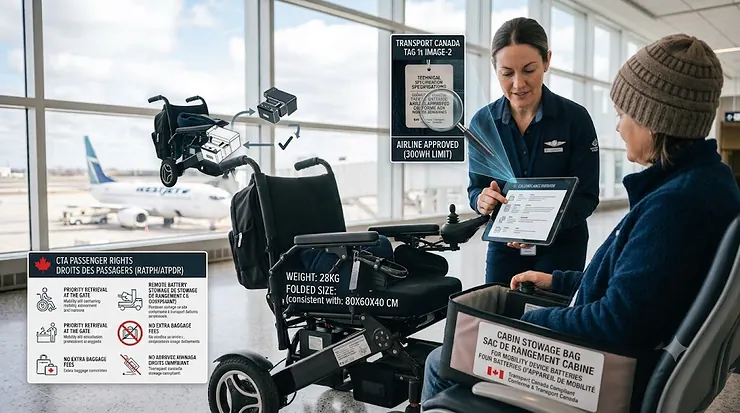
There’s no official government certification called “TSA approved transport wheelchair” or “CATSA approved wheelchair” — no sticker, no registration number. What both agencies actually require is that the chair passes their screening process, and that’s a procedural bar, not a product spec.
At Canadian airports, the Canadian Air Transport Security Authority confirms that mobility aids such as canes, walkers, and wheelchairs are permitted through pre-board screening, where a screening officer inspects the chair, performs an explosive trace detection swab, and — if the passenger can’t stand — conducts the screening while they remain seated in the chair. In the U.S., the TSA process is functionally similar: a passenger can request to be screened while seated, and the chair itself goes through visual inspection rather than the walk-through metal detector.
For powered wheelchairs, the real “approval” hinges on battery type. FAA and airline rules generally require a sealed, non-spillable lithium-ion battery under 300 Wh if it stays installed, or a removable battery carried in the cabin if it exceeds that threshold — anything larger typically needs advance airline notification. None of the seven chairs above are powered, which sidesteps this issue entirely; if you’re cross-shopping a power wheelchair, budget extra time for battery paperwork regardless of brand.
Can You Bring a Wheelchair On as Carry-On? Cabin Rules Explained
A wheelchair cabin approved for storage in the aircraft cabin itself — as opposed to the cargo hold — is rare, and mostly limited to very small folding manual chairs on aircraft with enough closet space, decided case-by-case at the gate. In practice, the vast majority of transport wheelchairs, including all seven featured above, travel in the cargo hold, not the overhead bin or cabin closet.
What most travellers actually mean by “carry-on wheelchair airline approved” is being able to use their own chair right up to the aircraft door, then have it gate-checked and returned at the door on arrival — not stowed in an overhead bin mid-cabin. This is standard practice on every major Canadian carrier, and it’s one of the genuine advantages of a folding transport chair over a rigid-frame model: gate agents can typically fold and stow it in the belly of even a narrow-body regional jet.
The practical upside of an ultralight like the FeatherMobility Lightweight Folding Wheelchair or the Karman Healthcare S-2512 Ergo Flight is less about cabin storage and more about how quickly ground crew can fold, tag, and return them — a lighter, simpler-folding chair moves through that process with fewer hands and less risk of mishandling.
Airport Wheelchair Regulations in Canada: CATSA and CTA Rules
Canada’s air travel accessibility rules aren’t scattered guidelines — they’re codified in the Accessible Transportation for Persons with Disabilities Regulations, enforced by the Canadian Transportation Agency. These rules define a mobility aid broadly, covering manual and electric wheelchairs, scooters, boarding chairs, walkers, canes, and crutches, and they set binding obligations, not suggestions, for large carriers.
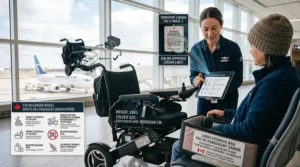
The most practical rule for wheelchair travellers: airlines flying to, from, or within Canada must transport a passenger’s mobility aid if notified at least 48 hours before departure, and the Canadian Transportation Agency notes this applies to all large airlines and to small airlines operating aircraft with 30 or more seats. If a carrier can’t accommodate your specific chair due to cargo-hold dimensions, it’s required to inform you before booking, not after you’ve already checked in.
At the security checkpoint itself, CATSA screening officers make every reasonable effort to screen the passenger and their mobility aid together rather than separating them, and many of Canada’s busiest airports post dedicated Family and Accessible screening lines for exactly this purpose. None of this requires advance documentation of a disability — you’re not obligated to prove your condition to security staff or airline agents.
✨ Ready to compare options? Scroll back up to see which of our top 7 fits your travel style best.
Airline Mobility Aid Policy: What Carriers Are Legally Required to Do
Every airline mobility aid policy operating in Canada is built on the same regulatory floor, even though the wording on each carrier’s website differs. Beyond simply transporting the chair, large carriers are required to assist with boarding, deplaning, and baggage handling; permit priority boarding for passengers who request help finding a seat or storing a mobility aid; and provide an on-board wheelchair for aisle access to the washroom during flight.
The real-world track record hasn’t always matched the policy on paper. CBC News reporting has documented hundreds of accounts from Canadians describing damaged wheelchairs, injuries during transfers, and mobility aids left behind entirely, including cases where replacement costs ran into the tens of thousands of dollars for custom power chairs. That gap between regulation and lived experience is exactly why a lighter, simpler-folding, less structurally fragile transport chair — like several on this list — reduces your practical risk even when the policy itself should already protect you.
If your mobility aid is damaged or delayed, the airline is required to address it, and if you believe you’ve encountered an undue barrier, you can file a complaint directly with the Canadian Transportation Agency, which has the authority to order corrective remedies.
How to Choose the Right Travel Wheelchair for Flying
Picking a travel wheelchair for flying comes down to weighing five factors against each other, roughly in this order of importance for most air travellers:
- Weight — Under 25 lb makes solo car-trunk lifting realistic; over 35 lb usually means you’ll need a second person for transfers.
- Seat width and frame size — Measure hip width, not just height; a chair that’s too wide compromises stability and control.
- Fold dimensions — Confirm the folded size against your airline’s cargo allowance before booking, especially on smaller regional aircraft.
- Capacity rating — Choose a chair rated meaningfully above the user’s actual weight, not right at the limit, for structural safety margin.
- Durability versus portability — Steel frames survive rough cargo handling better; aluminum and carbon frames save weight but ask more of ground crew care.
What most first-time buyers overlook is that the “lightest” option isn’t automatically the “best” one — a 13-lb chair that flexes uncomfortably over a gravel driveway isn’t doing anyone favours if most of the trip happens on rough terrain outside the airport itself.
Practical Usage Guide: Prepping Your Wheelchair for the Airport
Getting a transport wheelchair genuinely ready for its first flight takes more than folding it and hoping for the best. Start at least a week out: photograph the chair from all angles, note any existing scuffs or scratches, and keep those photos on your phone — this is your evidence if damage occurs in transit, and it’s the single most-recommended step among frequent flyers with mobility aids.
Remove or secure any loose accessories — cushions, bags, or attachable trays — since these frequently go missing during cargo handling and aren’t always covered by damage claims. Tag the chair clearly with contact information and “fragile — mobility aid” labelling, even though ground crews should already know what they’re loading.
At the gate, request a gate-check tag rather than checking the chair at the main counter whenever your itinerary allows it — this keeps the chair usable right up to the jet bridge and hands it back to you immediately on arrival, minimizing the time it spends unsupervised in cargo. Common first-flight mistakes include forgetting to notify the airline of a mobility aid within the 48-hour window, assuming all mobility aids automatically qualify for cabin storage, and neglecting to test-fold the chair at home before travel day — a fold mechanism that jams under gate pressure creates unnecessary stress for everyone involved.
Once you land, inspect the chair immediately at the gate, before leaving the secure area — reporting damage on the spot is dramatically more effective than reporting it after you’ve already left the airport.
Real-World Scenarios: Matching Wheelchairs to Traveller Types
Consider three genuinely different travellers booking the same Toronto-to-Vancouver route. First, a retired senior flying twice a year to visit grandchildren, travelling with an adult daughter who handles most transfers — for this profile, the durability and lower price of the Medline Durable Folding Steel Transport Wheelchair matters more than shaving a few pounds, since the daughter is doing most of the lifting and the trip frequency doesn’t justify a premium purchase.
Second, a university student with a spinal cord injury flying home for holidays alone, self-propelling through the terminal and handling their own car-trunk transfers at both ends — here, the Karman LT-980 Ultra Lightweight Wheelchair or the FeatherMobility Lightweight Folding Wheelchair make far more sense, since independence and low weight directly reduce physical strain on a solo traveller.
Third, a business consultant flying weekly across three time zones, whose chair takes the wear of dozens of cargo-hold cycles a year — for this frequent-flyer profile, the Karman Healthcare S-2512 Ergo Flight‘s premium build quality and reduced-fatigue ergonomic frame justify the higher upfront cost through sheer volume of use, where a cheaper chair would likely need replacing within a year or two.
Common Mistakes When Buying an Airline Approved Wheelchair
The most expensive mistake buyers make is choosing based on weight alone, without checking seat width against the actual user’s hip measurement — an ill-fitting chair undermines stability regardless of how light it folds. A close second is skipping the 48-hour advance notification to the airline, which can turn an otherwise smooth trip into a same-day scramble at check-in.
Buyers also frequently underestimate how much armrest and footrest adjustability matters for anyone spending extended time in the chair during layovers, opting instead for a barebones frame that saves a few dollars but costs comfort over an eight-hour connection. Reviewers consistently flag failing to test-fold a new chair before the actual travel day as a preventable, entirely avoidable stress point — a fold mechanism should be practiced at home, not learned for the first time at a check-in counter with a line building behind you.
Finally, many buyers assume a wheelchair capacity rating close to the user’s actual body weight is acceptable; in practice, choosing a rating with meaningful headroom above actual weight preserves structural integrity and reduces long-term wear on the frame.
Manual Transport Wheelchair vs Power Wheelchair for Flying
| Factor | Manual Transport Wheelchair | Power Wheelchair |
|---|---|---|
| Typical weight | 13–40 lb | 40–150+ lb |
| Battery paperwork | None required | Airline notification required |
| Fold complexity | Simple, fast | Often complex or non-folding |
| Best For | Occasional flyers, attendant-assisted travel | Users needing independent mobility on the ground |
The comparison above understates just how much friction a power wheelchair’s lithium battery adds to the airport experience — even a fully compliant battery under the FAA’s 300 Wh threshold still typically requires advance airline notice and, in some cases, removal for cabin carriage. A manual transport chair like any of the seven above sidesteps that entirely, trading some ground-level independence for a dramatically simpler airport experience.
🔍 Not sure which type fits your travel pattern? Revisit the comparison table above before you decide.
Long-Term Cost & Maintenance of Your Travel Wheelchair
The sticker price is only the starting point for total cost of ownership. Budget steel frames like the Medline Durable Folding Steel Transport Wheelchair cost less upfront but tend to need tire and caster replacements sooner under frequent cargo-hold handling, while premium builds like the Karman Healthcare S-2512 Ergo Flight justify their price over several years of heavy flying through reduced frame fatigue and fewer replacement parts.
Basic maintenance — wiping down upholstery, checking fold-hinge tightness, and inspecting wheel bearings every few months — extends any chair’s usable life regardless of price bracket. On the practical side, most transport wheelchairs on this list cost less over a five-year span than a single replacement claim for a damaged custom power chair, which is worth remembering if airline damage rates factor into your decision at all.
Frequently Asked Questions
❓ Is an airline approved wheelchair the same as a TSA approved transport wheelchair?
❓ Do I need to tell the airline in advance that I'm bringing a wheelchair?
❓ Can I keep my wheelchair with me until I board the plane?
❓ What happens if my wheelchair is damaged during a flight?
❓ How much does an airline approved wheelchair typically cost in Canada?
Conclusion
Choosing the right airline approved wheelchair isn’t about finding a mythical certified product — it’s about matching real weight, fold dimensions, and durability to how you actually fly. The Vive Mobility Ultra Lightweight Wheelchair remains the sensible all-around pick for most travellers, while the FeatherMobility Lightweight Folding Wheelchair and Karman Healthcare S-2512 Ergo Flight serve travellers who prioritize solo handling and premium build quality respectively, and the Medline Durable Folding Steel Transport Wheelchair covers anyone starting out on a tighter budget.
Beyond the chair itself, understanding Canada’s actual accessible-transportation rules — the 48-hour notification window, CATSA’s seated-screening option, and your right to file a complaint if things go wrong — matters just as much as the product you buy. Equip yourself with both, and flying with a mobility aid stops being a gamble and starts being routine.
✨ Don’t Miss These Exclusive Deals!
🔍 Take your next trip further with a transport wheelchair built for real airport handling. Click on any of the featured picks above to check current pricing and availability on Amazon.ca. The right chair turns a stressful travel day into just another flight.
Recommended for You
- Transport Wheelchair for Car Transfers: 7 Top Picks (2026)
- 7 Best Car Transport Wheelchairs 2026: Trunk-Ready Picks
- 7 Best Narrow Transit Wheelchairs for Tight Doorways in 2026
Disclaimer: This article contains affiliate links. As an Amazon Associate, I earn from qualifying purchases. If you purchase products through these links, we may earn a small commission at no additional cost to you.
✨ Found this helpful? Share it with your friends! 💬🤗
