
In This Article
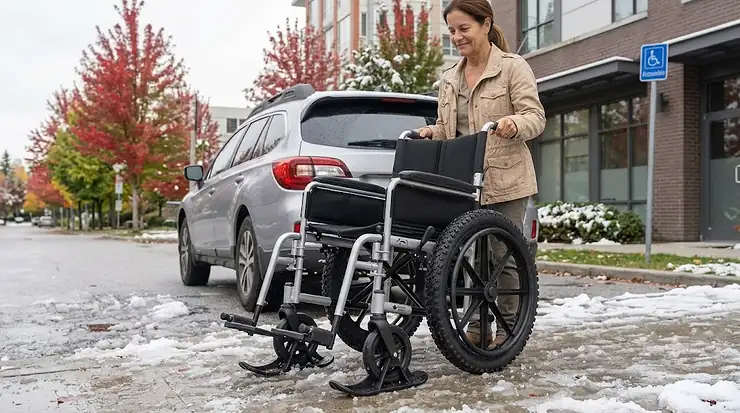
Here’s the moment every caregiver knows too well: you’ve got the appointment booked, the car running, and a family member ready to go — and then you’re standing at the open trunk, wrestling with a wheelchair that folds about as gracefully as a lawn chair having a bad day. A good car transport wheelchair changes that entire scene. It should fold in seconds, drop into a compact sedan trunk without a shoehorn, and still hold up when you’re lifting it in and out three times a week.

This guide breaks down seven real, currently available transport wheelchairs, chosen specifically for how well they handle vehicle loading — not just how they look in a showroom. Canada’s population is aging, and mobility needs are climbing right along with it: more than 3.1 million Canadians aged 15 and over reported a mobility disability in 2022, with prevalence climbing sharply from 11.4% among 45-to-64-year-olds to 25.5% among seniors. That’s a lot of trunks getting a workout every week.
So what is a car transport wheelchair, exactly? It’s a lightweight, folding wheelchair — usually 14 to 35 pounds — designed to be pushed by a caregiver rather than self-propelled long distances, built around quick-fold frames, removable footrests, and compact folded dimensions that clear most trunk openings. You can see the full breakdown of these trends in Statistics Canada’s 2022 infographic on mobility disabilities. Below, you’ll find real specs, honest comparative analysis, and the kind of practical detail Amazon’s own listings tend to skip entirely.
Quick Comparison Table
| Product | Weight | Folded Size (approx.) | Best For |
|---|---|---|---|
| Medline Ultralight Transport Wheelchair | 14.8–19 lbs | 24″L x 10″W x 30″H | Best all-rounder for small trunks |
| Drive Medical Blue Streak | ~19 lbs | Compact, swing-away footrests | Best budget pick |
| Medline Handbrake Transport Chair (12″ wheels) | 26 lbs | Compact fold | Best for hills and caregiver control |
| Karman LT-980 | 24 lbs | Compact aluminum fold | Best mid-range durability |
| Karman Ergo Flight | 14.5–19.8 lbs | Ultra-compact | Lightest premium pick |
| Hi-Fortune Magnesium Transport Wheelchair | 21 lbs | Fits included travel bag | Best for frequent travel |
| Hi-Fortune Magnesium Electric (P16H) | 35 lbs | Folds flat, quick-release | Best power-assist option |
Looking at the spread here, weight really is the deciding factor for most car owners — anything under 20 lbs tends to lift into a trunk one-handed, while the electric option trades some of that portability for genuine motorized assistance. Price naturally climbs with battery power and premium alloys, so the right pick usually comes down to how often the chair gets loaded and by whom.
💬 Just one click — help other Canadian golfers make a smarter bag choice too!😊
Top 7 Car Transport Wheelchairs: Expert Analysis
1. Medline Ultralight Transport Wheelchair — lightest all-rounder for small trunks
The standout here is the sub-20-pound aluminum frame, which is genuinely one of the lightest full-size transport chairs currently sold. At 14.8 to 19 lbs depending on configuration, with a 19-inch-wide seat and a 300 lb weight capacity, it folds down to roughly 24″ x 10″ x 30″ — small enough to slide beside a spare tire in most compact sedans. Based on the spec comparison, that folded footprint is the real differentiator; a lot of “lightweight” chairs still fold into an awkward L-shape that eats half a trunk. This chair is built for caregivers who load and unload multiple times a day and simply can’t afford a heavier frame straining their back or shoulders. Reviewers consistently note how easy the one-hand fold mechanism is, though several also mention the desk-length armrests feel a touch narrow for larger adults — worth checking against your specific user’s frame before buying.
Pros:
- ✅ Among the lightest full-size transport chairs available
- ✅ Folded size clears almost any trunk opening
- ✅ 300 lb capacity despite the low chair weight
Cons:
- ❌ Narrower armrests than some competitors
- ❌ Nylon upholstery shows wear faster than padded vinyl
Expect to pay in the C$180-C$260 range at the time of research — check current price before ordering, since Amazon.ca pricing shifts often. For the weight-to-capacity ratio alone, this is the value benchmark the rest of this list gets measured against.
2. Drive Medical Blue Streak — best budget pick for occasional trips
The Drive Medical Blue Streak leads with an 18-inch desk-arm seat and swing-away footrests on a steel frame that undercuts most competitors on price. What most buyers overlook about this model is that “steel frame” doesn’t mean “heavy” in this case — Drive Medical kept the tubing profile slim enough that the chair still folds into a manageable bundle for a mid-size trunk, even if it won’t beat the ultralight aluminum chairs on raw weight. The desk-length arms let a passenger pull up to a table or counter without backing the whole chair out, which caregivers taking someone to appointments or restaurants tend to appreciate. This is the chair for someone who needs a transport chair a few times a month rather than daily — not a heavy-duty solution, but a genuinely solid entry point. Aggregated review sentiment across retailers points to strong marks for value and assembly (arrives essentially ready to use), with occasional complaints about the armrest padding thinning out after a year or two of regular use.
Pros:
- ✅ Lowest price point among true steel-frame options
- ✅ Swing-away footrests simplify transfers
- ✅ Desk-length arms suit dining and desk use
Cons:
- ❌ Heavier than the aluminum and magnesium options here
- ❌ Armrest padding wears with heavy daily use
Price sits around C$150-C$220 at the time of research, making it the entry point for anyone testing whether a transport chair fits their routine before investing in a premium frame.
3. Medline Transport Chair with Handbrakes and 12-Inch Wheels — best for hills and caregiver control
The 26-lb aluminum frame here trades a bit of the ultralight advantage for something arguably more important on uneven Canadian sidewalks: hand brakes at the push handles plus rear-wheel locking brakes. The larger 12-inch rear wheels roll more smoothly over cracked pavement, curb cuts, and gravel driveways than the smaller casters found on pure ultralight chairs. Based on the spec comparison, this is the model to choose if your routine involves parking lots with any slope at all — a caregiver squeezing a hand brake while descending a ramp has real control that a chair without brakes simply doesn’t offer. It’s not the chair for someone chasing the lowest possible trunk-loading weight, but for safety on hills, it’s arguably the smartest pick on this list. Reviewers frequently cite the hand brakes as the reason they chose this model over lighter alternatives, particularly for outdoor use at medical campuses with sloped walkways.
Pros:
- ✅ Hand brakes give caregivers real speed control
- ✅ 12-inch wheels handle rough pavement smoothly
- ✅ 300 lb weight capacity with a sturdy frame
Cons:
- ❌ Heavier than the ultralight chairs on this list
- ❌ Bulkier folded profile needs a mid-size trunk
Expect a price in the C$220-C$300 range. If your local terrain has any real grade to it, the brakes alone can justify the extra few pounds.
4. Karman LT-980 — best mid-range durability
Karman Healthcare built a reputation on ultralight aluminum frames, and the LT-980 sits right in the sweet spot: about 24 lbs without the footrest, a desk-length armpad, and a seatbelt as standard. What separates this from bargain-bin alternatives is frame quality — Karman uses aircraft-style aluminum bending rather than generic tubing, which shows up in how the chair holds its shape after repeated folding. Here’s what to weigh: this isn’t the absolute lightest chair in this roundup, but it’s built to survive years of daily folding without the frame loosening or the welds fatiguing, which cheaper chairs often can’t claim. It’s the chair for a household that expects to use a transport chair for years, not months. Aggregated review sentiment highlights long-term durability and smooth wheel-locking casters, with a recurring note that the seat, at 18 inches, runs slightly narrow for larger-framed users.
Pros:
- ✅ Aircraft-grade aluminum construction holds up long-term
- ✅ Smooth-rolling front casters for tight indoor turns
- ✅ Seatbelt included as a standard safety feature
Cons:
- ❌ 18-inch seat width may be tight for larger adults
- ❌ Costs more upfront than comparable steel-frame chairs
Price generally runs C$320-C$420 at the time of research. Given the frame longevity, the cost-per-year of ownership often beats cheaper chairs that need replacing sooner.
5. Karman Ergo Flight — lightest premium pick
At 14.5 to 19.8 lbs (depending on whether wheels and footrest are removed for transport), the Karman Ergo Flight is built from aircraft-grade T6 aluminum with a patented S-shape seating frame — genuinely one of the lightest non-custom manual wheelchairs sold today. On paper this means less strain for caregivers doing multiple daily transfers between car and building, and the companion hand brakes at the push handles add a layer of control that pure ultralight chairs sometimes skip. The 220 lb weight capacity is a bit lower than some steel-framed competitors, which matters for larger users but won’t affect most transport-chair buyers. This is the chair for someone prioritizing minimum weight above almost everything else — frequent flyers, apartment dwellers without elevators, or caregivers with their own mobility limitations. Reviewers highlight the near-effortless one-hand lift into a trunk, alongside a common note that the premium price feels steep next to steel alternatives with similar function.
Pros:
- ✅ One of the lightest manual wheelchairs sold today
- ✅ Companion hand brakes improve caregiver control
- ✅ S-shape aluminum frame resists flex over time
Cons:
- ❌ 220 lb capacity lower than some steel-frame rivals
- ❌ Premium pricing relative to comparable-function chairs
Budget around C$480-C$620 at the time of research. For caregivers who physically cannot lift a heavier chair, this price gap is often worth paying.

6. Hi-Fortune Magnesium Transport Wheelchair — best for frequent travel
The magnesium alloy frame is the headline feature, and it delivers: at roughly 21 lbs with a quick-release hinge, this chair folds down fast enough that airport curb-checks and quick car swaps both feel manageable. It ships with a padded travel bag and cushion, which is a small but genuinely useful touch — most competitors leave you buying storage separately. Reviewers consistently note the top-mounted hand brakes make it easy to control on ramps, and the swing-away footrests detach cleanly for even tighter trunk packing. Based on the spec comparison, this is the chair for someone who’s not just driving to appointments but regularly combining car trips with flights, trains, or cruise transfers — the included bag and quick-release wheels solve a problem the other chairs on this list simply don’t address. The 220 lb capacity keeps it in line with other lightweight alloy chairs, though it’s worth checking against a larger user’s needs.
Pros:
- ✅ Magnesium frame keeps weight down without flimsy feel
- ✅ Included travel bag and cushion add real value
- ✅ Quick-release wheels simplify trunk loading further
Cons:
- ❌ 220 lb capacity limits it for larger users
- ❌ Smaller front casters can catch on gravel
Expect C$360-C$460 at the time of research. The bundled accessories make the price feel more reasonable than it looks at first glance.
7. Hi-Fortune Magnesium Folding Electric Wheelchair (P16H) — best power-assist option
This is the outlier on the list, and deliberately so: at about 35 lbs, the Hi-Fortune P16H is still light enough for most trunks, but it adds a brushless motor delivering up to 4 mph and roughly 15 miles of range on the dual-battery configuration, with a 7-hour charge time. What the spec sheet won’t tell you, but reviewers note, is how much this changes the daily calculus for someone who still wants independence but has lost the arm strength to self-propel a manual chair over any real distance. The magnesium frame keeps the folded weight manageable for a caregiver to still lift solo, and the quick-release design means it collapses flat rather than into an awkward wedge shape. It’s the obvious choice for anyone weighing a full power wheelchair against a folding manual chair and wanting a middle path — genuine motorized assist, without needing a wheelchair-accessible van. The 275 lb capacity is generous for the category, and flip-up armrests ease transfers from a car seat.
Pros:
- ✅ Genuine motorized assist without a full power chair
- ✅ Folds flat despite the onboard battery system
- ✅ 275 lb capacity, generous for a folding power chair
Cons:
- ❌ Heaviest option on this list at 35 lbs
- ❌ Battery charge time (about 7 hours) requires planning
Pricing for folding power chairs like this typically runs C$1,400-C$1,900 at the time of research — a significant step up, but one that can delay or replace a much costlier full-size power wheelchair and vehicle modification.
Top 7 Products: Specs & Value Snapshot
| Product | Capacity | Approx. Price (CAD) | Best For |
|---|---|---|---|
| Medline Ultralight Transport Wheelchair | 300 lbs | C$180-C$260 | Small-trunk, daily use |
| Drive Medical Blue Streak | Standard | C$150-C$220 | Occasional, budget use |
| Medline Handbrake Transport Chair | 300 lbs | C$220-C$300 | Sloped terrain, safety |
| Karman LT-980 | Standard | C$320-C$420 | Long-term durability |
| Karman Ergo Flight | 220 lbs | C$480-C$620 | Minimum weight priority |
| Hi-Fortune Magnesium Transport | 220 lbs | C$360-C$460 | Frequent travellers |
| Hi-Fortune Magnesium Electric (P16H) | 275 lbs | C$1,400-C$1,900 | Motorized assist |
This table makes the value pattern pretty clear: manual chairs cluster between C$150 and C$620 depending on frame material and brake features, while the single power option jumps into a different price tier entirely. If budget is the primary constraint, the Drive Medical Blue Streak and Medline Ultralight Transport Wheelchair both deliver strong function well under C$300. For anyone who has already ruled out a manual chair due to arm strength, the Hi-Fortune Magnesium Electric (P16H) is worth the jump precisely because it avoids the far higher cost of a full power wheelchair and van conversion.
✨ Don’t Miss These Trunk-Friendly Deals
🔍 Take the guesswork out of your next mobility purchase. Click through on any of the seven picks above to check current pricing and availability on Amazon.ca — the right transport chair can turn a stressful appointment morning into a five-minute routine.
Practical Usage Guide: Getting a Folding Wheelchair In and Out of the Car
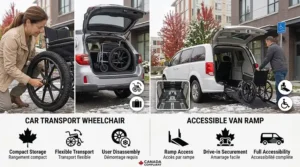
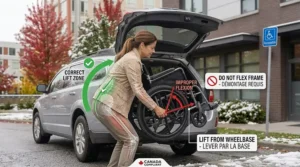
Buying the right chair is half the job; loading it correctly, every single time, is the other half. Start by learning the fold sequence with the chair empty, in your driveway, before the first real outing — most transport chairs fold by pulling up on the center of the seat while pressing down slightly on the armrests, and doing this under pressure at a curb is a bad time to learn. Remove the footrests first if they’re swing-away or detachable; this alone can shave several inches off the folded width, often the difference between sliding a chair in flat versus wedging it in at an angle.
In the first 30 days, the most common mistake is skipping the wheel locks before a transfer — a chair that rolls even two inches while someone’s shifting their weight onto it is a genuine fall risk. Get in the habit of engaging both the parking brake and, where available, the hand brake before every transfer, not just the tricky ones. For maintenance, a quick monthly check of tire pressure (on pneumatic-wheel models), bolt tightness at the fold hinges, and upholstery wear will catch small problems before they become a chair that won’t fold smoothly at the worst possible moment. One optimization trick that Amazon listings never mention: store the chair folded with the seatbelt buckled loosely across the seat — it keeps the fabric from developing a permanent crease line at the fold point over months of storage.
Real-World Scenarios: Matching the Right Chair to Your Life
Consider three fairly typical situations. A daughter driving her 78-year-old mother to twice-weekly physiotherapy in a compact hatchback needs the lightest possible chair she can lift solo, several times a week, without back strain — the Medline Ultralight Transport Wheelchair or Karman Ergo Flight both fit that brief, with the Medline winning on price and the Ergo Flight winning on absolute minimum weight.
A retired couple who travel frequently by car and occasionally by plane, and want one chair that does both jobs, are better served by the Hi-Fortune Magnesium Transport Wheelchair — the included travel bag and quick-release wheels solve exactly the packing headaches that come with mixed-mode travel.
Meanwhile, someone recovering from a hip replacement who has lost enough arm strength to struggle with self-propulsion, but still lives at home rather than in assisted care, is a strong candidate for the Hi-Fortune Magnesium Electric (P16H) — the motorized assist restores a meaningful amount of independence around the house and neighbourhood, without the far larger cost of a full power wheelchair and accessible vehicle.
How to Choose a Car Transport Wheelchair
What is the most important factor when choosing a car transport wheelchair? For most buyers, it’s the combination of folded weight and folded dimensions — a chair that’s light but folds into an awkward shape can still be a hassle at the trunk. Here’s how to work through the decision:
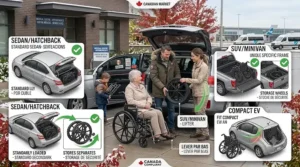
- Measure your trunk opening first. Most folded transport chairs run 24-30 inches tall and 10-12 inches wide; check this against your actual vehicle before ordering.
- Weigh the lifter, not just the chair. If the primary caregiver has back or shoulder limitations, prioritize anything under 20 lbs.
- Match wheel size to your terrain. Larger 12-inch rear wheels handle cracked pavement and gravel far better than small casters.
- Decide if brakes are a must-have. Hand brakes matter enormously on any slope, ramp, or hill.
- Check the weight capacity against the actual user. A 220 lb-rated chair is fine for most adults but too tight a margin for others.
- Factor in frequency of use. Daily use justifies spending more on frame durability; occasional use doesn’t.
- Consider manual versus power-assist honestly. If arm strength is already limited, a folding electric model may delay the need for a full power wheelchair.
Common Mistakes When Buying a Transport Chair for Car Travel
The single most common misstep is buying based on price or brand name alone, without ever measuring the trunk the chair needs to fit into — a seemingly great deal becomes useless if it wedges in sideways every time. A close second is overlooking weight capacity nuance: many ultralight aluminum and magnesium chairs cap out around 220 lbs, noticeably lower than the 300-400 lb capacity of steel-framed models, and that gap matters for some users. Buyers also frequently skip test-folding a chair in-store or reading the actual folded dimensions, relying instead on marketing photos that make every chair look equally compact.
Another overlooked detail: assuming all “transport wheelchairs” are interchangeable with standard self-propelled wheelchairs. Transport chairs typically have small rear wheels meant to be pushed by a caregiver, not the larger 20-24 inch wheels needed for self-propulsion — buying the wrong category entirely is a surprisingly common and expensive mistake.
Transport Chair vs Standard Self-Propel Wheelchair
A transport chair and a standard self-propel wheelchair solve genuinely different problems, and confusing the two leads to a lot of buyer’s remorse. Transport chairs use small rear wheels (8-12 inches) meant to be pushed by a caregiver, prioritizing folded weight and trunk-friendly dimensions over independent mobility. Standard wheelchairs use large 20-24 inch rear wheels with push rims, letting the user propel themselves, but at the cost of significantly more folded weight and bulk.
| Feature | Transport Chair | Standard Wheelchair |
|---|---|---|
| Typical weight | 14-35 lbs | 30-45+ lbs |
| Rear wheel size | 8-12 inches | 20-24 inches |
| Self-propulsion | No (caregiver-pushed) | Yes |
| Best for | Car trips, appointments, travel | Independent daily mobility |
| Trunk-friendliness | Excellent | Moderate to poor |
The takeaway is straightforward: if the primary use case is being pushed to and from a vehicle for appointments, errands, or travel, every chair in this guide — like the Medline Ultralight Transport Wheelchair or Karman Ergo Flight — will outperform a standard wheelchair on ease of loading. If the user needs to self-propel independently for hours at a time, a standard wheelchair remains the better long-term investment, even though it eats more trunk space.
What to Expect: Real-World Performance
Specs on a page don’t capture what a first outing actually feels like, so here’s the translation. A sub-20-lb aluminum chair like the Medline Ultralight Transport Wheelchair genuinely does lift into a trunk with one hand — you’ll notice the difference the very first time you’re also juggling a purse, a cane, and a car door. Hand-brake models like the Medline Handbrake Transport Chair feel noticeably more controlled going down even a gentle parking-lot slope; you squeeze, the chair slows, no drama. The magnesium and premium aluminum chairs fold with a satisfying, solid click rather than a wobble, which matters more than it sounds like it should when you’re doing this in the rain with somewhere to be. The electric Hi-Fortune P16H, meanwhile, feels closer to a scooter than a wheelchair once it’s moving — quiet, steady, and honestly a bit of a confidence boost for users who’ve been relying entirely on someone else to push them around for months.
Long-Term Cost & Maintenance
Sticker price is only part of the ownership picture. Manual transport chairs in this guide need little beyond occasional bolt-tightening, tire checks (on pneumatic models), and periodic upholstery cleaning — realistically a few dollars a year in upkeep. The electric Hi-Fortune P16H carries a higher total cost of ownership: battery replacement every few years, plus the electricity for regular charging, though this remains far cheaper than maintaining a full-size power wheelchair or a wheelchair-accessible vehicle conversion.
It’s also worth knowing that wheelchair purchase or rental costs are recognized as eligible expenses under Canada’s Medical Expense Tax Credit, which can meaningfully offset the cost of a premium chair like the Karman Ergo Flight or the Hi-Fortune Magnesium Electric (P16H). Keep every receipt, since the Canada Revenue Agency may request documentation later, and a prescription or medical practitioner’s note strengthens some claims. Factoring in this credit, the effective cost gap between a basic manual chair and a premium or powered option often narrows more than buyers expect at checkout.
| Price Tier | Approx. Range (CAD) | Value Verdict |
|---|---|---|
| Budget manual | C$150-C$260 | Best cost-per-use for occasional trips |
| Mid-range manual | C$300-C$460 | Best balance of durability and weight |
| Premium manual | C$480-C$620 | Worth it for caregiver back health |
| Folding electric | C$1,400-C$1,900 | Justified if manual strength is limited |
Reading across this table, the jump from mid-range to premium manual chairs is small compared with the jump into powered mobility — meaning most buyers get the most value staying within the manual tiers unless motorized assist is genuinely necessary.
Safety, Regulations & Compliance for Car Travel
Transport chairs themselves aren’t regulated the way vehicles are, but a few Canadian rules are worth knowing. If travel plans extend beyond car trips to planes, trains, or ferries, <cite index=”42-1″>a traveller’s mobility aid is treated as essential to their independence, safety, and comfort, with specific carrier obligations for its safe storage and transport</cite> under federal accessible transportation regulations. That matters if your routine, like the travel-focused couple mentioned earlier, mixes car trips with flights.
For the car itself, always secure the folded chair in the trunk rather than loose on a back seat, where it can become a projectile in a sudden stop. Use the seatbelt on the chair itself during any transfer, and never rely on a parking brake alone on a slope — hand brakes, where the chair has them, should always be engaged as a backup. None of the chairs in this guide require CSA vehicle-restraint certification since they’re stored folded rather than occupied during transport, but if a user ever needs to remain seated in a wheelchair inside a moving vehicle, that’s a different category of product entirely (a WC19-certified transit wheelchair), not the transport chairs covered here. The Canadian Transportation Agency’s guide to travelling with mobility aids is a useful reference if your routine ever extends beyond the car.
Frequently Asked Questions
❓ What is the best wheelchair for car transport?
❓ Will a folding wheelchair fit in a small car trunk?
❓ How much does a car transport wheelchair cost in Canada?
❓ Can I claim a transport wheelchair on my taxes in Canada?
❓ What's the difference between a transport chair and a regular wheelchair?
Conclusion
Choosing a car transport wheelchair really comes down to matching three variables honestly: who’s lifting it, how often, and over what terrain. For most Canadian households, the Medline Ultralight Transport Wheelchair hits the sweet spot of weight, price, and trunk-friendliness, while the Medline Handbrake Transport Chair earns its keep on anything sloped. Buyers chasing the absolute minimum weight should look at the Karman Ergo Flight, frequent travellers will get real value from the included bag on the Hi-Fortune Magnesium Transport Wheelchair, and anyone whose arm strength has genuinely declined should seriously weigh the Hi-Fortune Magnesium Electric (P16H) against the far larger cost of a full power wheelchair. None of these are exotic purchases — they’re practical tools that, chosen correctly, turn a dreaded logistics problem into a five-minute part of the morning.
✨ Ready to Make Trunk-Loading Easy?
🔍 Check current pricing on any of these seven trunk-friendly transport wheelchairs today, and give your next appointment morning one less thing to stress about.
Recommended for You
- 7 Best Narrow Transit Wheelchairs for Tight Doorways in 2026
- Value Standard Transit Wheelchair: 7 Honest Picks for 2026
- Standard Transit Wheelchair Guide 2026: 7 Top Picks Reviewed
Disclaimer: This article contains affiliate links. As an Amazon Associate, I earn from qualifying purchases. If you purchase products through these links, we may earn a small commission at no additional cost to you.
✨ Found this helpful? Share it with your friends! 💬🤗
