
In This Article
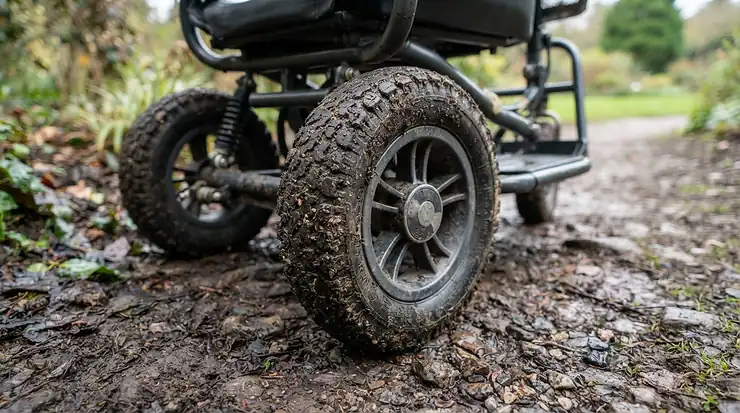
All-terrain power wheelchairs are motorized wheelchairs built for ground that stops ordinary indoor chairs cold: gravel driveways, grass, packed-dirt trails and cracked sidewalks. They pair larger tires and aggressive tread with stronger dual motors, more ground clearance and some form of suspension, so the ride stays stable when the surface stops cooperating.
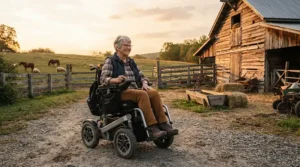
Picture the problem. You can get to the mailbox on a perfect day. The moment the lane turns to wet gravel, a small chair digs in and stalls. Canada is a country of gravel lanes, frost-heaved sidewalks, cottage docks and long shoulder seasons, so this isn’t a niche worry.
Powered chairs have Canadian roots, too. The first production electric-powered wheelchair was invented by George Klein, who worked at the National Research Council of Canada. Nearly eighty years later, the category has split into lightweight folding chairs and heavy-duty off-road machines.
This guide sorts through all of it. You’ll get seven real models, honest analysis of what the specs mean on actual ground, and a clear look at tire tread, price and Canadian funding. Every price is a ballpark range, and every spec is the manufacturer’s claim unless noted. Let’s find you a chair that survives your terrain.
Quick Comparison Table: Which All-Terrain Power Wheelchairs Fit You?
| Model | Motors | Claimed Range | Approx. Weight | Ballpark Price (CAD) | Best For |
|---|---|---|---|---|---|
| Ranger Discovery | Dual 250W | 20 mi (32 km) | 23–26 kg | C$2,500–C$3,500 | Folding all-rounder |
| Culver Artemis | Dual 150W | 12 mi (19 km) | 43 kg | C$1,200–C$1,800 | Tight budgets |
| ABAKAN | 500W | 30+ mi (48+ km) | Check listing | C$2,000–C$3,000 | Long range, warranty |
| Mujocooker | 700W, front-drive | 30+ mi (48+ km) | 41 kg | C$1,800–C$2,800 | Grass, mud, soft ground |
| Ranger The Beast | Dual 400W | Tri-battery | Heavy | C$4,500–C$6,500 | Serious trails, farms |
| Ranger Magnum Ultra | Dual 350W | Dual batteries | 48 kg | C$4,500–C$6,500 | Capacity up to 299 kg |
| Aotedor 22-Mile | 500W | 22 mi (35 km) | 18 kg | C$1,500–C$2,500 | Light travel chair |
Read the table as three tiers. The Culver Artemis and Aotedor 22-Mile anchor the budget end. The Ranger Discovery, ABAKAN and Mujocooker form the value middle. The Ranger The Beast and Ranger Magnum Ultra sit at the heavy-duty top, where weight capacity and frame strength cost real money. Note the trade-off between range and weight: the lightest chair here has the smallest battery pack, while the heaviest chairs need a ramp or lift.
💬 Just one click — help others make better buying decisions too!😊
Top 7 All-Terrain Power Wheelchairs: Expert Analysis
Each entry below blends manufacturer specs with the themes that keep surfacing in published buyer’s guides and owner reports. Treat range figures as best-case numbers. One buyer’s guide I reviewed notes that grass and gravel can cut range by 30 to 50 per cent.
1. Porto Mobility Ranger Discovery — best value foldable all-rounder
The Ranger Discovery is the chair most guides reach for when a reader wants one machine for the house and the weekend. Its frame folds in about three seconds, which matters more than it sounds when you’re loading a trunk in the rain.
Dual 250W brushless motors with Posi-Traction power distribution are enough for grass, gravel and steep driveways. Dual slide-out lithium batteries are listed as airline approved and give a claimed 20 miles (32 km). The listed 50 lb (23 kg) frame reportedly lands nearer 58 lb (26 kg) with both batteries installed, so lifting it solo into a tall SUV is still a workout. The 81 cm turning radius handles ordinary doorways.
Published reviews across the Discovery line are consistently positive, and the brand’s customer service gets repeated praise. Common complaints are a touchy joystick at first, which a controller adjustment reportedly fixes, and a thin seat cushion.
Pros:
- ✅ Folds in about three seconds
- ✅ Airline-approved slide-out batteries
- ✅ Tight turning radius for indoor use
Cons:
- ❌ Replacement batteries cost roughly C$500+ each
- ❌ Real weight is closer to 26 kg
Ballpark price: C$2,500–C$3,500. Check current price. The proven platform justifies the premium over bargain chairs.
2. Culver Artemis — cheapest genuine all-terrain entry point
The Culver Artemis is what readers get pointed to when the budget is tight but the driveway is real gravel. It folds in about three seconds and weighs roughly 95 lb (43 kg), so it is not a featherweight.
The dual 150W motors look modest on paper. In practice, they’re geared for outdoor use and top out around 6.4 km/h, which is gentle enough for a first-time rider. An electromagnetic brake holds steadily on damp grass, and the roughly 12-mile (19 km) range suits errands rather than all-day outings. The charge takes about eight hours.
Reviewer sentiment is mostly “good for the money,” with footrest weld quality and some right-turn quirks reported. One note for Canadians: the listing’s FSA/HSA eligibility is an American benefit and doesn’t apply here.
Pros:
- ✅ Lowest cost of the seven
- ✅ Reliable electromagnetic braking
- ✅ Folds quickly for car storage
Cons:
- ❌ Shorter range than every rival here
- ❌ Footrest weld issues reported by some owners
Ballpark price: C$1,200–C$1,800. Inspect the footrest joint on arrival. Fine for short daily routes; look elsewhere for hills and long days.
3. ABAKAN — long range backed by a five-year warranty
The ABAKAN earns attention for one number: a claimed 30+ miles (48+ km) from dual 13Ah lithium batteries. Range is the single biggest source of mid-ride anxiety, so that headline matters.
The 500W motor reportedly climbs a 15° hill without bogging down. The safety package is thorough: seat belt, puncture-proof tires, anti-tip wheels and an electromagnetic brake. Speed is adjustable from 1 to 4 mph, which helps beginners build confidence. The warranty is the real differentiator, with five years listed on the controller, charger and battery.
One roundup cites a 4.8-star average across 36 reviews. That is a small sample, so read it as encouraging, not conclusive. Reviewers mention tight fits through narrow older doorways and some minor setup on arrival.
Pros:
- ✅ Claimed 30+ mile range from dual batteries
- ✅ Five-year warranty on key electronics
- ✅ Anti-tip wheels and seat belt included
Cons:
- ❌ Narrow doorways can be a tight fit
- ❌ Sits in a premium price bracket
Ballpark price: C$2,000–C$3,000. The warranty offsets part of the premium, which is what makes this a strong rugged pick for riders who dread dead batteries.
4. Mujocooker — front-wheel drive built for soft ground
The Mujocooker goes against convention with front-wheel drive. On sand, mud and wet grass, a driven front wheel pulls the chair forward instead of pushing it into the ruts, so it tends to keep moving where rear-drive chairs dig in.
A 700W motor and dual 12Ah batteries deliver a claimed 30+ miles (48+ km). Six spring shock absorbers soak up rutted paths, and the 22-inch seat is wide and comfortable. A dust cover and backpack come with it. At roughly 41 kg, it needs a helper or ramp for vehicle loading.
Reviewers highlight soft-ground traction and seat comfort. The recurring caveats are the cushion having to come off before folding, a non-adjustable footrest and ground clearance that is lower than purpose-built off-road chairs.
Pros:
- ✅ Front-wheel drive grips soft ground
- ✅ Six spring shock absorbers smooth rough paths
- ✅ Wide 22-inch seat with accessories included
Cons:
- ❌ Heavy at roughly 41 kg
- ❌ Lower clearance than true off-road chairs
Ballpark price: C$1,800–C$2,800. Check current price. A smart middle-tier choice if your terrain is more meadow than mountain.
5. Ranger The Beast — the heavy-duty trail machine
The Ranger The Beast is the chair for people whose “driveway” is a hayfield. Dual 400W brushless motors, a six-point suspension and a tri-battery system make it the most capable off-road machine of the seven.
It supports 500 lb (227 kg) on a reinforced 6061 aluminum frame. The six-point suspension is its signature, absorbing impacts that would rattle a rigid-frame chair. Electromagnetic regenerative braking helps on steep descents. Owner reports mention hiking trails, farm work and beach trips.
Everything is a trade-off, though. This is not a portable chair, so you’ll need a van ramp or lift. The tri-battery setup charges slowly, and the front wheels need turning room. The joystick is very responsive, and reviewers describe a short learning curve.
Pros:
- ✅ Powerful dual 400W brushless motors
- ✅ Six-point suspension absorbs rough terrain
- ✅ Tri-battery system for extended range
Cons:
- ❌ Too large for comfortable indoor use
- ❌ Needs a ramp or lift for transport
Ballpark price: C$4,500–C$6,500. Pricey, but it is the one here that can replace a utility vehicle on rural property.

6. Ranger Magnum Ultra — highest weight capacity of the group
The Ranger Magnum Ultra answers a question most chairs ignore: what if you need 660 lb (299 kg) of capacity? Dual 350W brushless motors and a reinforced frame are engineered for that load.
Its IP4X rating is a tested ingress-protection standard, which means splash resistance, not submersion. That counts for something in a wet Canadian spring. A memory-foam cushion is included, which is a genuine comfort upgrade over the thin foam on many folding chairs. It folds in about five seconds with an auto-lock.
At roughly 48 kg it is not portable, it isn’t airline approved, and reviewers say 5 cm curbs need momentum. Charging is slow.
Pros:
- ✅ Industry-leading 299 kg capacity
- ✅ IP4X weatherproof rating
- ✅ Memory-foam seat included
Cons:
- ❌ Heavy and not airline approved
- ❌ Long charging time
Ballpark price: C$4,500–C$6,500. Check current price. Expensive, but for bariatric riders it removes the guesswork about frame fatigue.
7. Aotedor 22-Mile — lightest option for travel and beaches
The Aotedor 22-Mile is the featherweight, at a listed 39 lb (18 kg). That is light enough for one person to lift into a car, which transforms daily independence.
Two lithium batteries give a claimed 22 miles (35 km), and the listing says airline approved. The 500W motor system is reportedly punchy for a folding chair. One roundup tags it as a good beach-day pick, and another notes it has one of the highest review counts in the category, at 723 reviews averaging 4.4 stars.
Here’s the analytical catch. A very light frame carries less ballast on steep side-slopes, so it is better suited to gentle terrain than to hillside trails. A 4.4 average, while solid, trails the best-rated rivals, so inspect the unit on arrival.
Pros:
- ✅ Roughly 18 kg, easy to lift solo
- ✅ Dual lithium batteries, claimed 35 km range
- ✅ Large review base to read before buying
Cons:
- ❌ Light frame means less side-slope stability
- ❌ Review average trails the top-rated rivals
Ballpark price: C$1,500–C$2,500. Check current price. Strong value for travellers who prize portability above raw capability.
All-Terrain Power Wheelchair Price Comparison
Sticker price is only one number. A proper all-terrain power wheelchair price comparison weighs what each dollar buys in range, capacity and warranty. Here is the same field sorted by cost, using ballpark Canadian ranges at the time of research. Amazon.ca listings fluctuate, so confirm current prices.
| Tier | Model | Ballpark Price (CAD) | What the Money Buys | Best For |
|---|---|---|---|---|
| Budget | Culver Artemis | C$1,200–C$1,800 | Basic all-terrain capability | Short daily routes |
| Budget | Aotedor 22-Mile | C$1,500–C$2,500 | Portability, 35 km range | Travellers |
| Mid | Mujocooker | C$1,800–C$2,800 | Soft-ground traction, range | Meadow and mud |
| Mid | ABAKAN | C$2,000–C$3,000 | Range, five-year warranty | Worry-free battery |
| Mid | Ranger Discovery | C$2,500–C$3,500 | Folding polish, proven platform | All-round use |
| Premium | Ranger The Beast | C$4,500–C$6,500 | Suspension, 227 kg capacity | Rural trails |
| Premium | Ranger Magnum Ultra | C$4,500–C$6,500 | 299 kg capacity, IP4X | Bariatric riders |
The jump from budget to mid-tier buys the most. You gain roughly double the range and noticeably better traction for a modest increase in cost. The jump from mid to premium buys frame strength and capacity, which only matter if you need them. If you don’t, stopping in the middle is usually the smarter spend.
For context, dealer-channel chairs like the Magic Mobility Extreme X8, a 4×4 off-road chair listed through Canadian catalogues, play in a different, much higher price universe, with integrated power seating. They’re built for rehab-level needs and rural work, not for weekend gravel paths.
Tire Tread Types for Rough Ground
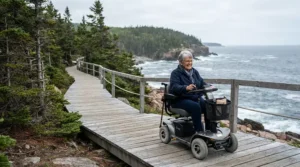
Tires decide whether all-terrain power wheelchairs actually deserve the name. Understanding tire tread types for rough ground will save you from buying the wrong chair, or from a wrong swap later.
Tread Patterns
- Knobby or block tread: Deep, widely spaced lugs bite into grass, mud and loose soil. Ride noise and rolling resistance go up on pavement.
- Ribbed or semi-smooth tread: Low resistance, quiet and efficient on pavement and hard-pack. Slippery in mud and wet grass.
- Hybrid or multi-surface tread: Smaller lugs with a smooth centre strip. A solid compromise for sidewalk-to-gravel commutes.
Tire Construction
- Pneumatic (air-filled): The best shock absorption and traction on grass, gravel and dirt. They can go flat, so carry a patch kit.
- Foam-filled: Mimics the pneumatic feel and never goes flat, with a slightly harsher ride.
- Solid: Puncture-proof but transfers every bump to the rider. Pavement only.
Matching Tread to Terrain
For gravel, choose pneumatic or foam-filled with deeper tread. For packed park paths, hybrid tread keeps the chair efficient. For sand and snow, wider tires at lower pressure spread the load and float better, a general principle worth confirming with your dealer. Whatever you pick, check the sidewall for recommended pressure, because under-inflated tires drain batteries and over-inflated ones slip.
How to Choose All-Terrain Power Wheelchairs
Selecting one comes down to seven decisions, in roughly this order.
- Map your real terrain. Gravel and grass need dual 250W motors or more, while steep rocky trails call for 350W to 400W each. Honest terrain mapping prevents overbuying.
- Check weight capacity. Choose a limit at least 23 kg above your body weight. Frames fatigue faster when run at their ceiling.
- Demand a range buffer. Plan for roughly 50 per cent more range than your typical day, since rough ground eats batteries.
- Decide on drive layout. Two-wheel drive handles most grass, gravel and mild dirt. Four-wheel drive earns its cost on sand, deep mud, snow and steep rock.
- Inspect ground clearance. Under about 7.5 cm risks high-centring. True off-road chairs clear 10 to 15 cm.
- Match portability to your vehicle. Folding chairs of 18 to 26 kg suit trunks. Heavier chairs need ramps or lifts.
- Test before committing. Municipal programs help here. The City of Calgary, for example, runs all-terrain wheelchair rentals on a seasonal basis, and trying a style first clarifies what you need.
✨ Not sure which tier fits you? 🔍 Scan the picks above, then click any highlighted model to check current pricing and availability on amazon.ca. A chair matched to your terrain beats the fanciest spec sheet every time!
Affordable All-Terrain Power Wheelchair Canada: Where Your Budget Stretches Furthest
Hunting for an affordable all-terrain power wheelchair Canada riders can actually rely on means ignoring the headline price and checking the supporting details. The cheapest chair can become the most expensive once you add shipping, a replacement battery or a repair that stalls for weeks.
Where the Savings Are Real
The Culver Artemis and Aotedor 22-Mile are the practical budget anchors. Both deliver authentic outdoor capability at the low end of the range. The Mujocooker lands slightly above them but gives a lot of range and a wide seat for the money. Larger-brand chairs like the Serianie and WEYRAL also appear in value roundups, though reviewers flag spec inconsistencies on some units, such as a seat narrower than listed.
Where Cheap Gets Expensive
Batteries are the hidden bill. A replacement for the Ranger Discovery reportedly runs about C$500 or more, which is real money five years in. Shipping is another cost, since heavy chairs can add considerable freight. Finally, support matters: smaller brands show more variable long-term service, according to published buyer’s guides.
Shop for an affordable all-terrain power wheelchair Canada can service. Ask whether replacement batteries, tires and controllers are stocked locally before you click buy.
Best Value Rugged Electric Wheelchair: How to Spot One
The phrase “best value rugged electric wheelchair” gets thrown around loosely. Here’s a cleaner way to judge it: value is capability per dollar over the chair’s whole life, not the lowest tag.
Three Quick Tests
- Frame and suspension. Aircraft-grade aluminum and real shock absorbers signal durability. The Ranger The Beast and Mujocooker both advertise genuine suspension.
- Warranty depth. The ABAKAN‘s five-year coverage on the controller, charger and battery is rare in this segment, and warranties show confidence.
- Review volume and consistency. A model with hundreds of reviews, such as the Aotedor 22-Mile, gives you a more reliable signal than a perfect score on a handful.
Our Value Verdict
Based on the spec comparison and review themes, the Ranger Discovery is the best value rugged electric wheelchair for most riders. The ABAKAN is the pick if range and warranty rank first. The Mujocooker wins on soft ground. None is flawless, and that is the honest lesson: value depends on the fit between chair and life.
Balancing Price and Durability
Balancing price and durability is the central tension in this category. Spend too little and parts fail early. Spend too much and you pay for strength you’ll never use.
What Actually Wears Out
On outdoor chairs, wear concentrates in four places: batteries, tires, joysticks and weld points. Reviewers flag footrest welds on the Culver Artemis and some frame flex on the reclining Ranger Maestro. Batteries typically degrade first, regardless of brand.
A Simple Durability Rule
Match the chair to the harshest terrain you’ll face weekly, not occasionally. If you ride rutted farm paths every day, the premium suspension of the Ranger The Beast earns its cost. If you cross a park twice a week, a mid-tier chair will outlast your needs.
Total Cost of Ownership
Add up purchase price, one battery replacement and a spare set of tires over five years. A chair costing C$2,000 more but needing no rescue repairs can come out cheaper. That’s the arithmetic of balancing price and durability, and it favours buying slightly above your minimum, not at the very bottom.
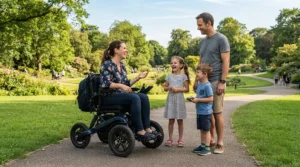
All-Terrain Power Wheelchairs vs Mobility Scooters and Manual Chairs
| Feature | All-Terrain Power Wheelchair | Mobility Scooter | Manual Wheelchair |
|---|---|---|---|
| Rough-ground traction | Strong (dual motors, knobby tires) | Moderate | Poor |
| Indoor manoeuvrability | Good (tight turning) | Limited | Excellent |
| Rider effort | Minimal | Minimal | High |
| Transport | Folding models fit trunks | Often bulky | Easy |
| Best For | Mixed indoor/outdoor | Long outdoor runs | Light, short trips |
Power chairs win on versatility. A scooter’s tiller and long wheelbase suit open outdoor routes but make a doorway an ordeal, while a manual chair gets exhausting on gravel. Wikipedia’s overview of motorized wheelchairs notes that outdoor models rely on a wide wheelbase and large tires for stability and comfort. Heavier all-terrain power wheelchairs can still tip on steep side-slopes, so slope angle matters more than motor wattage.
Financing and Insurance Options for Mobility Equipment
Financing and insurance options for mobility equipment in Canada depend heavily on where you live, and the rules change often. Funding policies differ substantially across provinces and territories, so confirm with your local program before spending.
Provincial Funding
In Ontario, the Assistive Devices Program helps people with long-term physical disabilities pay for equipment like wheelchairs. Generally you must be an Ontario resident with a valid health card and a physical disability lasting six months or longer, and the program does not consider income. Sources note it requires an assessment by an authorized professional and a registered vendor, and it doesn’t fund batteries, repairs or used equipment. A chair bought online generally won’t be funded this way, and recreation-only use is a grey area, so ask an authorizer first.
Tax Relief
At the federal level, wheelchairs are a recognized eligible expense under the medical expense tax credit. The Canada Revenue Agency’s Income Tax Folio on the medical expense tax credit explains the rules. The disability tax credit is separate and requires Form T2201. Keep every receipt and consult a tax professional.
Payment Plans and Insurance
Some dealers offer payment plans. Compare interest rates before signing. For insurance, the dedicated powered-wheelchair policies I came across were British products that largely exclude Canada from their cover. A practical route is asking your home or tenant insurer or broker whether the chair is covered for theft, damage and liability. Policies vary, so get answers in writing.
Practical Usage Guide: Your First 30 Days
A new outdoor chair rewards a careful first month.
Week One: Set Up and Learn
Charge fully before the first ride. Set speed to the lowest level, then raise it gradually. A sensitive joystick, mentioned in reviews of several models, becomes manageable with controller adjustments. Practise turns on flat ground before gravel.
Weeks Two to Four: Build Terrain Confidence
Approach slopes straight on, not sideways. Keep both batteries seated and listen for rubbing noises. If your chair has pneumatic tires, check pressure weekly and carry a patch kit.
Maintenance Schedule
- Weekly: Wipe down, check tire pressure, test the brake.
- Monthly: Inspect welds, footrest joints and fasteners.
- Seasonally: Store batteries partially charged in a cool, dry place.
Canadian Winter Tips
Lithium batteries lose capacity in the cold, so expect a noticeable range drop. Charge indoors and warm batteries before a ride. For snow, choose a chair with good ground clearance.
Common First-Month Mistakes
- Running the battery to empty regularly.
- Ignoring uneven tire wear.
- Overloading the storage pockets.
Real-World Scenarios: Three Canadian Riders
Scenario 1: The Rural Retiree
Marguerite lives on a gravel lane outside a small Prairie town and rides to the mailbox daily, with occasional field walks. A budget of C$4,500+ and a truck ramp make the Ranger The Beast realistic. Its suspension and capacity suit her terrain, though she’d want a covered storage spot.
Scenario 2: The City Commuter on a Budget
Devon crosses cracked sidewalks and a gravel path to a transit stop and has no vehicle ramp. At roughly C$2,000, the Aotedor 22-Mile fits: light enough to carry, with ample range. If hills are steep, the Ranger Discovery adds motor torque and a proven platform.
Scenario 3: The Cottage Family
Priya’s family heads to a lake property with sand, grass and a dirt drive. A mid-priced Mujocooker with front-wheel drive suits the soft ground, and a wide seat helps on long days. A roof-rack ramp solves the weight issue.
The Decision Shortcut
- If you need a ramp anyway, buy more chair.
- If you lift it yourself, prioritize weight.
- If your terrain is soft, prioritize drive layout and tire tread.
Safety, Transport and Regulations in Canada
Use these basics for safe riding and transport.
Safety Checklist
- Wear the seat belt on slopes, and watch side-slopes, where tip risk is highest.
- Ask whether a chair is tested to the ISO 7176 wheelchair standards series.
- Check that brakes engage before every outdoor ride.
Transport and Flying
“Airline approved” is a manufacturer claim. Airlines set their own limits on lithium battery size, so confirm with your carrier before booking. Chairs like the Ranger Magnum Ultra are explicitly not airline approved.
Where You Can Ride
Rules for power chairs on roads, sidewalks and trails vary by municipality and province. Park authorities may restrict certain areas. Check local bylaws before planning a route.

FAQ
❓ How much do all-terrain power wheelchairs cost in Canada?
❓ Can I fly with an all-terrain power wheelchair?
❓ Do all-terrain power wheelchairs work in snow?
❓ Is a 2WD or 4WD chair better for gravel?
❓ Where can I buy an affordable all-terrain power wheelchair in Canada?
Conclusion
The best all-terrain power wheelchairs aren’t the ones with the biggest wattage numbers. They’re the ones that suit your ground, your body and your vehicle.
For most riders, the Ranger Discovery is the safest all-rounder, with a folding frame, strong reviews and airline-approved batteries. Budget shoppers should start with the Culver Artemis or Aotedor 22-Mile. If range matters, the ABAKAN and Mujocooker both claim 30+ miles. For rural trails and heavy loads, the Ranger The Beast and Ranger Magnum Ultra are in a class of their own.
Before you buy, remember three things: spec sheets are claims, not guarantees, funding rules vary by province, and the best test is time on your own terrain.
✨ Ready to get moving?
🚀 Click any highlighted model to check current pricing and availability on amazon.ca, and take your first confident ride off the pavement. Your gravel lane is waiting!
Recommended for You
- Heavy Duty Power Wheelchair: 7 Tough Picks For Canada 2026
- Small Turning Radius Power Wheelchair For Home Use: 7 Best (2026)
- Mid-Wheel Drive Vs Rear-Wheel Drive Power Wheelchair: 7 Best Of 2026
Disclaimer: This article contains affiliate links. As an Amazon Associate, I earn from qualifying purchases. If you purchase products through these links, we may earn a small commission at no additional cost to you.
✨ Found this helpful? Share it with your friends! 💬🤗
