
In This Article
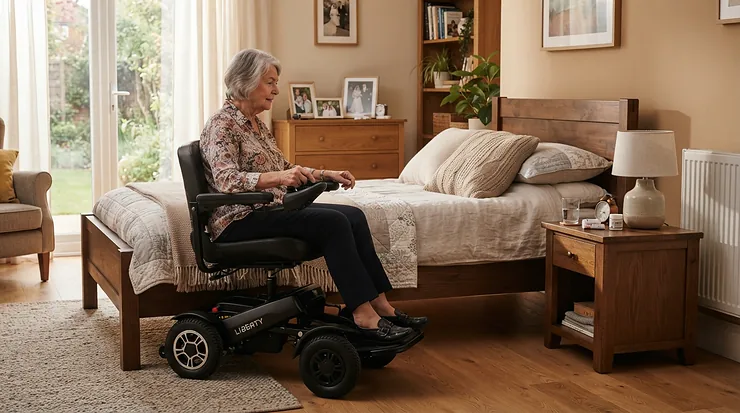
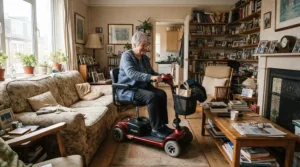
Picture two power chairs at the same hallway door. One spins on the spot like a figure skater. The other swings a wide arc, like a delivery van backing out of a laneway. That mismatch is the whole mid-wheel drive vs rear-wheel drive power wheelchair debate in one image, and it decides whether your living room feels roomy or like an obstacle course.
In Canada the stakes are higher than a spec sheet suggests. You may be dealing with condo elevators, bungalow hallways, heaved sidewalks after a freeze-thaw cycle, a van ramp, and a front step that was never designed for anyone. Where the drive wheels sit relative to your body shapes how the chair turns, how steady it feels, how it meets a curb, and how long it takes to learn.
This guide compares seven real models: five mid-wheel drive chairs and two rear-wheel drive chairs. The split is deliberate. The rear-wheel drive models I could verify in Canadian-facing documentation are mostly portable travel chairs, because the rehab and everyday market has largely moved to mid-wheel designs.
A few honesty notes. Specs come from manufacturer and retailer sheets, and some regional figures differ, so ask for the Canadian data sheet. Independent owner reviews for rehab-class chairs are thin, and I say so where that applies. Prices are indicative CAD ranges, so check current price and availability.
Mid-Wheel Drive vs Rear-Wheel Drive Power Wheelchair: Quick Comparison
| Feature | Mid-Wheel Drive | Rear-Wheel Drive |
|---|---|---|
| Turning | Tightest circle; pivots near its own centre | Widest radius; front end swings out |
| Indoor use | Excellent in halls, doorways, bathrooms | Harder in tight spaces |
| Outdoor feel | Steady on paved paths; suspension absorbs bumps | Tracks straight; steady at speed and on rougher ground |
| Learning curve | Most intuitive for new riders | Slower to learn; drivers may find it natural |
| Best For | Pride Jazzy Select 6 2.0, Pride Jazzy EVO 614, Quantum Q6 Edge 2.0, Permobil M3 Corpus, Invacare TDX SP2 (home-first riders) | Pride Jazzy Passport, Pride Go Chair (travel and portability) |
Read the table as a pattern, not a verdict. Mid-wheel drive wins most Canadian homes because floor space is the scarcest resource you have. Rear-wheel drive earns its place when the chair needs to fold, disassemble or ride in a trunk more than it needs to pivot in a closet-sized bathroom.
💬 Just one click — help others make better buying decisions too!😊
Power Wheelchair Drive Types Explained
What is the difference between mid-wheel drive and rear-wheel drive in a power wheelchair? In a mid-wheel drive chair, the powered wheels sit roughly beneath the rider’s centre of gravity, with casters at both ends, so it turns tightly. In a rear-wheel drive chair, the powered wheels sit behind the rider, which tends to track straighter outdoors but swings wider.
Wikipedia’s overview of four general styles of powerchair drive systems lists front, centre (mid) and rear drive plus all-wheel drive. Centre-drive chairs use a six-wheel layout, with a caster at each end.
The easiest way to think about it is the rider’s centre of gravity relative to the drive axle:
- Front-wheel drive: the rider’s weight sits behind the drive wheels.
- Mid-wheel drive: the weight sits roughly over them.
- Rear-wheel drive: the weight sits ahead of them, and the chair effectively pushes you along.
Mid-wheel’s tight pivot is why many riders call it the most intuitive layout. The drive axis lines up with your midline, so the chair turns around you instead of swinging away from you.
Top 7 Power Wheelchairs: Expert Analysis of Mid-Wheel and Rear-Wheel Drive Models
I picked these chairs to cover budget, mid-range and premium tiers, plus two rear-wheel travel models for contrast. Each entry explains what the numbers mean in practice. Where I couldn’t verify real owner feedback, I say so rather than invent it.
1. Pride Jazzy Select 6 2.0 — tight-turning budget pick for home-first riders
The standout is the Mid-Wheel 6 layout. Six wheels stay planted, so the chair pivots tightly without feeling tippy.
Pride’s Canadian brochure lists a 23.76 in. (60 cm) turning radius, up to 4.3 mph (6.9 km/h), 136 kg (300 lb) capacity, and 10 in. flat-free drive wheels. Ground clearance is modest at about 6.4 cm (2.5 in.) at the footplate and 4.5 cm (1.77 in.) at the motor bracket. That is fine for threshold ramps but a warning for chunky curb faces. Overall length is listed at 43.27 in. (110 cm), so measure your bathroom before assuming “tight turning” means “fits anywhere.”
On paper, this suits riders whose days are mostly indoors with short outdoor hops: the mailbox, the café, the pharmacy. The small wheels and modest speed aren’t built for long gravel stretches, which is where the larger-wheel chairs below pull ahead.
Verified independent reviews of the 2.0 are scarce. A UK retailer’s write-up of the earlier Select 6 praised its manoeuvrability and non-clinical looks, but noted it can occasionally struggle with steeper ramps. That is a useful flag if you rely on a van ramp.
Pros:
- ✅ Tight turning around doors and corners
- ✅ Active-Trac suspension smooths thresholds
- ✅ Flat-free tires cut maintenance
Cons:
- ❌ Low ground clearance for taller curbs
- ❌ Longer overall base than the older model
Expect roughly C$4,000–C$5,500 at the time of research; check current price. It is good value if indoor handling is your priority.
2. Pride Jazzy EVO 614 — bigger drive wheels and independent suspension
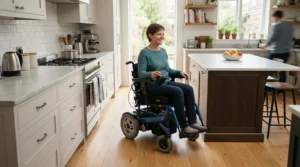
The headline is the 13.75 in. (35 cm) perforated drive wheels, which help a mid-wheel chair roll over rougher surfaces with less fuss.
Pride lists a 22 in. (56 cm) turning radius, up to 4.4 mph (7.1 km/h), 136 kg (300 lb) capacity, and 7.6 cm (3 in.) of ground clearance. It also has full independent front and rear Active-Trac ATX suspension. US sheets quote up to 19 miles (about 30 km) per charge at 300 lb. That figure is derived from theoretical calculations, so budget less for cold weather.
The practical upgrade over the Select family is clearance and wheel diameter. You get more room to clear a door-threshold lip and a smoother ride on cracked pavement. A heavy-duty 614 HD version raises capacity to 204 kg (450 lb), which matters if standard limits are tight for you.
I couldn’t find enough independent owner reviews to summarize responsibly. Treat the manufacturer’s claims about gravel, grass and thresholds as things to confirm on a trial drive.
Pros:
- ✅ Large drive wheels for rougher surfaces
- ✅ Independent front and rear suspension
- ✅ HD version available for 204 kg riders
Cons:
- ❌ Longer base at about 103 cm (40.5 in.)
- ❌ Top speed still modest at 7.1 km/h
Roughly C$4,500–C$6,000 at the time of research; check current price. It is strong value for mixed indoor and outdoor use.
3. Quantum Q6 Edge 2.0 — fastest here, with optional seat elevation
Standard motors of roughly 6 mph (about 10 km/h) make this the sprinter of the group.
Quantum lists a 20.5 in. (52 cm) turning radius, 14 in. solid drive wheels (pneumatic and knobby optional), and 6 in. casters. Ground clearance is 6.9 cm (2.7 in.), base width is 62 cm (24.4 in.), and capacity reaches 136 kg (300 lb) depending on seating. The optional iLevel raises the seat up to 30 cm (12 in.) and still drives at walking speed, about 5.6 km/h (3.5 mph).
Seat elevation matters more than it sounds. It helps with reaching counters, talking at eye level and transferring. The compact base, roughly 82 cm (32.2 in.) long, makes this one of the more apartment-friendly chairs that still accepts rehab-grade seating. All those options make pricing configuration-driven.
Owner review volume is thin because chairs like this are specified with a clinician and a dealer. Ask the dealer for client references.
Pros:
- ✅ Very tight 52 cm turning radius
- ✅ Speeds around 10 km/h
- ✅ Optional seat elevation at walking speed
Cons:
- ❌ Quote-based, configuration-driven pricing
- ❌ Heavy base at about 63 kg (138.6 lb)
Pricing is quote-based, and configured units commonly land in five figures; check current price with an authorized dealer.
4. Permobil M3 Corpus — premium seating and positioning
The star here is Corpus seating, with dual-density foam, a pelvic well insert and extensive tilt options.
Manufacturer data lists a 52 cm (20.5 in.) minimum turning radius, a 61 cm (24 in.) base width, and 35 cm (14 in.) drive wheels. Top speed is about 10 km/h (6 mph), range is 25–32 km depending on battery, and user weight reaches 150 kg (330 lb). FlexLink suspension uses independent caster swing-arms. Some of these figures come from regional pages, so request the Canadian data sheet.
ActiveReach forward tilt (up to 20°), up to 50° of posterior tilt and a 30 cm (12 in.) seat elevator are functional features, not vanity. The maker pitches them at pressure redistribution, reach and security on slopes. The downside is weight. Regional data puts the chair with batteries around 174 kg (384 lb), which affects van lifts and ramps.
I found no verifiable aggregated owner reviews, only vendor descriptions. A clinician-led trial matters more here than star ratings.
Pros:
- ✅ Deep seating and positioning options
- ✅ Compact mid-wheel base
- ✅ App tracking of battery and seat use
Cons:
- ❌ Heavy at roughly 174 kg with batteries
- ❌ Likely the highest total cost
Quote-based and well into five figures once configured; check current price.
5. Invacare TDX SP2 — centre-wheel drive with stability lock
The signature feature is Invacare’s Stability Lock, which uses gas cylinders that engage if the rear casters begin to lift.
Invacare describes True Center Wheel drive, SureStep suspension, and LiNX electronics with Bluetooth diagnostics. Regional listings quote a turning radius of about 20 in. (about 51 cm), although one lists 56 cm. The earlier TDX SP is listed at 20.5 in. (52 cm), up to 5.8 mph (9.3 km/h) and 136 kg (300 lb), with about 30 km (18.4 mi) of range. Confirm SP2 figures on Canadian sheets.
The LiNX G-TRAC tracking technology is aimed at correcting small path deviations on uneven surfaces. That is relevant on the crowned, sloped sidewalks common across Canadian cities. Combined with SureStep, it addresses the front-caster hang-ups that gave early mid-wheel chairs a bad reputation.
No verified aggregated owner reviews turned up. Ask your dealer about service response times in your region.
Pros:
- ✅ Stability Lock guards against caster lift
- ✅ G-TRAC path correction on uneven ground
- ✅ Configurable Ultra Low Maxx seating
Cons:
- ❌ Specs vary between regional listings
- ❌ Heavy base, roughly 138–154 kg in UK listings
Quote-based and typically five figures once configured; check current price.
6. Pride Jazzy Passport — folds for planes, trunks and condos
A folding frame is the point. It is a travel chair first and a daily driver second.
Pride Canada lists a 24.25 in. (62 cm) turning radius, up to 3.6 mph (5.8 km/h), and 113 kg (250 lb) capacity. Drive tires are about 12 in. (30 cm); listings vary between 11.25 in. perforated and 12 in. pneumatic. Front casters are 8 in. solid. Weight is about 24–27 kg (54–60 lb) without batteries, and it folds to roughly 79 × 60 × 41 cm (31 × 23.5 × 16 in.). Range reaches about 15 km (9.6 mi) on the larger lithium pack. A 10.4 Ah airline-compliant battery is optional, but check your airline first.
Rear-wheel drive here is a packaging choice. Pride itself frames the chair for travel on even terrain, and that caveat deserves to be taken literally.
One retailer listing shows a single five-star review, which is too small a sample to mean anything.
Pros:
- ✅ Folds in a few steps for car trunks
- ✅ Airline-compliant battery option
- ✅ Light enough to lift, about 24 kg bare
Cons:
- ❌ Lower 113 kg weight capacity
- ❌ Limited suspension and short range
Under the C$5,000 range at the time of research; check current price. It is good value for frequent travellers.
7. Pride Go Chair — five-piece take-apart design
The hook is tool-free disassembly into five pieces, with the heaviest piece at about 16 kg (36 lb).
Pride lists 136 kg (300 lb) capacity, up to 3.7 mph (6 km/h), and 9 in. (23 cm) solid rear drive wheels. Turning radius is 25.5 in. (65 cm) with the foot platform, the widest in this list. Range figures vary by generation, from about 14 km (8.7 mi) to roughly 21 km (13.2 mi). A current Canadian retailer listing for the Go Chair MED quotes up to about 15 km (9.41 mi).
Solid tires mean no flats, but ground clearance is only about 4.1–4.8 cm (1.6–1.9 in.). That makes it a smooth-floor, mall-and-airport chair, not a rutted-sidewalk chair. Its 136 kg capacity is more generous than many folding competitors, including the Pride Jazzy Passport.
I didn’t find a large independent review base to summarize. Retailer copy stresses portability, which is what the design delivers.
Pros:
- ✅ Quick five-piece disassembly
- ✅ 136 kg capacity for a travel chair
- ✅ Solid, low-maintenance tires
Cons:
- ❌ Widest turning radius in this list
- ❌ Low clearance limits rough ground
Under the C$5,000 range at the time of research; check current price. It is solid value for travel-heavy lifestyles.
Side-by-Side Comparison of the Top 7
| Model | Drive | Turning radius | Top speed | Price range (CAD) | Best For |
|---|---|---|---|---|---|
| Pride Jazzy Select 6 2.0 | Mid | 60 cm (23.76 in.) | 6.9 km/h | C$4,000–C$5,500 | Indoor-focused budget buyers |
| Pride Jazzy EVO 614 | Mid | 56 cm (22 in.) | 7.1 km/h | C$4,500–C$6,000 | Mixed indoor and outdoor use |
| Quantum Q6 Edge 2.0 | Mid | 52 cm (20.5 in.) | ~10 km/h | Quote-based | Active riders wanting seat elevation |
| Permobil M3 Corpus | Mid | 52 cm (20.5 in.) | ~10 km/h | Quote-based | Complex seating needs |
| Invacare TDX SP2 | Mid | ~51–56 cm (confirm) | Confirm with dealer | Quote-based | Sloped, uneven routes |
| Pride Jazzy Passport | Rear | 62 cm (24.25 in.) | 5.8 km/h | Under C$5,000 | Fold-and-fly travel |
| Pride Go Chair | Rear | 65 cm (25.5 in.) | 6 km/h | Under C$5,000 | Take-apart trunk transport |
The mid-wheel chairs cluster around 51–60 cm turning radii, while the rear-wheel pair sit at 62–65 cm. That gap is only a few centimetres, but it adds up in a tight bathroom. If you need rehab-grade seating, Quantum Q6 Edge 2.0, Permobil M3 Corpus and Invacare TDX SP2 are the sensible shortlist. If portability outranks everything, Pride Jazzy Passport and Pride Go Chair trade manoeuvrability for transportability.
Rear-Wheel vs Mid-Wheel Drive Stability: What the Physics Means for You
Rear-wheel drive puts your centre of gravity ahead of the drive wheels. Many sources describe it as tracking straight, handling speed well and feeling steady on rough ground, because the chair pushes you along rather than pulling you.
Mid-wheel drive puts the weight roughly over the drive axle. Early versions earned a reputation for caster hang-ups on obstacles, and Pride notes that front- and mid-wheel designs are more susceptible to this than rear-wheel designs. Modern suspension was the fix: Active-Trac and ATX on the Pride Jazzy Select 6 2.0 and Pride Jazzy EVO 614, FlexLink on the Permobil M3 Corpus, and SureStep with Stability Lock on the Invacare TDX SP2. All of them aim to keep six wheels in contact with the ground.
Drive position is only one stability variable. Seat height, tilt angle, footplate position and anti-tip wheels matter too. Elevating seats, like the optional iLevel on the Quantum Q6 Edge 2.0, change your centre of gravity while you drive, so the stability engineering behind them matters. Ask the dealer to show you what the chair does when you tilt, elevate and drive on a slope.

Choosing a Drive Type for Home Use
Most Canadian homes are won or lost on a handful of measurements. Mid-wheel drive usually wins because it gives you the smallest turning footprint.
A caregiver’s forum post compared a mid-wheel chair to an older rear-wheel Invacare Bora. The mid-wheel was described as far easier to steer between rooms and through doors. That is one anecdote, but it matches the geometry.
Here is a practical way to decide:
- Tape the footprint. Use about 60–65 cm wide by 90–110 cm long, which covers the models above. Rehearse your hardest turn, such as bedroom to bathroom.
- Check thresholds. Ground clearance runs from about 4.5 cm on the Pride Jazzy Select 6 2.0 to 7.6 cm on the Pride Jazzy EVO 614.
- Plan storage and charging. Folding or take-apart chairs like the Pride Go Chair suit small entry halls and closets.
Rear-wheel drive makes sense at home only if your layout is open-plan and your priority is frequent travel.
Outdoor vs Indoor Drive-Type Suitability
Indoors, mid-wheel drive is the clear winner. Outdoors, the answer depends on the surface.
Several explainers describe mid-wheel chairs as best on urban areas and established paths, while rear-wheel drive handles rough, uneven terrain better. Karma Medical’s guide recommends rear-wheel drive for outdoor and long-distance use, citing good suspension over rough ground.
That advice needs a Canadian filter. Freeze-thaw heaves, gravel shoulders, slush and road salt are the realities. Wheel size helps more than drive type in many of these conditions. The 14 in. drive wheels on the Quantum Q6 Edge 2.0 and Permobil M3 Corpus, and 13.75 in. on the Pride Jazzy EVO 614, outclass the 9 in. wheels on the Pride Go Chair. Pneumatic or knobby tire options also soften the ride, though they need pressure checks.
Neither layout is built for deep snow or ice. Check the owner’s manual for moisture and cold guidance before you commit.
Ramp and Curb Performance by Drive Type
Start with the slope. A Toronto Rehab guide notes the Canadian building code calls for a ramp no steeper than 1:12, and some riders prefer gentler ramps of 1:16 or 1:20. You can read the details in Toronto Rehab’s guide to ramps for home access. The math is simple: a 0.5 m rise needs 6 m of ramp at 1:12 and 10 m at 1:20.
On a ramp, a mid-wheel chair’s front caster usually meets the incline first. The caregiver forum post mentioned above worried this would lift the drive wheels, but the owner reported that the suspension lets the casters rise independently. A retailer, meanwhile, notes the Pride Jazzy Select 6 can struggle on steeper ramps. Test your actual ramp, especially a wheelchair-accessible van ramp.
Rear-wheel travel chairs have a different issue. They rely on small anti-tip wheels behind the drive wheels, so check how those clear a ramp transition.
On curbs, ground clearance and approach angle matter more than drive type. Clearances run from about 4.1 cm on the Pride Go Chair to 7.6 cm on the Pride Jazzy Passport. Use curb cuts, approach square, and never improvise a tall curb.
Test-Driving a Power Wheelchair in Canada: A Step-by-Step Guide
A good test drive is the most valuable hour of the whole process.
- Start with an assessment. In Ontario, funding requires an assessment by an ADP authorizer, typically an occupational therapist or physiotherapist. Other provinces have their own processes.
- Bring your real obstacles. Measure your own doorways, and take photos of your ramp and entry step.
- Drive for at least 30 minutes. Do hallways, thresholds, a ramp and a curb cut, not just a showroom loop.
- Use a skills checklist. Dalhousie University’s Wheelchair Skills Program offers a free manual, assessment tools and videos covering ramps, curbs and uneven ground.
- Compare two drive types back-to-back. Try a mid-wheel chair and a rear-wheel chair on the same course.
- Ask about loaners. Some vendors provide loaner equipment while funding approval is pending.
- Get Canadian warranty terms in writing. Pride’s Canadian EVO 614 brochure lists a 24-month limited drivetrain warranty, versus 13 months on several US sheets.
✨ Ready to Compare in Person?
🔍 Take your search to the next level by shortlisting two or three chairs from this guide. Click any highlighted product name to check current pricing and availability, then book a demo with an authorized dealer.
Real-World Scenarios: Matching Drive Type to Three Canadian Riders
These are hypothetical profiles to show the reasoning, not real customers.
The condo retiree. Budget around C$5,000, mostly indoors, with sidewalk trips a few times a week and an elevator-served building. The Pride Jazzy Select 6 2.0 fits the budget and hallways. If the route has rougher pavement, the Pride Jazzy EVO 614 gives you larger wheels and more clearance.
The rural homeowner. A gravel driveway, a yard and daily outdoor use. The verifiable rear-wheel chairs here are travel models, so I would not recommend them for this rider. Test 14 in.-wheel mid-wheel chairs like the Quantum Q6 Edge 2.0 with pneumatic or knobby tires. Ask dealers separately about rear-wheel rehab bases.
The snowbird traveller. Flights, rental cars, and a small home. The Pride Jazzy Passport with its airline-compliant battery option folds for transport. The Pride Go Chair takes apart into five pieces, with the heaviest at 16 kg.
The rider needing complex seating. Power tilt, recline or seat elevation moves you toward the Permobil M3 Corpus or Invacare TDX SP2. In Ontario, chairs with power tilt or recline go through the Central Equipment Pool.
How to Choose a Mid-Wheel Drive vs Rear-Wheel Drive Power Wheelchair: 6 Steps
- Map your home first. The narrowest doorway and tightest turn decide your maximum footprint.
- Rank your terrain. Mostly smooth floors favour mid-wheel. Rough, long outdoor routes call for large wheels and good suspension.
- Check transport. Folding and take-apart chairs trade performance for portability.
- Weigh seating needs. If you need tilt, recline or elevation, shortlist rehab-class mid-wheel bases.
- Verify the numbers for Canada. Ask for the Canadian spec sheet and warranty terms, because regional figures differ.
- Test back-to-back. Spend an hour driving your real obstacles before deciding.
Mid-Wheel Drive vs Rear-Wheel Drive Power Wheelchair vs Traditional Alternatives
| Option | Indoor manoeuvrability | Outdoor distance | Best For |
|---|---|---|---|
| Mid-wheel drive power chair | Tightest pivot | Good on paved paths | Home-first riders, e.g. Quantum Q6 Edge 2.0 |
| Rear-wheel drive power chair | Wider swing | Steady at speed and rougher ground | Travellers, e.g. Pride Jazzy Passport |
| Mobility scooter | Typically a wider turning circle | Often strong for longer outdoor trips | Riders with trunk control and mostly outdoor use |
| Manual or attendant-pushed chair | Light and narrow | Limited by stamina | Short trips and occasional use |
Wikipedia’s overview notes power chairs suit people who cannot propel a manual chair, or who need to cover distance or terrain that would be tiring in one. A scooter can be a good outdoor machine, but it generally gives up the in-home agility that makes a mid-wheel chair so useful. If most of your day is indoors, drive type matters more than the powered-versus-manual question.
Long-Term Cost, Funding and Safety in Canada
The sticker price is only the opening move. Batteries wear out, tires need attention, and repairs are not always funded. Pride sheets list batteries on a 13-month limited warranty. Ontario’s information sheet says ADP does not pay for power wheelchair batteries, and a Toronto Rehab handout adds that ADP does not fund repairs or maintenance.
Funding varies by province. The Ontario Assistive Devices Program helps people with long-term physical disabilities pay for wheelchairs. Eligibility generally requires an Ontario health card, a disability lasting six months or longer, and meeting clinical criteria. Income is not considered. Other provinces, March of Dimes Canada and Veterans Affairs Canada can also help.
On safety, power wheelchairs are medical devices. Pride’s sheets say range is tested per ISO 7176-4 but derived from theoretical calculations at maximum weight, so real range will be lower. Ask your dealer for the manufacturer’s Canadian documentation and the service plan.

FAQ
❓ Are rear-wheel drive power wheelchairs still worth buying in 2026?
❓ How much should I budget for a mid-wheel drive power wheelchair in Canada?
❓ How wide a doorway does a mid-wheel drive power wheelchair need?
❓ Can I fly with a folding rear-wheel drive power wheelchair in Canada?
❓ Do I need a prescription or assessment to get a power wheelchair?
Conclusion
Strip away the jargon and the mid-wheel drive vs rear-wheel drive power wheelchair choice comes down to where you spend your hours. If it is mostly indoors, with short outdoor trips, mid-wheel drive is the safer bet. It turns tightest, feels most intuitive, and modern suspension has closed most of the old stability gap. If travel and portability rule your life, a rear-wheel chair like the Pride Jazzy Passport or Pride Go Chair is a fair trade.
For rehab-grade seating, shortlist the Quantum Q6 Edge 2.0, Permobil M3 Corpus and Invacare TDX SP2. For budget-friendly home use, the Pride Jazzy Select 6 2.0 and Pride Jazzy EVO 614 lead the list.
Whatever you choose, don’t skip the trial. Power wheelchair drive types explained on paper only go so far, and the best proof is your own hallway, your own ramp and your own curb.
Recommended for You
- Mid-Wheel Drive Power Wheelchair: 7 Best Picks For Canada 2026
- Lightweight Foldable Power Wheelchair For Indoor Transport 2026
- Indoor Power Wheelchair For Narrow Hallways: 7 Best Picks (2026)
Disclaimer: This article contains affiliate links. As an Amazon Associate, I earn from qualifying purchases. If you purchase products through these links, we may earn a small commission at no additional cost to you.
✨ Found this helpful? Share it with your friends! 💬🤗
