
In This Article
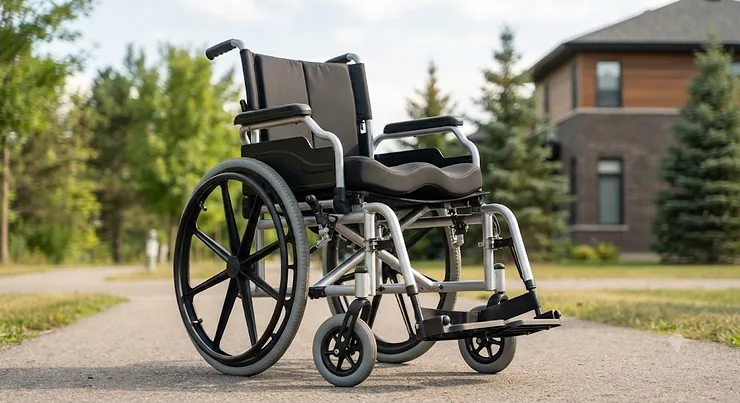
Shopping for a heavy duty wheelchair is a different experience than browsing standard mobility aids, and if you’ve spent any time scrolling listings you already know why. Seat widths jump around, weight capacities get thrown out like marketing confetti, and half the “reviews” read like they were written by someone who’s never sat in the thing. A heavy duty wheelchair is a wheelchair engineered with reinforced frames, wider seating, and elevated weight capacities (typically 400 lbs and up) to safely support larger-bodied users where standard chairs would flex, crack, or simply feel cramped. That’s the plain definition — everything after this is about which specific chairs actually deliver on it.
This guide leans on real product specifications and aggregated customer-review sentiment rather than manufacturer marketing copy, because the difference between a chair that lasts five years and one that needs replacing in five months usually comes down to details buried three paragraphs into a spec sheet: axle placement, frame gauge, caster diameter. We’ll walk through seven genuine products sold in Canada, spanning steel and aluminum frames, manual and powered options, and budget through premium price points. Along the way we’ll cover weight limits in plain language, what “steel frame wheelchair” actually buys you over aluminum, and how to stretch a budget mobility aid dollar without ending up with something flimsy.
Canada’s own contribution to this story is worth noting up front: engineer George Klein, widely regarded as the most productive inventor in Canada in the 20th century, is credited with contributions to the first electric wheelchairs for quadriplegics, work done at the National Research Council of Canada in Ottawa. Nearly seventy years later, Canadian buyers still have some of the strongest funding infrastructure in the world backing mobility devices — a point we’ll return to later, because it can quietly slash what you actually pay.
Quick Comparison Table
| Product | Weight Capacity | Frame | Best For |
|---|---|---|---|
| Karman KM-8520X | 352 lbs | Aluminum | Lightest lift-and-go option |
| Vive Heavy Duty Wheelchair | 400 lbs | Steel | First-time steel frame buyers |
| NOVA Bariatric Transport Chair | 400 lbs | Steel | Caregiver-controlled appointments |
| Vive Mobility Bariatric Transport | 450 lbs | Steel | Wider transport with more ceiling |
| Medline Excel Extra-Wide | 500 lbs | Steel (chrome) | Daily self-propelled independence |
| ProHeal Titus K7 | Up to 700 lbs | Steel | Highest weight ceiling, pressure relief |
| Drive Trident HD | 450 lbs | Steel | Powered mobility, longer distances |
Looking at the spread here, the split between transport chairs (caregiver-pushed, no self-propel wheels) and true self-propelled or powered wheelchairs matters more than most buyers initially realize — it’s arguably a bigger decision than the exact weight number. The Karman KM-8520X sits apart as the only aluminum-frame chair in the group, trading some weight ceiling for a frame that’s roughly a third the mass of its steel competitors. Meanwhile, the ProHeal Titus K7 and Drive Trident HD represent the two premium directions this category splits into: maximum structural capacity versus powered independence.
💬 Just one click — help others make better buying decisions too!😊
Top 7 Heavy Duty Wheelchairs: Expert Analysis
1. Karman KM-8520X Lightweight Bariatric Wheelchair — lightest heavy-duty chair on the market
At just 35 lbs, the Karman KM-8520X flips the usual heavy duty wheelchair trade-off on its head: instead of adding steel to handle more weight, it uses a 6061 T-6 aircraft-grade aluminum frame to keep the chair itself light while still supporting up to 352 lbs. The 24-inch rear wheels with quick-release axles mean the whole unit breaks down small enough to fit in a compact car trunk without a struggle, and the attendant brakes give a caregiver speed control on ramps. Based on the spec comparison against steel competitors in this list, this chair trades roughly 50-150 lbs of capacity ceiling for a frame that’s often less than half the weight of its rivals — a fair exchange if the person loading it into a vehicle daily isn’t particularly strong themselves. It’s best suited to households where portability outranks maximum weight capacity, and less ideal for anyone approaching the 350 lb mark, where a steel-frame option offers more margin. Reviewers on manufacturer and retailer product pages consistently point to the folding mechanism and quick-release wheels as the standout feature, with a recurring theme that this is the chair caregivers reach for when a heavier bariatric model simply won’t fit in the car. A common thread in aggregated feedback is appreciation for the standard-included seat belt and anti-tippers, since many aluminum-frame competitors sell those as add-ons.
Pros:
- ✅ Lightest heavy-duty wheelchair frame in this roundup
- ✅ Quick-release axles simplify loading and storage
- ✅ Seat belt and anti-tippers included standard
Cons:
- ❌ Lower weight ceiling than every steel option here
- ❌ Aluminum frame flexes more under repeated heavy use
Expect to pay in the C$500-C$700 range at the time of research; for buyers under 350 lbs who transport the chair often, the weight savings alone can justify the premium over a bulkier steel transport chair.
2. Vive Heavy Duty Wheelchair — steel frame entry point for first-time buyers
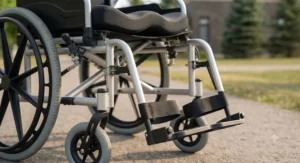
The Vive Heavy Duty Wheelchair is where most people land when they search specifically for a steel frame wheelchair without wanting to spend premium money. Its 20-inch wide seat and 400 lb weight capacity put it squarely at the entry level of true bariatric support, and the 27-inch overall width means it navigates most residential doorways without the wide-load feel of the 24-inch options further down this list. What most buyers overlook about this chair is that it’s built to function as both a self-propel and caregiver-push design — the dual handle setup means it can serve either role depending on who’s around that day. At 45 lbs it isn’t the lightest chair here, but that additional mass is largely what’s paying for the steel tubing that flexes less under sustained heavy use than the aluminum alternative above. It suits budget-conscious buyers who want genuine steel construction without stepping up to the 22-24 inch premium tier, and it’s a sensible starting point for someone newly needing bariatric support who isn’t sure yet how much seat width they’ll want long-term. Aggregated reviewer sentiment across retail platforms consistently flags the swing-away footrests as easier to manage solo than expected, though several buyers note the 45 lb chair weight is noticeably harder to lift into a trunk than a standard wheelchair.
Pros:
- ✅ Genuine steel frame at an accessible price point
- ✅ Dual-purpose self-propel and caregiver-push design
- ✅ Swing-away footrests ease transfers in and out
Cons:
- ❌ 20-inch seat is narrower than most bariatric alternatives
- ❌ 45 lb frame weight is awkward for solo vehicle loading
At around C$300-C$400, this sits in true budget mobility aid territory, and reviewers seem to agree it delivers real steel durability at that price rather than a compromise.
3. NOVA Heavy Duty Bariatric Transport Chair — caregiver-controlled locking hand brakes
The NOVA Heavy Duty Bariatric Transport Chair is a transport chair rather than a self-propel wheelchair, meaning there’s no oversized rear wheel for the user to push — it’s designed to be steered and stopped by whoever is pushing. The 22-inch seat and 400 lb capacity pair with locking hand brakes on the push handles, which is the detail that actually matters on inclines: the caregiver controls speed and stopping, not the user. Here’s what to weigh before choosing this over a self-propelled model: if the person using the chair has any upper-body strength and independence, a transport-only design will feel restrictive fast, but if the chair is primarily for medical appointments, errands, or situations where a companion is always present, the smaller 12-inch rear wheels and lighter overall build make it easier to maneuver through hospital corridors and tight aisles than a full-size self-propel chair. The flip-up arms are a genuinely practical touch for lateral transfers from a bed or car seat, something that’s harder to do gracefully on chairs with fixed armrests. Aggregated review sentiment on major retail sites consistently praises the anti-tip wheels and adjustable seat belt for peace of mind on uneven pavement, while a recurring complaint is that the smaller wheels struggle on gravel, thick carpet, or grass compared to the larger-wheeled self-propel chairs later in this list.
Pros:
- ✅ Locking hand brakes give the caregiver full speed control
- ✅ Flip-up arms simplify lateral transfers
- ✅ Anti-tippers and adjustable seat belt included
Cons:
- ❌ No self-propel capability — companion-dependent by design
- ❌ Smaller wheels struggle on grass, gravel, and thick carpet
Priced in the C$350-C$450 range, it’s a strong value pick specifically for appointment-and-errand use rather than full-time independent mobility.
4. Vive Mobility Bariatric Transport Wheelchair — wider transport chair with more ceiling
Stepping up from the base Vive model, the Vive Mobility Bariatric Transport Wheelchair keeps the same caregiver-pushed transport-chair format but raises the weight capacity to 450 lbs and widens the seat to 22 inches. That extra 50 lbs of ceiling and two inches of seat width sound minor on paper, but based on the spec comparison, this is often the difference between “fits comfortably” and “technically fits” for users in the upper-mid range of bariatric sizing. The swing-away footrests carry over from the smaller model, and the steel frame construction gives it noticeably less flex than aluminum alternatives when navigating uneven surfaces like driveway transitions or curb cuts. This chair makes the most sense for households already familiar with the standard Vive transport chair who found the 20-inch seat too narrow, or for anyone shopping specifically in the 400-450 lb bracket who wants a transport-only design rather than self-propel wheels. Reviewers consistently note that the wider seat noticeably improves comfort for longer outings like grocery trips or full medical appointments, compared to narrower 18-20 inch transport chairs. On the downside, aggregated feedback points out that the wider frame is proportionally heavier and bulkier to fold and store than its narrower sibling, which matters if trunk space or closet storage is tight.
Pros:
- ✅ Higher 450 lb capacity than the base Vive transport chair
- ✅ Wider 22-inch seat improves comfort on longer outings
- ✅ Steel frame holds up well on uneven surfaces
Cons:
- ❌ Transport-only — still requires a companion to push
- ❌ Bulkier folded footprint than the narrower 20-inch model
At roughly C$400-C$500, it occupies a sensible middle ground for buyers who’ve outgrown entry-level transport chairs but don’t yet need the full 500+ lb ceiling of the self-propelled options ahead.
5. Medline Excel Extra-Wide Bariatric Wheelchair — daily self-propelled independence
This is where the list shifts from transport chairs to a genuine self-propelled wheelchair built for everyday independent use. The Medline Excel Extra-Wide Bariatric Wheelchair pairs a 24-inch by 18-inch seat with large rear wheels the user can push themselves, all mounted on a carbon steel frame with chrome plating that resists the rust and chipping that plagues cheaper painted frames over years of daily use. The adjustable axle position lets the seat height be raised or lowered roughly two inches, which is a small feature that makes a real difference for matching the chair to different tables, desks, or transfer heights around a home. What most buyers overlook about self-propelled bariatric chairs generally is that the desk-length removable arms aren’t just a comfort feature — they’re what allows a side transfer from a bed or car seat without lifting the user over an armrest, a detail that matters enormously for caregivers managing transfers alone. Reviewers on major retail platforms rate this chair at roughly 4.1 out of 5 stars across around 100 verified ratings, with recurring praise for the generous seat room and smooth turning radius, alongside a consistent complaint that the 60 lb chair weight makes lifting it into a trunk a two-person job for many caregivers. This chair suits anyone prioritizing long-term daily independence over portability — it’s the option for someone who’ll be living in this chair for years, not just using it for occasional trips.
Pros:
- ✅ Large wheels enable genuine self-propelled independence
- ✅ Adjustable axle height fits different transfer situations
- ✅ Chrome-plated steel frame resists rust and chipping
Cons:
- ❌ 60 lb chair weight is difficult to lift solo
- ❌ Folded width still challenges narrow interior doorways
Expect a price in the C$400-C$550 range, and given the review volume and consistency, this is arguably the safest mid-range pick for anyone who needs a wheelchair rather than a transport chair.
6. ProHeal Titus K7 Heavy-Duty Bariatric Wheelchair — highest capacity with elevating leg rests
For users approaching or exceeding the 500 lb mark, the ProHeal Titus K7 is built specifically for that upper bracket, with configurations supporting up to 700 lbs depending on the model chosen. The silver vein steel frame uses a slide-tube construction that’s noticeably more substantial than the standard tubing on the mid-range chairs above, and the 24-inch urethane wheels with adjustable 3-position casters give it more stability on uneven ground than smaller-wheeled alternatives. The tool-free elevating leg rests, powered by a pneumatic piston, are the standout feature here — they allow infinite positioning rather than the two or three fixed angles common on cheaper elevating footrests, which matters clinically for reducing lower-leg swelling during long periods of sitting. Based on the spec comparison against the Medline chair above, the trade-off is clear: this chair carries meaningfully more weight capacity and pressure-relief functionality, at the cost of being the heaviest and least portable manual chair in this entire lineup. It’s the right call for users who genuinely need the 500-700 lb ceiling, or for anyone whose care plan specifically calls for adjustable leg elevation, rather than a general-purpose pick for smaller bariatric users. Aggregated feedback from buyers and caregivers consistently highlights the push-to-lock wheel system as easier to operate one-handed than traditional lever locks, while some reviews note that the sheer bulk of the frame makes it a poor fit for smaller apartments or homes with narrow hallways.
Pros:
- ✅ Highest weight capacity in this comparison, up to 700 lbs
- ✅ Tool-free elevating leg rests aid circulation
- ✅ Adjustable 3-position casters improve outdoor stability
Cons:
- ❌ Heaviest and least portable chair in this roundup
- ❌ Bulky frame is a poor fit for narrow hallways
Pricing typically lands in the C$600-C$800 range depending on configuration, positioning it as the premium choice specifically for higher-weight or clinically complex needs.
7. Drive Trident HD Heavy Duty Power Wheelchair — powered mobility for longer distances
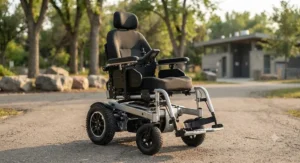
The Drive Trident HD is the only powered option in this list, and it exists for a specific type of buyer: someone whose upper-body strength or endurance simply can’t sustain self-propelling a manual chair, even a well-built one. Its 450 lb capacity comes with a semi-reclining captain’s seat, front-wheel drive with 14-inch drive wheels, and a genuinely useful design detail — the whole unit disassembles into four separate pieces (base, battery pack, and two seat/back sections) specifically so it can be loaded into a standard vehicle trunk without a ramp or lift. On paper this means a 4 mph top speed and a 15-mile range per charge, numbers that translate to roughly a full day of errands and short outings before needing to recharge, though reviewers note actual range drops noticeably on carpet, incline-heavy routes, or in cold weather, which affects battery performance. The front-wheel drive layout gives it better traction over grass, gravel, and door thresholds than rear-wheel-drive competitors, a detail that matters more than most spec sheets emphasize for anyone living somewhere with unpaved paths or older curb cuts. This chair makes sense for users prioritizing independent powered mobility over long distances, not for anyone who mainly needs to move around a small apartment, where a manual self-propel chair would be simpler to store and maintain. What the spec sheet won’t tell you, but user reports suggest, is that the semi-reclining captain’s seat is noticeably more comfortable for multi-hour outings than the sling seating on manual bariatric chairs, at the cost of a heavier overall system near 212 lbs including batteries.
Pros:
- ✅ Disassembles into four pieces for standard vehicle transport
- ✅ Front-wheel drive handles grass, gravel, and thresholds well
- ✅ Semi-reclining captain’s seat suits multi-hour outings
Cons:
- ❌ Heaviest total system weight once batteries are included
- ❌ 15-mile range requires planning around charging
Power wheelchairs carry a real price jump over manual chairs, typically in the C$1,800-C$2,400 range at the time of research — a gap that makes the funding programs discussed later in this guide especially relevant for this category.
Practical Usage Guide: Setting Up and Living With Your Heavy Duty Wheelchair
Getting a heavy duty wheelchair home is only step one — the first 30 days are where most avoidable problems show up. Start by checking tire pressure on any pneumatic or semi-pneumatic wheels weekly at first; underinflated tires make self-propulsion noticeably harder and wear unevenly, which is a common early mistake that gets blamed on the chair rather than the tires. Armrests and footrests on most of the chairs above are removable or swing-away specifically to ease transfers, so it’s worth practicing that motion a few times in a low-stakes setting before it needs to happen quickly. For steel frame wheelchairs, a light wipe-down of exposed metal joints every few weeks prevents the surface rust that eventually seizes folding mechanisms — chrome-plated frames like the Medline Excel resist this longer than painted steel, but it’s not immune. Wheel locks deserve genuine attention during setup: test them on a slight incline (with someone spotting) rather than assuming they’ll hold, since locking mechanisms occasionally need a small adjustment out of the box. A maintenance schedule worth adopting: monthly checks on brake tension and armrest bolts, quarterly checks on caster wheel bearings for grinding or resistance, and an annual full inspection if the chair sees daily use. One optimization trick that doesn’t show up in any manual: slightly overinflating semi-pneumatic tires by 10% in winter compensates for cold-weather pressure loss and keeps rolling resistance consistent through Canadian winters.
Real-World Scenarios: Matching the Right Chair to Your Life
Consider a retired machinist in his early 70s, recovering strength after a hospital stay, who needs a chair mainly for trips to appointments and the grocery store with his spouse pushing — a transport chair like the NOVA Heavy Duty Bariatric Transport Chair or Vive Mobility Bariatric Transport Wheelchair fits this use case well, since neither requires him to self-propel and both fold small enough for a sedan trunk. Now consider a working-age adult with a permanent mobility impairment who needs to move independently around a home and workplace all day — for that scenario, a self-propelled chair like the Medline Excel Extra-Wide makes far more sense, since the large wheels support genuine independence rather than dependence on a companion. Finally, picture someone with limited hand strength who still wants to run errands solo and cover real distances — several blocks to a pharmacy, a full loop of a shopping mall — the Drive Trident HD power chair addresses that need directly, trading manual effort for battery power and a longer effective range. Budget, environment, and frequency of use all shape which of these three profiles fits best: an urban apartment-dweller making short indoor trips has very different needs than someone managing a rural property with gravel driveways, and matching the chair type to daily reality matters more than chasing the highest weight capacity available.
How to Choose a Heavy Duty Wheelchair
Working through this decision methodically saves both money and frustration:
- Confirm actual user weight against capacity, with margin. Choose a chair rated at least 50-75 lbs above current body weight, since capacity ratings assume ideal conditions, not repeated daily stress.
- Decide between transport and self-propel early. This single choice affects wheel size, frame weight, and how much independence the user will have — it matters more than most other specs combined.
- Measure doorways and hallways before finalizing seat width. A 24-inch seat that won’t clear a bathroom doorway isn’t a functional purchase, regardless of how comfortable it looks online.
- Weigh frame material against how often it’ll be transported. Steel frame wheelchairs handle daily heavy use better; aluminum wins when the chair needs lifting into vehicles regularly.
- Check what’s included versus sold separately. Anti-tippers, seat belts, and elevating leg rests vary by model — some chairs bundle these standard, others charge extra.
- Read aggregated review themes, not star ratings alone. A 4.1-star chair with consistent praise for a specific feature tells you more than a 4.5-star chair with vague five-word reviews.
- Factor in Canadian funding eligibility before finalizing budget. As covered further down, provincial programs can cover a meaningful share of the cost for qualifying buyers.
Understanding Weight Limits: Heavy Duty Wheelchairs for 400 lbs and Up
The phrase “weight limit” on a wheelchair spec sheet is doing more work than it appears to. Manufacturers test capacity under controlled, static conditions — a seated adult, minimal dynamic movement — which means real-world use, especially transfers, uneven terrain, and repeated daily loading, erodes the practical safety margin faster than the number suggests. This is why, when shopping specifically for a heavy duty wheelchair for 400 lbs and up, industry guidance and dealers alike commonly recommend choosing a rated capacity at least 50 to 75 lbs above actual body weight rather than cutting it close to the printed maximum. It’s also worth understanding that “bariatric” isn’t a single tier — within this article alone, capacities range from 352 lbs on the aluminum Karman KM-8520X up to 700 lbs on the ProHeal Titus K7, and that spread reflects genuinely different frame engineering, not just marketing variation. Seat width tends to scale alongside weight capacity for a practical reason: wider frames distribute load across a broader base, reducing stress concentration on any single weld point or crossbrace. For couples or families shopping together, it’s worth noting that weight capacity and seat width are somewhat independent variables — a user can need a high weight rating without needing the widest seat available, and vice versa, so treating them as one combined spec during shopping is a common and avoidable mistake.
| Weight Bracket | Typical Frame | Represented By |
|---|---|---|
| Up to 400 lbs | Aluminum or lighter steel | Karman KM-8520X, Vive Heavy Duty Wheelchair, NOVA Transport Chair |
| 400-500 lbs | Reinforced steel | Vive Mobility Bariatric Transport, Drive Trident HD |
| 500-700 lbs | Heavy-gauge steel | Medline Excel Extra-Wide, ProHeal Titus K7 |
This bracketing makes it easier to shortlist quickly: figure out which row applies based on actual body weight plus margin, then compare only the chairs in that row rather than scanning all seven options from scratch. Note that the Medline Excel and ProHeal Titus K7 overlap brackets slightly since ProHeal offers multiple capacity configurations under the same model name — always confirm the specific configuration’s rated capacity before purchase rather than assuming the model name guarantees a single number.

Steel Frame Wheelchairs vs Aluminum and Other Materials
Six of the seven chairs in this guide use steel frames, and that ratio isn’t a coincidence — for genuinely heavy-duty applications, steel remains the dominant material for good structural reasons. A steel frame wheelchair resists the flex and fatigue that repeated heavy loading causes far better than aluminum, since steel’s yield strength under sustained stress is meaningfully higher relative to its cost. That durability comes with an obvious trade-off: steel is heavier, which is exactly why the Karman KM-8520X exists as this guide’s aluminum counterpoint, sacrificing some weight ceiling specifically to stay liftable for caregivers with limited strength. Chrome-plated steel, as used on the Medline Excel Extra-Wide, adds a further layer of protection against the surface rust that plain painted steel eventually develops, particularly relevant in Canadian climates where road salt and winter humidity accelerate corrosion on anything stored near an entryway.
| Frame Material | Typical Weight | Durability Under Heavy Load | Best Use Case |
|---|---|---|---|
| Aluminum | Lighter (30-40 lbs) | Good, some flex over time | Frequent transport, lower weight range |
| Standard steel | Heavier (45-60 lbs) | Very good | Daily heavy use, mid weight range |
| Chrome-plated steel | Heavier (50-60 lbs) | Excellent, rust-resistant | Long-term daily use, higher weight range |
The practical takeaway from this comparison is that frame material should follow from use pattern rather than price alone: a chair that’s loaded into a vehicle multiple times a week benefits disproportionately from aluminum’s weight savings, while a chair that mostly stays in one home benefits more from steel’s superior fatigue resistance over years of daily wear. Titanium and carbon-fibre frames exist in the broader wheelchair market but are largely absent from the heavy-duty bariatric category specifically because their cost scales poorly against the reinforcement needed for 400+ lb capacities — steel and aluminum remain the practical choices at this end of the market.
Common Mistakes When Buying a Heavy Duty Wheelchair
The single most common mistake is buying to the exact current body weight rather than building in margin, which leaves no buffer for weight fluctuation or the extra dynamic stress of transfers and uneven terrain. A close second is underestimating chair weight itself — buyers focus entirely on user weight capacity and forget that a 60 lb self-propelled chair needs to be lifted by someone, often repeatedly, into a vehicle trunk. Skipping doorway and hallway measurements before ordering a wide-seat model is another frequent and entirely avoidable error; a 24-inch seat wheelchair simply won’t clear many standard interior doorways, which measure closer to 28-32 inches including the frame. Buyers also commonly overlook the transport-versus-self-propel distinction, assuming any wheelchair allows independent movement, only to discover after purchase that a transport chair requires a companion for every trip. Finally, many shoppers treat star ratings as the whole picture and skip reading the actual review text, missing recurring complaints (like the lifting difficulty noted repeatedly for the Medline Excel) that a simple average score doesn’t capture. Reading aggregated review themes rather than the headline number consistently surfaces these patterns before they become a returned or unused purchase.
Long-Term Cost & Maintenance: The Real Price of Ownership
The sticker price is only part of what a heavy duty wheelchair costs over its useful life. Tires on pneumatic or semi-pneumatic wheels typically need replacement every 12-24 months with regular outdoor use, and upholstery on vinyl-seated chairs like the Medline Excel generally holds up 3-5 years before showing wear serious enough to warrant replacement. Power wheelchairs like the Drive Trident HD carry an additional recurring cost that manual chairs don’t: battery replacement, typically needed every 1-2 years depending on charge cycles, and running several hundred dollars CAD when it comes due. Looking at value per year of use rather than sticker price alone changes the calculus meaningfully — a C$700 chrome-steel chair that lasts eight years with minimal maintenance often works out cheaper per year than a C$400 painted-steel chair that needs frame repair or replacement within three years due to rust or weld fatigue. Warranty coverage varies significantly across this list too: frame warranties range from one year on some budget models up to limited-lifetime coverage on premium options like the extended warranty available on certain Medline Excel configurations, and checking this detail before purchase can meaningfully change the total cost of ownership calculation. Routine maintenance — the wipe-downs, tire checks, and bolt tightening covered earlier — isn’t optional if minimizing long-term cost matters, since neglected maintenance is the single biggest driver of premature frame and component failure across this entire category.
Budget Mobility Aid: Getting Heavy-Duty Support Without Overspending
Finding a genuinely capable budget mobility aid doesn’t have to mean settling for a flimsy frame — but it does mean prioritizing carefully. If cost is the primary constraint, start by being honest about transport versus self-propel needs, since transport-only chairs like the NOVA Heavy Duty Bariatric Transport Chair consistently run cheaper than self-propelled equivalents while still offering genuine steel construction and a real weight capacity. Second, resist the pull toward maximum weight capacity if it isn’t needed — a chair rated for 700 lbs costs meaningfully more than one rated for 400-450 lbs, and that premium is wasted money if actual body weight sits well under the lower threshold. Third, and often the biggest lever available to Canadian buyers specifically: check provincial funding eligibility before finalizing a purchase decision. Ontario’s Assistive Devices Program, for example, is described by mobility equipment providers as typically covering a substantial share of approved device costs for eligible residents with a valid health card and a qualifying physical disability, following an assessment by an authorized occupational or physical therapist — a detail worth exploring through a provider like Motion’s ADP funding guide before assuming full retail price is unavoidable. Other provinces run comparable programs under different names, and federal support exists for veterans through Veterans Affairs Canada. On top of provincial funding, the purchase price of a wheelchair is also recognized federally as an eligible expense under the CRA’s medical expense tax credit, which can claw back a further portion of out-of-pocket cost at tax time for qualifying purchases with proper receipts. Combining a well-chosen mid-tier chair with available provincial and federal support often delivers better real-world value than stretching an unfunded budget toward the cheapest possible unit.
Buyer’s Decision Framework
Use this quick framework to narrow the field fast:
- If body weight is under 350 lbs and portability is the top priority, choose an aluminum frame like the Karman KM-8520X, because the weight savings on loading and unloading outweigh the reduced capacity ceiling.
- If a companion is always present and outings are occasional, choose a transport chair like the NOVA Heavy Duty Bariatric Transport Chair, because self-propel wheels add cost and bulk that go unused.
- If daily independent mobility around the home matters most, choose a self-propelled steel chair like the Medline Excel Extra-Wide, because large wheels and a durable frame are built for sustained daily use.
- If body weight approaches or exceeds 500 lbs, choose a reinforced heavy-gauge option like the ProHeal Titus K7, because standard bariatric frames aren’t engineered for that upper range.
- If upper-body strength limits self-propulsion but independence still matters, choose a power chair like the Drive Trident HD, because battery-assisted mobility solves a problem manual chairs simply can’t.
Safety, Regulations & Compliance in Canada
Wheelchair safety in Canada extends beyond the chair itself into how it interacts with public spaces and transportation. Accessibility requirements for terminals and transportation equipment reference the national standard CSA B651-18, and the Accessible Transportation for Persons with Disabilities Regulations incorporate relevant requirements from that standard for carriers and terminal operators across Canada, covering everything from manoeuvring space to how mobility aids are secured during transit. For anyone planning to fly, checked or gate-handled with a wheelchair, it’s worth reviewing the Canadian Transportation Agency’s guide to travelling with mobility aids before booking, since battery-powered chairs like the Drive Trident HD carry additional handling requirements that airlines require advance notice for. At home, basic safety practices matter just as much as regulatory compliance: always engage wheel locks fully before any transfer, never exceed the rated weight capacity even briefly, and inspect anti-tip wheels regularly if the chair sees outdoor use on inclines. For power chairs specifically, keeping the battery charged above 20% avoids the deep-discharge cycles that shorten battery lifespan, and storing the chair away from extreme cold when possible preserves both battery performance and range consistency through Canadian winters.

FAQ
❓ What weight limit should I look for in a heavy duty wheelchair?
❓ Is a steel frame wheelchair better than aluminum?
❓ How much does a heavy duty wheelchair cost in Canada?
❓ Can I get funding help for a heavy duty wheelchair in Canada?
❓ What's the difference between a transport chair and a self-propelled wheelchair?
Conclusion
Choosing among these seven options really comes down to answering three questions honestly: how much weight capacity is genuinely needed with a safe margin, whether independent self-propulsion matters or a transport chair will do, and how often the chair needs to be lifted, folded, or transported. The Karman KM-8520X and Vive Heavy Duty Wheelchair cover the budget and portability end of that spectrum, the NOVA and Vive Mobility Bariatric Transport chairs handle caregiver-assisted outings well, the Medline Excel Extra-Wide stands out for daily self-propelled independence, and the ProHeal Titus K7 and Drive Trident HD address the highest-capacity and powered-mobility needs respectively. None of these chairs is objectively “best” in isolation — the right pick is the one matched honestly to actual weight, actual daily routine, and actual budget, including any provincial funding that might apply. Whichever direction fits best, prioritizing genuine steel or aircraft-aluminum construction, a realistic weight margin, and aggregated real-world review feedback over flashy marketing claims will lead to a chair that holds up for years rather than months.
✨ Ready to compare current pricing and availability on any of these seven picks? Click through on the model that fits your situation best and check today’s listing before deciding.
Recommended for You
- Bariatric Wheelchair for Home Care: 7 Tough Picks (2026)
- 7 Best Portable Wheelchair for Travel Picks in 2026
- Lightest Transport Wheelchair: 7 Best Sub-15lb Picks (2026)
Disclaimer: This article contains affiliate links. As an Amazon Associate, I earn from qualifying purchases. If you purchase products through these links, we may earn a small commission at no additional cost to you.
✨ Found this helpful? Share it with your friends! 💬🤗
